Cafe Furniture Indonesia Wholesale: A Chain Buyer's Guide to Sourcing, MOQs, and Container Planning
14 min read
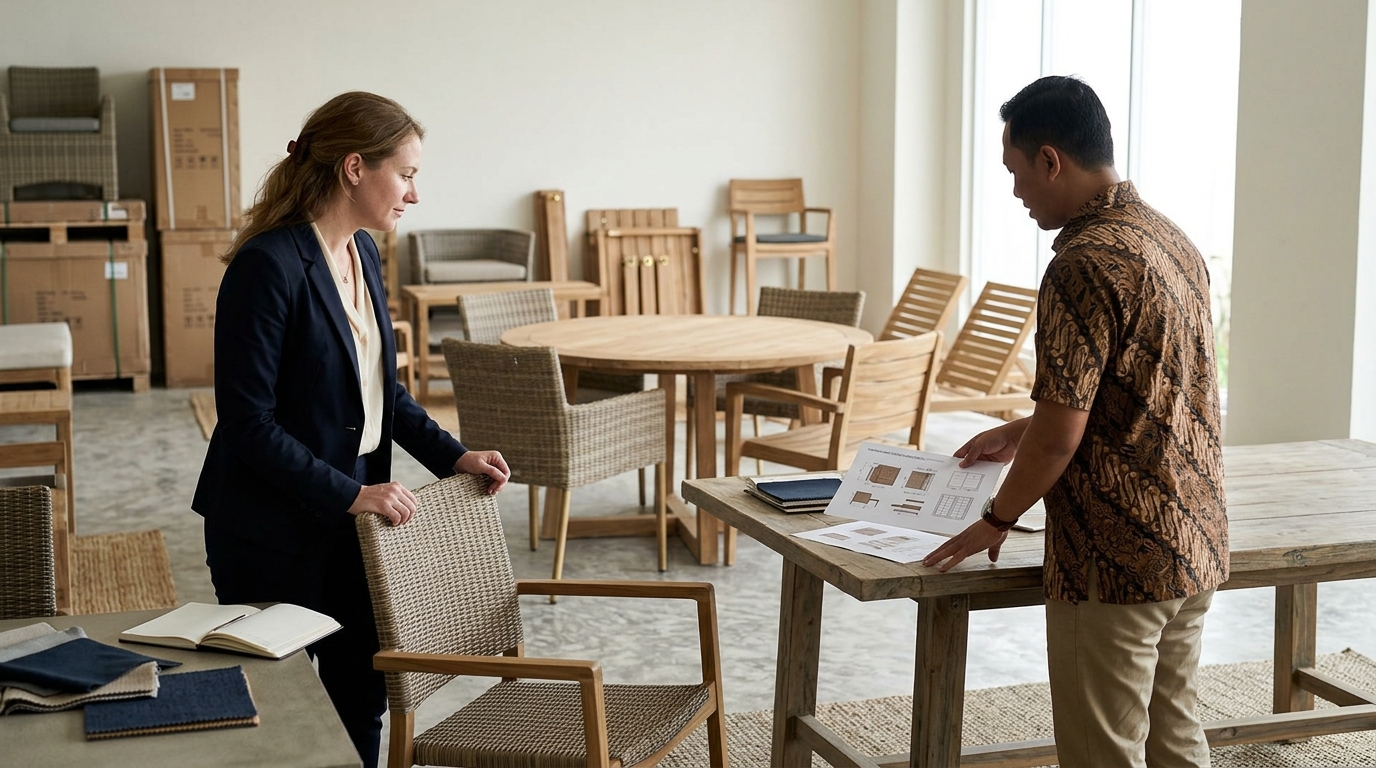
Scaling a coffee shop brand means making furniture decisions at volume. A single-location operator can visit a showroom and pick pieces.
Scaling a coffee shop brand means making furniture decisions at volume. A single-location operator can visit a showroom and pick pieces.
Indonesia is the dominant origin for commercial-grade natural wood and rattan cafe furniture. Factories clustered in Jepara (Central Java), Cirebon, Semarang, Surabaya, and Bali produce teak, mahogany, rattan, and suar pieces at a cost-to-quality ratio that no other country reliably matches for hospitality-grade product.
This guide helps chain operators and F&B fit-out contractors evaluate cafefurniture Indonesiawholesale sourcing. It covers cafe-specific formats, commercial durability specs, and MOQ structures. Topics also include container loading logic, supplier vetting, US import compliance, and multi-site customisation.
The sections that follow move from product specification through supplier qualification to logistics and landed cost. Read them in order for a phased rollout, or jump to the section most relevant to your current sourcing stage.
Why Indonesian Factories Lead the Global Market for Cafe Furniture Indonesia Wholesale
The cost-to-quality advantage is structural, not cyclical
Indonesia's position in global wholesale cafe furniture is not a pricing accident. It reflects three structural advantages working simultaneously. First, proximity to raw materials: Grade-A teak plantations, plantation-grown mahogany, suar wood, and natural rattan are all harvested domestically.
The result: a commercial-grade teak bistro chair manufactured in Indonesia typically lands in a US warehouse at a total cost significantly below an equivalent piece from domestic US producers or European manufacturers — and often below Vietnamese alternatives for solid teak product.
Compliance credentials that matter for US importers
Indonesian timber exporters operate under the SVLK (Sistem Verifikasi Legalitas Kayu) national timber legality assurance system. SVLK-certified wood is recognised as compliant with the US Lacey Act, which prohibits import of illegally harvested timber. For chain buyers, this eliminates a significant compliance risk.
How Indonesia compares to China and Vietnam for cafe-specific pieces
| Factor | Indonesia | China | Vietnam |
|---|---|---|---|
| Solid teak availability | High — domestic plantation supply | Low — mostly imported or absent | Low |
| Natural rattan expertise | High — Cirebon cluster | Limited | Limited |
| Section 301 tariff exposure | None currently | 25%+ on most furniture | None currently |
| US Lacey Act compliance path | SVLK + FSC | Requires separate due diligence | Requires separate due diligence |
| Artisan joinery quality | High — Jepara tradition | Variable | Variable |
| Lead time to US West Coast | Approx. 25–35 days transit | Approx. 14–20 days transit | Approx. 20–28 days transit |
For buyers sourcing natural wood cafe chairs, bistro tables, and rattan stools specifically, Indonesia offers a combination of material authenticity, tariff advantage, and compliance documentation that neither China nor Vietnam matches at this product category.
Cafe-Specific Furniture Formats That Indonesian Factories Build Well
Restaurant furniture and cafe furniture are not the same category. Chain coffee operators need to specify clearly — generic hospitality furniture briefs produce wrong-size pieces, wrong stack heights, and wrong base configurations.
Compact bistro tables for high-density floor plans
Cafe floor planning targets higher covers-per-square-metre than full-service restaurants. A 60 cm round top or 60 × 70 cm rectangular top is the standard cafe bistro format. Full dining tables (75–90 cm wide) waste aisle space in coffee shop configurations. Specify top dimensions explicitly in your purchase order.
Pedestal bases suit tight rows and allow chairs to slide in fully. Four-leg bases create aisle obstruction in narrow layouts. For terrace zones with uneven pavers, specify levelling glides on all bases.
Stackable chairs and stools for rapid turnover operations
Stackability is non-negotiable for high-turnover formats. Specify:
- Maximum stack height of 6–8 chairs for standard ceiling clearance - Seat pitch (distance between stacked seats) of approximately 8–12 cm - Dolly or trolley compatibility for efficient off-peak storage - No exposed metal edges at the stack contact points — this damages finishes quickly
Counter-height stools (approx. 65–75 cm seat height) suit espresso bar and brew bar configurations. Bar-height stools (approx. 75–80 cm) suit raised counter rails. Specify height category in millimetres, not labels. Indonesian factories produce both; the difference matters for ADA compliance and ergonomic comfort.
Matching indoor and terrace material families
A coherent aesthetic across indoor and terrace zones requires a planned material family at the time of ordering. Mix-and-match across containers creates visual inconsistency. A workable approach: specify teak frames with natural fibre seats for both zones, varying only the finish (matte oil for indoor; marine-grade varnish for terrace).
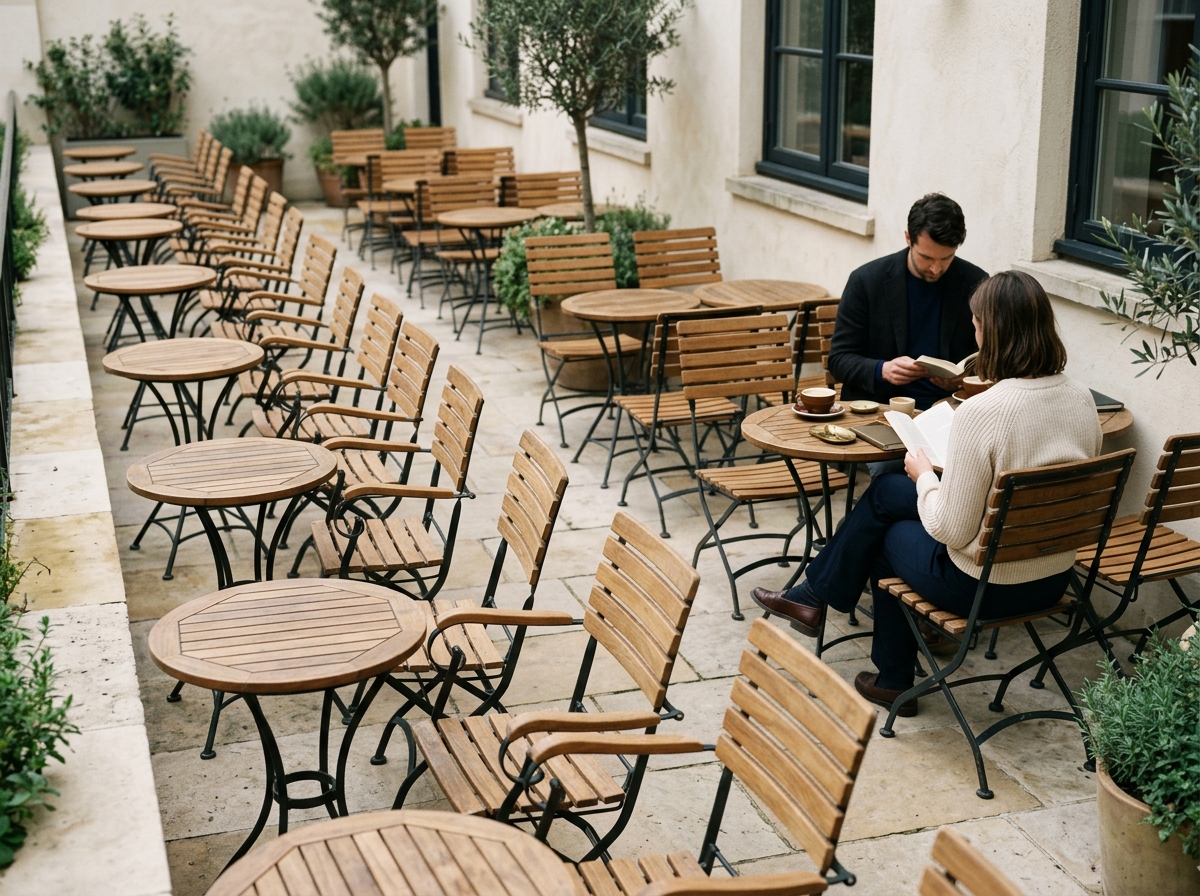
Key Materials in Commercial Cafe Furniture Indonesia Wholesale Sourcing
Grade-A teak: the benchmark for durability
Grade-A teak (first-cut, close-grained, high natural oil content) is Indonesia's most commercially significant export timber. For cafe furniture, its properties are directly relevant: natural UV resistance, dimensional stability across humidity cycles, and resistance to insect damage without chemical treatment.
For outdoor uncovered terraces, specify marine-grade varnish or tung oil finish rather than standard lacquer. Teak weathers to silver-grey if left unfinished — that may suit some brand aesthetics, but chain operators should decide this explicitly before ordering.
Natural and synthetic rattan
Natural rattan from Indonesia's Cirebon cluster is the world benchmark for furniture-grade rattan weaving. It is lightweight, stackable, and visually aligned with third-wave coffee shop aesthetics. Its limitation: it requires covered environments. Sustained rain exposure degrades natural rattan rapidly.
Synthetic rattan (resin-woven over aluminium frames) is appropriate for uncovered terraces. It is more durable, easier to clean, and available in a wide colour range. It does not carry the same sustainability narrative as natural rattan but performs better in harsh outdoor conditions.
Reclaimed teak and suar wood
Reclaimed teak (from decommissioned structures) and suar wood (a large-grained plantation timber) offer a sustainability narrative that resonates with chain brands building ESG documentation. Reclaimed teak in particular has existing carbon embedded in the material — a legitimate claim in responsible sourcing reports.
Powder-coated steel and aluminium combination frames
For high-turnover terrace zones, powder-coated steel or aluminium frames with wood or rattan seats balance durability with aesthetic. Aluminium is significantly lighter (relevant for daily chair stacking). Powder coating should be specified to a minimum thickness — typically 60–80 microns — for commercial durability.
Commercial Durability Specs Cafe Chains Must Verify Before Ordering
Durability failures in a chain rollout are expensive — replacement freight alone can exceed the original furniture cost. Specify these parameters in writing before issuing a purchase order.
Seat load rating: Minimum 150 kg static load for commercial certification is a standard benchmark. Request test documentation. Mortise-and-tenon joint construction is significantly stronger than dowel-and-glue at the leg-to-seat junction. Specify joint type in the technical sheet.
Finish standards by zone:
| Zone | Recommended finish | Avoid |
|---|---|---|
| Indoor high-humidity (near espresso bar) | Catalytic lacquer or tung oil | Water-based standard lacquer |
| Covered terrace | Marine-grade varnish | Standard polyurethane |
| Uncovered terrace (teak) | Teak oil or left natural | Film-forming lacquers |
| Uncovered terrace (aluminium frame) | Powder coat 60–80 micron min. | Spray paint |
UV and abrasion resistance: For US commercial insurance compliance and ADA documentation, request material data sheets covering UV resistance ratings and surface abrasion test results. Not all Indonesian exporters produce these documents automatically — they exist in most mid-to-large factories but must be requested explicitly.
Warranty terms: Standard Indonesian B2B export warranties typically cover structural defects for one to two years. Chain operators with multi-site rollouts can negotiate extended structural warranties (up to five years for teak frames) by committing to volume across multiple container orders. Get warranty terms in writing in the sales contract, not just in email correspondence.
MOQ Structures, Container Loading, and Phased Opening Schedules
Per-SKU MOQ versus per-container minimum
This distinction is critical for chain buyers and is rarely addressed clearly by suppliers. Two MOQ structures operate simultaneously:
- Per-SKU MOQ: The minimum quantity the factory will produce of a single item. Commonly 20–50 pieces for standard commercial chairs; 10–20 pieces for table tops. Custom finishes or logos typically raise the per-SKU MOQ. - Per-container minimum: Many exporters require a minimum of one 20ft FCL to offer factory-direct pricing. This does not mean you must order 400 chairs — it means the total order must fill (or come close to filling) a container.
The practical implication for chain buyers: you can hit per-container minimums by mixing SKUs — chairs, stools, tables, benches, and accessories — within one shipment. This allows a pilot of five locations to ship one container with mixed product rather than five separate small orders at higher per-unit cost.
Sample container loading matrix
| SKU | Unit CBM (approx.) | Qty (20ft FCL) | Total CBM |
|---|---|---|---|
| Teak bistro chair (stackable) | 0.08 | 120 | 9.6 |
| Counter stool (non-stackable) | 0.12 | 30 | 3.6 |
| 60cm round bistro table (KD) | 0.10 | 40 | 4.0 |
| 4-seater bench | 0.18 | 15 | 2.7 |
| Rattan side chair | 0.07 | 30 | 2.1 |
| **Total** | — | **235 pieces** | **22.0 CBM** |
CBM figures are approximate. A standard 20ft FCL holds approximately 25–28 CBM. Knock-down (KD) assembly reduces CBM significantly for tables.
Lead times and phased opening scheduling
Ex-factory lead times from Indonesian furniture manufacturers typically range from 45 to 90 days, depending on order complexity, custom finish requirements, and factory capacity at time of order. Add approximately 25–35 days ocean transit to US West Coast ports, plus 7–14 days for customs clearance and inland drayage.
Total timeline from purchase order to site delivery: approximately 75–130 days. Chain operators opening multiple locations should stagger container orders by location opening date, typically placing orders in 3–4 week intervals per site cluster.
Stackability and Space Planning for High-Density Coffee Shop Operations
Specialty coffee formats (pour-over bars, seated tasting areas) operate at different density targets than quick-service cafe formats. Know your format before specifying furniture dimensions.
Covers-per-square-metre benchmarks (approximate):
- Quick-service cafe: 1.5–2.0 seats per sqm of usable floor area - Specialty/third-wave coffee: 1.0–1.4 seats per sqm - Espresso bar standing counter: 0.8–1.0 seats per linear metre of counter
Stackable chair specs to request from Indonesian suppliers:
- Stack height ratio: no more than 1.5× chair height per 6 chairs stacked - Seat pitch in stack: minimum 8 cm to prevent chairs locking under weight - Dolly pin holes or recessed slots for standard trolley compatibility
Table base selection and ADA clearance:
Pedestal bases require a minimum 76 cm knee clearance height for ADA compliance at accessible seating positions. Four-leg bases with cross-stretchers obstruct wheelchair approach. Specify at least approximately 20% of seating positions as ADA-accessible in US commercial deployments.
Modular banquette systems:
Banquette seating in modular 60 cm or 120 cm sections allows reconfiguration for private events and corporate bookings — a revenue channel for chain coffee operators. Specify connector hardware and levelling feet.
How to Qualify an Indonesian Cafe Furniture Wholesale Supplier at Scale
Factory audit checklist
Do not rely on Alibaba verification badges or Made-in-China audit scores as sole qualification evidence. Conduct or commission an independent factory audit covering:
- ✓Confirm factory is a manufacturer, not a trader or nested intermediary
- ✓Verify production capacity against your volume requirements
- ✓Inspect finishing facility — catalytic spray booths, UV ovens, drying rooms
- ✓Review quality control documentation — in-process and final inspection records
- ✓Cross-check SVLK and FSC certificate numbers on issuing body databases
- ✓Request material data sheets for all woods, fabrics, and metal finishes
- ✓Review sub-contractor usage — uncontrolled sub-contracting is a major quality risk
- ✓Confirm export documentation capability — Bill of Lading, phytosanitary, CO
Certifications to request
- SVLK: Indonesian government timber legality certificate — required for Lacey Act compliance - FSC: Forest Stewardship Council chain-of-custody — preferred by ESG-oriented chains - BSCI: Business Social Compliance Initiative — covers labour standards in production - Material data sheets: For any upholstery fabric, powder coating, or surface finish
Sampling and BOM lock
Order pre-production samples before issuing a bulk purchase order. Review finish, joint construction, and dimensional accuracy against your technical sheet. Approve a "golden sample" that becomes the reference standard for production inspection.
Payment terms
Standard Indonesian furniture export payment terms:
- T/T (Telegraphic Transfer): Typically 30–50% deposit on order confirmation, balance against shipping documents or before container release - Letter of Credit (L/C): Available from established exporters; preferred for orders above approximately USD 50,000 - Trade finance: Available through specialist freight forwarders and trade finance platforms for qualified buyers
US Import Compliance and Landed Cost for Indonesian Cafe Furniture
HS codes and Section 301 tariff position
Wooden cafe chairs typically fall under HS code 9401.69 (seats with wooden frames, other than upholstered). Rattan seating may fall under 9401.59. Tables fall under 9403.60 (wooden furniture, other) or 9403.89 depending on construction. Confirm HS classification with your customs broker before shipment — misclassification delays clearance.
Indonesia is currently exempt from Section 301 tariffs applied to Chinese-origin goods. Chinese-origin furniture in equivalent categories carries tariffs of approximately 25% or more on the FOB value. This tariff differential represents a significant landed cost advantage for Indonesian-origin cafe furniture when comparing alternatives.
Landed cost calculation
| Cost component | Notes |
|---|---|
| FOB price | Ex-factory price + local inland freight to port |
| Ocean freight (FCL) | Approx. per-container rate, Semarang/Surabaya to LA/NY/Houston |
| US customs duty | Typically 0% on teak furniture (HTSUS dependent — verify) |
| MPF (Merchandise Processing Fee) | Calculated on entered value, subject to US CBP minimums/maximums |
| Inland drayage | Port to warehouse or direct to site |
| Devan labour | Unloading and sorting at destination |
| Freight forwarder fees | Documentation, customs brokerage |
All cost components are approximate and subject to market rate variation. Request a full landed cost estimate from your freight forwarder before finalising supplier pricing comparisons.
Transit times: Semarang or Surabaya to Los Angeles approximately 25–35 days. To Houston approximately 30–40 days. To New York (East Coast via Panama Canal) approximately 35–45 days.
Customisation and Brand Consistency Across Multi-Site Chain Rollouts
Chain operators have requirements that single-location buyers do not. Consistency across containers shipped 6 months apart, custom stain colours that match brand guidelines, and logo integration all require specific contractual provisions.
Custom stain and finish: Request Pantone or NCS colour references for any custom stain. Approve against the golden sample under controlled lighting. Indonesian factories can match most standard commercial stain palettes. Re-order batches 12+ months later may drift without documented colour standards — specify the reference system in the contract.
Logo and silhouette customisation: Chair back branding (laser engraving, inlay, or applied badge) is available from most mid-to-large Jepara factories under NDA. Proprietary silhouettes require a design NDA and tooling agreement. Tooling costs are typically a one-time fee amortised across the initial order volume.
COM (Customer's Own Material) for upholstery: If your brand uses proprietary fabric on banquette seats or cushions, specify COM in the purchase order. Confirm the factory's COM approval process — most Indonesian exporters work with a list of approved local upholstery vendors as an alternative. Allow additional lead time (typically 2–3 weeks) for COM sourcing and pre-production approval.
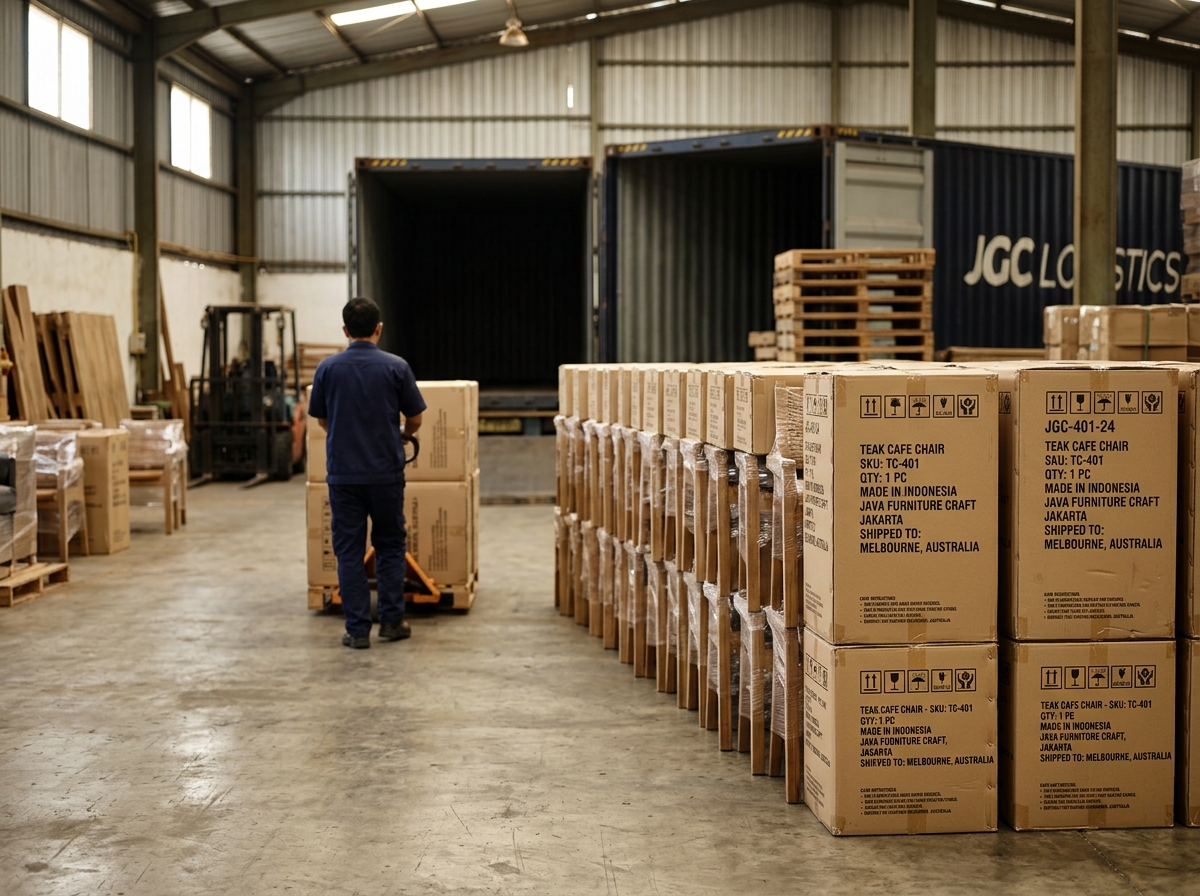
Packaging for direct-to-site delivery: Multi-location rollouts often ship containers direct to construction sites rather than central warehouses. Specify location-specific labelling on all cartons (location code, furniture zone, assembly sequence). This reduces devan time and mislabelling risk when multiple containers are opening simultaneously across different cities.
Consistency management across multi-container orders: The risk of batch variation increases with time between orders. Mitigate it by: locking BOM and golden sample before first production run; requiring DUPRO (during production) inspection on repeat orders; and specifying that the original golden sample must be available at the factory for the life of the supply agreement.
Frequently Asked Questions
What is the minimum order quantity (MOQ) for cafe furniture from Indonesian wholesale suppliers?
Per-SKU MOQs typically range from 20 to 50 pieces for standard commercial chairs and stools. Custom finishes, custom silhouettes, or logo branding generally increase per-SKU MOQs to 50–100 pieces.
How long does it take to receive a container of cafefurniture from Indonesiato the US?
Allow approximately 45–90 days ex-factory production lead time, plus approximately 25–45 days ocean transit depending on the US destination port, plus 7–14 days for customs clearance and inland delivery. Total door-to-site: approximately 75–130 days from purchase order.
Is Indonesian teak cafe furniture compliant with the US Lacey Act?
Yes, if the factory holds valid SVLK certification. SVLK (Sistem Verifikasi Legalitas Kayu) is Indonesia's government-operated timber legality verification system, which the US government recognises as satisfying Lacey Act due diligence requirements.
Can I mix different cafe furniture SKUs in a single container order?
Yes. Mixing chairs, stools, tables, benches, and accessories within one FCL is standard practice and the most cost-efficient approach for chain buyers who need multiple furniture categories per site. The sample loading matrix in the MOQ section above illustrates a typical SKU mix for a 20ft container.
What certifications should I ask for when sourcing commercial cafe furniture from Indonesia?
Request SVLK (timber legality, Lacey Act), FSC chain-of-custody (if ESG documentation is needed), BSCI (labour standards), and material data sheets for all finishes and fabrics. For structural compliance, request seat load test documentation showing minimum 150 kg static rating.
How does the landed cost of Indonesian cafe furniture compare to domestic US or Chinese alternatives?
Indonesian-origin teak and rattan cafe furniture typically lands significantly below domestically manufactured equivalents. Compared to Chinese-origin alternatives, the Section 301 tariff exemption (currently approximately 25%+ on China-origin furniture in most categories) removes a major cost disadvantage.
Indonesian factories in Jepara, Cirebon, Semarang, and Surabaya have spent decades building the export infrastructure, material expertise, and compliance credentials that chain cafe buyers need.
The frameworks in this guide — per-SKU versus per-container MOQ structures, container loading matrices, durability spec requirements, and COM customisation provisions — give you the operational language to issue a technically sound brief to an Indonesian supplier and hold them to it.
You now have the specification and evaluation framework to move from sourcing interest to a structured supplier brief.
Share your site count, SKU requirements, and opening schedule. A verified Indonesian cafe furniture manufacturer will return a per-SKU pricing sheet, container loading matrix, and phased delivery proposal.
Request a Wholesale Container Quote →Need eyes on the ground in Indonesia?
MTS is an execution partner — supplier verification, manufacturing management, quality control and export logistics across Indonesia, Vietnam and China.
Related services
Related articles
Receive furniture sourcing insights across Asia.
One email per week. No spam.