Swimwear and Resortwear Manufacturers in Indonesia and Bali: Complete Sourcing Guide
14 min read
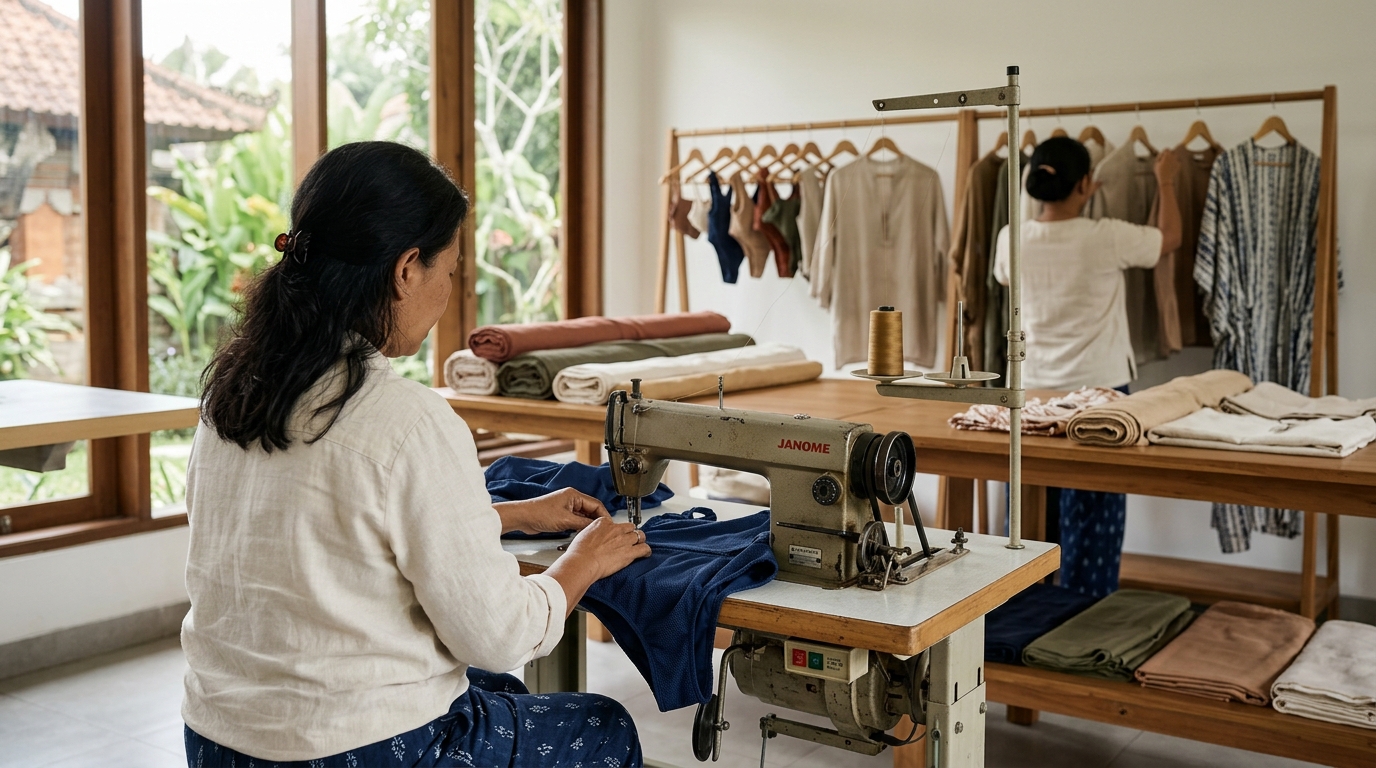
Sourcing swimwear and resortwear from Bali presents a genuine competitive advantage — but only if you understand how the manufacturing ecosystem actually works. US-based brand founders and sourcing managers face a common set of decisions: which factories handle both cut-and-sew swimwear and woven…
Sourcing swimwear and resortwear from Bali presents a genuine competitive advantage — but only if you understand how the manufacturing ecosystem actually works. US-based brand founders and sourcing managers face a common set of decisions: which factories handle both cut-and-sew swimwear and woven resortwear, what MOQs are realistic at launch stage, and how seasonal production calendars in Bali align with US retail buy windows.
This guide addresses those decisions directly. It covers fabric options, digital print technologies, cost benchmarks, sampling timelines, sustainability certifications, and supplier vetting protocols. The goal is to give you a reference you can use in supplier conversations, not a general overview of the island's appeal.
Swimwear resortwearmanufacturers IndonesiaBali operate across a wide range of factory types — from small artisan cut-and-sew studios with 20 workers to mid-size export-oriented facilities with 200-plus employees. Matching your program to the right factory type is the single most important sourcing decision you will make. The sections below give you the framework to do that.
Why Bali Became a Global Hub for Swimwear and Resortwear Production
Bali's manufacturing cluster did not emerge by accident. From the 1990s onward, proximity to surf and resort culture attracted international buyers looking for factories that already understood the aesthetic and functional requirements of beachwear. That early demand seeded a dense network of pattern makers, sample rooms, and cut-and-sew operators that now serves brands from the US, Australia, and Europe.
The Skills and Infrastructure Behind the Cluster
The concentration of skilled artisans in Bali is structurally different from industrial manufacturing zones elsewhere in Indonesia. Factories here typically employ pattern makers, sample machinists, and finishing specialists within the same building. That vertical integration at small scale compresses sampling cycles significantly compared to larger industrial facilities in Java or mainland Southeast Asia.
Export logistics from Bali are well established. Regular container services connect through Surabaya and Jakarta to major US ports. Freight forwarders familiar with garment-specific documentation — including textile fiber content labeling required by the US Federal Trade Commission — operate locally. This reduces administrative friction for first-time importers.
Design Proximity as a Competitive Input
Factories operating near surf and resort communities receive continuous informal feedback on fit, construction, and fabric behavior in water. That proximity shapes technical competence. Bali swimwear manufacturers tend to have stronger in-house knowledge of chlorine-resistant linings, UPF fabrics, and hardware selection than factories producing swimwear as a secondary category.
Fabric Options Available from Indonesian Swimwear Manufacturers
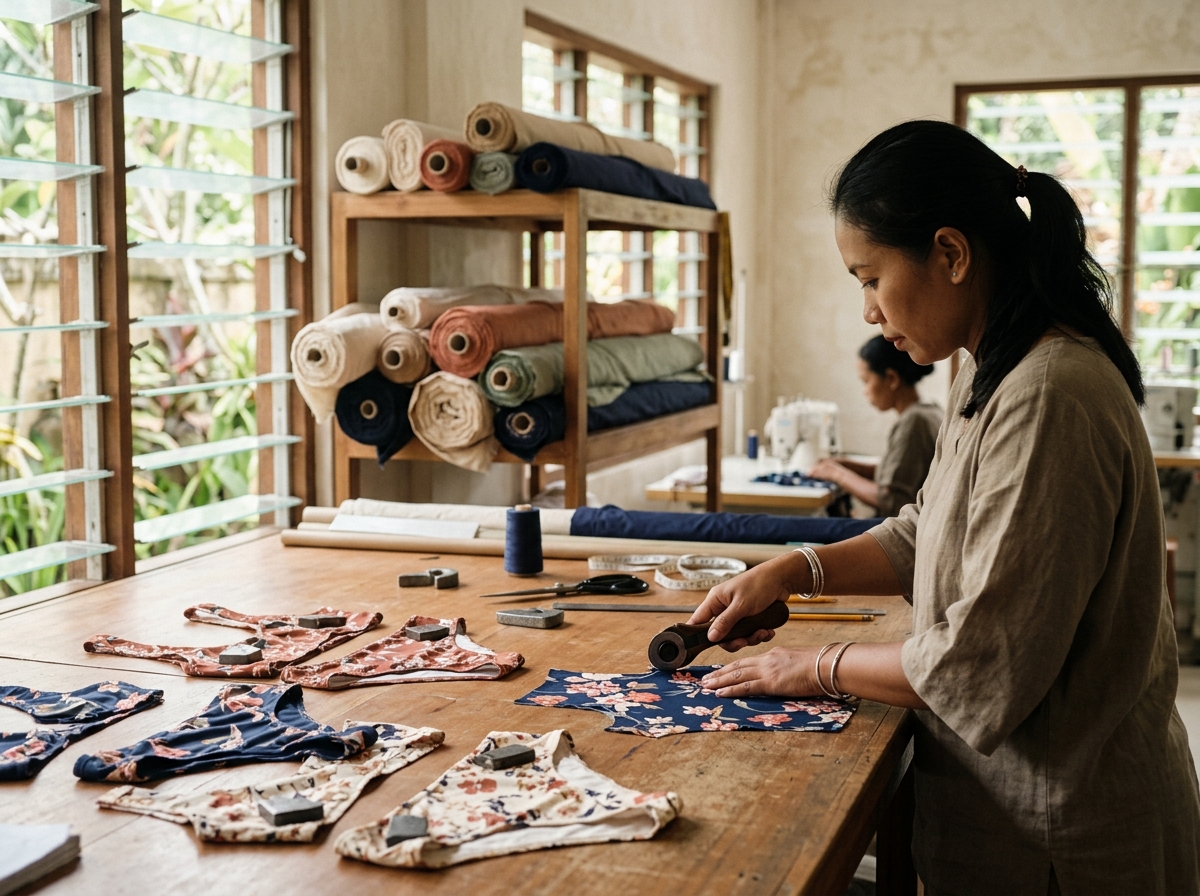
Material selection determines cost, compliance, and customer performance expectations. Indonesian swimwear manufacturers source from a mix of domestic and imported inputs. Understanding what is locally available versus what gets imported affects both lead times and unit costs.
Stretch Fabrics for Swimwear Construction
The primary stretch substrates available from Bali and wider Indonesia-based suppliers include:
| Fabric | Typical Composition | Key Application |
|---|---|---|
| Nylon-spandex | 80% nylon / 20% spandex | Performance swim, competitive |
| Polyester-lycra | 80% polyester / 20% elastane | Recreational swim, printed styles |
| ECONYL regenerated nylon | Recycled nylon / spandex blend | Sustainable swim, premium positioning |
| Power mesh | Nylon or polyester mesh | Lining layer, support panels |
| Athletic liner | Stretch woven | Brief lining, one-pieces |
Chlorine-resistant variants of nylon-spandex and polyester-lycra are available through most mid-size factories. ECONYL, produced by Aquafil, is an imported yarn but is stocked or accessible through fabric agents regularly used by Bali manufacturers targeting the sustainable swimwear segment.
Resortwear Wovens
For cover-ups, dresses, wide-leg pants, and shirts, factories offering full resortwear programs work primarily with:
- Rayon-viscose: lightweight, drapes well, widely available domestically - Linen and rayon-linen blends: increasingly available through Jakarta and Surabaya import agents; pure linen often sourced from China or India - Cotton voile and gauze: used for cover-ups requiring sheerness with breathability
Digital Printing Capabilities and Custom Design in Bali Factories
Digital print is a key differentiator for swimwear brands competing on custom colorways and seasonal prints. Bali has developed meaningful print infrastructure, but not all factories operate identically.
Sublimation vs. Reactive Digital Printing
These two technologies serve different substrates and produce different results:
| Print Method | Best Substrate | Color Vibrancy | Washfastness | Stretch Compatibility |
|---|---|---|---|---|
| Sublimation | Polyester-lycra | Very high | Excellent | Excellent — dye bonds with fiber |
| Reactive digital | Natural/cellulosic (rayon, cotton) | High | Good | Limited — for wovens only |
Sublimation is the standard method for printed polyester-lycra swimwear. It produces colors that are fully embedded in the fiber and will not crack or peel under repeated chlorine exposure. Reactive digital printing is used for woven resortwear pieces in rayon or cotton.
In-House vs. Third-Party Print Bureaus
Many Bali swimwear factories do not own print equipment. They work with local print bureaus on a service basis. This is common and not a red flag — provided the factory has a tested relationship with a specific bureau and can show printed sample history.
Factories with in-house sublimation printing offer faster iteration on color corrections. Third-party bureau models add approximately three to seven business days per revision cycle. Clarify this upfront when requesting printed strike-off samples.
Minimum print runs typically start at approximately 25-50 meters per colorway, which roughly corresponds to 30-60 units of a bikini bottom depending on the style and yield. Color-matching accuracy should be evaluated against a signed physical swatch standard, not a screen reference.
Artwork requirements for sublimation printing: 150 dpi minimum at print scale, CMYK color profile, repeat pattern supplied as a seamless tile. Turnaround from approved artwork to printed proto sample is typically two to three weeks.
MOQ Structures and Small-Batch Programs for Emerging Swim Brands
MOQ is the most frequently misunderstood variable in Bali swimwear sourcing. The right number depends entirely on factory type, style complexity, and whether the piece is plain or printed.
Typical MOQ Ranges by Style and Program
| Style Type | Small Factory MOQ | Mid-Size Factory MOQ |
|---|---|---|
| Plain bikini (top or bottom) | 50–100 units per style | 100–200 units per style |
| Printed bikini | 50–100 units per colorway | 100–300 units per colorway |
| One-piece, plain | 50–100 units | 100–200 units |
| Underwired one-piece | 100–150 units | 200–300 units |
| Woven cover-up / dress | 50–100 units | 100–200 units |
Small artisan-scale factories in Bali — those with 20 to 50 workers — are the most accessible entry point for emerging brands. Startup-friendly programs at 50-100 units per style are genuinely available, though pricing per unit reflects the lower volume.
How Complexity Drives MOQ
Underwired styles require specialist machinists for wire casing and cup construction. Factories price this skill into their MOQ. Expect minimum commitments to be 30-50% higher than for soft-cup equivalents. Heavily embellished pieces — ring hardware, cutouts with bar tacks, knotted halter details — similarly compress margin at low volume.
Negotiating Terms for Repeat Programs
Most factories in Bali offer graduated terms for repeat buyers. After one or two successful production runs, MOQs can often be renegotiated down by 20-30% in exchange for booking consistency. Committing to two seasonal orders per year is frequently sufficient leverage.
Resortwear Production Programs: Wovens, Linens, and Hand-Finished Garments
Not every swimwear factory in Bali handles woven resortwear. Confirming that a factory can produce both is essential for brands building a complete swim-and-resort collection.
Swimwear-Only vs. Full Resortwear Factories
Swimwear-only factories are optimized for stretch fabric handling: feed dogs, differential feed, and cover-stitch machines dominate their floor. Adding woven garments requires different machinery and different operator skills. Factories that handle both genuinely have invested in separate lines or shared resources managed by experienced supervisors.
When evaluating a factory for combined programs, ask to see woven garment samples in their showroom. Request wash and shrinkage test results for rayon and linen pieces. This tells you whether they treat woven production seriously or treat it as an upsell they subcontract out.
Artisanal Details and Hand Finishing
Bali's artisan heritage directly influences resortwear production. Hand-smocking, crochet trim, tassel details, and block-print accents are available from factories that maintain artisan finishing teams. These details carry a price premium — typically added per piece at approximately USD 1.50 to USD 4.00 depending on complexity — but support premium retail positioning.
US Compliance for Woven Resortwear
Woven resortwear sold in the US must meet specific labeling requirements under the Textile Fiber Products Identification Act, enforced by the Federal Trade Commission. Labels must include fiber content by percentage, country of origin, care instructions, and manufacturer identification. Factories experienced in US export will know this. Factories without US export history may require detailed guidance.
Sampling Speed, Lead Times, and the US Seasonal Production Calendar
Timing is where many US brands get into trouble sourcing from Bali. The time-zone difference, factory peak seasons, and long freight transit times all compress the usable production window.
Typical Sampling and Production Timelines
| Stage | Typical Duration |
|---|---|
| Proto / concept sample | 2–4 weeks from tech pack receipt |
| Fit sample (after proto approval) | 2–3 weeks |
| Pre-production sample | 1–2 weeks |
| Bulk production — plain styles | 8–10 weeks |
| Bulk production — printed or complex | 10–16 weeks |
| Sea freight to US West Coast | 20–25 days approximately |
Aligning with US Retail Seasons
US swim and resort retail operates on two primary windows:
- Holiday / Resort drop: in-store or online delivery typically October–November. This requires bulk completion by September at the latest. - Spring / Summer launch: delivery typically February–April. Bulk must ship by late January.
Working backward from these windows, brands sourcing with swimwear resortwearmanufacturers IndonesiaBali should initiate tech pack submission no later than:
- Holiday drop: tech packs by late May / early June - Spring / Summer launch: tech packs by late September / early October
Bali Factory Peak Seasons and Booking Windows
Bali factories experience high demand from Australian brands operating on a Southern Hemisphere retail calendar. This creates capacity pressure from approximately January through April for Spring/Summer Australian delivery. US brands booking in the same window may face longer lead times or higher minimums from in-demand factories.
Book production slots at least 14-16 weeks before your required ship date. For factories with strong sustainability positioning or established brand relationships, popular windows fill even earlier.
Sustainability and Ethical Certifications Worth Requiring from Bali Factories
Sustainability has become a default talking point among Bali manufacturers. Verifying it requires going beyond marketing language.
Certifications That Carry Verifiable Weight
| Certification | What It Covers | Where to Verify |
|---|---|---|
| OEKO-TEX Standard 100 | Harmful substance limits in fabric and trims | oeko-tex.com certificate database |
| Global Recycled Standard (GRS) | Chain of custody for recycled content (e.g., ECONYL) | Control Union or Bureau Veritas certificate |
| BSCI | Social compliance audit — wages, hours, safety | amfori.org member search |
ECONYL certification is a material-level claim made by yarn supplier Aquafil. A factory claiming to use ECONYL should be able to show a purchase order or material invoice from an Aquafil-authorized distributor. Ask for it.
Fair wage transparency in Bali's manufacturing sector varies. BSCI-audited factories have undergone third-party social compliance reviews. Non-audited factories may be fully compliant in practice but offer no verified evidence. For brands with public sustainability commitments, BSCI or equivalent audit documentation is a minimum.
- ✓Request valid OEKO-TEX certificate number and verify on oeko-tex.com
- ✓Ask for GRS certificate if recycled content is claimed
- ✓Confirm ECONYL use with supplier invoice from Aquafil distributor
- ✓Ask for most recent BSCI or SMETA audit report
- ✓Confirm wastewater treatment process for dyeing and printing operations
- ✓Request wage range disclosure for production workers
How to Vet and Onboard a Bali Swimwear or Resortwear Manufacturer
Due diligence on a new supplier determines whether your first collection ships on time and within spec. The vetting process should be systematic, not relationship-driven.
Factory Visit and Evaluation Criteria
A factory visit — in person or through a vetted sourcing partner — should assess:
- Machinery: cover-stitch, flatlock, overlock machines appropriate for stretch; separate machines for wovens if claiming resortwear capability - Sample room quality: dedicated sample machinists, CAD or manual pattern drafting capability, fitting mannequin availability - Team size and turnover: a stable core team of 30-plus reduces quality inconsistency risk - Storage and material management: fabric rolls stored off the floor, organized by dye lot
Key Questions Before Signing a Production Agreement
Ask these before committing to a sampling fee or deposit:
- What is your tech pack requirement format? - Do you support grading across size ranges in-house? - Who owns the tooling and patterns if we discontinue the relationship? - What is your policy on design exclusivity per client? - Have you exported to the US before, and can you provide references?
Intellectual Property and Design Protection
IP protection is a practical risk that most sourcing guides ignore. Bali manufacturers generally do not register designs on behalf of clients, but establishing clear IP terms in a written agreement matters. Key steps:
- Include a design exclusivity clause in your production agreement — specify geographic scope and duration. - Watermark all tech packs and mood boards submitted digitally. - Avoid sending final, production-ready tech packs before a signed NDA or framework agreement is in place. - Register original prints with the US Copyright Office before sharing artwork files with any overseas vendor.
Red Flags in Supplier Screening
- Promises of three-week bulk production for printed styles - No tech pack support or unwillingness to work from your specification - Vague or verbal intellectual property policies - Inability to show working samples in the category they are quoting - Reluctance to allow third-party inspection during production
Cost Benchmarks and Pricing Structures for Indonesia Swimwear Production
FOB pricing from Indonesian swimwear and resortwear manufacturers varies significantly based on style, fabric, and volume. The ranges below are approximate and directional — actual quotes will depend on specific construction details and factory tier.
FOB Price Benchmarks by Style
| Style | Approximate FOB Range (USD) |
|---|---|
| Basic bikini top, plain | USD 6–12 |
| Basic bikini bottom, plain | USD 5–10 |
| Printed bikini top or bottom | USD 8–16 |
| Soft-cup one-piece, plain | USD 12–20 |
| Underwired one-piece, printed | USD 18–30 |
| Woven cover-up / kaftan, plain | USD 10–18 |
| Woven dress, hand-finished detail | USD 15–28 |
What Drives Unit Cost Variation
- Fabric type: ECONYL blends carry a material premium of approximately 15-25% over standard polyester-lycra - Print complexity: all-over digital print adds approximately USD 2–5 per unit versus plain fabric - Hardware and trims: metal rings, adjustable sliders, and underwire add USD 1–4 per unit depending on sourcing - Hand finishing: smocking, crochet trim, or embroidery adds USD 1.50–5 per unit at minimum
Payment Terms and Landed Cost
Standard payment terms in Bali follow a deposit-and-balance structure. Expect approximately 30-50% deposit at order confirmation, with the balance due before or upon shipment. Letters of credit are uncommon with smaller factories; wire transfer is standard.
Landed cost calculation for US importers should include:
- FOB price - Sea freight (typically USD 3–6 per kg for LCL; lower per unit for FCL at sufficient volume) - Marine insurance (approximately 0.5–1% of cargo value) - US import duties (swimwear from Indonesia currently subject to applicable duty rates — verify current HTS classification and rate with a licensed customs broker) - Port handling, drayage, and domestic freight
Duty rates on swimwear from Indonesia under standard Most Favored Nation (MFN) rates can range from approximately 10-28% depending on HTS classification. Confirm the applicable rate for your specific product before finalizing cost models.
Frequently Asked Questions from Swim Brand Founders
What is the typical minimum order quantity for Bali swimwear manufacturers?
Small factories typically accept 50-100 units per style. Mid-size factories usually require 100-300 units per style. MOQs rise with print complexity and construction difficulty.
How long does sampling take with an Indonesian swimwear factory?
Proto samples take approximately two to four weeks from tech pack receipt. Fit samples take an additional two to three weeks after approval. Total sampling rounds to bulk order placement commonly take six to twelve weeks.
Do Bali manufacturers offer recycled or sustainable fabric options for swimwear?
Yes. ECONYL regenerated nylon is accessible through most factories targeting the sustainable swimwear segment. Verify with GRS certification and supplier invoices from Aquafil-authorized distributors. OEKO-TEX certified fabrics are also available across standard nylon-spandex and polyester-lycra options.
Can Indonesian factories handle both swimwear and woven resortwear in the same order?
Some can. Confirm by requesting samples of both garment types and asking about machinery. Factories that genuinely handle both maintain separate or dual-purpose production lines. Do not assume capability — verify it.
What certifications should I look for when sourcing swimwear from Bali?
Prioritize OEKO-TEX Standard 100 for fabric safety, GRS for recycled content claims, and BSCI for social compliance. For US-specific compliance, confirm knowledge of FTC labeling requirements and relevant CPSC standards.
How do I protect my designs and intellectual property when working with a Bali manufacturer?
Sign a written production agreement with an explicit IP and exclusivity clause before sharing production-ready files. Register original prints with the US Copyright Office. Use watermarked documents during initial supplier conversations. Do not rely on verbal commitments regarding design exclusivity.
Bali and Indonesia offer a genuinely capable manufacturing base for swimwear and resortwear brands — provided you match your program to the right factory type, verify certifications independently, and build your production calendar around realistic lead times. The brands that succeed here treat supplier selection as a structured evaluation process, not a relationship-first shortcut.
Ready to move from research to action? You now have the framework to evaluate swimwear resortwear manufacturers Indonesia Bali against real criteria. Request samples from vetted Bali swimwear and resortwear manufacturers today and start the qualification process with full specification clarity.
Connect with pre-vetted swimwear and resortwear manufacturers in Bali and Indonesia. Specify your MOQ, fabric requirements, and seasonal timeline to receive matched factory introductions and sample quotes.
Request Manufacturer Introductions →Need eyes on the ground in Indonesia?
MTS is an execution partner — supplier verification, manufacturing management, quality control and export logistics across Indonesia, Vietnam and China.
Related services
Related articles
Receive furniture sourcing insights across Asia.
One email per week. No spam.