Restaurant Chain Furniture Rollout Program Indonesia: The Complete Sourcing and Operations Guide
13 min read
Managing furniture across 20 or more restaurant openings per year is a supply chain problem, not a procurement problem. Each new location needs hundreds of matched pieces delivered on time, to spec, and consistent with every other site in the network. A single delayed container or an off-spec…
Managing furniture across 20 or more restaurant openings per year is a supply chain problem, not a procurement problem. Each new location needs hundreds of matched pieces delivered on time, to spec, and consistent with every other site in the network. A single delayed container or an off-spec finish batch can push an opening date and damage brand perception before the first guest walks in.
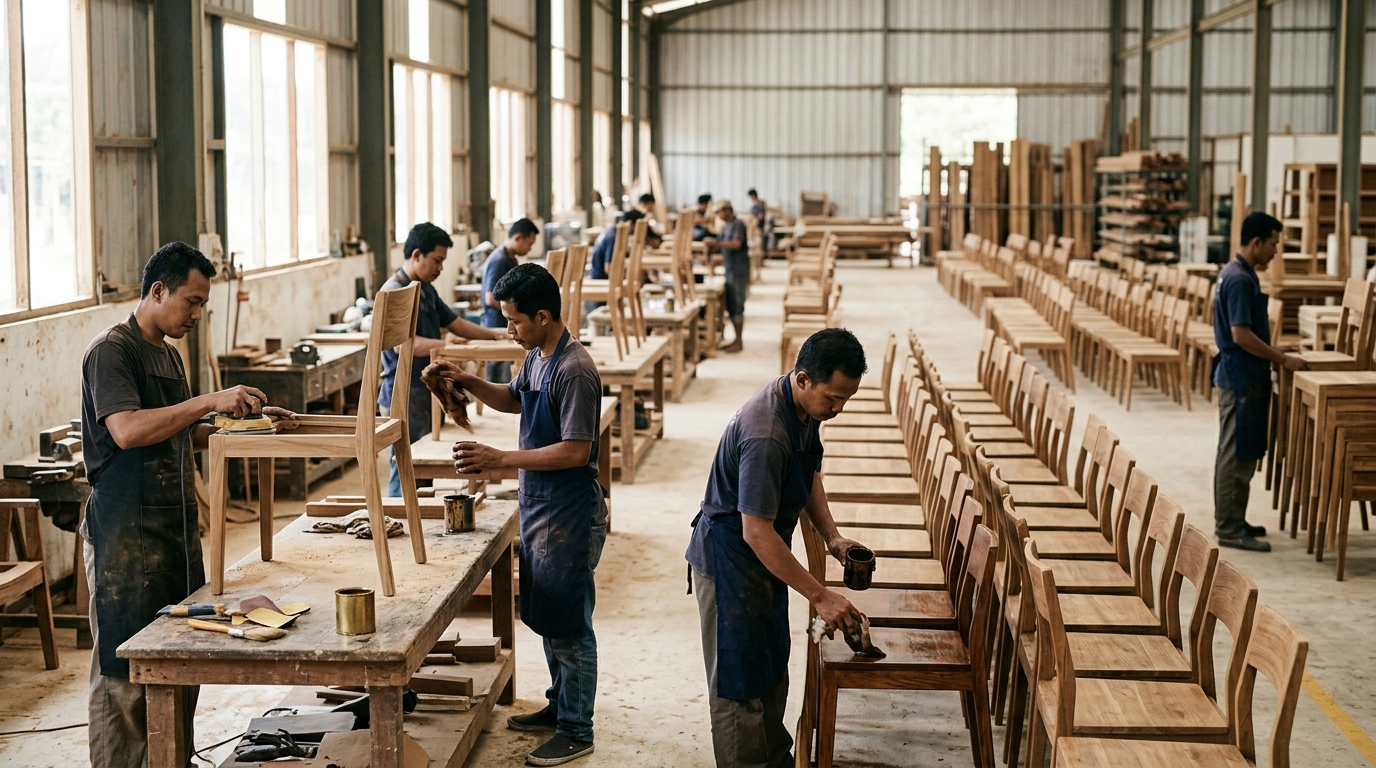
A restaurant chain furniture rollout program Indonesia built on the right factory partnerships solves this at scale. Indonesian manufacturers — concentrated in clusters like Jepara, Cirebon, Semarang, and Bali — have built export infrastructure specifically suited to high-volume, repeat-order commercial programs. They work across teak, rattan, solid mahogany, and upholstered frames. They understand OEM production discipline.
This guide covers everything a chain operator or franchise development manager needs to execute a multi-site furniture program sourced from Indonesia. Topics include SKU standardization by format type, phased production scheduling, consistency control across batches, replacement stock modeling, warehousing strategy, US import compliance, and supplier selection criteria.
If your chain is planning 10 or more openings annually, the decisions covered here will determine whether your furniture program scales cleanly or creates recurring operational drag.
Why Indonesian Factories Are Purpose-Built for Multi-Site Chain Furniture Programs
Material Depth and Manufacturing Specialization
Indonesia's furniture manufacturing ecosystem is among the most material-rich in Asia. The country produces commercial-grade furniture across teak, merbau, suar, rattan, mahogany, and upholstered frames — all within a relatively compact cluster geography.
Key production clusters relevant to chain operators:
- Jepara, Central Java — solid teak and mahogany dining furniture; the largest single concentration of wood furniture manufacturers in Indonesia - Cirebon, West Java — rattan and wicker seating; dominant supplier for outdoor and casual dining formats - Semarang — mid-market outdoor and contract furniture; strong on metal-frame upholstered pieces - Bali — artisan-grade luxury andresort furniture; relevant for premium full-service concepts - Surabaya — mid-market commercial production with established export logistics
This geographic clustering means a chain operator can source a complete dining room package — solid wood tables, upholstered booth seating, rattan accent chairs, and metal bar stools — from factories within a single region, simplifying logistics coordination.
Scale and Cost Advantages Over Competing Source Countries
Large Indonesian factories — those with 200 to 500 or more workers — operate automated spray lines, CNC routing, and controlled drying chambers. They are equipped to produce hundreds of identical SKUs per production run without handcraft variance creeping into dimensional tolerances.
Cost-competitiveness versus alternatives:
| Source Country | Relative Cost Position | Key Trade-Off |
|---|---|---|
| United States | High | Short lead time; limited scale |
| European Union | High | Design quality; poor volume economics |
| China | Medium | Scale; anti-dumping duty exposure on some categories |
| Vietnam | Medium-Low | Strong quality; less rattan/teak depth |
| Indonesia | Low-Medium | Strong material range; longer ocean transit |
Indonesia's government export infrastructure — established trade lanes to US West Coast and East Coast ports, bonded warehouse availability, and phytosanitary certification systems — supports the logistics requirements of a restaurant chain furniture rollout program indonesia at volume.
Building a Standardized SKU Catalog That Locks In Brand Consistency Across Every Location
A multi-site rollout without a fixed SKU catalog is unmanageable. Every format in your network needs a defined furniture package — specified down to material, finish code, dimension, and weight — before production begins.
Format-Specific Furniture Packages
Different restaurant formats carry different furniture loads. As a general benchmark, a 120-seat casual dining location typically requires approximately 200 individual furniture items when accounting for dining chairs, tables, bar stools, booth frames, host stand, and outdoor sets (approximate, based on industry benchmarks for mid-scale restaurant fit-outs).
| Format Type | Core SKU Categories | Typical Seat Count Range |
|---|---|---|
| QSR / Fast Food | Hard dining chair, 4-top table, high-top counter stool | 60–120 |
| Fast Casual | Upholstered dining chair, mixed table sizes, bench seating | 80–150 |
| Full Service / Casual Dining | Upholstered chair, booth seating, bar stool, lounge chair, outdoor set | 100–200+ |
| Bar / Gastropub | Bar stool (counter + bar height), communal table, booth, lounge | 80–160 |
| Drive-Thru / Counter Service | Limited indoor seating; outdoor patio sets prioritized | 20–60 indoor |
Technical Datasheet Requirements
Each SKU in the catalog needs a technical datasheet submitted to the factory before production approval. Minimum datasheet fields:
- Overall dimensions (H × W × D) with tolerance range (typically ±3mm for wood) - Seat height and seat depth - Frame material and species (e.g., Grade A teak, FSC-certified) - Finish specification: stain code, sheen level (matte / satin / semi-gloss) - Upholstery: COM grade, pattern direction, thread count minimum - Weight tolerance band - Stacking or nesting requirement - Load-bearing test standard (e.g., BIFMA X5.4 for seating)
Phased Production Scheduling That Keeps Pace With Your Opening Calendar
Mapping Production to a Rolling Pipeline
A restaurant chain furniture rollout program indonesia only delivers value if production timelines are aligned to your opening schedule. Twelve to approximately 24 months of forward pipeline visibility is the minimum requirement for effective capacity planning.
Work backward from each opening date:
1. Furniture must be in-store at least 10– approximately 14 days before opening for installation and punch-list resolution 2. US customs clearance and domestic trucking add approximately 7–21 days from port arrival 3. Ocean transit from Indonesian ports to US West Coast: approximately 18–25 days; to East Coast via Suez: approximately 28–35 days (approximate; varies by routing and carrier) 4. Pre-shipment inspection and documentation: 5– approximately 10 days 5.
Lead Time Benchmarks by SKU Category
| SKU Category | Approximate Lead Time (from PO confirmation) |
|---|---|
| Solid teak dining chairs, standard finish | 45–60 days |
| Custom upholstered booth seating | 60–90 days |
| Rattan or woven seating | 45–75 days |
| Metal-frame bar stools, powder-coated | 30–50 days |
| Outdoor solid wood sets | 50–70 days |
| Large custom tables, custom dimensions | 60–90 days |
Capacity Allocation and Buffer Production
Negotiate a capacity allocation agreement with your factory partner. This reserves a defined number of production slots per quarter, giving your program priority over spot buyers.
Build a buffer into every opening cohort. A 10– approximately 15% overage per batch covers in-transit damage, inspection rejects, and last-minute seat count changes. Buffer stock either ships with the main order to a US warehouse or remains in Indonesian pre-positioned inventory for the next opening wave.
Consistency Control Across Production Runs: The Technical Discipline That Protects Your Brand
Master Sample Creation and Storage
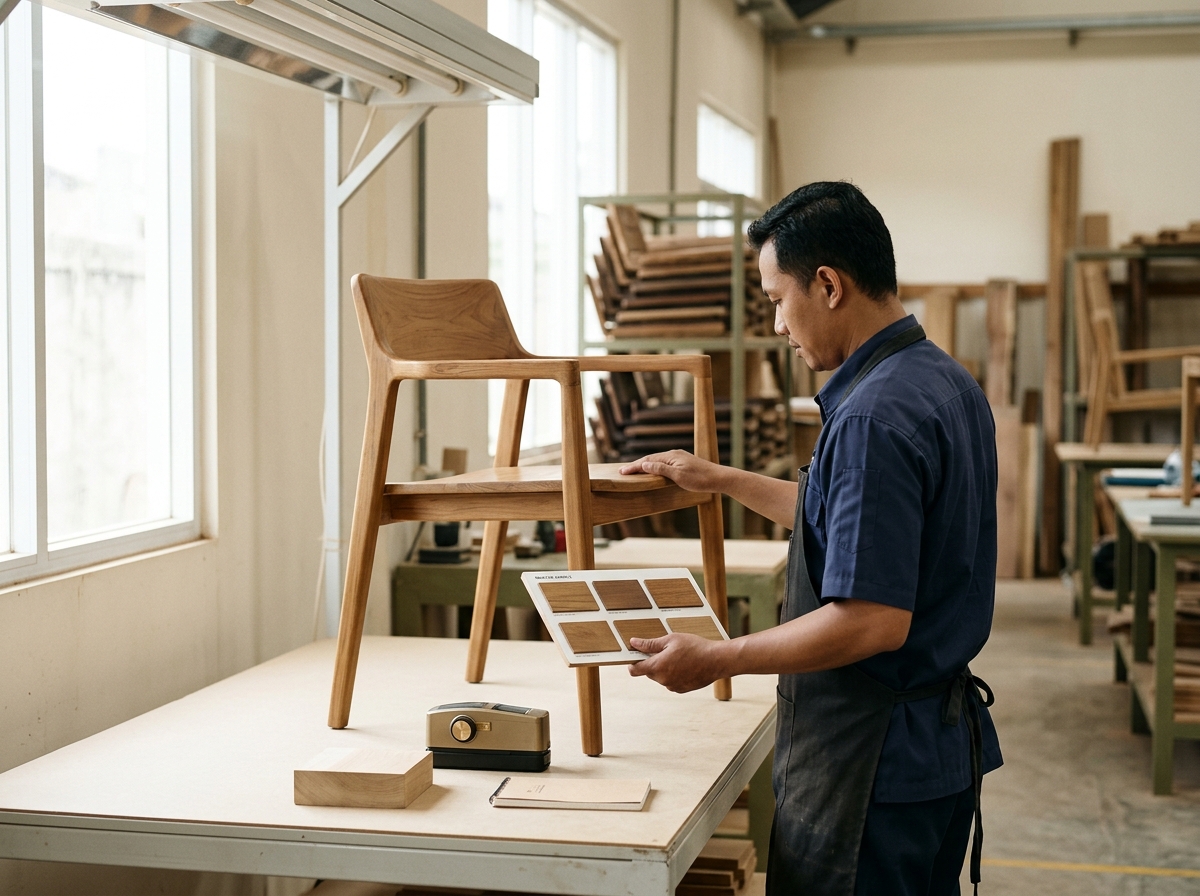
The physical master sample is the single reference point that governs all production runs. One approved sample per SKU must be:
- Signed off by the chain's brand or design team - Tagged with a unique reference number tied to the technical datasheet - Stored in a controlled environment at the factory (away from sunlight and humidity variation) - Photographed under standardized lighting conditions from six angles - Retained for the full duration of the supplier agreement
If you operate across multiple factories — which larger programs often require — each factory must hold its own approved master sample for every SKU it produces.
Third-Party Quality Control Inspections
Relying on factory self-inspection is insufficient for a commercial furniture program. Three inspection stages are standard:
1. Pre-production inspection — before materials are cut; confirms raw materials, hardware, and upholstery meet spec 2. During-production (DUPRO) inspection — at 20–40% completion; catches process deviations early 3. Pre-shipment inspection (PSI) — on 100% completion, before container loading; dimensional checks, finish comparison to master sample, function tests
Inspection reports must include dimensional measurements, photographic evidence of finish matching, and pass/fail status against each technical datasheet field. Reports go directly to the chain operator, not through the factory.
- ✓Dimensional check against datasheet tolerances
- ✓Finish color match to master sample under D65 lighting
- ✓Seat load test (static) witnessed or documented
- ✓Hardware torque check on all fasteners
- ✓Upholstery seam alignment and tension review
- ✓Quantity count against packing list
- ✓Carton drop and stacking test for shipment integrity
Replacement Stock Planning: Protecting Guest Experience Across Your Entire Network
A growing chain's furniture program doesn't end at opening. Replacement stock is a recurring operational requirement that most operators underplan.
Calculating Annual Replacement Rates
Replacement demand varies by item category and average daily cover count. Approximate annual replacement rate benchmarks for high-traffic casual dining:
| Item Category | Approximate Annual Replacement Rate |
|---|---|
| Dining chairs (upholstered) | 8–15% of installed quantity |
| Dining chairs (solid wood, no upholstery) | 3–7% of installed quantity |
| Bar stools (counter seating, high traffic) | 10–20% of installed quantity |
| Dining tables | 2–5% of installed quantity |
| Booth seating (frame) | 1–3% of installed quantity |
| Booth seating (upholstered seat/back) | 10–18% of installed quantity |
These rates are approximate and increase with higher daily cover counts, 24-hour operations, or family-format restaurants with high chair-handling frequency.
Standing Purchase Orders and SKU Continuity
Structure a standing purchase order — or a blanket order — with your Indonesian factory for replacement SKUs. This locks pricing, maintains production priority, and avoids the risk of a discontinued finish or material.
Critical contract term: require a minimum 3–5 year SKU continuity commitment from the factory. This means the factory agrees to maintain the same material specifications, finish formulas, and production tooling for the agreed SKU list throughout the contract period. Without this commitment, a finish or dimension change in year two creates visible inconsistency across your network.
Retirement and Rotation Cycles
Establish a defined retirement protocol. When a location's chair inventory degrades below a defined standard (e.g., finish wear on more than 40% of surface area, structural wobble, upholstery tearing), replacement should trigger automatically — not reactively after guest complaints.
Refurbishment — reupholstering booth seats in-market, for example — can extend cycle life by 2–3 years for frame-sound pieces. Define which SKUs are refurbish-eligible versus direct-replace.
Warehousing Strategy Between Openings: Pre-Positioning Inventory to Eliminate Delays
In-Country Indonesian Pre-Positioning
For chains opening 15 or more locations per year, holding pre-positioned inventory in Indonesia reduces per-shipment lead time. A bonded or commercial warehouse near Semarang or Surabaya can receive completed furniture from multiple factories, consolidate it into opening packages, and hold it until the shipment window opens.
Benefits of in-country pre-positioning:
- Allows production to run ahead of confirmed opening dates - Enables multi-factory consolidation into single FCL containers - Reduces the risk of a single factory delay holding up an entire opening cohort
US-Side 3PL Warehousing and Distribution
Furniture arriving at US ports — Los Angeles, Long Beach, Seattle, or East Coast alternatives — requires domestic distribution to opening sites. A 3PL with experience in commercial furniture handling (blanket wrapping, white-glove delivery, room placement) is essential.
Key 3PL selection criteria for chain furniture programs:
- Ability to receive FCL containers and break-bulk to individual opening packs - Inventory management system with SKU-level tracking and photo condition reporting - Scalable storage capacity aligned to your opening pipeline volume - Carrier relationships for LTL delivery to markets where volume doesn't justify FTL
Consolidation Shipping: FCL Economics
Consolidating multiple location orders into fewer FCL (full container load) shipments reduces per-unit freight cost significantly versus LCL (less than container load) shipping.
A standard 40-foot high-cube FCL typically accommodates furniture for one to two full-service restaurant locations, depending on SKU density and packaging. Pallet optimization and nested or stackable chair designs improve container utilization.
US Import Compliance for Indonesian Restaurant Furniture: What Every Chain Operator Must Know
This section is where mostfurniture sourcingguides fail. Compliance errors on US-bound Indonesian furniture create clearance delays, penalties, and potential import bans. Get this right before the first container ships.
Wood Composite Compliance: CARB Phase 2 and TSCA Title VI
Any furniture containing composite wood components — MDF, plywood, particleboard — used in US commercial spaces must comply with CARB Phase 2 formaldehyde emission standards. Under TSCA Title VI (effective from approximately 2018), these standards are federally enforceable nationwide.
Requirements:
- Panels must be produced by CARB-certified panel manufacturers - Finished products must be labeled with the compliant panel certification - Importers must maintain records of panel supply chain compliance
Solid teak, rattan, and metal-frame pieces without composite wood components are not subject to CARB/TSCA Title VI requirements.
Lacey Act Documentation for Solid Wood
The Lacey Act requires US importers to declare the species, country of harvest, and quantity of plant material in imported wood products. Indonesian species commonly used in restaurant furniture — teak, merbau, suar — must be declared on the APHIS PPQ Form 505 (Plant and Plant Product Declaration).
Ensure your Indonesian factory provides:
- Species confirmation per SKU (common name and scientific name) - Country of harvest (Indonesia, or certified plantation origin) - Phytosanitary certificate issued by Indonesian agricultural authorities - Fumigation certificate where required by the receiving port
HTS Classification and Import Duties
US Harmonized Tariff Schedule (HTS) classification determines the applicable duty rate for your furniture. Key categories:
| Furniture Type | HTS Chapter | Approximate Duty Rate |
|---|---|---|
| Wooden seats (dining chairs) | 9401.69 | Approximately 0% |
| Other wooden furniture (tables) | 9403.60 | Approximately 0% |
| Metal-frame seating | 9401.79 | Approximately 0% |
| Upholstered seating | 9401.61 | Approximately 0% |
Duty rates shown are approximate and subject to change. Confirm current rates with a licensed US customs broker before shipment.
Indonesia does not currently face Section 301 tariffs applicable to Chinese-origin furniture, which is a meaningful cost advantage for US-bound programs.
Selecting the Right Indonesian Factory Partner for a Chain Furniture Rollout
Not every Indonesian manufacturer is equipped to support a multi-site rollout. Artisan workshops in Bali and small cooperatives in Jepara produce exceptional furniture — but they cannot deliver the production consistency, export documentation capability, or capacity reliability a chain program requires.
Minimum Factory Criteria
| Criterion | Minimum Requirement for Chain Programs |
|---|---|
| Worker count | 150+ for primary SKUs; smaller for specialist categories |
| Export history | Minimum 3 years of direct US or EU export experience |
| QC system | Documented internal QC process; third-party inspection access |
| Certifications | CARB-compliant panel sourcing; FSC or SVLK (Indonesia's timber legality system) for solid wood |
| Account management | Dedicated export coordinator; English-language communication |
| Capacity buffer | Demonstrated ability to scale 20–30% within 60 days |
Red Flags to Eliminate Early
- No formal export documentation experience (Lacey Act declarations, phytosanitary certificates) - Reluctance to accept third-party pre-shipment inspections - No documented master sample retention system - Unable to provide production schedule reports or DUPRO inspection access - Single-owner workshops presenting as factories
Contractual Protections for Chain Operators
Key terms to include in any long-term furniture program contract:
- SKU lock-in period with minimum 3-year continuity commitment - Minimum order quantities per SKU per year (protects your production slot priority) - Replacement stock priority clause (your replacement orders are not displaced by spot buyers) - Inspection access rights (third-party inspectors at all production stages) - Defect liability and replacement shipment terms (timeline and cost responsibility) - Price escalation caps tied to defined raw material indices
Frequently Asked Questions: Indonesian Restaurant Furniture for Chain Operators
What types of furniture are manufactured in Indonesia suitable for restaurant chains? Indonesian factories produce solid teak dining chairs and tables, rattan and woven seating, mahogany and suar wood pieces, upholstered booth seating with imported fabric, powder-coated metal bar stools, and outdoor timber sets.
How much does it cost to source and ship restaurantfurniture from Indonesiato the US? Ex-factory pricing varies significantly by material and complexity. Solid teak dining chairs typically range from lower to mid hundreds of dollars per unit for commercial grade; upholstered booth seating runs higher.
How do you maintain furniture consistency across multiple restaurant locations over time? Consistency requires three disciplines working together: locked technical datasheets per SKU, physical master samples stored at the factory, and third-party pre-shipment inspections tied to those standards for every production run. SKU continuity clauses in the supplier contract prevent unilateral material or finish changes.
What compliance certifications are required to import Indonesian furniture into the United States? CARB Phase 2 / TSCA Title VI compliance for any composite wood components. Lacey Act documentation (PPQ Form 505) for solid wood species. Phytosanitary and fumigation certificates where required. Standard US Customs entry documentation (commercial invoice, packing list, bill of lading, certificate of origin).
How do you plan replacement stock for a growing restaurant chain's furniture program? Model replacement demand by SKU category using estimated annual replacement rates (8–15% for upholstered chairs in high-traffic locations is a common starting point). Layer in your network's expected growth to project total annual replacement volume.
What lead times should F&B chains expect when ordering custom furniture from Indonesian factories? Solid wood dining chairs typically run 45–60 days from PO to shipment-ready. Custom upholstered pieces extend to 60– approximately 90 days. Add 18–35 days for ocean transit to US ports depending on routing, plus 7–21 days for customs clearance and domestic delivery.
A well-structured restaurant chain furniture rollout program indonesia reduces per-unit cost, protects brand standards across every location, and eliminates the reactive procurement that slows growing chains. The decisions that matter most — SKU standardization, factory selection, compliance preparation, and warehousing strategy — must be made before the first production order is placed, not during an opening crisis.
You now have the framework to evaluate Indonesian manufacturers on the criteria that determine rollout success: capacity, QC discipline, export compliance capability, and long-term SKU commitment.
You understand what a multi-site furniture program from Indonesia requires. The next step is connecting with a manufacturing partner who can commit to your opening schedule, your brand specs, and your compliance requirements — not just your first order. Request a rollout program proposal from an Indonesian furniture manufacturer today and get a structured response covering capacity allocation, lead times, and SKU continuity terms.
Request a Rollout Proposal →Need eyes on the ground in Indonesia?
MTS is an execution partner — supplier verification, manufacturing management, quality control and export logistics across Indonesia, Vietnam and China.
Related services
Related articles
Receive furniture sourcing insights across Asia.
One email per week. No spam.