Custom Furniture Prototyping in Indonesia: From Sketch to First Sample
15 min read
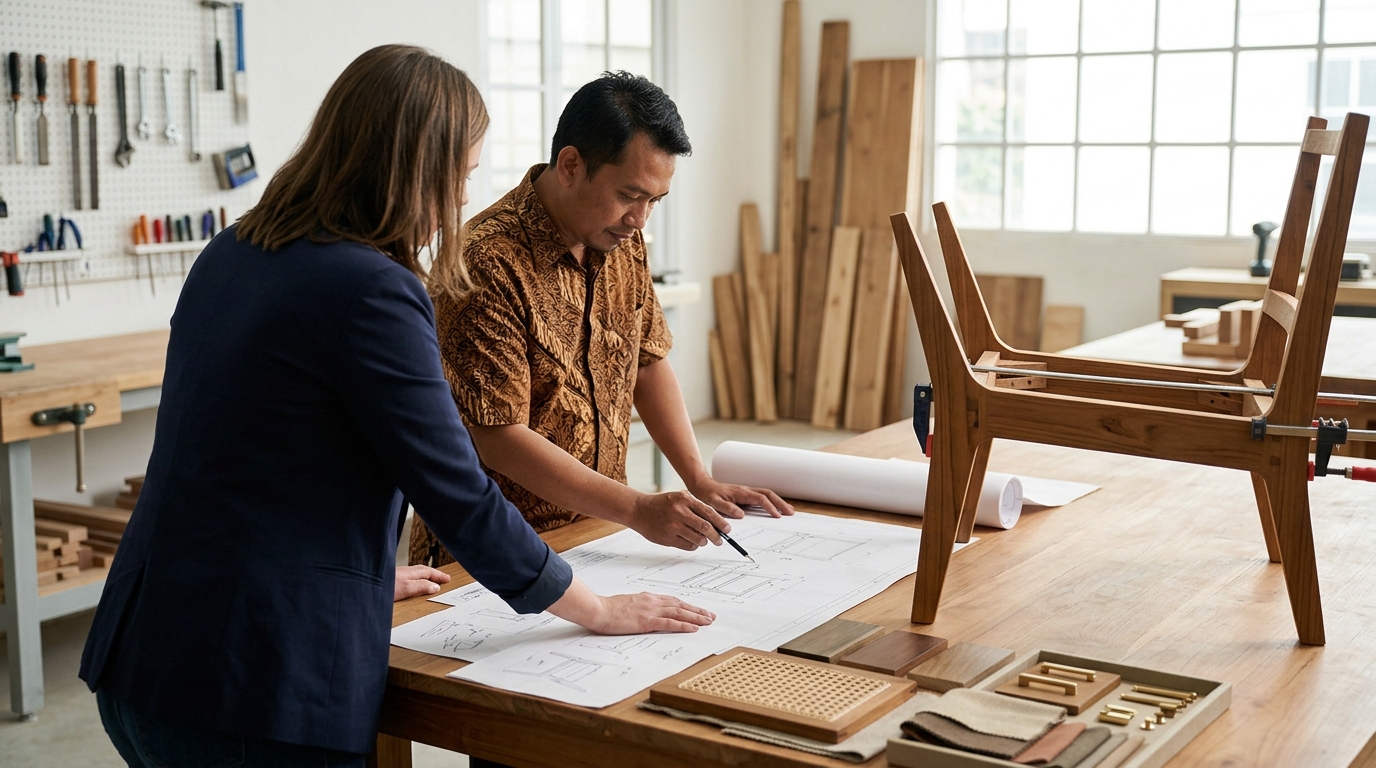
There is a critical distinction every US-based product developer must make before engaging an Indonesian workshop. Ordering a catalog sample — selecting an existing design from a manufacturer's range and requesting a branded version — is a logistics exercise. Developing a custom furniture…
There is a critical distinction every US-based product developer must make before engaging an Indonesian workshop. Ordering a catalog sample — selecting an existing design from a manufacturer's range and requesting a branded version — is a logistics exercise. Developing acustom furnitureprototype from a new concept sketch or CAD file is an engineering and design process.
Furniture prototyping Indonesia custom sample development is not a service every workshop offers. Many factories excel at replicating their own catalog with minor modifications. True new-product prototype development requires a dedicated sample team, tolerance management, and a structured iteration process.
This guide walks US-based OEM buyers and product developers through every stage of the process. It covers identifying capable Indonesian workshops, translating design intent into a brief, and structuring iteration rounds with remote sign-off gates.
Why Indonesian Workshops Lead in Custom Furniture Prototype Development
Indonesia occupies a distinct position in the global furniture supply chain. Its competitive advantage is not volume throughput — Vietnam and China dominate there. Its edge is in natural material mastery, artisan depth, and multi-process capability within a single workshop footprint.
Cluster Capabilities Across Jepara, Bali, and Surabaya
Each major cluster brings different strengths to prototype work.
Jepara (Central Java) is Indonesia's largest furniture production hub. It specializes in solid teak and mahogany — joinery, carving, and surface finishing. Workshops here can handle complex hand-carved detailing alongside CNC routing. For structurally demanding prototypes in solid timber, Jepara is the primary starting point.
Bali skews toward luxury artisan output — resort furniture, mixed-media pieces combining teak, rattan, metal, and stone. Workshops are smaller but accustomed to hospitality-grade finishing standards and designer-driven briefs. Iteration costs are higher, but finish quality on first-round samples is typically stronger.
Surabaya sits in the mid-market range. Workshops are more industrialized, better suited to prototypes that need to bridge artisan construction and scalable production. Metal fabrication integration is more accessible here than in Jepara.
The Cost Argument for Multi-Round Iteration
Nearshore alternatives — Mexico, Poland, Portugal — offer shorter flight times for factory visits but significantly higher labor costs per iteration round. For development programs requiring three or more rounds of physical samples, Indonesia's labor cost structure matters considerably. Skilled woodworking labor in Jepara and surrounding areas remains cost-competitive against any comparable craft tradition globally.
The practical implication: a US buyer can afford to run a genuine three-round prototype cycle in Indonesia — raw structure, material and finish, production-ready — within a budget that nearshore alternatives would exhaust in one or two rounds.
Catalog Sample vs. True Prototype Development
[[NOTE title="Self-Qualification Check" body="If you are modifying an existing Indonesian workshop design with your logo and a finish change, this article is not for you. The content below assumes you are introducing an entirely new form, new joinery approach, or new material combination — and that no Indonesian workshop currently produces it."]]
True prototype development means the workshop is building tooling, jigs, and construction sequences from scratch against your specifications. It requires a dedicated sample team separate from the production floor. Ask any prospective workshop directly: do they have a sample room with its own staff, or do prototypes get built between production runs?
How to Select the Right Indonesian Workshop for Your Prototype Scope
Core Capability Checklist
Not every workshop can execute every design. Before sharing drawings, verify the following:
[[CHECKLIST title="Workshop Capability Verification Checklist" items="CNC routing capability (3-axis minimum for most furniture forms)|Hand-carving and joinery expertise for solid timber|In-house upholstery workshop if the design includes seating|Metal fabrication or confirmed subcontractor for metal inlays or bases|Spray booth and multi-step finishing capability|Kiln-dried timber stock and drying chamber on-site|Dedicated sample room separate from production floor|NDA policy in writing before any drawing is shared"]]
A workshop missing more than two of these either subcontracts those processes — which introducesquality controlgaps — or is not equipped for your scope.
Workshop Size vs. Prototype Agility
Large Indonesian factories (often ASMINDO-affiliated exporters with 200+ workers) have the equipment depth but prioritize production order flow. Prototype work gets scheduled around production commitments. Lead times suffer.
Mid-size workshops — typically 30 to 80 workers — offer better prototype responsiveness. They depend on sample development for client acquisition and treat it as a priority revenue stream. For first-time prototype programs, mid-size workshops with a documented sample history are generally the right tier.
Vetting Questions and Red Flags
Ask every candidate workshop:
- What is your minimum quantity for a prototype engagement? - Is there a dedicated prototype team, or do production workers build samples? - Will you sign an NDA before receiving design files? - Who retains ownership of jigs, templates, and tooling built for my design?
[[WARNING title="Prototype Tooling Ownership Risk" body="Some Indonesian workshops treat jigs and templates built for a client prototype as workshop assets. They may reuse them for other clients or for their own catalog. Clarify tooling ownership in writing before the engagement begins. This clause should appear in your contract, not just your NDA."]]
Red flags include reluctance to sign an NDA before document exchange and inability to identify a specific sample team lead. Watch for vague answers about subcontracting arrangements. Also avoid workshops quoting prototype pricing identical to catalog sample pricing, indicating they do not differentiate the service.
Translating Your Concept Sketch or CAD File Into an Actionable Workshop Brief
Furniture prototyping Indonesia custom sample development stalls most often at the documentation stage. A mood board is not a brief. A sketch on a napkin is not a technical drawing.
Required Documentation Package
| Document | Minimum Standard | Purpose |
|---|---|---|
| Dimensioned drawings | All critical dimensions, tolerances noted | Enables accurate quoting and construction |
| Material call-outs | Species, grade, grain direction | Prevents material substitution without approval |
| Finish reference | Physical swatch or RAL/NCS code | Eliminates finish misinterpretation |
| Joinery details | Section drawings or exploded views | Defines construction method |
| Hardware specs | Model numbers or dimensional specs | Prevents hardware substitution |
| Ergonomic notes | Seat height, edge radius, weight limits | Protects product performance |
A workshop cannot quote accurately or build correctly without this package. If your concept exists only as a 3D render or mood board, budget time for a design development step before engaging the prototype workshop.
Converting Concept Intent to Workshop-Readable Specs
If you work from 3D renders, export dimensioned orthographic drawings from your CAD software. Indonesian workshops work from 2D drawings in practice — even sophisticated workshops. A detailed 3D render is useful as a visual reference, but the dimensioned drawing is the construction document.
For joinery details communicated remotely, section drawings at key connection points are essential. Describe edge profiles in millimeters. Specify whether mortise-and-tenon, dowel, or biscuit joinery is required — or leave it open and ask the workshop to propose their standard approach for that joint type in the chosen material.
Physical reference pieces sent by courier are often the most effective communication tool for finish and texture. A small timber sample with your target finish applied eliminates weeks of back-and-forth on color and sheen level.
[[TIP title="Remote Communication Best Practice" body="Send a physical finish swatch alongside your digital brief. Request that the workshop photograph their finish interpretation against the swatch under natural light before applying it to the full prototype. This single step typically eliminates one full iteration round."]]
Structuring Prototype Iteration Rounds to Minimize Cost and Time
The Standard Three-Round Framework
A realistic Indonesian prototype cycle for a new furniture design follows three rounds. Compressing to two rounds typically produces a first production run with unresolved issues.
Round 1 — Raw Structure Mockup: Build in the target primary material. No finish beyond sanding. Goal: validate form, proportion, joinery integrity, and ergonomics. Sign-off gate: dimensional conformance and structural approval before advancing.
Round 2 — Material and Finish Application: Apply specified finishes, add hardware, complete upholstery if applicable. Goal: validate aesthetics and material behavior. Sign-off gate: finish and material approval.
Round 3 — Production-Ready Sample: Full specification compliance, production-equivalent build quality. Goal: confirm the design can be replicated at scale. This round becomes the golden sample.
Remote Review Tactics for US-Based Buyers
You will not be in Jepara for every review. Build a remote review protocol into the workshop agreement upfront:
- Video walkthrough: Require a structured video call with the prototype on camera, shot in natural light. Request close-ups of joinery, edges, and finish transitions. - Calibrated color swatches by post: Send a physical color and finish reference at brief stage. Workshop ships a finish chip back to you before full application. - 3D scanning (selective use): For complex forms where dimensional conformance is critical, request 3D scanning output and compare against your CAD model. Not all workshops offer this; factor in cost if you source it externally.
Lead Times and Scheduling
Approximate lead times per round for a mid-complexity solid timber piece:
| Round | Typical Lead Time | Notes |
|---|---|---|
| Round 1 (raw structure) | 3–5 weeks | Timber sourcing can extend this |
| Round 2 (material and finish) | 2–4 weeks | Depends on finish complexity |
| Round 3 (production-ready) | 2–3 weeks | Faster if Round 2 changes are minor |
Plan around Indonesian public holidays. Eid al-Fitr (date varies by lunar calendar) typically results in a two-to-four week slowdown across all Jepara and Central Java workshops. Nyepi in Bali closes operations for at least one day with broader disruption. Build these windows into your development schedule.
Material Selection and Substitution Decisions During Indonesian Prototype Development
[IMAGE prompt="Close-up of Indonesian timber samples including teak, suar, and reclaimed wood boards laid out on a workshop table for comparison" placement="inline" style="photography" aspect="4:3" alt="Indonesian timber options for furniture prototyping including teak, suar, and [reclaimed teak" caption="Core timber species used in Indonesian prototype workshops — each carries different grain, workability, and structural properties."]]
Core Indonesian Timber Options
| Species | Characteristics | Best For |
|---|---|---|
| Teak (Tectona grandis) | High oil content, durable, fine grain | Outdoor, dining, structural applications |
| Suar (Albizia saman) | Wide natural slabs, distinctive grain | Live-edge tables, decorative pieces |
| Mahogany | Stable, machines well, medium density | Indoor cabinetry, detailed carvings |
| Reclaimed teak | Variable, aged patina, sustainability credential | Premium interior, hospitality |
| Mindi (Melia azedarach) | Lighter weight, cost-effective | Secondary structure, internal frames |
Rattan and bamboo are accessible across Bali and Cirebon-area workshops. Mixed-media prototypes combining timber frames with rattan weaving or metal bases are common in Bali's hospitality furniture workshops.
Evaluating Workshop-Proposed Material Substitutions
Workshops sometimes propose substitutions when specified materials are unavailable, outside their normal stock, or significantly more expensive than alternatives. Evaluate any substitution against three criteria:
1. Structural equivalence: Does the substitute species have comparable density, hardness, and joinery behavior? 2. Aesthetic alignment: Does the grain pattern and tone match design intent? 3. Production continuity: Is the substitute available in the volumes required for production runs?
Mindi is sometimes proposed as a substitute for mahogany in internal framing. This is structurally reasonable for non-load-bearing components. It is not appropriate where the grain or color is visible in the finished piece.
SVLK certification (Sistem Verifikasi Legalitas Kayu — Indonesia's timber legality verification system) applies to export timber. Confirm your chosen species is available with SVLK documentation, particularly for US imports requiring compliance with the Lacey Act.
Understanding the True Cost of Custom Prototype Development in Indonesia
Cost Components
Prototype unit cost is not production unit cost. Every buyer must understand this before the first invoice arrives.
| Cost Component | What It Covers |
|---|---|
| Design consultation | Workshop engineering of your brief into buildable specs |
| Raw materials | Typically purchased at small-quantity rates, not bulk |
| Skilled labor | Sample team time, often billed at premium vs. production workers |
| Finishing | Multi-step finishing applied manually, not on production lines |
| Jigs and templates | One-time build cost for construction aids |
| Photography and documentation | Workshop documentation for sign-off |
| International packaging | Custom crating for air or sea freight |
Concrete Cost Scenario
Consider a solid teak dining chair — original design, four-leg construction, upholstered seat pad, mortise-and-tenon joinery, hand-rubbed oil finish.
Approximate cost structure across three rounds (indicative only — actual quotes vary by workshop and complexity):
- Round 1 (raw structure): materials plus labor for one unit, plus jig build - Round 2 (finish and upholstery): additional materials, finishing labor, fabric - Round 3 (production-ready): full build to specification with documentation
Total prototype development cost across three rounds typically runs approximately three to eight times the projected production unit cost for a piece at this complexity level. For a mid-complexity solid teak chair, budget the three-round program accordingly — and treat jig and tooling costs as amortizable across the production run.
[[NOTE title="Prototype Budget Framing" body="Prototype unit cost reflects one-off material purchasing, dedicated sample labor, and tooling build. It is not an indicator of production unit cost. Present prototype expenditure to stakeholders as product development investment, not manufacturing cost."]]
Cost Impact of Complexity
Curved forms require custom jigs and often more handwork — cost increases. Multi-material assemblies (teak plus metal plus rattan) require coordination across process steps or subcontractors — lead time and cost increase. Bespoke hardware (custom pulls, proprietary connectors) may require local fabrication — add cost and lead time per unit.
Protecting Your IP and Design Rights When Working With Indonesian Workshops
IP protection in Indonesia requires practical mechanics, not just contractual language. Indonesian contract law provides some protections, but enforcement of IP rights against a domestic workshop is slow and uncertain for a foreign party.
Practical IP Controls Before Sharing Any File
[[CHECKLIST title="IP Protection Steps Before Sharing Design Files" items="Execute a bilateral NDA before any document transfer|Include design exclusivity clause: workshop may not produce this design for any other party|Watermark all technical drawings with your company name, date, and 'Confidential'|Compartmentalize: share only the drawings a specific workshop needs for their scope|Retain full CAD source files — share only PDF exports or locked file formats|Register your design with Indonesia's Directorate General of Intellectual Property (DGIP) before sharing detailed specs"]]
Design registration with Indonesia's DGIP (Direktorat Jenderal Kekayaan Intelektual) provides a legal basis for exclusivity claims within Indonesian jurisdiction. Registration is not instantaneous — begin the process before detailed technical documents leave your hands.
Evaluating a Workshop's Confidentiality Track Record
Ask for references from current clients — specifically clients who have completed prototype development and moved to production. Ask those references directly whether the design appeared in any other context. A workshop with a strong confidentiality record will welcome this question. One that deflects it should be noted.
Compartmentalization is your strongest practical control. A finishing subcontractor does not need your full construction drawings. An upholstery supplier does not need your timber joinery details. Share only what each party needs for their specific scope.
Shipping, Inspection, and Locking the Approved Prototype for Production
Packaging Prototypes for International Freight
Furniture prototypes are one-of-a-kind objects. Standard production packaging is not appropriate. For air freight, custom foam-lined crating is standard. For sea freight, additional bracing and humidity-control measures inside the crate are necessary — Indonesian coastal humidity and container transit conditions can affect timber and finish integrity.
Request that the workshop photograph the piece before crating and after crating. This establishes a condition baseline if damage occurs in transit.
Third-Party Pre-Shipment Inspection
For prototype approval, a third-party inspector on-site in Indonesia is worth the cost. The inspector should verify dimensional conformance against your drawings, finish quality against your reference swatch, joinery integrity, and hardware installation. This step catches issues before the prototype ships — not after a three-week transit.
Golden Sample Designation and Preventing Spec Drift
The approved Round 3 prototype becomes the golden sample. This is the physical and documented standard against which all production units are measured.
Golden sample designation requires:
- Full dimensional record (photograph every angle, close every joint) - Finish specification locked in writing (species, stain reference, topcoat sheen level) - Hardware specification locked (model, supplier, finish) - Joinery and construction method documented in a production spec sheet - One copy retained by the workshop, one shipped to you
[[WARNING title="Spec Drift Risk at Production Stage" body="The most common failure in prototype-to-production transitions is undocumented substitution — a slightly different timber grade, a substitute hardware finish, a different upholstery foam density. The golden sample documentation package is your legal and operational reference when challenging non-conforming production units."]]
Spec drift occurs most often when: the sample team hands over to the production team without a structured brief; raw material supply changes between prototype and production runs; or the workshop substitutes components without notifying the buyer.
Frequently Asked Questions
What is the difference between a custom prototype and a catalog sample from an Indonesian manufacturer? A catalog sample is a copy of an existing design the workshop already produces.
How many iteration rounds does a typical furniture prototype require in Indonesia? Three rounds is the realistic standard for a new design: raw structure, material and finish, production-ready. Two rounds is possible for simple designs with excellent documentation. Expecting one round typically results in an unresolved production sample.
What is prototyping in product design and why does it matter for furniture development? Prototyping is the process of building a physical realization of a design to test form, construction, material behavior, and ergonomics before committing to production tooling and inventory.
How do I protect my furniture design IP when sharing CAD files with an Indonesian workshop? Execute an NDA with a design exclusivity clause before sharing any file. Register your design with Indonesia's DGIP before sharing detailed specifications. Watermark all drawings. Share only file formats that cannot be directly edited.
What does it cost to develop a custom furniture prototype in Indonesia? Cost depends on material, complexity, and number of rounds. As a budgeting principle, prototype unit cost across a three-round program typically runs approximately three to eight times the projected production unit cost. Treat the total as a product development investment amortized across the production run.
Can Indonesian workshops prototype furniture using materials I specify, not their standard stock? Yes, within the constraints of what is available in Indonesia and what can be legally exported with SVLK documentation. Workshops will advise when specified materials are unavailable or impractical and propose substitutions.
Effective furniture prototyping and custom sample development in Indonesia requires three parallel commitments. First, rigorous documentation before the workshop touches timber. Second, a structured iteration framework with hard sign-off gates and a golden sample process that makes the prototype legally and operationally binding for production replication.
Ready to move from concept to physical prototype? You now have the framework. The next step is getting your design documentation in front of a workshop that can execute it.
Submit your concept drawings — dimensioned sketches, CAD exports, or reference images — and we will match you with an Indonesian workshop qualified for your prototype scope, material requirements, and timeline.
Submit Your Design Brief →Need eyes on the ground in Indonesia?
MTS is an execution partner — supplier verification, manufacturing management, quality control and export logistics across Indonesia, Vietnam and China.
Related services
Related articles
Receive furniture sourcing insights across Asia.
One email per week. No spam.