Golden Sample Approval: The Contractual Quality Reference for Indonesian Furniture Production
14 min read
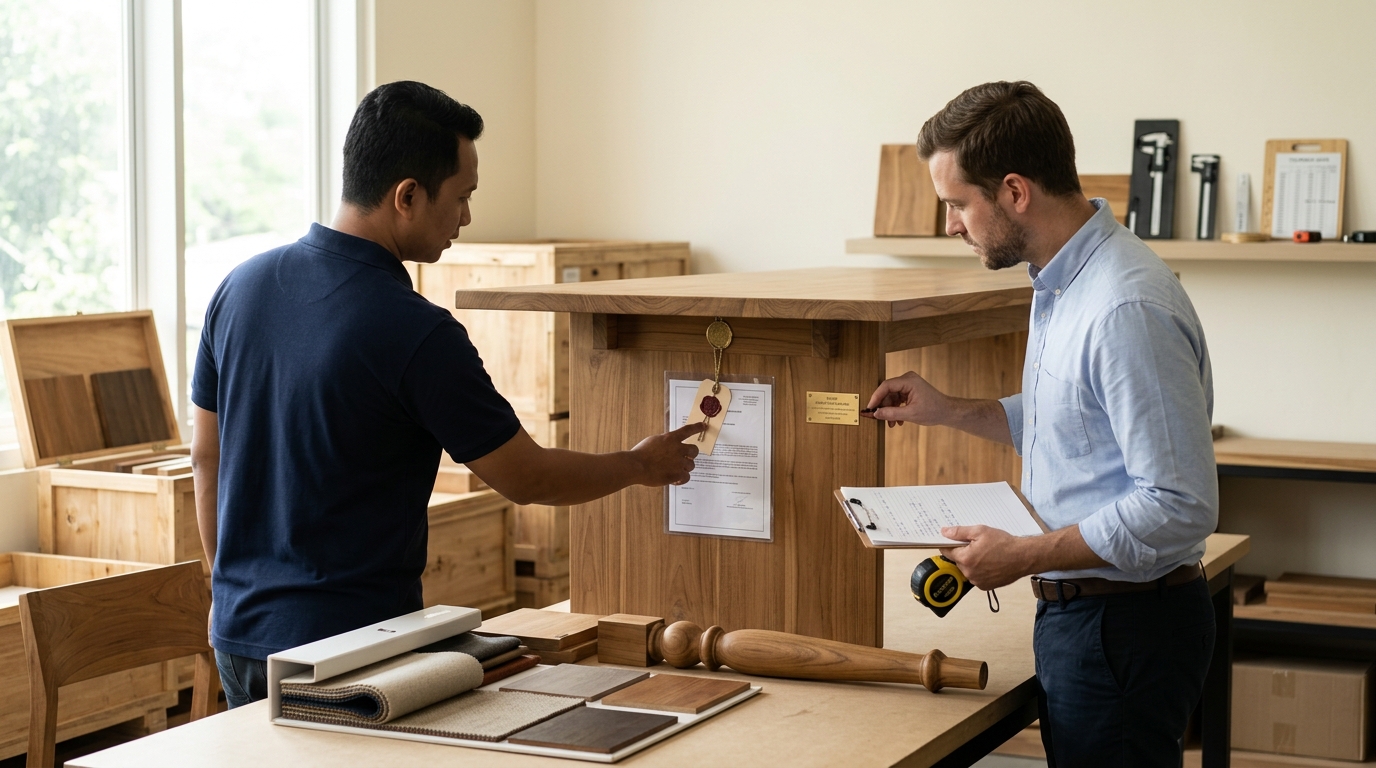
US import buyers sourcing furniture from Indonesia face a recurring problem. The approval sample looks perfect. Bulk production arrives and looks different. Finish tones shift. Joint gaps appear. Hardware gets quietly substituted. Written specifications alone cannot resolve these disputes because…
US import buyers sourcingfurniture from Indonesiaface a recurring problem. The approval sample looks perfect. Bulk production arrives and looks different. Finish tones shift. Joint gaps appear. Hardware gets quietly substituted. Written specifications alone cannot resolve these disputes because language is ambiguous and memory is selective. A physical, sealed, legally referenced golden sample eliminates that ambiguity.
This article covers the full golden sample approval furniture production quality reference workflow — from factory submission through sealing, tolerance definition, counter-sample loops, and dispute resolution. It addresses Indonesia-specific realities: tropical climate storage conditions, teak and rattan material variation, and the factory structures common in clusters like Jepara and Cirebon. Each section gives you a procedural framework you can apply directly to your purchase order and QC plan.
The stakes are high.Indonesian furnitureis globally recognized for handcrafted teak, mahogany, rattan, and resort-grade pieces. That craft tradition also means higher natural variation than automated production lines. Without a binding golden sample approval furniture production quality reference, that variation becomes your liability, not the factory's.
What Separates a Golden Sample from Every Other Reference in Furniture QC
The definition that buyers often get wrong
A golden sample is the single, final, mutually approved physical unit that becomes the contractual quality benchmark for an entire production run. It is not a pre-production sample. It is not a showroom display piece. It is the unit both parties sign off on, seal, and store as the shared authority for every quality decision that follows.
Pre-production samples are exploratory. They test whether a factory can attempt the design. A golden sample confirms that the factory has succeeded — and locks that result in place.
A limit sample is different again. It defines the outer boundary of acceptable variation, typically showing the worst finish or grain pattern a buyer will still accept. The golden sample sits at the center of that range. The limit sample defines its edges.
A counter-sample is a factory-made duplicate, produced after the golden sample is approved, to confirm reproducibility before bulk production starts. It is subordinate to the golden sample, not equivalent to it.
Why physical reference outperforms written specs in furniture
Written specifications describe. A physical sample proves. For teak furniture, a spec sheet might state "medium brown, satin finish." But medium brown in one person's reading is a different shade than in another's. A sealed golden sample eliminates interpretation.
Indonesian furnitureinvolves materials with inherent variation — teak grain patterns, rattan weave tension, hand-applied lacquer finishes. These cannot be fully captured in a document. A physical unit holds all variables simultaneously: color, texture, joinery tightness, hardware weight, upholstery tension.
US import buyers who rely on written specs alone commonly encounter what the industry calls a sample bait-and-switch: the approval sample comes from one production setup, and the bulk run shifts to cheaper materials or a subcontractor. A referenced and sealed golden sample is the primary defense against that pattern.

The Golden Sample Approval Process: Step-by-Step from Factory Submission to Buyer Sign-Off
Submission and iteration workflow
The process typically follows five stages:
1. Factory produces the first sample based on buyer-approved drawings, material specs, and finish references. 2. Buyer or third-party inspector evaluates the sample against all defined criteria. 3. Redlines are issued as a written deviation report with photos and measurements. 4. Factory produces a revised sample addressing each redline. 5. Final sign-off is issued when all criteria are met.
Iteration cycles commonly run two to four rounds for complex pieces. For a carved teak dining chair from a Jepara OEM factory, expect at least two rounds focused on joinery precision and finish uniformity.
Criteria a sample must meet to earn golden status
| Attribute | Evaluation Method | Typical Standard |
|---|---|---|
| Dimensions | Calibrated tape / digital calipers | Within ±2 mm of technical drawing |
| Finish / color | Side-by-side against color swatch | ±1 shade grade on agreed scale |
| Joinery tightness | Manual force test, visual inspection | Zero visible gaps at load-bearing joints |
| Hardware | Weight, plating, function test | Exact specification match |
| Material species | Visual + grain comparison | Confirmed match to approved material ref |
| Upholstery tension | Manual pull test | Uniform, no bubbling or puckering |
Sign-off authority and documentation
Sign-off authority should be defined in the purchase order before sampling begins. Typically:
- Buyer QC manager holds final approval authority. - Third-party inspector (if engaged) provides a formal written assessment but does not replace buyer sign-off. - Factory QA lead countersigns to confirm the sample represents reproducible production capability.
The documentation package that accompanies golden sample approval must include:
- Signed golden sample approval form with date and signatory names - Full photo report (minimum four angles, detail shots of joints and hardware) - Measurement record with actual vs. specified values - Material confirmation sheet (species, finish batch, hardware model)
This package becomes an annex to the purchase order and is referenced by number in the main PO body.
- ✓Signed approval form with buyer and factory signatories
- ✓Full photo report — minimum four angles plus detail shots
- ✓Measurement record — actual vs. spec for all critical dimensions
- ✓Material confirmation sheet — species, finish batch, hardware model
- ✓Golden sample reference number cross-referenced in purchase order body
Sealing and Storing the Golden Sample to Preserve Its Integrity in Indonesian Conditions
Physical sealing methods
Sealing prevents post-approval alteration and establishes a clear tamper-evidence record. Use the following methods in combination:
- Tamper-evident labels applied across all panel joints, drawer openings, and hardware attachment points. Any attempt to access or modify the sample breaks the label visibly. - Acrylic coating applied over finish surfaces on a designated reference panel, fixed in the approved state. This prevents refinishing or color drift on the reference surface. - Sealed bags for fabric swatches, hardware samples, and material chips attached to the unit. Each bag is labeled, dated, and co-signed. - Photo documentation of the sealed unit from all angles, with seals visible, stored in a shared cloud folder accessible to buyer and factory.
Climate-specific storage in Indonesia
Indonesia's equatorial climate creates a specific risk for golden sample integrity. Average relative humidity in Java and Bali typically exceeds 70% year-round. Fluctuating humidity causes teak and rattan to expand and contract, which can distort the reference dimensions of an unsealed sample over time.
Storage requirements for Indonesian factory conditions:
- Humidity-controlled environment: maintain relative humidity between 45% and 55% using a dehumidifier unit in the storage room. - Away from direct sunlight: UV exposure causes finish yellowing and color drift in lacquered teak surfaces within weeks. - Off the floor: elevated storage prevents moisture absorption from concrete floors. - Away from paint and finishing areas: solvent vapors can alter lacquer surfaces on the sealed sample.
Dual-custody storage protocol
No competitor addresses this directly. Dual-custody storage is the single most effective structural protection for US buyers sourcing from Indonesia.
The protocol works as follows:
- Factory retains one sealed golden sample in its humidity-controlled storage room. This is the production-floor reference used by QC inspectors during inline and pre-shipment inspection. - Buyer or buyer's designated third-party lab retains a second sealed golden sample. This unit travels to the buyer's country or is held by an independent inspection company with bonded storage in-country.
If a dispute arises, the factory cannot claim its reference sample was accidentally damaged or altered. The buyer's copy provides independent verification. Both units should carry matching reference numbers and matching seal signatures.
The retention period runs from production start through at least one full shipping cycle after final delivery — typically six to twelve months post-delivery. After that period, both parties sign off on formal decommissioning.
Defining Tolerances Against the Golden Sample for Furniture Production Quality Reference
Tolerances define how far from the golden sample a production unit can deviate and still be accepted. They should be expressed relative to the physical sample — not just against abstract written specs.
Dimensional tolerances
For solid wood furniture, a commonly applied dimensional tolerance is ±2 mm on primary structural dimensions (height, width, depth). Secondary decorative elements may carry a slightly wider tolerance, typically ±3 mm, due to hand-carving variation in Indonesian factories.
Tolerances should be measured against the golden sample directly using calibrated calipers, not recalculated from the technical drawing each time. The golden sample is the primary reference; the drawing is secondary.
Finish and color tolerances
Finish tolerances for teak furniture are typically expressed as a shade grade range. A practical method uses a numbered swatch scale agreed between buyer and factory. The golden sample occupies grade zero. Acceptable production units fall within ±1 grade.
Rattan and bamboo present a different challenge. Natural color variation is inherent. The golden sample defines the median acceptable tone, and a limit sample should show the darkest and lightest acceptable extremes. Both the golden sample and the limit samples are stored together as a reference set.
Furniture-specific attributes requiring defined tolerances
| Attribute | Expression of Tolerance | Notes |
|---|---|---|
| Wood grain pattern | Qualitative: no knots in load-bearing zones | Cannot be fully quantified |
| Color / finish tone | ±1 grade on agreed swatch scale | Use limit samples for range |
| Surface texture | No raised grain, no fisheye, no orange peel | Inspect under raking light |
| Upholstery tension | No visible sag or bubble at rest | Manual pull-test at QC |
| Joint gap | Zero visible gap at face joints | Gap gauge for concealed joints |
| Hardware finish | Match to golden sample hardware | Plating thickness test if required |
Documenting tolerances in the QC plan
Tolerances must be documented in aquality controlplan appended to the purchase order. The QC plan should state explicitly that all tolerance measurements are taken relative to the golden sample unit with reference number [X]. This language makes the golden sample legally operative — not just a physical object stored in a warehouse.
[[BLOCK:NOTE title="Tolerance Documentation Language for Purchase Orders" body="Include the following clause in your QC plan annex: 'All production units shall be evaluated against Golden Sample Reference [number], sealed on [date] and co-signed by [buyer representative] and [factory QA lead]. Tolerances apply to that physical unit as the primary reference standard.'"]]
Counter-Sample Workflows Between Buyer and Indonesian Furniture Factory
A counter-sample is a factory-produced duplicate of the approved golden sample. Its purpose is to confirm that the factory can reproduce the golden result from its production line before bulk materials are committed.
The counter-sample review loop
1. Factory receives the signed golden sample approval and begins the counter-sample build using production-grade materials and standard labor. 2. Factory ships the counter-sample to the buyer or third-party inspector with a completed counter-sample submission form. 3. Buyer or inspector performs a side-by-side comparison against the golden sample reference photos and measurement record. 4. Any deviations are logged in a written redline report. Each deviation is categorized: critical (reject), major (requires correction), minor (acceptable with note). 5. Factory addresses critical and major deviations, resubmits if required. 6. Counter-sample approval is issued in writing. This approval gates bulk material release.
Gating bulk material release
Bulk production materials — timber, hardware, fabric — should not be ordered in full until counter-sample approval is issued. For Indonesian factories in Jepara processing teak, this typically means holding the full timber allocation until the counter-sample confirms that the production setup matches the golden standard.
This gate prevents the most common Indonesian sourcing problem: a factory ordering low-grade or off-spec timber before the buyer has confirmed reproducibility.
Chain-of-custody log
Maintain a chain-of-custody log for every sample exchange. The log records:
- Sample type and reference number - Dispatch date and courier tracking number - Receiving party name and signature - Date of evaluation - Outcome (approved / redlined / rejected)
This log becomes supporting evidence if a production dispute escalates to formal negotiation or legal process.
Using the Golden Sample as Evidence in Quality Dispute Resolution
How the sealed golden sample functions as primary evidence
When a production dispute arises — and in Indonesianfurniture sourcing, disputes over finish variation or hardware substitution are common — the sealed golden sample is the primary evidence standard. Its value depends entirely on its integrity: sealed, dated, co-signed, and stored correctly.
A factory cannot credibly argue that production matches specification if a side-by-side comparison with the sealed golden sample shows visible deviation. The physical comparison is harder to dispute than a written argument about what a spec sheet meant.
Structured dispute resolution protocol
A practical protocol runs in three stages:
Stage 1 — Side-by-side factory comparison. The buyer's representative or third-party inspector conducts an on-site comparison of disputed production units against the factory-held sealed golden sample. Deviations are photographed and measured.
Stage 2 — Third-party inspection report. An independent inspection company issues a written deviation report referencing the golden sample by number. The report categorizes each deviation and states whether the production lot meets the contractual quality reference.
Stage 3 — Written resolution. Both parties sign a deviation resolution document specifying whether the lot is accepted, reworked, or rejected, and who bears the cost.
Common dispute scenarios in Indonesian furniture sourcing
- Finish variation: Teak lacquer shifts color between the approval sample and bulk production due to batch changes in the lacquer formulation. The golden sample's sealed acrylic reference panel shows the approved tone clearly. - Joint gaps: Hand-carved joinery in Jepara factories can vary between craftsmen. The golden sample establishes the maximum acceptable gap. The gap gauge used at QC is calibrated against the golden sample measurement record. - Hardware substitution: A factory substitutes a lower-grade hinge or handle when the specified part becomes unavailable. The golden sample's sealed hardware bag holds the approved original. Any deviation is immediately visible.
Contractual language that makes the golden sample legally binding
The golden sample must be explicitly referenced in the purchase order to carry legal weight. Recommended language includes:
- Main PO body: "Production quality shall conform to Golden Sample Reference [number], dated [date], sealed and stored per the Golden Sample Storage Protocol annexed hereto." - Annex: the signed approval form, photo report, and measurement record. - Payment clause: "Final payment installment is conditional on pre-shipment inspection confirming conformance to Golden Sample Reference [number]."
This structure makes the golden sample enforceable as a contractual document, not merely a physical object.
Integrating Golden Sample Approval Into Your Ongoing Inspection Workflow
How QC inspectors use the golden sample at each inspection stage
The golden sample approval furniture production quality reference should be active at every inspection gate:
- During production (DUPRO inspection): Inspector visits the factory mid-production and compares in-process units against the golden sample. Finish and joinery are the priority checks at this stage. - Pre-shipment inspection (PSI): Inspector draws an AQL sample from the finished lot and compares each unit against the golden sample reference photos and measurement record. AQL inspection for furniture typically applies ISO 2859 / ANSI/ASQ Z1.4 sampling tables. Critical defects typically carry a zero acceptance number; major defects commonly use AQL 2.5; minor defects use AQL 4.0. - Container loading inspection (CLI): Inspector spot-checks cartons as they load and confirms sealed carton markings match the approved golden sample reference number.
Re-validation triggers for the golden sample
A golden sample does not govern production indefinitely. Re-validation is required when:
- Design update: Any change to dimensions, finish spec, or hardware model requires a new sample cycle. - Material substitution: If teak sourcing shifts from one certified supplier to another, the grain and color baseline may change. A new golden sample confirmation is needed. - Factory line change: If the factory moves production to a different workshop, shifts craftsmen, or subcontracts a component, the golden sample re-validation cycle should be triggered. - Time lapse: For programs running longer than approximately twelve months, a re-validation check is prudent even without explicit design changes.
Digital photo documentation for remote QC teams
Not all buyers can send a representative to Indonesia for every inspection. High-resolution photo documentation of the sealed golden sample — standardized lighting, consistent angles, ruler in frame — allows remote QC teams to make reliable comparisons against inspector-submitted photos.
Recommended digital documentation set:
- Minimum eight angles, including top, underside, and all four sides - Close-up of each joint type - Close-up of each hardware piece against the sealed hardware bag - Color reference shot alongside the approved swatch card - All photos stored in a shared folder referenced in the QC plan
This digital record does not replace the physical golden sample. It supports remote teams and accelerates pre-shipment approval when inspectors are working across multiple factories simultaneously.
A well-executed golden sample approval furniture production quality reference locks your standard before a single bulk unit is produced. It gives your QC team a physical anchor for every inspection decision, and it gives your purchase order genuine contractual teeth when production deviates. Seal it properly, store it in dual custody, define your tolerances explicitly, and reference it by number in every inspection report and payment condition.
You now have the full framework for making a golden sample stick as a binding contractual reference — from approval through dispute resolution. The next step is applying it systematically before your next production run begins. Download our Golden Sample Approval Checklist to capture every sealing, storage, tolerance, and counter-sample checkpoint in one structured document.
Download the Golden Sample Approval Checklist →Ready to formalise a golden-sample workflow for your next production run? Contact the MTS team for a QC framework tailored to your specifications and a project quote.
Need eyes on the ground in Indonesia?
MTS is an execution partner — supplier verification, manufacturing management, quality control and export logistics across Indonesia, Vietnam and China.
Related services
Related articles
Receive furniture sourcing insights across Asia.
One email per week. No spam.