OEM Furniture FOB Indonesia: Full Cost Breakdown for Buyers
14 min read
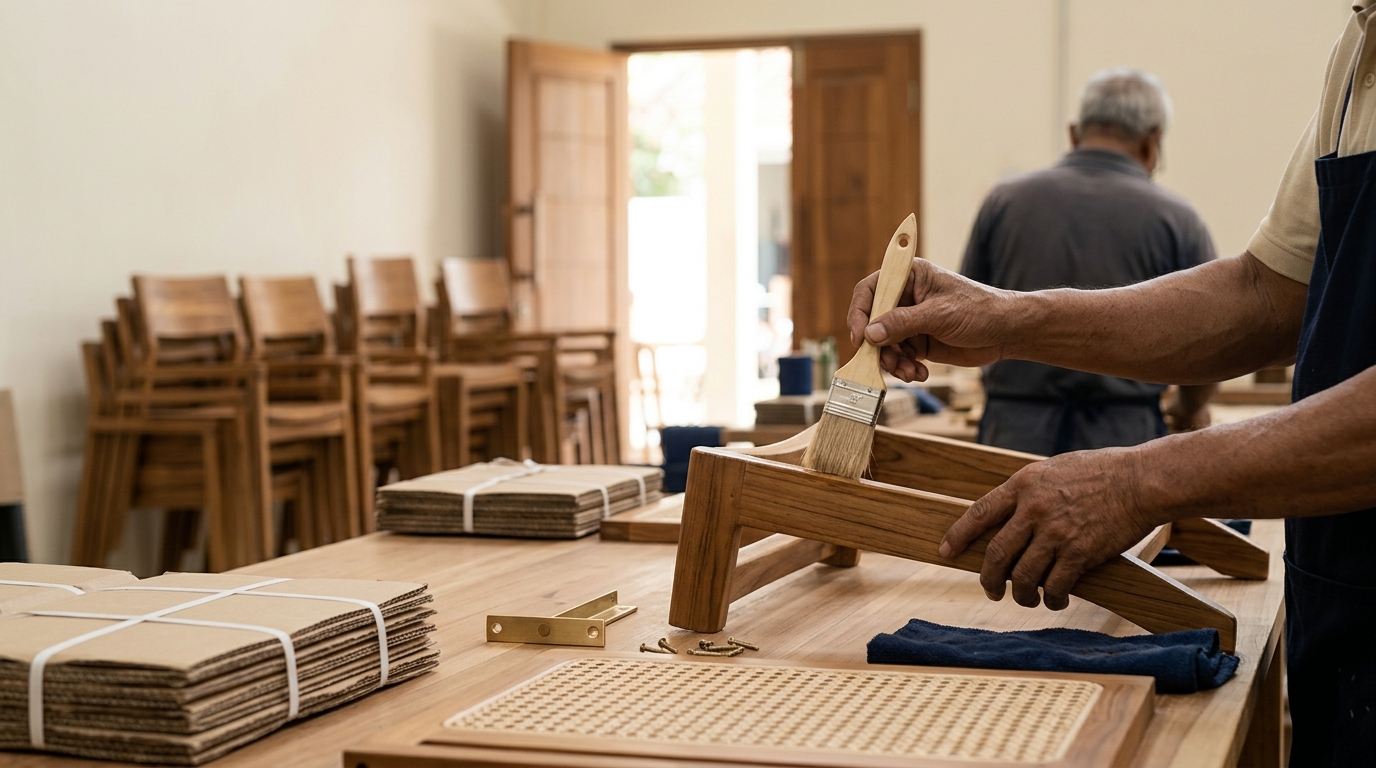
Sourcing OEM furniture from Indonesia means negotiating a FOB price that bundles six or seven distinct cost layers into a single number. Most buyers accept that number without knowing what's inside it. That is a costly mistake — literally.
Sourcing OEMfurniture from Indonesiameans negotiating a FOB price that bundles six or seven distinct cost layers into a single number. Most buyers accept that number without knowing what's inside it. That is a costly mistake — literally.
This article breaks every component of an Indonesian FOB furniture quote into its constituent parts: raw materials, labour by production centre, finishing, packaging, factory overhead, and margin. It covers the regulatory touchpoints — SVLK, FSC, ISPM 15, UMR — that move those numbers in predictable ways.
The goal is not to help you squeeze factories unfairly. It is to help you make smarter specification choices, distinguish padded quotes from legitimate ones, and build supplier relationships based on shared cost transparency. All figures below are illustrative approximations drawn from published market reference ranges. Treat them as directional anchors, not guarantees.
Illustrative FOB Cost Breakdown: Three OEM Scenarios Side by Side
Before diving into individual cost drivers, here is the complete picture. All figures are approximate and illustrative only. Actual costs will vary by factory, volume, spec complexity, and market conditions.
| Cost Component | Scenario A: Solid Teak Dining Chair (Jepara, 500 units) | Scenario B: Upholstered Nightstand (Cirebon, 300 units) | Scenario C: Rattan Accent Chair with Metal Frame (Bali, 200 units) |
|---|---|---|---|
| Raw Materials | $45–$60 | $38–$52 | $30–$45 |
| Labour | $20–$30 | $18–$28 | $22–$35 |
| Finishing / Coating | $8–$14 | $6–$10 | $5–$9 |
| Packaging (incl. ISPM 15) | $5–$9 | $5–$8 | $6–$10 |
| Factory Overhead | $8–$12 | $7–$11 | $8–$13 |
| Factory Margin (8–12%) | $8–$13 | $7–$11 | $7–$11 |
| **Estimated FOB Total** | **$94–$138** | **$81–$120** | **$78–$123** |
All figures in USD per unit. Illustrative only. Does not include ocean freight, insurance, import duties, or US inland logistics.
Why FOB Indonesia Is the Standard Pricing Basis for OEM Furniture Orders
FOB — Free On Board — means the seller delivers goods onto the nominated vessel at the named Indonesian port. Risk and cost transfer to the buyer at that point. The factory price includes everything up to and including loading. It excludes ocean freight, marine insurance, destination port charges, import duties, and US inland transport.
Indonesian OEM factories quote FOB almost universally for two reasons. First, they have no control over freight markets or destination-country logistics costs. Second, FOB aligns with how buyers consolidate shipments: many buyers mix SKUs from multiple factories into a single container, so freight is handled at the buyer's end.
EXW (Ex Works) is occasionally quoted by smaller workshops, but it shifts customs export paperwork to the buyer — creating complications when the factory lacks a formal export licence. Some export companies and merchant exporters handle this for smaller Jepara or Cirebon workshops, acting as the legal exporting entity on the bill of lading.
CIF pricing is rare in direct-factory OEM relationships. Factories that quote CIF are typically trading companies adding a freight markup. For direct-factory sourcing, FOB is cleaner and more auditable.
What FOB does not cover matters as much as what it does. Buyers sometimes assume anti-dumping duties, fumigation at destination, and US Customs clearance fees are folded in. They are not. The oem furniture cost breakdown fob indonesia framework covers only the factory-side components that land inside the FOB price.
Raw Materials: The Largest Single Driver of Your FOB Unit Price
Material cost typically represents 40–55% of the FOB price for solid-wood furniture. It is the most visible lever — and the most misunderstood.
Wood Species and Grade Selection
Indonesian furnitureexports are built around three primary species:
- Teak (Tectona grandis): Premium, naturally oily, highly durable. Plantation teak is the dominant legal source. Kiln-dried plantation teak commands the highest material cost in the Jepara market. Grade A heartwood carries a significant premium over mixed grain. - Mahogany: Lighter colour, easier to work, lower cost than teak. Common in mid-market bedroom and dining categories. - Suar wood (rain tree): Distinctive grain, increasingly popular in live-edge and casual dining. Competitively priced relative to teak.
Engineered alternatives — teak-plywood hybrids, MDF cores with veneer faces — can reduce material cost substantially per unit. The trade-off is in durability, moisture resistance, and perceived value on the retail floor.
Certification Costs: SVLK and FSC
SVLK (Sistem Verifikasi Legalitas Kayu) is Indonesia's mandatory timber legality verification system. All wood furniture exported from Indonesia must comply. SVLK is not optional — it is a regulatory baseline, not a premium. However, FSC certification sits above SVLK and does carry a cost premium, typically in the range of a few dollars per unit depending on species volume and factory throughput.
Moisture Content: A Hidden Quality Cost
Full-cycle factories with on-site kiln-drying facilities dry timber to 8– approximately 12% moisture content (MC). This is non-negotiable for furniture destined for US and European interiors with central heating or air conditioning. Assembly-only operations that source pre-cut panels from third parties often cannot verify MC at the point of processing.
Veneer, Plywood, and Hardware
Veneer-over-plywood constructions reduce solid-wood content and cost. The quality of the substrate — whether it is CARB2-compliant for formaldehyde emissions — matters for US import compliance. Hardware (hinges, drawer slides, pulls) is often quoted as a lump sum inside materials. In practice, hardware sourcing in Indonesia draws heavily on Chinese component imports, which makes it sensitive to exchange rate fluctuations.
Labour Costs Across Jepara, Cirebon, and Bali: What Buyers Actually Pay
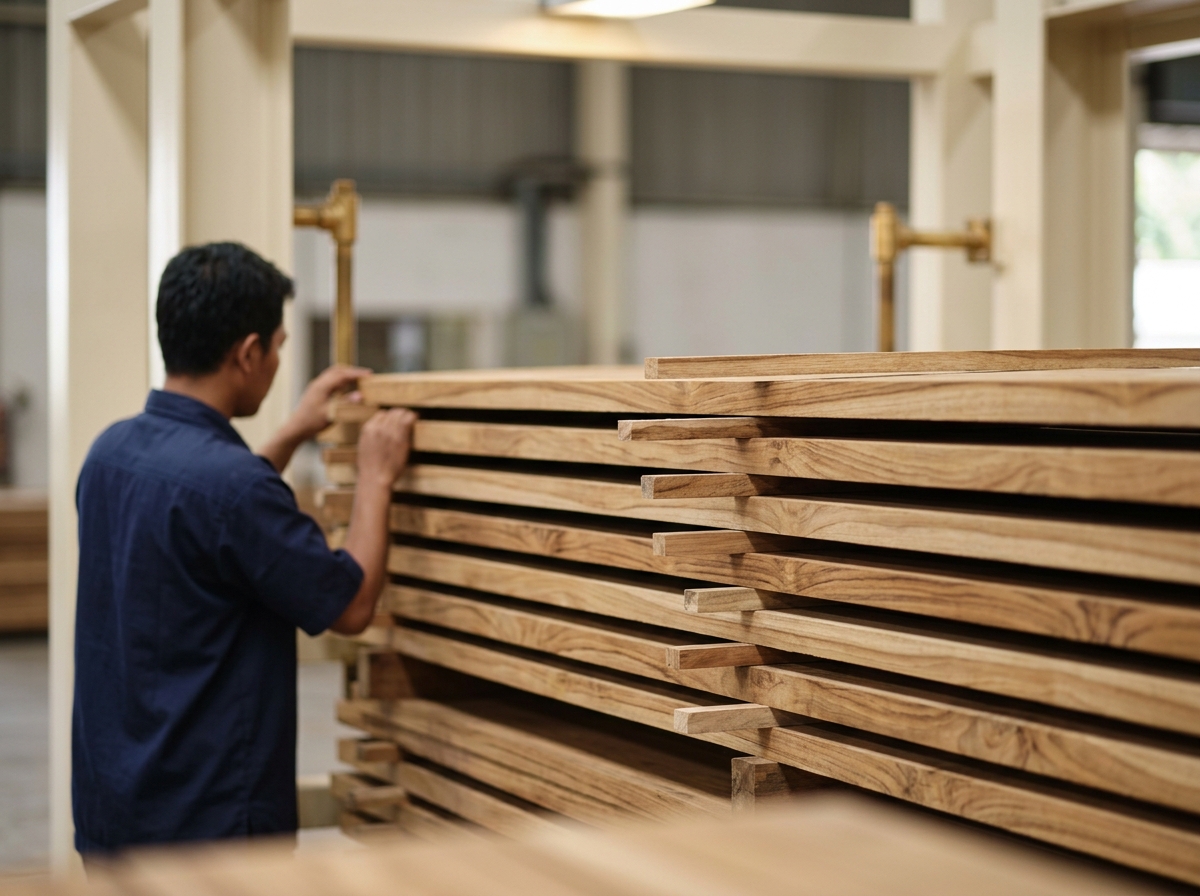
Labour is typically the second-largest FOB cost component, representing roughly 18–28% of the unit price for mid-market solid-wood furniture.
Regional Wage Benchmarks and UMR
UMR (Upah Minimum Regional) — Indonesia's regional minimum wage — is set annually by provincial governments. Jepara (Central Java), Cirebon (West Java), and Bali each operate under different UMR levels. Bali's tourism economy historically drives a higher cost of living and higher wage floors compared to Jepara. Cirebon sits in between.
UMR increases have been consistent in real terms over recent years. Buyers with multi-year sourcing programmes should model a gradual labour cost escalation into their FOB price projections — typically in the range of single-digit percentage increases annually, though this varies by province and policy cycle.
Joinery Complexity and the Skill Premium
Traditional mortise-and-tenon and dovetail joinery requires experienced craftspeople and significantly more time per unit than CNC-routed butt joints or cam-lock assembly. The labour premium for hand-cut joinery is real and material. For a teak dining chair with through-tenon construction, expect labour to sit at the higher end of the range.
CNC routing reduces variability and can lower per-unit labour cost, but it requires capital equipment that smaller Jepara workshops often lack. Mid-size OEM factories with CNC capacity can offer a better labour cost structure on complex profiles than pure artisan workshops.
Order Volume and Per-Unit Labour Allocation
Labour cost per unit is not fixed. At 200 units, a factory absorbs setup and jig-building time across fewer pieces. At 500 units, that amortisation drops meaningfully. The cost scenarios in the table above reflect this: Scenario A (500 units, Jepara) benefits from better labour efficiency than Scenario C (200 units, Bali).
Finishing, Coating, and Surface Treatment: A Direct Cost Lever for Buyers
Finishing cost is often underestimated. It can represent 6– approximately 12% of the FOB price and is one of the most controllable cost levers in the specification process.
Coating Types and Their Cost Implications
| Finish Type | Approximate Cost Position | Durability | Common Application |
|---|---|---|---|
| Nitrocellulose lacquer | Lower | Moderate | Indoor residential |
| Water-based lacquer | Mid | Good | US market, low-VOC preference |
| UV-cured coating | Higher | Excellent | High-traffic / contract |
| Oil / wax finish | Mid | Moderate | Teak, natural look |
| Polyurethane | Mid-to-high | Very good | Indoor/outdoor crossover |
Each additional coat of sealer, base coat, or topcoat adds material and labour time. A three-coat system costs more than a two-coat system — but offers meaningfully better protection. Define your coat sequence in the technical specification, not in conversation.
Anti-Termite and Anti-Fungal Treatment
Export-gradefurniture from Indonesiashould include anti-termite and anti-fungal treatment, particularly for solid wood destined for subtropical US markets. This adds a measurable cost per unit. Some factories include it as standard; others treat it as a line-item add-on. Confirm inclusion in writing.
Custom Colour and Distressed Finishes
Custom RAL/Pantone colour matching, multi-step aged finishes, or wire-brushed textures each add finishing labour time and material cost. A standard walnut stain is cheaper than a three-stage hand-applied distressed finish by a meaningful margin. If your range includes multiple colourways, consolidating to fewer standard finishes will reduce per-unit cost.
Packaging, Export Crating, and ISPM 15 Compliance Costs Inside the FOB Price
Packaging typically represents 5–10% of the FOB price. It is often the least scrutinised line item — and a source of hidden cost variation.
Standard Carton vs. Custom Crating
Most mid-market OEM orders ship in double-wall corrugated cartons with internal foam corner protection. Custom foam-in-place packaging or bespoke wooden crating adds cost but reduces transit damage claims — a genuine ROI calculation for fragile or high-value items.
ISPM 15: A Regulatory Cost Buyers Must Budget Separately
ISPM 15 (International Standards for Phytosanitary Measures No. 15) requires all solid wood packaging materials — pallets, crates, dunnage — to be heat-treated or fumigated and marked with the IPPC stamp. This is mandatory for US import.
Knock-Down vs. Assembled Packaging
KD (knock-down) packaging allows more units per container. A 40-foot container that holds 200 assembled dining chairs might hold 350+ in KD format. The trade-off is assembly complexity at destination and potential quality risk at the joint. For hospitality procurement at scale, KD packaging with professionally engineered assembly instructions can materially reduce per-unit landed cost.
Labelling and Documentation
Barcoding, country-of-origin labelling, and compliance documentation (packing lists, certificates of origin, SVLK V-Legal documents) are absorbed into the FOB price by most established OEM factories. For first-time buyers, confirm this explicitly. Trading companies sometimes charge separately for documentation handling.
What Hides Inside the FOB Quote: Factory Overhead Allocation Explained
Overhead is the least transparent cost component in any oem furniture manufacturing cost indonesia analysis. It typically ranges from 8–15% of total unit cost, varying significantly by factory type and size.
A small Jepara workshop with 15–30 workers allocates overhead informally — the owner's time, electricity, and tool maintenance are rarely itemised. A mid-size OEM factory with 100–300 workers, a formal QC department, and ISO or BSCI certification allocates overhead systematically across production lines.
Overhead components buyers should understand:
- Facility cost: Rent or depreciation on factory space - Utilities: Electricity for CNC, compressors, spray booths, kilns - QC department: In-line inspection, final QC, sampling - Design and sample development: Amortised across production runs for custom OEM specs - Tooling and jig fabrication: First-order cost for new profiles or joinery details
Pre-shipment inspection (PSI) by a third-party QC firm (SGS, Bureau Veritas, or similar) is sometimes folded into the FOB quote by the factory. More commonly, it is a separate buyer-side cost. Clarify this in your commercial terms.
Factory Margin and Profit Structure: Reading an Indonesian FOB Quote Accurately
Net factory margin on OEM furniture in Indonesia typically runs 5–15%, with the majority of established mid-size OEM factories operating in the 8–12% range. Smaller workshops may accept lower margins to fill capacity; larger factories with strong order books hold firmer.
What Compresses Margin Legitimately
- Volume commitments: 500-unit MOQs attract better pricing than 100-unit trials - Repeat order history: Factories price new customers cautiously; proven buyers get tighter quotes - Payment terms: approximately 30% deposit / 70% before shipment is standard; earlier payment can soften price - Long-term supply agreements (LTA): Multi-season commitments allow factories to pre-order materials in volume, reducing their own input costs — savings they can share
Trading Company vs. Direct Factory: The Markup Layer
A trading company or merchant exporter sourcing from Jepara workshops adds a markup layer — typically 10–20% above ex-factory price — to cover their coordination, documentation, and consolidation services. For buyers without Indonesia-based operations or sourcing agents, this layer may be worth the cost. For buyers with the volume and infrastructure to go direct, it represents recoverable margin.
Red Flags and Green Flags in a Quote
Red flags: Materials quoted at a fixed round number regardless of species grade; labour at implausibly low levels; overhead absent entirely from the cost sheet; margin claimed to be under 5% for a standard order.
Green flags: Itemised cost sheet with line-by-line breakdown; willingness to discuss material sourcing; factory can provide SVLK documentation, moisture content records, and kiln logs.
How Specification Choices Move Each FOB Cost Component
Every design decision you make before signing a purchase order is a cost decision. The oem furniture cost breakdown fob indonesia framework becomes most valuable when applied at the specification stage.
- Material substitution: Replacing solid teak throughout with a teak-face / engineered-core hybrid can reduce material cost by 20– approximately 35% depending on the profile. Visible surfaces retain the premium aesthetic; internal structural members use cost-efficient engineered wood. - Joinery simplification: Eliminating a through-tenon detail in favour of a mortise-and-tenon blind joint reduces labour time without compromising structural integrity for most residential applications. - Hardware standardisation: Specifying the same hinge and slide across multiple SKUs in a range enables volume purchasing from a single hardware supplier — a direct unit cost reduction. - Finishing coats: Reducing from a five-coat to a three-coat system (sealer + base + topcoat) lowers finishing cost visibly. Audit whether the fifth coat is genuinely adding durability or was specified by habit. - Colour consolidation: Fewer colourways mean longer production runs per colour, less booth cleaning time, and lower per-unit finishing cost.
Cost-Engineering Levers That Reduce FOB Price Without Compromising Quality
- ✓Itemised cost sheet with materials, labour, finishing, packaging, overhead, and margin as separate line items
- ✓Wood species, grade, and moisture content specification in writing
- ✓SVLK V-Legal document number and FSC chain-of-custody certificate (if applicable)
- ✓Hardware brand and model specification
- ✓Finishing schedule: number of coats, product names, dry-film thickness targets
- ✓Overhead percentage and basis of allocation
- ✓Payment term sensitivity: ask how a 50/50 or 40/60 split affects unit price
- ✓MOQ sensitivity: request pricing at 200, 500, and 1,000 units to understand volume curves
MOQ and Container Optimisation
A 40-foot container loaded efficiently is one of the most powerful cost levers in furniture sourcing. Work backwards from container cubic metre capacity to your SKU dimensions. Consolidating SKUs into a single full-container load (FCL) reduces per-unit freight cost and often qualifies you for better factory pricing than a partial load (LCL).
Seasonal Ordering and Off-Peak Capacity
Indonesian furniture factories — particularly in Jepara and Cirebon — run at higher capacity utilisation in Q1 and Q3 as they fulfil trade show and retail season orders. Placing orders for Q2 or Q4 delivery can access idle capacity at softer rates. Not all factories offer this flexibility; those that do often signal it as a negotiable point.
Long-Term Supply Agreements
An LTA — even an informal letter of intent committing to quarterly orders over 12– approximately 24 months — changes the factory's cost structure. They can forward-buy timber at better rates. They can dedicate a production line and avoid setup costs on each order. The resulting savings are shareable. Buyers who treat each order as a spot transaction leave this value on the table.
Open-Book Costing: The Most Underused Negotiation Tool
Open-book costing means requesting an itemised cost sheet from the factory and negotiating on component lines rather than on the total FOB number. Most Indonesian OEM factories with genuine export experience will engage with this approach — particularly if you frame it as a long-term partnership conversation rather than an adversarial audit.
Buyer FAQs: What Indonesian FOB Furniture Pricing Actually Means in Practice
What does FOB Indonesia actually include and exclude in a furniture quote? FOB includes all manufacturing costs, packaging, inland transport to the named Indonesian port, export customs clearance, and loading onto the vessel. It excludes ocean freight, marine insurance, destination port fees, US Customs duties, and inland US logistics.
How do I verify a factory's cost breakdown is accurate and not inflated? Request an open-book cost sheet (see checklist above). Cross-reference material costs against published timber market rates for the species and grade. Commission an independent pre-shipment inspection and, for strategic suppliers, a physical factory audit that verifies kiln-drying capacity, QC systems, and workforce scale against the quoted labour cost.
What is a realistic FOB price range for a solid teak dining chair from Indonesia in 2025–2026? Based on indicative market data, a mid-market solid teak dining chair from a reputable Jepara OEM factory at 500-unit MOQ typically falls in the $94–$138 FOB range (see Scenario A table above). Premium hand-carved or designer-profile chairs will sit higher.
How much does SVLK or FSC certification add to the FOB unit cost? SVLK is a regulatory baseline — it is built into legal Indonesian timber sourcing and does not typically appear as a separate line item.
Can I negotiate open-book costing with Indonesian OEM furniture factories? Yes — and it is more common than competitors suggest. Established OEM factories with US or European export history are accustomed to professional buyers who request itemised cost sheets. Frame it as a prerequisite for a long-term relationship, not as distrust.
How does trading-company sourcing compare to direct-factory FOB pricing in Indonesia? A trading company or merchant exporter typically adds 10–20% above the direct-factory FOB price. For buyers without Indonesian sourcing infrastructure or language capability, this cost may be justified. For buyers placing significant volume with auditable factories, direct sourcing recovers that margin.
The Bottom Line on Indonesia OEM Furniture FOB Cost Breakdown
Understanding the oem furniture cost breakdown fob indonesia is not a theoretical exercise — it is a sourcing management discipline. Every specification decision, from wood species and joinery type to finishing coats and packaging format, has a quantifiable cost impact inside the FOB price. Buyers who can read a factory quote at the component level negotiate from a position of knowledge rather than hope.
Apply the open-book costing approach from the first meaningful order. Build LTA structures once a factory has proven its quality consistency. Model UMR trajectory into multi-year cost plans. These are the levers that protect your margin and your quality simultaneously.
You now have the framework to dissect any Indonesian OEM furniture FOB quote line by line. The natural next step is applying it to your specific product range with factory-level data.
Share your product specifications and target FOB price. Our team will provide a component-level cost audit benchmarked against current Jepara, Cirebon, and Bali market rates — so you negotiate with accurate data, not assumptions.
Request Your FOB Cost Audit →Need eyes on the ground in Indonesia?
MTS is an execution partner — supplier verification, manufacturing management, quality control and export logistics across Indonesia, Vietnam and China.
Related services
Related articles
Receive furniture sourcing insights across Asia.
One email per week. No spam.