Furniture Container Consolidation Indonesia Multiple Suppliers: A Complete Import Guide
14 min read
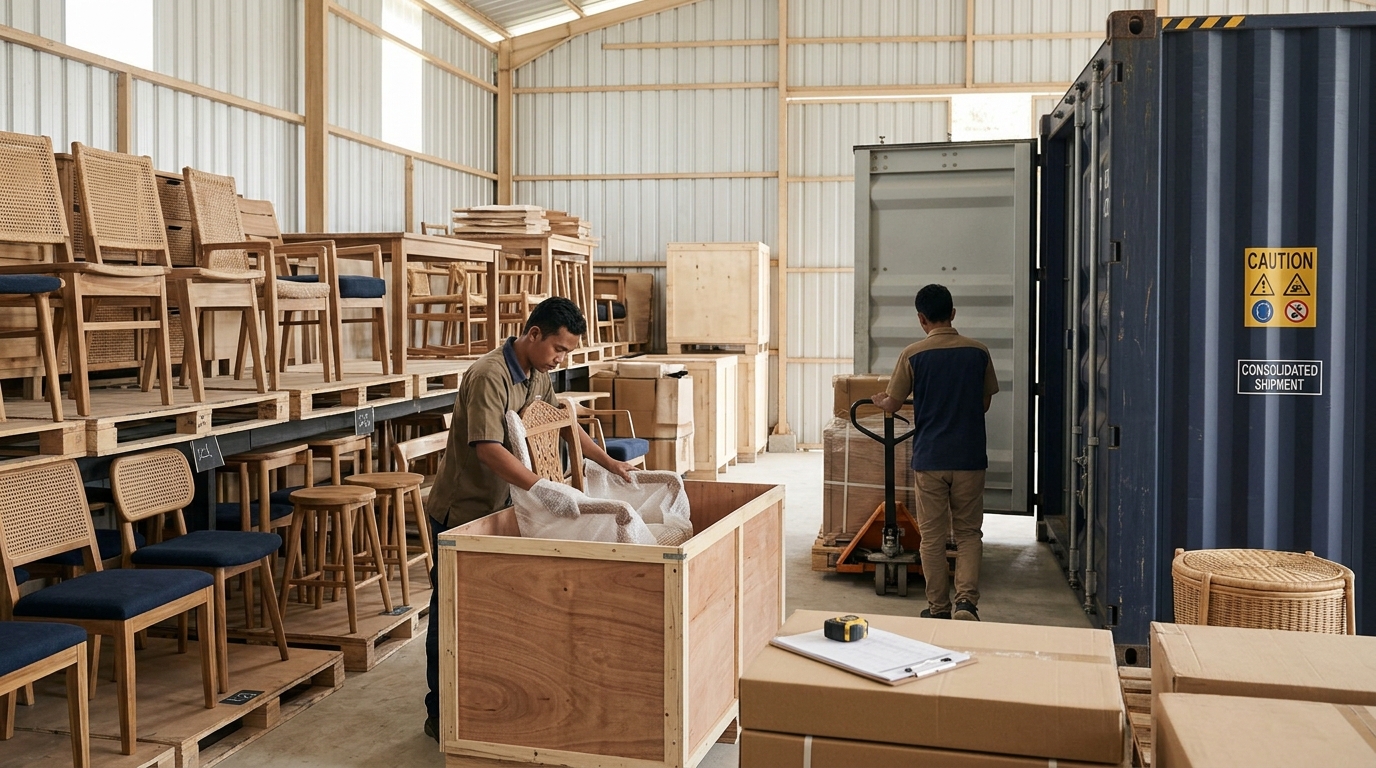
Sourcing furniture from Indonesia means working with multiple workshops. Jepara carves solid teak. Cirebon weaves rattan. Semarang produces outdoor pieces. Each supplier operates on its own production schedule, packs to its own standards, and issues its own documentation. Shipping each order…
Sourcingfurniture from Indonesiameans working with multiple workshops. Jepara carves solid teak. Cirebon weaves rattan. Semarang produces outdoor pieces. Each supplier operates on its own production schedule, packs to its own standards, and issues its own documentation. Shipping each order separately is expensive and operationally chaotic.
Furniture container consolidation Indonesia multiple suppliers solves this directly. Instead of booking three or four Less than Container Load (LCL) shipments, you combine all orders at a single consolidation warehouse, stuff one Full Container Load (FCL), and move it under one set of export documents. The result: lower ocean freight per cubic meter, fewer customs entries, and a cleaner supply chain.
This guide covers every operational layer of that process — warehouse workflow, CBM planning, packing standards, SVLK and ISPM-15 compliance, documentation, cost mechanics, partner selection, and delay prevention. It is written for US-based importers who are actively evaluating consolidation as a sourcing strategy, not exploring it in theory.
How Indonesian Furniture Container Consolidation Works — and Why It Saves Money
The difference between LCL and FCL in practice
An LCL shipment moves your cargo inside a shared container alongside goods from unrelated shippers. You pay per cubic meter (CBM). A freight forwarder at origin groups multiple LCL consignments, stuffs one FCL, and deconsolidates at destination.
An FCL consolidation is different. You book the entire container. Your consolidation agent collects cargo from your specific Indonesian suppliers, stages it at a private warehouse, and stuffs one container exclusively with your goods. You control the load plan, the inspection sequence, and the documentation set.
For importers sourcing from multiple small-to-mid-size Indonesian workshops, FCL consolidation consistently outperforms multiple LCL bookings once total order volume exceeds approximately 12–15 CBM. Below that threshold, LCL may still be justified. Above it, you are effectively subsidizing a freight forwarder's container utilization without capturing the savings yourself.
Why Indonesian furniture buyers benefit most
Indonesia's production base is highly fragmented. Jepara alone hosts hundreds of small carvers and solid-wood workshops. Cirebon's rattan producers typically operate as family cooperatives. Most cannot fill a 20-foot container (approximately 25–28 CBM usable) on their own. Ordering from three to five suppliers simultaneously is standard practice for US importers building a mixed SKU range — teak dining sets, rattan accent chairs, carved sideboards, outdoor teak benches.
Sending each order separately generates: multiple ocean freight bookings, multiple inland trucking legs, multiple sets of export documents, multiple US Customs entries, and multiple demurrage risks. Furniture container consolidation Indonesia multiple suppliers eliminates all of that duplication.
Inside the Consolidation Warehouse: Step-by-Step Workflow From Supplier to Container
Pickup, intake, and quality check
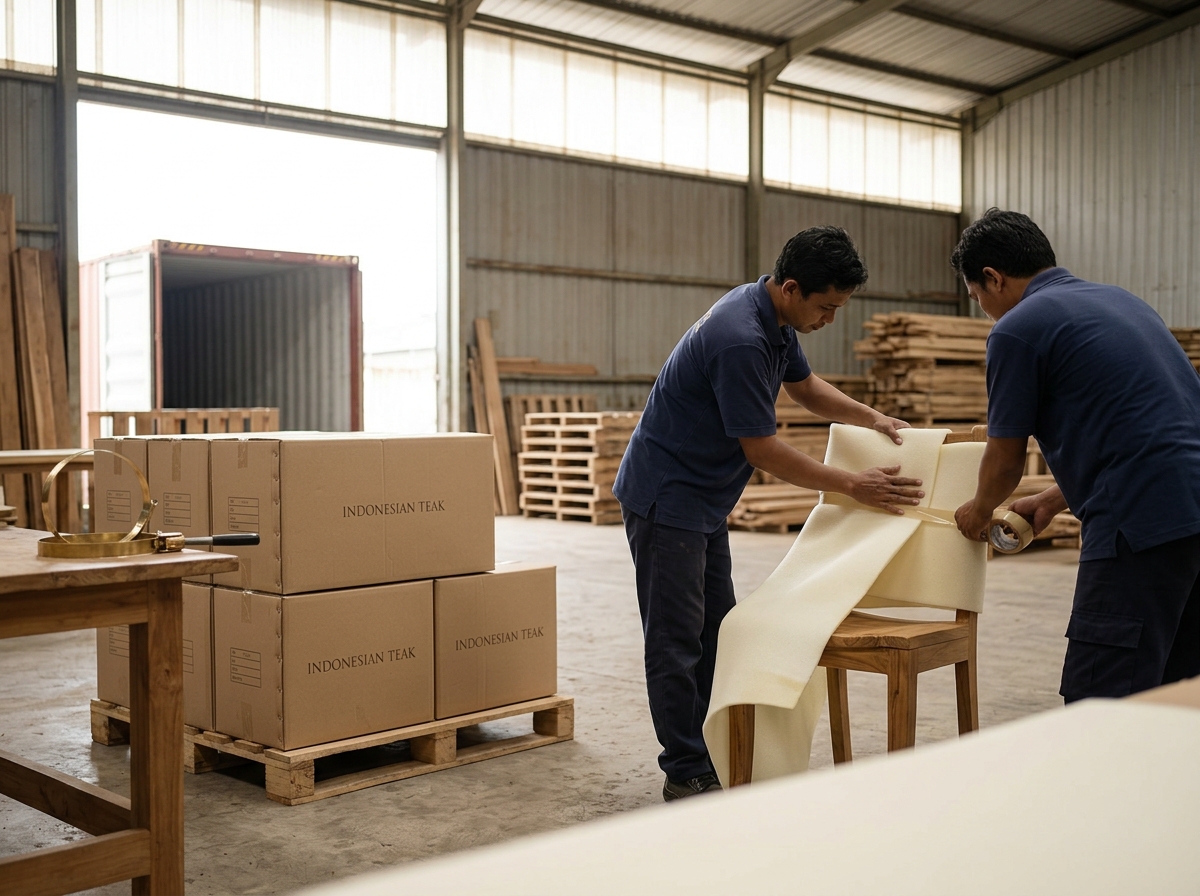
The first stage of the process is inland collection. Your consolidation agent coordinates truck dispatches to each supplier location — whether that is Jepara, Cirebon, Semarang, or another production center. When goods arrive at the consolidation warehouse, they are accompanied by supplier packing lists and pro-forma invoices, which warehouse staff then verify against your purchase orders line by line.
A visual quality check follows intake. This is not a full pre-shipment inspection (PSI), but it catches obvious damage, wrong finishes, or missing items before they enter the staging area. Any discrepancy is flagged immediately to the importer.
Palletizing, packing, and container stuffing
Once all supplier orders have cleared intake, the warehouse team builds the load plan. Items are palletized or floor-loaded according to weight, fragility, and CBM allocation. Heavier items — solid teak tables, marble-top consoles — go in first and against the container walls. Lighter, fragile pieces — rattan chairs, carved decorative panels — are positioned last and protected with foam and cardboard corners.
Container stuffing at Indonesian export hubs — Tanjung Priok (Jakarta), Tanjung Emas (Semarang), or Tanjung Perak (Surabaya) — typically follows a fumigation step if ISPM-15 treatment has not been completed at the supplier level.
Typical turnaround and staging windows
From first supplier delivery to container ready date (CRD), a well-managed consolidation warehouse in Indonesia typically needs 5–10 working days for staging, final packing, and documentation preparation. Allow additional time if any supplier delivers late or if fumigation must be arranged at the warehouse rather than at the factory.
Planning a Mixed Container Load Across Multiple Indonesian Suppliers
CBM allocation and container selection
When floor-loaded, a standard 20-foot container provides roughly 25–28 CBM of usable space. The 40-foot standard container brings that figure up to approximately 55–60 CBM. For tall case goods or bulky upholstered pieces, the 40-foot high-cube is typically the preferred option, offering approximately 67–72 CBM of capacity.
To allocate CBM per supplier, request a dimensional packing list from each one before production ends. Calculate length × width × height for each carton, multiply by quantity, and sum per supplier. Add 5–8% buffer for dunnage and structural bracing. If total CBM falls between 28 and 40 CBM, consider whether a 40-foot container with partial fill is still cheaper than two LCL bookings — it often is, once you factor in LCL handling surcharges.
Sequencing production timelines
This is where most consolidation plans fail. Supplier A finishes teak tables in approximately 45 days. Supplier B needs approximately 60 days for upholstered rattan sofas. Supplier C delivers carved panels in approximately 30 days. If you book a single container ready date based on the fastest supplier, Suppliers B and C will miss it.
Map each supplier's confirmed production completion date against the target CRD. Set the CRD at least 7 days after the slowest confirmed completion date. Build a shared production tracker — even a simple spreadsheet with weekly check-ins — and require photo confirmation at key milestones: frame completion, finishing, packing.
Managing SKU variety: teak, rattan, upholstered, carved wood
Mixed-material containers require careful load sequencing. Key rules:
- Teak and solid wood: heaviest, most structurally rigid — load first - Upholstered pieces: susceptible to compression — never stack anything on top - Rattan and woven pieces: fragile frames — wrap individually, load last - Carved decorative panels: high surface-damage risk — use full foam wrapping and rigid corner bracing
Packing Standards Every Supplier Must Meet Before Consolidation
ISPM-15: phytosanitary compliance for wood packaging
ISPM-15 (International Standards for Phytosanitary Measures No. 15) applies to all wood packaging materials — including pallets, crates, and dunnage — imported into the United States, making compliance mandatory rather than optional. When wood packaging does not meet ISPM-15 standards, CBP has the authority to place a hold on the shipment, require re-export, or order destruction at the US port of entry.
Wood packaging must undergo heat treatment or methyl bromide fumigation and bear the official IPPC stamp, which displays the country code, producer code, and treatment method (HT or MB). Each supplier in Indonesia is individually responsible for ensuring their own packaging meets ISPM-15 requirements. If even one supplier's materials fail to comply, the entire container is at risk of being held.
Individual item packing specifications
Each item should meet these minimum standards before leaving the supplier:
- Foam wrapping: minimum 10mm EPE foam on all finished surfaces - Cardboard corners: all edges and corners protected with rigid corner protectors - Export carton: double-wall 5-ply corrugated, rated for the item weight - Internal bracing: cavity fill or crumple paper to prevent movement inside the carton
Carton labeling requirements
Every carton must display:
- Importer's purchase order number - Supplier code or name - Destination port (e.g., Los Angeles, Long Beach, New York) - HS code (6-digit minimum) - Gross and net weight in kilograms - Carton dimensions in centimeters - Carton sequence number (e.g., 1/24, 2/24)
Single Export Documentation Set for Multi-Supplier Consolidated Shipments
Core documents and who prepares them
| Document | Prepared By | Notes |
|---|---|---|
| Master Bill of Lading | Ocean carrier / NVOCC | One B/L covering entire FCL |
| Combined commercial invoice | Consolidation agent / exporter | Aggregates all supplier invoices |
| Consolidated packing list | Consolidation agent | Line-item detail per supplier |
| Certificate of Origin (Form D) | Indonesian trade authority | ASEAN-US FTA; verify eligibility |
| Phytosanitary Certificate | Indonesian agricultural authority | Required for solid wood furniture |
| SVLK Verification Documents | Licensed Indonesian verifier (LV) | Mandatory for wood furniture export |
SVLK: Indonesia's timber legality system explained
SVLK (Sistem Verifikasi Legalitas Kayu) is Indonesia's mandatory Timber Legality Verification System. Any Indonesian company exporting wood furniture must hold a valid SVLK certificate issued by a Ministry of Environment and Forestry-accredited verification body.
Within a consolidated shipment, every supplier contributing wood furniture must hold their own valid SVLK certificate — the requirement is individual, not collective. The consolidation agent brings these certificates together as part of the full export documentation package. A single V-Legal document can cover the consolidated shipment, but only on the condition that each participating supplier's certificate remains current and has not expired.
US CBP entry requirements for consolidated furniture
When it comes to furniture container consolidation Indonesia multiple suppliers, US Customs and Border Protection (CBP) imposes the following requirements:
- ISF 10+2 filing: At minimum 24 hours before the vessel departs Indonesia, the Importer Security Filing must be submitted. For a consolidated container drawing from multiple suppliers, the ISF must identify the importer of record, consignee, each supplier as manufacturer, country of origin, and the HTS code for every line item. Manufacturer details should reflect actual supplier addresses — the consolidation warehouse address is not an acceptable substitute. - HS tariff classification: The primary chapter covering furniture under the HTS is Chapter 94. Upholstered seating, case goods, and outdoor furniture are each classified separately and carry their own duty rates. - Antidumping considerations: At the time this article was written, no antidumping orders were actively targetingIndonesian furniture. That said, trade remedy status is subject to change — confirm current standings with a licensed customs broker before any shipment departs.
Cost Mechanics: LCL vs FCL Consolidation From Indonesia to the US
Illustrative cost comparison
The figures in the table below are directional ranges only. Actual rates will differ based on route, season, carrier, and cargo type.
| Cost Element | 3 Separate LCL Shipments (~18 CBM total) | 1 FCL 40ft Consolidation (~18 CBM total) |
|---|---|---|
| Ocean freight (per CBM or per container) | Higher per-CBM LCL rate × 18 CBM | Fixed FCL rate ÷ 18 CBM = lower effective rate |
| Inland trucking (Indonesia) | 3 separate pickup charges | 1 consolidation run or grouped pickups |
| CFS/warehouse handling | 3 CFS handling fees | 1 consolidation warehouse fee |
| Documentation | 3 B/Ls, 3 customs entries | 1 B/L, 1 customs entry |
| US destination charges | 3 deconsolidation + delivery charges | 1 container delivery |
| Fumigation | Per shipment × 3 | Once per container |
| **Approximate total** | **Materially higher** | **Lower at >12–15 CBM** |
Breakeven CBM threshold
Industry practitioners generally cite approximately 12–15 CBM as the point where FCL consolidation begins to outperform multiple LCL bookings on total landed cost. Below that volume, LCL flexibility often wins. Above 20 CBM, the FCL advantage typically becomes decisive.
Hidden costs to budget for
- Demurrage and detention: When a supplier delivers late and the container exceeds the port's free time — typically 5–7 days at Indonesian ports — demurrage charges begin accruing on a daily basis. - Customs examination: CBP uses risk profiling to select containers for examination. All fees associated with the examination, along with any resulting delays, fall to the importer. - Fumigation surcharges: When ISPM-15 treatment cannot be completed at the factory and must instead be performed at the port, both costs and processing delays increase significantly. - Drayage delays: During peak periods, congestion at Tanjung Priok (Jakarta) can extend inland drayage timelines by 2–5 days.
Choosing the Right Consolidation Partner for Indonesian Furniture Imports
Non-negotiable criteria
A capable consolidation partner for Indonesia furniture export consolidation must have:
- Physical presence in furniture production clusters. An agent with staff or a warehouse in or near Jepara can coordinate Jepara suppliers directly. Remote-only agents relying on third-party transporters add an uncontrolled logistics layer. - Documented track record with US-bound FCL shipments. Ask for references from US importers, not just local clients. - In-house QC or affiliated inspection capability. Pre-shipment inspection at each supplier factory requires local inspectors — not just warehouse intake checks. - SVLK familiarity. An agent who cannot explain SVLK certification requirements is not qualified to manage Indonesian wood furniture exports.
Questions to ask before signing
- What is your warehouse capacity and maximum concurrent consolidations? - What insurance covers goods in your warehouse and during stuffing? - Can you coordinate pickup from multiple provinces (Central Java, West Java, East Java)? - How do you handle supplier delays relative to the container ready date? - Who files the ISF 10+2 — your team or a nominated customs broker?
Red flags
- No staff based in Indonesia; operations managed from overseas only - Cannot produce sample SVLK documentation or explain the V-Legal process - Vague about documentation ownership — who signs the combined invoice? - No clear process for damage claims between supplier handoff and container stuffing
A sourcing agent with consolidation capability differs from a pure freight forwarder. The freight forwarder manages transport. The sourcing agent manages suppliers, production schedules, QC, and transport as an integrated service. For multi-supplier consolidation from Indonesia, the latter provides materially better risk control.
Preventing Delays in Multi-Supplier Container Consolidation From Indonesia
Build a production readiness schedule with buffer days
Map every supplier's production completion date against the target CRD. Add at least 5 buffer days per supplier. Communicate the CRD clearly to all suppliers at order placement — not one week before the container books.
Pre-shipment inspection at each factory
Among all intervention points in the consolidation chain, a pre-shipment inspection conducted at the factory before goods are released represents the most cost-effective quality control measure available. With an inspector on-site, non-conforming items can be rejected, repacking can be requested, and ISPM-15 deficiencies can be identified and corrected while the goods are still at the source. Once those goods have moved to the consolidation warehouse, resolving the same issues becomes both more expensive and more time-consuming.
- ✓All supplier production confirmed complete
- ✓PSI completed and passed at each factory
- ✓SVLK certificates verified and current for all wood suppliers
- ✓ISPM-15 marks verified on all wood packaging
- ✓All cartons labeled per importer specification
- ✓Consolidated packing list reconciled with physical count
- ✓ISF 10+2 data submitted to customs broker
- ✓Container load plan approved by importer
- ✓Fumigation certificate obtained or scheduled
Communication protocols across suppliers
Maintain a shared production tracker — a basic spreadsheet is sufficient — and require each supplier to provide status updates on a weekly basis. At three defined milestones — production completion, individual item packing, and carton labeling — request photo documentation. This approach builds an audit trail and enables errors to be caught before goods reach the consolidation warehouse.
Contingency planning for a late supplier
If one supplier misses the CRD, you have three options:
1. Hold the container: Wait for the late supplier. Incur additional warehouse staging fees and potentially a new vessel booking. 2. Ship without the late supplier: Move the partial container, book an LCL or separate FCL for the late order. Costs increase but the majority of the shipment stays on schedule. 3. Negotiate a partial shipment from the late supplier: Ship completed items and hold back unfinished pieces for the next consolidation cycle.
The right choice depends on the late supplier's CBM share, the cost of the delay, and your inventory urgency in the US market. Define the decision rule before the shipment books — not during a live delay.
Frequently Asked Questions: Indonesia Furniture Container Consolidation
How many suppliers can be combined into one consolidated container shipment from Indonesia?
There is no regulatory limit. Practically, most consolidation warehouses manage 3–8 suppliers per container without logistical complexity increasing significantly. Beyond that, supplier coordination, documentation aggregation, and load planning become progressively harder to manage. The container itself — 20-foot or 40-foot — is the physical limit.
What is the minimum CBM order needed to justify furniture consolidation in Indonesia?
As a directional benchmark, consolidation begins to generate meaningful savings over multiple LCL bookings at approximately 12–15 total CBM across all suppliers. Below that volume, LCL flexibility and lower upfront commitment often make more sense.
Does each supplier need their own Bill of Lading in a consolidated shipment?
No. An FCL consolidation moves under a single master Bill of Lading issued to the importer of record. Suppliers may receive a forwarder's cargo receipt (FCR) or a house B/L for their internal records, but the ocean carrier issues only one master B/L for the container.
What role does SVLK timber legality certification play in consolidated furniture exports from Indonesia?
Each Indonesian supplier sending wood furniture into the consolidation must hold an individual, currently valid SVLK certificate. While the V-Legal document — the export declaration — is issued at the shipment level, its validity depends on the underlying certification held by every participating supplier. Any supplier whose SVLK certificate has lapsed is legally prohibited from exporting wood furniture, and their portion of the container will be blocked by Indonesian customs.
What happens if one supplier's furniture fails the pre-shipment inspection before container stuffing?
The failed goods should not proceed to the consolidation warehouse. The supplier must correct the defects and pass a re-inspection. If the timeline is too tight, the importer must decide whether to hold the container or proceed without that supplier's order. This is precisely why PSI should be completed with buffer days before the CRD, not on the day of pickup.
Are there antidumping duties on Indonesian furniture imports to the United States?
At the time this article was produced, no antidumping orders specifically directed at Indonesian furniture were in force. However, the scope of antidumping duties is not static and can shift. Before finalizing import pricing, verify the current status with a licensed customs broker by consulting CBP and International Trade Administration (ITA) records.
Furniture container consolidation Indonesia multiple suppliers is operationally straightforward when each layer — production scheduling, packing compliance, SVLK documentation, and ISF filing — is managed as a connected system rather than a series of independent tasks. The cost savings are real, but only when supplier readiness, packing standards, and documentation are treated with equal rigor as the freight booking itself.
What you now have is a complete operational framework covering the evaluation, planning, and execution of a consolidated Indonesian furniture shipment. The logical next step is translating that framework into action with a team that maintains in-country presence across Indonesia's furniture production clusters.
You understand the workflow, the documentation requirements, and the cost mechanics. Our Indonesia sourcing and logistics team manages supplier coordination, consolidation warehouse operations, SVLK compliance, and US-bound FCL export from Jepara, Semarang, Surabaya, and Jakarta. Request a consolidation quote tailored to your specific supplier locations and CBM requirements.
Request a Consolidation Quote →Need eyes on the ground in Indonesia?
MTS is an execution partner — supplier verification, manufacturing management, quality control and export logistics across Indonesia, Vietnam and China.
Related services
Related articles
Receive furniture sourcing insights across Asia.
One email per week. No spam.