Handmade Leather Footwear from Yogyakarta and Bogor Indonesia: A B2B Sourcing Guide
13 min read
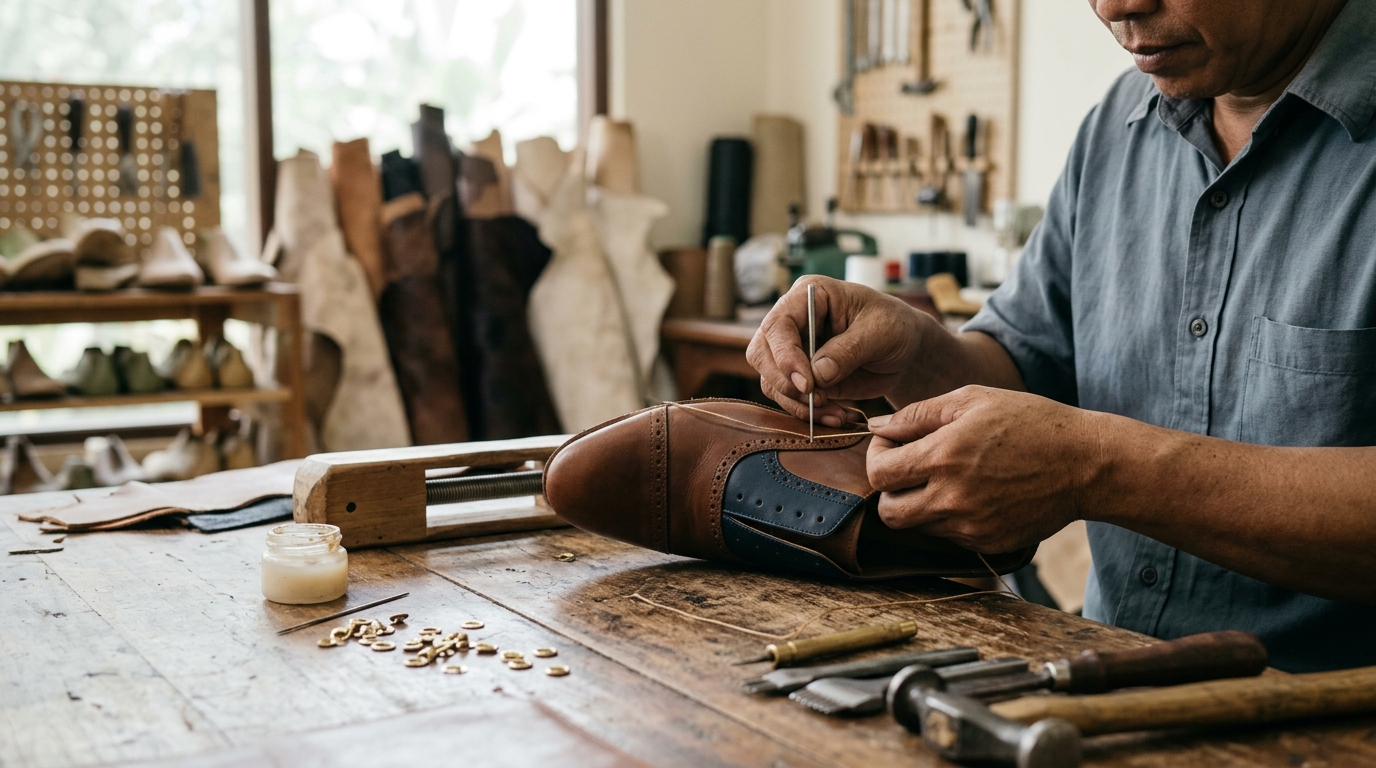
Boutique footwear brands entering the artisan leather market face a concrete decision: where to source handmade leather footwear that delivers craft quality, reliable small-batch production, and margins that support premium retail pricing. Indonesian workshops have earned serious attention from US…
Boutique footwear brands entering the artisan leather market face a concrete decision: where to source handmade leather footwear that delivers craft quality, reliable small-batch production, and margins that support premium retail pricing. Indonesian workshops have earned serious attention from US and European buyers.
This guide covers what US sourcing managers need to evaluate both cities as B2B supply origins. It addresses MOQs, construction methods, pricing frameworks, quality control workflows, export compliance, and supplier vetting.
Indonesia's leather footwear sector has grown steadily as a complement to the country's dominant furniture and textile export industries. Decades of hand-welted and hand-stitched production have built a skilled workforce.
Why Indonesian Artisan Leather Workshops Outcompete Factory Alternatives for Boutique Brands
Indonesia's shoemaking tradition spans multiple generations. Hand-lasting, hand-stitching, and welt-based construction have been practiced at the workshop level — not just the factory level — for decades. That depth of craft skill is the baseline, not the selling point.
The commercial argument for boutique brands is cost-competitiveness at artisan quality. A hand-welted dress shoe produced by an Indonesian workshop typically costs a fraction of an equivalent piece from Portuguese, Spanish, or English ateliers — without sacrificing construction integrity.
Indonesian artisan footwear has been supplying boutique brands in North America and Europe for well over a decade. That export track record means workshops in Yogyakarta and Bogor increasingly understand labeling requirements, FOB documentation, and the quality expectations of international buyers.
For a US brand building a private-label or OEM line at 50–300 pairs per SKU, Indonesian handmade artisan footwear workshops represent the most viable combination of craft output and accessible minimums currently available in Asia.
Yogyakarta Leather Footwear Workshops: Craft Heritage and Production Capabilities
Workshop Neighborhoods and Cluster Structure
Yogyakarta's artisan shoe sector is concentrated in specific sub-districts, particularly around areas with long-standing leather craft traditions. Workshops range from micro-operations of two to eight craftspeople to mid-size ateliers employing up to approximately thirty skilled workers.
The cluster structure means that specialty skills are geographically adjacent. A workshop focused on hand-welted oxfords may subcontract heel-building or insole preparation to a neighbor. This is normal and not inherently a risk — but it requires clarity during supplier vetting.
Construction Methods Available in Yogyakarta
Yogyakarta workshops commonly offer:
- Goodyear welt — stitched welt attached to a rib, then sole sewn to welt. Resoleable. Labor-intensive. Best fordress shoesand boots targeting premium retail. - Hand-welted construction — similar to Goodyear but executed without a welt machine, using a hand awl. Slower, more expensive per pair, but produces tighter stitch lines. - Hand-lasting — upper pulled and nailed by hand over the last. Standard practice in craft workshops. Affects fit precision and upper shaping. - Blake stitch — single-needle stitch through insole, upper, and outsole. Faster than Goodyear, slightly less resoleable, but produces a sleeker profile.
Not every workshop offers all methods. Confirm capabilities during sample evaluation, not after placing a trial order.
Leather Sourcing in Yogyakarta
Local tanneries in Central Java supply cowhide in various tempers. Quality ranges significantly. For export-grade product, most serious workshops supplement local supply with imported full-grain hides — typically from Italy, India, or Brazil — or use domestically processed vegetable-tanned leather from select regional tanneries with consistent output.
Vegetable-tanned leather sourced well in Yogyakarta develops excellent patina. It is appropriate for natural-finish dress shoes and heritage-style boots. Chrome-tanned leather is also available and better suited for high-volume or fashion-forward styles requiring color consistency.
Bogor Leather Footwear Producers: Specializations, Materials, and Logistics Advantages
How Bogor Differs from Yogyakarta
Bogor's leather footwear sector has a distinct profile. Workshops here have historically specialized in more casual and mid-market construction — moccasin-style hand-sewn footwear, loafers, and casual boots — alongside a growing segment producing higher-construction styles.
Bogor producers often serve the Indonesian domestic market alongside export clients. That dual-market orientation means they are accustomed to faster turnaround expectations but may require more guidance on export packaging and documentation standards.
Proximity to Jakarta and Logistics Impact
Bogor sits approximately 60 kilometers south of Jakarta. That proximity is a direct operational advantage. Jakarta's Tanjung Priok port handles the majority of Indonesian leather goods exports. Shorter inland transport from Bogor reduces drayage costs and transit time to port.
Air freight from Halim Perdanakusuma or Soekarno-Hatta airports is also accessible for urgent sample shipments or first-season trial orders. Yogyakarta's Adisutjipto airport handles air cargo but with lower frequency and capacity than Jakarta's options.
Materials and Construction Methods in Bogor
Cowhide is the dominant material. Goatskin is available through regional traders and is commonly used for lighter casual shoes and loafers.
Construction methods common in Bogor include:
- Blake stitch — predominant for casual dress shoes and loafers - Hand-sewn moccasin — traditional construction for slip-ons and casual styles - Norwegian welt — available at select workshops; suited for outdoor and heritage boot styles requiring a robust, water-resistant welt
Yogyakarta vs. Bogor: Side-by-Side Workshop Profile Comparison
| Dimension | Yogyakarta | Bogor |
|---|---|---|
| Primary specialization | Dress shoes, hand-welted boots, formal styles | Casual shoes, loafers, moccasins, mid-market boots |
| Construction methods | Goodyear welt, hand-welt, Blake stitch, hand-lasting | Blake stitch, hand-sewn moccasin, Norwegian welt |
| Typical workshop size | 2–30 artisans | 5–25 artisans |
| Leather supply | Local + imported full-grain and veg-tan | Primarily cowhide; goatskin via regional traders |
| Port access | Solo/Yogyakarta to Semarang port (~3–4 hrs inland) | Jakarta/Tanjung Priok (~1–2 hrs inland) |
| Export experience | High — established international buyer relationships | Moderate — growing export orientation |
| Typical MOQ range | 30–100 pairs per style | 24–80 pairs per style |
| Lead time (post-sample) | 45–90 days | 35–75 days |
| Price positioning | Slightly higher due to construction complexity | Slightly lower; competitive for casual styles |
Small-Batch Sourcing: MOQs, Lead Times, and Seasonal Planning for Handmade Leather Footwear Yogyakarta Bogor Indonesia
Artisan workshops in both cities operate on craft-production rhythms, not factory-line schedules. Understanding how that affects your sourcing calendar prevents the most common planning failures.
Minimum Order Quantities by Workshop Type
Most Yogyakarta and Bogor artisan workshops accept orders starting at approximately 24–50 pairs per style for established buyer relationships. First-order MOQs are often higher — commonly 50–120 pairs — because workshops need to amortize pattern development, last preparation, and material sourcing costs.
If a workshop quotes you MOQ of fewer than 24 pairs on a first order for a complex hand-welted style, verify carefully. Either they are absorbing real costs elsewhere (which affects sustainability of the relationship) or the quality level is not what it appears.
Production Lead Times
| Stage | Typical Duration |
|---|---|
| Sample development | 3–6 weeks from tech pack approval |
| Sample revision rounds | 1–2 weeks per round |
| Bulk production (post-sample approval) | 5–10 weeks depending on order size |
| Export documentation and port clearance | 1–2 weeks |
| Sea freight to US West Coast (LCL) | 3–4 weeks |
| **Total FOB to US delivery (sea)** | **Approximately 10–18 weeks from sample approval** |
Air freight cuts transit to approximately one week but costs significantly more per pair. Use air for samples and emergency reorders only.
Planning Around the Indonesian Workshop Calendar
Indonesian workshops observe national holidays that affect production continuity. Eid al-Fitr (date varies annually with the Islamic calendar) typically results in two to four weeks of reduced or halted production. Plan bulk orders to ship before Eid, or build buffer into your delivery timeline.
Year-end holidays in December also reduce capacity. For US spring/summer season drops, place orders by September at the latest. For fall/winter drops, place by March.
Scaling Volume Across Multiple Workshops
Working with two or three vetted workshops — one in Yogyakarta and one in Bogor — is a practical strategy. It distributes construction type risk (dress styles in Yogyakarta, casual in Bogor), reduces single-supplier dependency, and gives you leverage to manage capacity constraints during peak periods.
Quality Consistency Management Across Artisan Production Runs
Handmade leather footwear from Indonesian artisan clusters will show pair-to-pair variation. That is inherent to hand production. The sourcing manager's job is to define acceptable tolerance ranges and build systems that keep variation within them.
Common Quality Variance Issues
- Welt stitch density inconsistency across a production run - Last pulling variation causing minor fit asymmetry - Edge finishing color or sheen differences between pairs - Sole attachment pressure variance in cemented constructions - Leather temper inconsistency when material is sourced in multiple lots
None of these issues is automatically disqualifying. They become problems when they are undocumented and unmanaged.
Establishing Quality Standards
Before bulk production begins, issue a tolerance document to your workshop. It should specify:
- Acceptable stitch count range per inch - Maximum allowable last deviation (typically ±1–2mm for hand-lasted shoes) - Edge paint coverage and finish standard with reference photos - Sole adhesion test requirement (manual flex test, not destructive) - Leather grain consistency standard with approved swatch
Pair this with a golden sample protocol: one approved production sample is sealed and held by both parties as the reference standard for the batch.
Inspection Workflow for Small Batches
- ✓Tech pack and tolerance document issued before production start
- ✓Golden sample approved and physically retained by both buyer and workshop
- ✓During Production (DUPRO) inspection at 30–40% completion
- ✓Pre-shipment inspection of 100% of pairs or AQL sampling at shipment stage
- ✓Photo documentation of each inspection stage uploaded to shared folder
- ✓Defect log maintained across batches to track recurring issues
For orders under 100 pairs, a remote photo-based inspection with a trusted local contact is often sufficient. For orders above 200 pairs or for first-season production, an on-site third-party inspection is worth the cost. Several inspection firms operate in Java and can cover both Yogyakarta and Bogor workshops.
Pricing Structure for Handmade Leather Footwear from Indonesian Artisan Workshops
Understanding cost structure prevents both overpaying and negotiating workshops into unsustainable margins — which degrades quality over time.
Cost Component Breakdown
| Cost Component | Share of FOB Price (Approximate) |
|---|---|
| Leather (upper material) | 25–40% |
| Last (amortized across order) | 5–15% (higher on small first orders) |
| Labor (lasting, stitching, finishing) | 25–35% |
| Sole, welt, hardware | 10–20% |
| Workshop overhead and profit | 10–20% |
These proportions shift significantly with construction method. A hand-welted boot has higher labor share. A cemented-sole casual shoe has lower labor and welt costs but higher material dependency.
Pricing by Construction Method
| Construction | Relative FOB Price | US Retail Multiple Potential |
|---|---|---|
| Hand-welted (Goodyear or true hand-welt) | Highest in artisan tier | 4–6x FOB typical for premium boutique |
| Blake stitch dress shoe | Mid-range | 3.5–5x FOB |
| Norwegian welt boot | High | 4–5x FOB |
| Hand-sewn moccasin | Lower | 3–4x FOB |
| Cemented sole casual | Lowest | 2.5–3.5x FOB |
Compared to European artisan producers (Portugal, Spain, England), Indonesian handmade leather footwear from Yogyakarta and Bogor typically prices at approximately 30–55% lower FOB for equivalent construction quality.
Negotiation Levers
- Material upgrades: Offer to supply your own imported leather. This reduces workshop material risk and often improves per-unit pricing because they are not carrying inventory. - Payment terms: 30–50% deposit upfront with balance before shipment is standard. Offering faster payment can unlock small discounts. - Volume commitments: A written commitment for two or three seasonal orders — even without a binding contract — gives workshops planning confidence and often yields better pricing on the second order.
Vetting and Onboarding a Yogyakarta or Bogor Leather Footwear Workshop
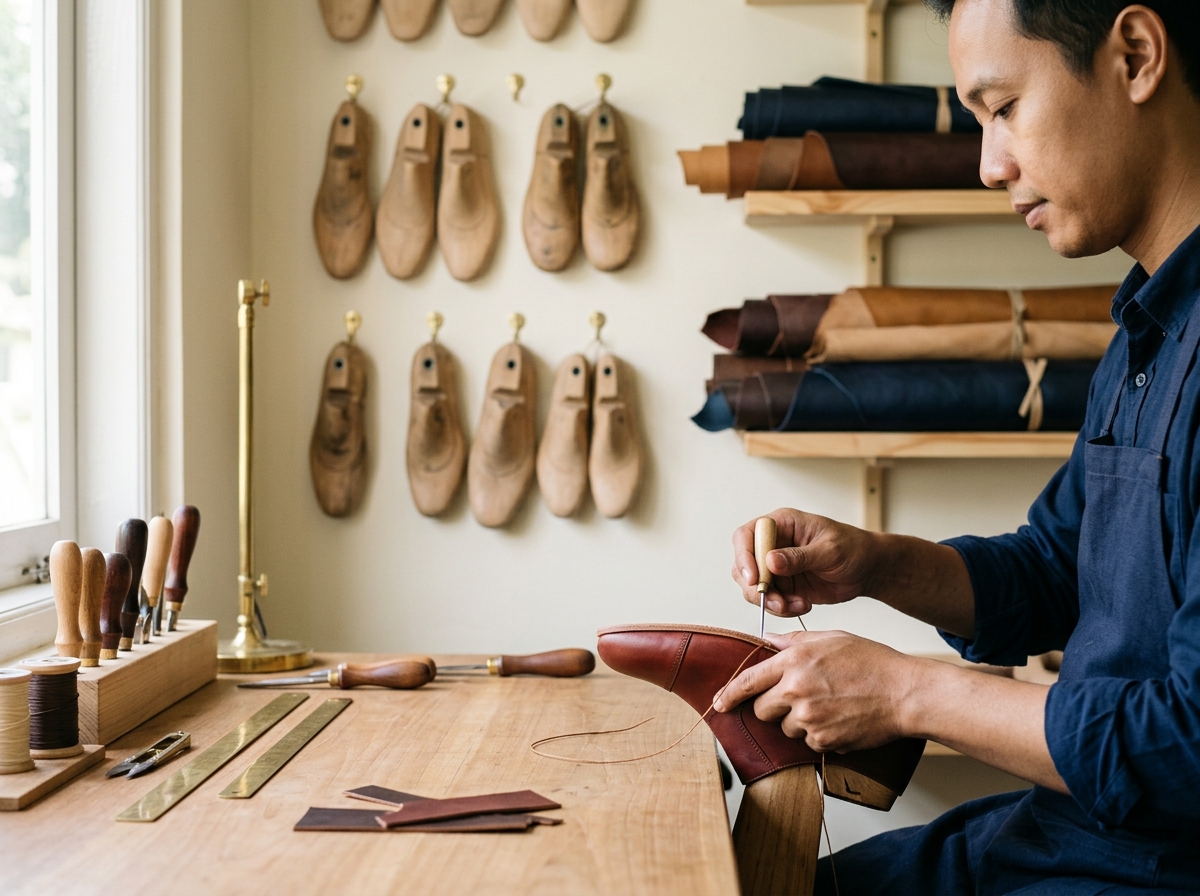
Due-Diligence Checklist
- ✓Business registration (SIUP or NIB in Indonesia) — verify the legal entity exists
- ✓Export capability confirmation — NPWP tax registration and export license
- ✓Sample history — request photos or physical samples from previous export clients
- ✓Workshop visit or unannounced audit — verify production is in-house, not reassigned
- ✓Craftsperson count and skill level — how many are trained in the specific construction method you need
- ✓Lead time reliability — ask for references from current international buyers
- ✓Subcontracting disclosure — identify which stages leave the primary workshop
- ✓Financial stability signals — consistent payroll, equipment maintenance, material stock
Evaluating Craftsmanship Through Samples
Order a reference sample before any commercial discussion. Specify the construction method, leather type, and finishing standard explicitly. Evaluate:
- Stitch consistency and density - Last shape accuracy against your specification - Edge finishing uniformity - Sole attachment integrity - Leather surface quality and temper
Do not accept verbal assurances about capabilities. The sample is the only valid evidence.
Ethical Sourcing Standards
Indonesian artisan workshops vary in labor practices. Verify:
- Workers are paid above regional minimum wage (UMP) for the relevant province - Workshop has safe working conditions — adequate ventilation for adhesive fumes, lighting, and space - No child labor — Indonesia's minimum working age is 15, with restrictions to 18 for hazardous work - Leather sourcing does not involve protected species without proper CITES documentation
Ethical sourcing is increasingly a US retail requirement, not a preference. Build it into your supplier qualification standard from the first conversation.
Communication and Project Management
Indonesian workshops respond well to WhatsApp-based communication for day-to-day updates. For formal documentation — tech packs, tolerance documents, production schedules — use shared Google Drive or Dropbox folders. Keep all decisions in writing. Verbal agreement in a video call is not a production instruction.
Logistics, Export Compliance, and Shipping Handmade Leather Footwear from Indonesia to the US
HS Codes and Import Duties
Leather footwear imports into the US are classified primarily under HS Chapter 64. Key subheadings for handmade leather footwear include:
- 6403.51 — footwear with outer soles of leather, covering the ankle, for men - 6403.59 — other footwear with leather outer soles - 6403.91 / 6403.99 — leather upper footwear by ankle coverage
US import duties on leather footwear from Indonesia generally range from approximately 8.5% to 10% ad valorem, depending on subheading and construction type. Indonesia does not currently benefit from US GSP coverage across most active footwear tariff lines. This gap can materially affect landed cost models.
Packaging Requirements for Handmade Footwear
Handmade leather shoes are more susceptible to transit damage than factory-produced footwear because finishing layers are thinner and hand-applied. Require:
- Individual shoe bags (non-woven or flannel) - Toe and heel stuffing with acid-free tissue - Shoe box with minimum 3mm corrugated insert - Master carton double-walled, palletized for LCL
Specify packaging requirements in your purchase order, not as a verbal request.
Freight Options: Sea LCL vs. Air
| Freight Mode | Transit Time (to US West Coast) | Approximate Cost Basis | Best For |
|---|---|---|---|
| Sea LCL | 25–35 days | Lower cost per CBM | Seasonal bulk orders, 50+ pairs |
| Air freight | 5–8 days | Significantly higher per kg | Samples, urgent reorders, under 20 pairs |
| Sea FCL | 25–35 days | Efficient at full container volume | Not typical for boutique brands at start |
For most boutique brands sourcing handmade leather footwear from Yogyakarta or Bogor, sea LCL is the standard freight method. Consolidate seasonal orders into a single shipment to reduce per-pair freight cost.
Export Documentation Required
- Commercial Invoice (FOB value, HS code, country of origin) - Packing List - Certificate of Origin (Form E or general CO issued by Indonesian trade authority) - Bill of Lading (sea) or Airway Bill (air) - Phytosanitary certificate if wooden shoe boxes or lasts are exported - CITES permits where applicable
Work with a freight forwarder experienced in Indonesian leather goods exports. They will manage Customs clearance on the Indonesian side and coordinate with your US customs broker.
Frequently Asked Questions: Sourcing Handmade Leather Footwear from Indonesia
What are the most reputable handmade leather shoe workshops in Yogyakarta and Bogor?
Specific workshop names fluctuate as businesses open, close, and change ownership. The reliable approach is to request references from sourcing agents or trade contacts who have physically visited Indonesian workshops and have current relationships.
What is the typical MOQ for artisan leather footwear from Indonesian workshops?
First orders typically start at 50–120 pairs per style. Established buyer relationships can bring this down to 24–50 pairs. MOQs below 24 pairs per style for complex hand-welted construction are rare and should be verified carefully — the unit economics rarely support them without hidden compromises.
How do I ensure quality consistency across batches of handmade leather shoes?
Issue a tolerance document before production. Approve a golden sample. Conduct DUPRO inspection at 30– approximately 40% completion. Perform pre-shipment inspection before payment of the balance. Maintain a defect log across orders. Consistency improves significantly after the second or third production run with the same workshop.
What construction methods are available in Indonesian workshops?
Goodyear welt, hand-welted, Blake stitch, Norwegian welt, hand-lasting, and hand-sewn moccasin construction are all available in Indonesia — but not from every workshop. Match the construction method requirement to workshop capability during sample evaluation.
How does Indonesian handmade leather footwear pricing compare to Europe or other Asian countries?
Indonesian artisan workshops typically price approximately 30–55% below comparable European ateliers at FOB. Against Indian artisan producers, pricing is broadly comparable with differences driven by leather origin and finishing standards.
Are Indonesian handmade leather shoes genuinely original in quality — what buyers call 'sepatu kulit asli'?
Yes — when sourced from workshops with verified hand-construction practices. 'Sepatu kulit asli' (genuine leather shoes) is the local standard description, but it does not guarantee export-grade quality or construction method.
Handmade leather footwear from Yogyakarta and Bogor represents a credible, cost-competitive sourcing option for US boutique brands — provided sourcing decisions are grounded in verified workshop capabilities, documented quality standards, and realistic production timelines. The craft skills exist. The export infrastructure is accessible.
You now have the framework to evaluate, onboard, and manage artisan leather footwear production from Yogyakarta and Bogor. The next step is identifying the right workshops for your specific construction and brand requirements. Request a sourcing consultation to connect with vetted Yogyakarta and Bogor leather footwear workshops that match your style specifications, MOQ range, and quality standards.
Request a Sourcing Consultation →Need eyes on the ground in Indonesia?
MTS is an execution partner — supplier verification, manufacturing management, quality control and export logistics across Indonesia, Vietnam and China.
Related services
Related articles
Receive furniture sourcing insights across Asia.
One email per week. No spam.