Indonesia Espadrille Manufacturers: Sourcing Casual Footwear at Scale
14 min read
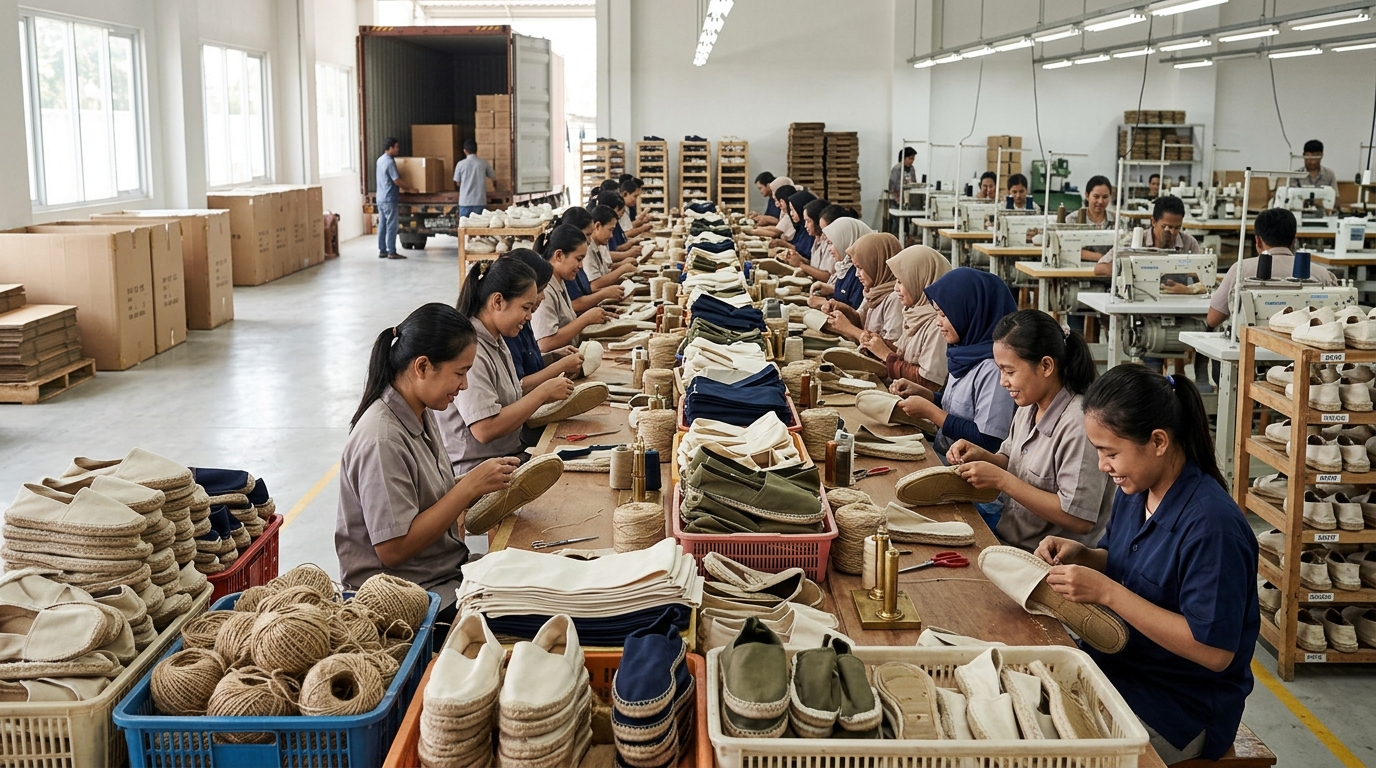
US footwear buyers face a specific challenge when sourcing espadrilles: most supplier directories list generic shoe factories with no visibility into jute sole capabilities, canvas weight options, or construction methods. The decision to commit to a production partner in Indonesia requires more…
US footwear buyers face a specific challenge when sourcing espadrilles: most supplier directories list generic shoe factories with no visibility into jute sole capabilities, canvas weight options, or construction methods. The decision to commit to a production partner in Indonesia requires more than a factory address. It requires a clear view of material access, construction capabilities, MOQ structures, and container-level logistics.
This article covers all of it. It addresses the eight core evaluation areas that matter to brand managers and product development buyers sourcing casual footwear espadrilles, canvas slip-ons, and jute-soled shoes from Indonesian manufacturers. You will find a construction method comparison table, container planning reference figures, colorway consolidation strategies, and a compliance checklist specific to US import requirements.
Indonesia is not a generic low-cost sourcing destination. For espadrilles and canvas casuals specifically, it offers a rare combination: local jute fiber supply, natural rubber production, strong canvas processing infrastructure, and deep craft traditions in key manufacturing clusters. Understanding how those advantages map to your product and price point is where sound sourcing decisions begin.
Why Indonesia Outperforms Other Sourcing Countries for Canvas and Jute-Soled Footwear
Indonesia consistently ranks among the world's top five footwear-exporting nations by volume. For casual footwear espadrilles manufacturers, Indonesia offers a structural advantage that China and Vietnam cannot fully replicate: domestic availability of both jute fiber and natural rubber, the two defining materials in espadrille construction.
Labor Cost and Quality Certification Trajectory
Factory labor costs in Indonesia run meaningfully lower than coastal China. The gap has widened as Chinese wages have risen steadily over the past decade. Indonesian footwear factories have simultaneously improved their compliance posture. BSCI audits, ISO 9001 quality systems, and OEKO-TEX material certifications are now common among mid-tier export-ready factories in East Java and West Java.
Government Export Support and Trade Framework
The Indonesian government supports footwear exports through bonded zone incentives, import duty exemptions on raw materials used in export production, and active participation in trade facilitation frameworks.
Product Range Available From Indonesian Factories
Indonesian factories produce a broad range of casual footwear, including:
- Canvas espadrilles with jute rope soles - Rubber-soled canvas slip-ons - Vulcanized canvas sneakers - Sandals and open-toe espadrilles - Wedge espadrilles with jute-wrapped platforms - Woven upper casuals using natural fibers
For buyers specifically seeking casual footwear espadrillesmanufacturers Indonesiacan serve across flat, platform, and wedge silhouettes in both men's and women's sizing.
Natural Materials That Define Indonesian Espadrille Construction
Jute Supply Chain Within Indonesia
Indonesia is not a primary jute-growing country. Raw jute fiber is predominantly sourced from Bangladesh and India, with some supply entering through Surabaya port. This import dependency has practical implications for buyers. Jute-related lead time risk increases when global fiber supply is constrained or port congestion affects Surabaya intake. Factories with standing inventory agreements with fiber importers can offer more predictable schedules.
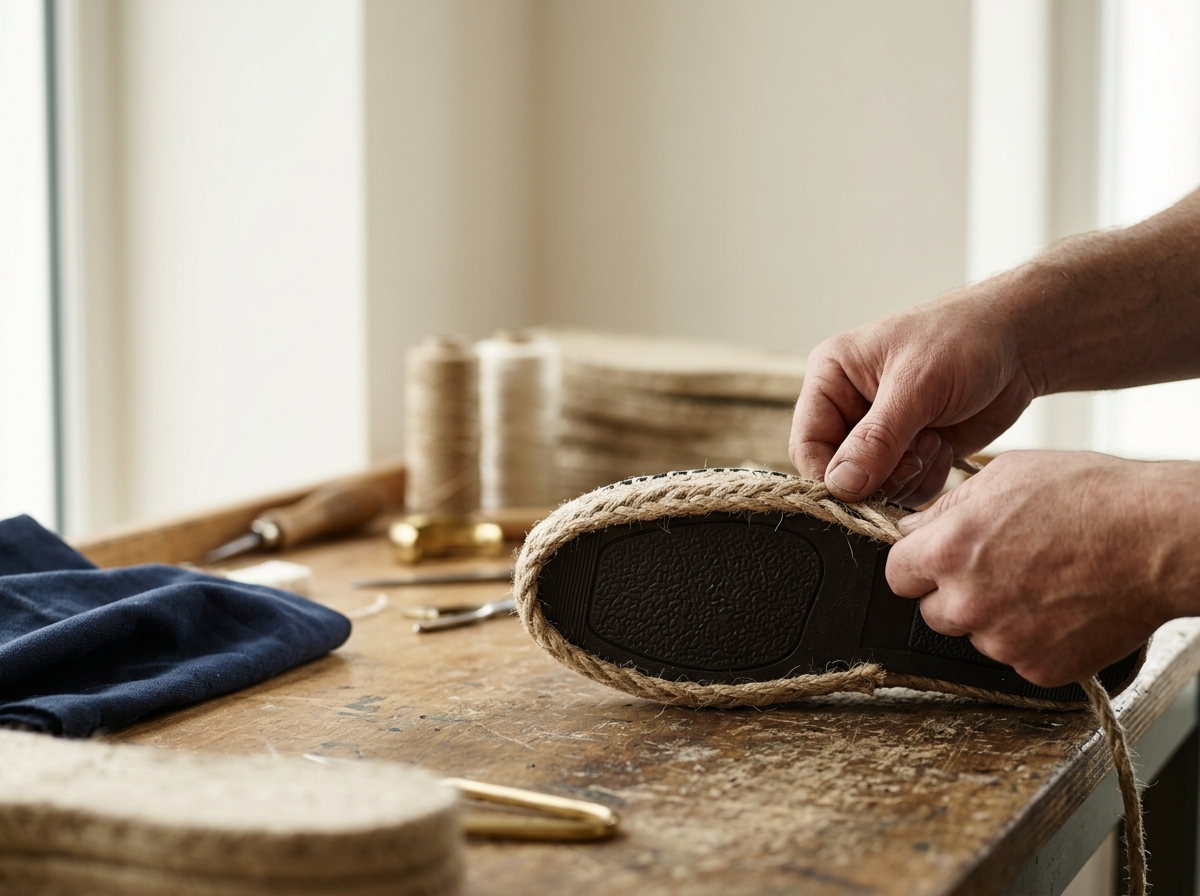
Jute sole construction involves braiding or wrapping fiber around a last or mold, then stitching or bonding the braid to the upper. Indonesian factories with dedicated braiding lines can produce consistent rope sole profiles. Factories without in-house braiding outsource this step, which adds a coordination variable to your timeline.
Canvas Upper Specifications
Cotton canvas for espadrille uppers is available from Indonesian textile mills and regional suppliers in the following weight ranges:
| Canvas Weight | Common Use | Finish Options |
|---|---|---|
| 8 oz (approx. 272 g/m²) | Lightweight summer espadrilles | Reactive dye, pigment print |
| 10 oz (approx. 340 g/m²) | Standard espadrille upper | Reactive dye, screen print, wax coat |
| 12 oz (approx. 407 g/m²) | Structured or platform upper | Stone wash, enzyme wash, heat transfer |
Heavier canvas offers better shape retention but requires more aggressive dying processes to achieve saturated colorways. Confirm colorfastness standards with the factory — ISO 105-B02 for light fastness and ISO 105-C06 for wash fastness are the relevant references.
Natural Rubber Outsoles
Indonesian factories access both crepe rubber and vulcanized rubber for espadrille outsoles. Crepe rubber produces a softer, slightly textured finish and is associated with traditional espadrille profiles. Vulcanized rubber delivers a harder, more abrasion-resistant surface. Many factories now offer jute-wrapped rubber platforms — a hybrid construction where a molded rubber platform provides structural support while jute braiding provides the visual character of a traditional espadrille.
Vulcanized vs. Cement Construction: What Espadrille Buyers Need to Know
Construction method is the single most consequential specification decision for espadrille buyers. It affects durability, price, factory compatibility, and retail positioning.
| Criteria | Vulcanized Construction | Cement (Cold Bond) Construction |
|---|---|---|
| Process | Heat and pressure cure in autoclave | Adhesive bonding at room temperature |
| Durability | Higher — bond is chemical and structural | Adequate for flat, low-stress styles |
| Factory requirement | Specialized autoclave equipment | Standard lasted construction line |
| Unit cost premium | Typically higher — equipment amortization | Lower — simpler tooling |
| Best retail price point | Mid to premium ($45–$90+ retail) | Entry to mid ($25–$55 retail) |
| Lead time impact | Slightly longer — cure cycle adds time | Standard |
| Indonesian availability | Available in larger East Java factories | Widely available across all clusters |
How Vulcanization Works in Indonesian Factories
Vulcanized construction bonds the canvas upper and rubber outsole through heat curing in an autoclave or press at temperatures typically around 150–170°C. The result is a molecular bond between rubber and canvas rather than a surface adhesive joint. Indonesian factories offering this capability are predominantly located in the Surabaya and Sidoarjo corridors, where footwear infrastructure is most developed.
Cement Construction for Flat Espadrilles
Cement-lasted construction dominates Indonesian espadrille production by volume. The upper is lasted over a form, the outsole is prepared with adhesive (typically polyurethane or neoprene-based), and the two components are pressed together and cooled. For flat canvas espadrilles at accessible retail price points, cement construction delivers acceptable durability.
Custom Colorways, Prints, and Private Label Branding From Indonesian Factories
Indonesian factories serving export markets offer a practical range of customization options for canvas espadrilles. Understanding what is genuinely in-house versus subcontracted helps you assess risk and timeline accuracy.
Canvas Upper Decoration Methods
- Reactive dyeing: Produces the most colorfast results on cotton canvas. Best for solid colorways. Minimum dye lot requirements apply — typically aligned with the canvas mill's minimum order, not the shoe factory's MOQ. - Screen printing: Suitable for bold graphics, logos, and two- to six-color patterns on canvas uppers. Registration quality varies by factory equipment age. Request print strike-offs before approving colorways. - Heat-transfer printing: Enables photographic-quality or gradient designs. Best for smaller print runs. Some factories subcontract this step to specialist print houses.
Jute Sole Color and Customization
Natural jute rope is off-white to tan in its raw state. Some factories offer colored jute wrapping using fiber-reactive dyes, but colorfastness on jute is inherently lower than on cotton canvas. If colored jute soles are a design requirement, test wash fastness at the sample stage.
Private Label and Packaging Options
Standard private label services from Indonesian espadrille factories include:
- Embossed or printed insoles with buyer's brand name - Woven neck labels and flag labels in uppers - Custom hangtags (factory typically sources locally) - Custom shoebox printing (minimum box order quantities apply separately) - Polybag and tissue packaging to buyer's spec
Sample lead times for a first colorway typically run four to eight weeks from tech pack approval. Colorway approval (color lab dip plus physical strike-off) adds one to three weeks per round of revision.
MOQ Structures and Colorway Planning for Seasonal Espadrille Lines
Typical MOQ Ranges for Indonesian Espadrille Factories
MOQ varies by factory size, construction complexity, and material sourcing:
| Factory Type | MOQ Range (pairs/colorway) | Notes |
|---|---|---|
| Small/artisan (Bali, Bandung) | 100–300 | Higher unit cost, handcraft capability |
| Mid-volume export factory | 300–600 | Standard canvas espadrilles, cement construction |
| Large industrial (Sidoarjo, Surabaya) | 600–1,200+ | Vulcanized option available, lower unit cost |
These figures are approximate and vary by season, material complexity, and factory loading. Jute-wrapped platform styles typically carry higher MOQs than flat canvas styles due to sole production complexity.
Colorway Consolidation Strategies
Meeting MOQ per colorway is the most common obstacle for emerging brands building seasonal espadrille lines. Practical consolidation approaches:
- Shared-upper colorway, varied trim: Run one canvas color across multiple SKUs and vary the jute color, lace color, or insole print to create product differentiation without new MOQ thresholds. - Carry-forward colorways: Maintain one or two core colorways season over season to build cumulative volume, reserving new MOQ commitments for seasonal accent colors only. - Size consolidation: Confirm that MOQ is per colorway across a full size run, not per size. Most Indonesian factories count total pairs across the size curve — not individual sizes — toward the MOQ threshold.
Seasonal Order Timing
Indonesian factories serving US buyers typically operate on two primary production windows. Spring/summer espadrille programs should enter production no later than October–November for March–April delivery. Fall programs with canvas casuals follow a March–April production entry for August–September delivery.
Container Planning and Export Logistics From Indonesian Espadrille Factories
Pair Counts per Container for Boxed Espadrilles
Espadrille carton sizes vary by style, but approximate planning figures for standard flat canvas espadrilles in individual shoeboxes:
| Container Type | Approximate Pair Count | Notes |
|---|---|---|
| 20ft (approx. 33 CBM usable) | 2,500–3,500 pairs | Assumes standard shoebox ~0.010–0.013 CBM |
| 40ft (approx. 67 CBM usable) | 5,000–7,000 pairs | Standard for mid-volume seasonal orders |
| 40ft High Cube (approx. 76 CBM usable) | 5,800–8,000 pairs | Preferred where box height allows |
Wedge or platform espadrilles with taller boxes will reduce these counts by approximately 15–25%. Confirm carton dimensions and CBM at the sampling stage, not at shipment.
Primary Export Ports
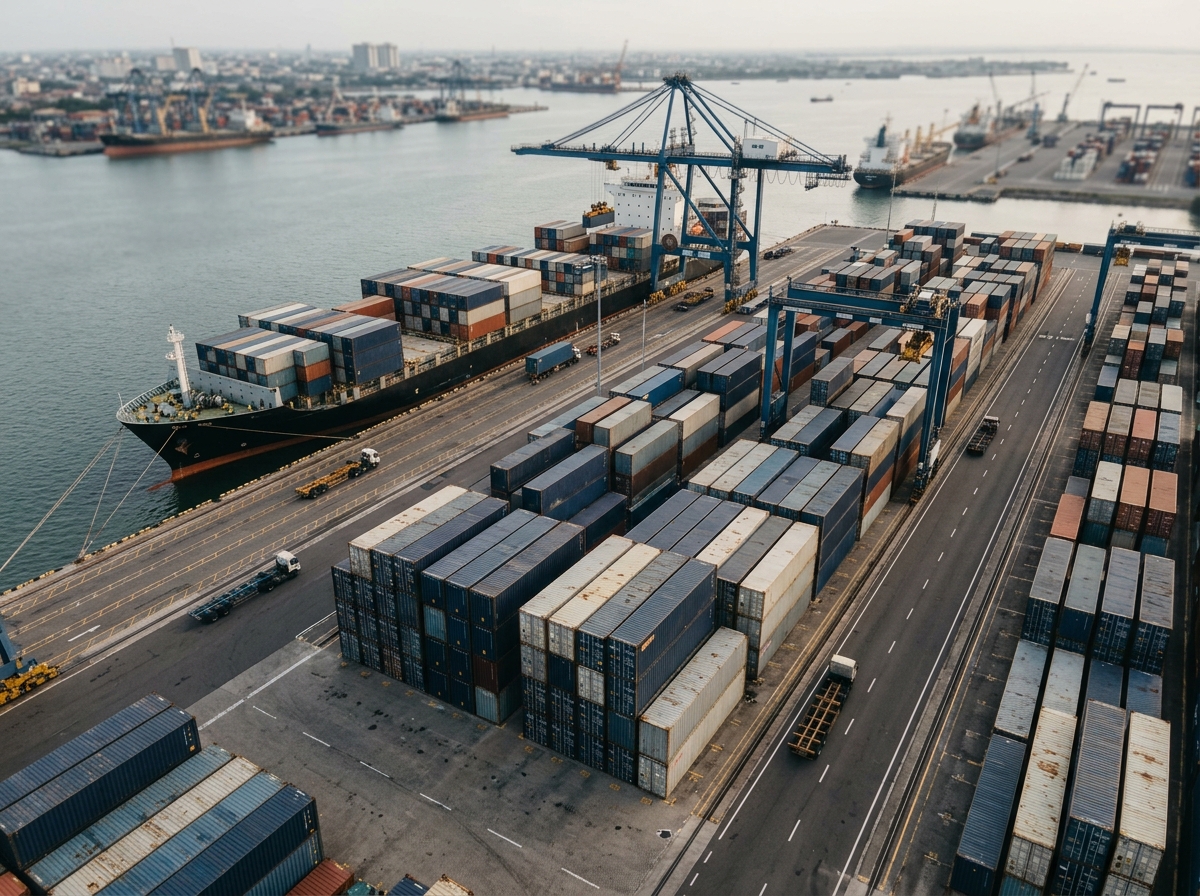
- FOB Surabaya (Tanjung Perak Port): Primary gateway for East Java factories. Best option for factories in Sidoarjo, Mojokerto, and greater Surabaya. Direct services to US West Coast and transhipment via Singapore to US East Coast. - FOB Semarang (Tanjung Emas Port): Serves Central Java production. Smaller port with fewer direct liner services — transit via Singapore is common, adding approximately three to five days.
Incoterms and Negotiation Points
Most Indonesian footwear factories quote FOB as their standard term. US buyers should negotiate:
- FOB Surabaya or FOB Semarang — buyer controls freight and insurance from port of loading - CIF or CFR — factory arranges freight; less buyer control but simpler for smaller importers - Pre-shipment inspection rights (third-party DUPRO) should be written into the purchase order regardless of Incoterm
Transit Times to US Ports
| Route | Estimated Transit Time |
|---|---|
| Surabaya → Los Angeles (West Coast) | Approximately 18–24 days (direct or via Singapore) |
| Surabaya → New York (East Coast via Panama) | Approximately 28–35 days |
| Surabaya → East Coast via Suez | Approximately 30–38 days |
These are approximate sailing times and exclude port dwell time at origin and destination. Add five to ten business days for port processing and inland delivery.
How to Evaluate and Qualify an Indonesian Espadrille Manufacturer Before Committing
Factory Audit Criteria for Casual Footwear Sourcing
- ✓BSCI or equivalent social compliance audit (within 24 months)
- ✓ISO 9001 quality management certification
- ✓OEKO-TEX Standard 100 for canvas and lining materials
- ✓In-house sole production vs. outsourced (confirm and visit if possible)
- ✓Autoclave/vulcanization equipment present if vulcanized construction required
- ✓Jute inventory on-site or contracted supply agreement
- ✓REACH compliance documentation for adhesives and dyes
- ✓CPSC-relevant chemical test reports (azo dyes, heavy metals in pigments)
- ✓Sample room capability and dedicated development team
- ✓Active export history to US or EU markets — request bill of lading references
Red Flags During Audits
- Factory cannot confirm who produces the soles — outsourced sole production without a disclosed subcontractor is an audit gap. - No colorway approval process documented — indicates lack of quality workflow. - Sample lead times quoted under three weeks for a new style — unrealistic and typically means the sample will be inaccurate. - Unwillingness to provide adhesive or dye material safety data sheets.
Finding Vetted Suppliers
Trade platforms (Alibaba, Made-in-China) provide starting points but require independent verification. More reliable discovery channels for casual footwear espadrillesmanufacturers Indonesiainclude:
- Trade shows: The International Footwear and Leather Show (IFLS) in the US regularly features Indonesian exhibitors. Regional shows including Expo Shoes in Asia attract mid-volume export factories. - Indonesian trade promotion bodies: The government-linked Indonesia Eximbank and trade attachés at Indonesian consulates can provide initial factory referrals. - Sourcing agents based in Surabaya or Bandung: Agents with active footwear factory networks provide pre-screened introductions and can conduct on-the-ground factory visits. Confirm the agent's fee structure and ensure they do not have undisclosed commercial relationships with specific factories.
Key Manufacturing Regions for Espadrille and Canvas Shoe Factories in Indonesia
East Java: The Core Footwear Manufacturing Cluster
East Java is the dominant region for Indonesian footwear export production. The Surabaya–Sidoarjo–Mojokerto triangle contains the highest concentration of export-ready factories. These factories typically employ 150–800 workers, operate lasted construction lines, and have established relationships with US and European buyers. Factories in this cluster are most likely to offer vulcanized construction, in-house canvas printing, and full private label services.
West Java: Mid-Volume and Emerging Factories
Bandung and Bogor in West Java host a different factory profile. Smaller factories (typically 50–200 workers) with more flexible MOQ thresholds and stronger craft orientation operate here. Bandung has a well-established textile and apparel manufacturing base, which supports canvas supply for footwear production. These factories suit brands seeking lower MOQs, more design collaboration, or artisan-positioned casual footwear lines.
Bali: Handmade and Premium Espadrille Programs
Bali-based producers serve a distinct segment: premium handmade espadrilles, often with natural fiber uppers, hand-stitched soles, and artisan detailing. Production volumes are low (often under 200 pairs per style), unit costs are higher, and lead times are longer. This profile suits brands building premium or craft-positioned espadrille programs at higher retail price points.
| Region | Factory Scale | MOQ Profile | Best For | Export Port |
|---|---|---|---|---|
| East Java (Surabaya, Sidoarjo) | Medium–large | 300–1,200 pairs | Volume espadrilles, vulcanized option | FOB Surabaya |
| West Java (Bandung, Bogor) | Small–medium | 100–400 pairs | Mid-volume, design-forward styles | FOB Jakarta (Tanjung Priok) |
| Bali | Artisan–small | 50–200 pairs | Premium handmade espadrilles | FOB Denpasar or consolidation via Surabaya |
Frequently Asked Questions: Sourcing Espadrilles From Indonesian Manufacturers
Which types of shoes are commonly manufactured in Indonesia?
Indonesian factories produce a broad range of footwear including canvas espadrilles, rubber-soled slip-ons, vulcanized canvas sneakers, sandals, wedge espadrilles, and woven fiber casuals. The country's manufacturing base is strongest in natural-material casual footwear, leveraging domestic rubber supply and imported jute.Leather dress shoesandathletic footwearare produced in smaller volumes relative to Vietnam and China.
Why do footwear brands choose Indonesia over other Asian sourcing countries?
Indonesia offers domestic access to both natural rubber and jute fiber — the core materials in espadrille construction. Labor costs are lower than coastal China. Craft skills in jute braiding and handwork are deeply embedded in regional manufacturing culture. The absence of US Section 301 tariff surcharges on Indonesian footwear improves landed cost competitiveness versus Chinese-origin product.
What is the typical MOQ for custom espadrilles from an Indonesian factory?
MOQ ranges from approximately 100 pairs per colorway at small artisan producers to 600–1,200 pairs at larger industrial factories. Mid-volume export factories typically set MOQ at 300–600 pairs per colorway for standard canvas espadrilles. Complex constructions — vulcanized soles, jute-wrapped platforms, custom canvas prints — generally carry higher minimums.
What construction methods do Indonesian factories use for espadrilles?
Cement (cold bond) construction is the most common method for flat canvas espadrilles across Indonesian factories. Vulcanized construction is available at larger East Java factories with autoclave equipment. Jute-wrapped rubber platforms are a popular hybrid — molded rubber provides structure while jute braiding delivers the traditional espadrille aesthetic.
How long does production and shipping take from Indonesia to the United States?
Production lead times for canvas espadrilles typically run eight to fourteen weeks from purchase order confirmation, depending on factory loading, material procurement, and construction complexity. Ocean transit from Surabaya to US West Coast ports takes approximately eighteen to twenty-four days. Total door-to-port timeline from order placement to US port arrival commonly runs twelve to nineteen weeks — plan accordingly for seasonal programs.
What sustainability certifications should I ask an Indonesian espadrille manufacturer to provide?
Priority certifications for US-bound espadrille production:
- OEKO-TEX Standard 100 for canvas uppers, lining materials, and jute components — confirms absence of harmful substances at tested concentration levels - BSCI or SMETA social compliance audit for factory working conditions - REACH compliance documentation for adhesives, dyes, and surface treatments — particularly relevant for cement construction adhesives - CPSC-relevant chemical test reports covering azo colorants, heavy metals in pigments, and phthalates in any rubber or plastic components
For Bali artisan producers without formal certification, commission independent laboratory testing (SGS, Intertek, Bureau Veritas) on pre-production materials before bulk production begins.
Indonesia's combination of jute access, natural rubber supply, established canvas manufacturing, and competitive labor costs makes it the strongest single-country sourcing option for US brands building espadrille programs at scale. The key sourcing decisions — construction method, factory region, colorway consolidation strategy, and container planning — are all solvable with the right factory partner and clear specifications before production begins.
You now have the evaluation framework to identify, qualify, and engage Indonesian espadrille factories with confidence. The logical next step is getting factory-specific data against your actual product requirements.
You have evaluated the construction methods, MOQ structures, and logistics options. Now match your program to the right Indonesian production partner. Request factory profiles and MOQ quotes from vetted casual footwear espadrilles manufacturers Indonesia today.
Request Factory Profiles →Need eyes on the ground in Indonesia?
MTS is an execution partner — supplier verification, manufacturing management, quality control and export logistics across Indonesia, Vietnam and China.
Related services
Related articles
Receive furniture sourcing insights across Asia.
One email per week. No spam.