Leather Dress Shoes Manufacturers Indonesia: A Complete Sourcing Guide
13 min read
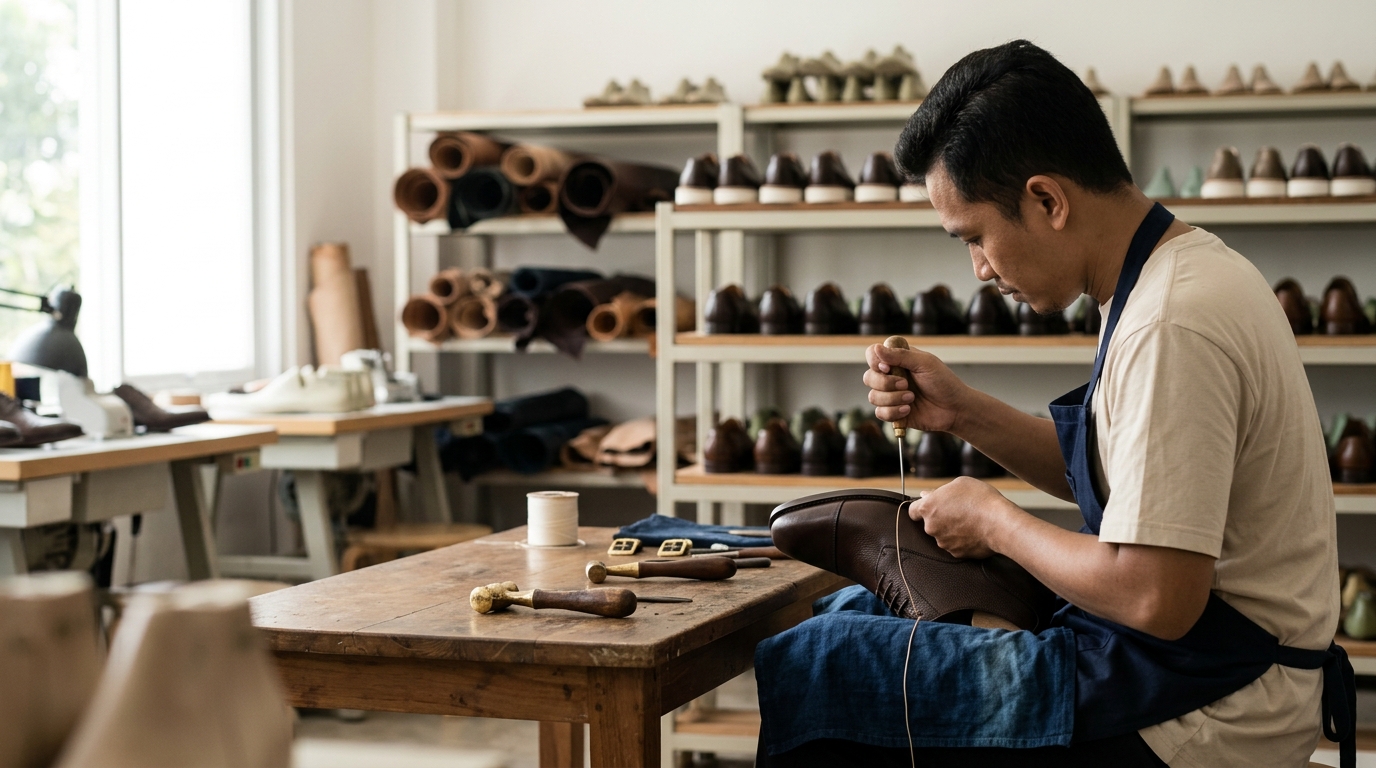
Sourcing leather dress shoes from Indonesia is a genuine strategic option — not a fallback. US brand owners and private label buyers increasingly look beyond China for formal footwear production, driven by tariff pressure, quality diversification, and the search for skilled handcraft at…
Sourcing leather dress shoes from Indonesia is a genuine strategic option — not a fallback. US brand owners and private label buyers increasingly look beyond China for formal footwear production, driven by tariff pressure, quality diversification, and the search for skilled handcraft at competitive cost. Indonesia has the manufacturing infrastructure to deliver.
This guide covers what US buyers need to make an informed supplier decision. You will find practical breakdowns of construction methods, leather sourcing from Garut tanneries, sizing standards for export, MOQ thresholds by factory type, and the compliance documentation required to clear US customs. Each section is built around decision criteria, not generalizations.
Indonesia's footwear sector is anchored by APRISINDO — the Indonesian Footwear Association — which sets industry standards, facilitates trade, and maintains a manufacturer directory that is more reliable than most Alibaba listings. Understanding how to use that network, alongside trade shows like IFEX, is a key differentiator for buyers who want vetted partners rather than cold leads.
The sections below move from macro positioning to factory-level specifics. If you are evaluating leather dress shoesmanufacturers Indonesiafor the first time, start with construction methods and MOQ thresholds. If you are returning to validate a shortlist, jump to quality markers and compliance.
Why Indonesia Punches Above Its Weight in Dress Shoe Production
Indonesia is a top-five global footwear exporter by volume. The country ships hundreds of millions of pairs annually, covering athletic, casual, and formal categories. Within formal leather footwear specifically, the skilled labor base is concentrated and deep — particularly in Bandung, Surabaya, and the Cibadak corridor in West Java.
Bandung has the highest density of trained cordwainers in the country. Many workshops there trace their craft lineage back several generations. Surabaya and East Java host larger export-scale factories capable of managing multi-thousand-pair programs. Cibadak sits adjacent to the Garut tanning district, giving tannery-adjacent factories a supply chain advantage for locally sourced leather.
Cost-quality positioning versus alternatives:
| Source Country | Relative Labor Cost | Goodyear Welt Availability | Artisan Craft Depth | Export Infrastructure |
|---|---|---|---|---|
| Indonesia | Low–Medium | Yes (select factories) | High | Established |
| China | Medium–High | Yes (widespread) | Medium | Mature |
| India | Low | Limited | Medium | Moderate |
| Eastern Europe | High | Yes (widespread) | High | Established |
Indonesia's primary advantage is the combination of craft depth and cost efficiency. Blake and cemented construction are broadly available at competitive price points. Goodyear welt capacity is more selective but exists at export scale. Eastern European manufacturers match craft quality but at significantly higher FOB prices.
APRISINDO plays a structural role here. The association provides member directories, participates in international trade fairs, and sets voluntary quality benchmarks. For US buyers, the APRISINDO directory is a starting point for identifying mid-size export factories that have demonstrated trade compliance — a meaningful filter beyond general marketplace listings.
Construction Methods Available from Indonesian Leather Dress Shoe Factories
Goodyear Welt: Capacity, Access, and MOQ Realities
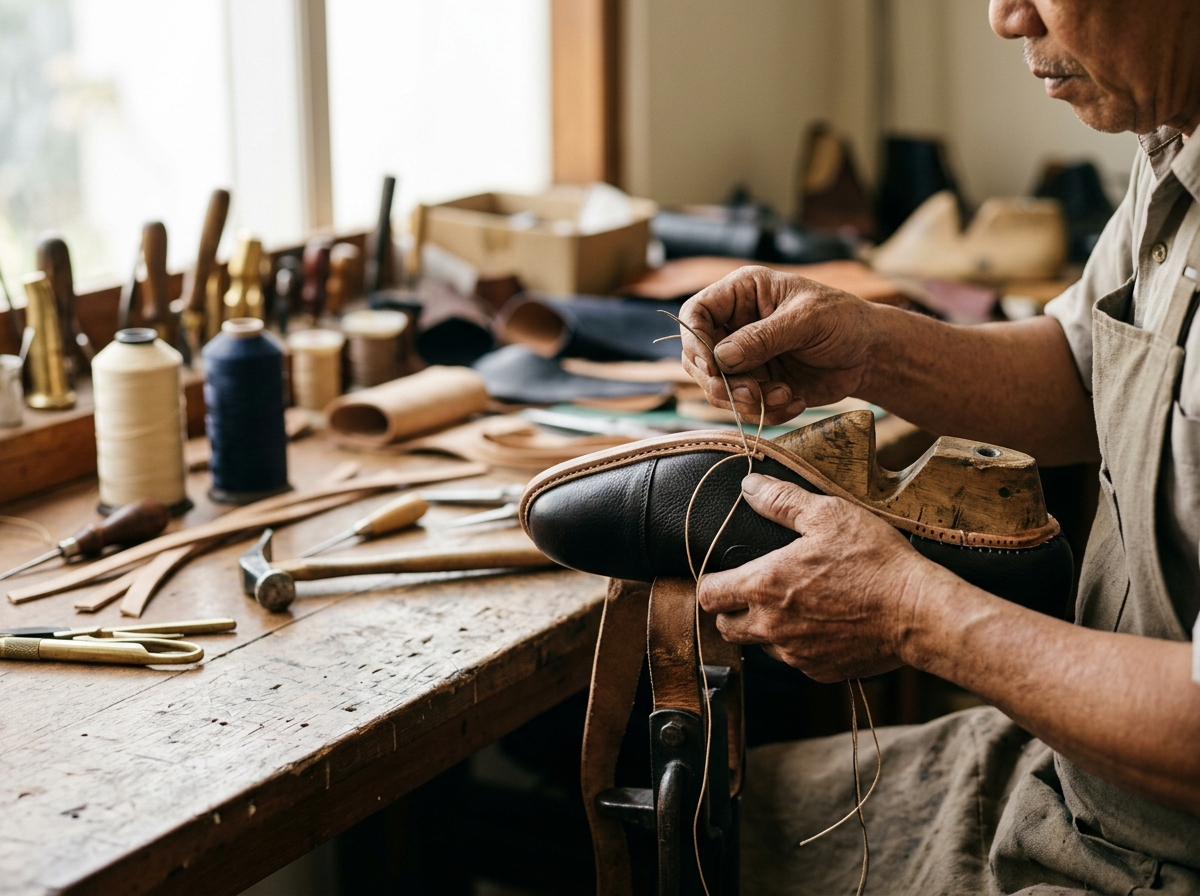
Goodyear welt is the most structurally durable construction method for dress shoes. It allows resoling and produces a firm, structured silhouette. In Indonesia, genuine Goodyear welt capacity — using a welt sewing machine rather than a simulation — is concentrated in a smaller number of factories, primarily in Surabaya and the greater Bandung area.
Expect MOQs of approximately 150 to 300 pairs per style for Goodyear welt from mid-size export factories. Artisan workshops in Bandung may offer lower entry points — sometimes 50 to 100 pairs — but lead times are longer and production capacity per month is limited.
A benchmark for welt stitch density on export-quality dress shoes is approximately 7 to 9 stitches per inch on the welt seam. Request this specification in your tech pack. Factories that cannot confirm this standard during pre-production discussion should be treated with caution.
Blake and Blake Rapid: Mid-Tier Construction for Formal Styles
Blake stitch is more widely available than Goodyear welt across Indonesian factories. It produces a sleeker insole profile, suits dress shoe aesthetics well, and requires less tooling investment per style. Blake Rapid — a two-seam variant — adds a secondary outsole seam for improved durability without the bulk of a full welt construction.
Both methods are available at lower MOQs than Goodyear welt — typically 100 to 200 pairs per style from mid-size factories. Blake construction is a practical choice for brands launching dress shoe lines where resolability is not a priority feature.
Cemented Construction: Cost Efficiency and Trade-Offs
Cemented (direct attach) construction bonds the outsole to the upper using adhesive, without stitching. It is the most widely available method across Indonesia and carries the lowest per-unit cost. For formal styles at accessible retail price points, it is a legitimate choice.
Durability trade-off is real: cemented soles cannot be resoled and are more vulnerable to delamination under heavy moisture exposure. Buyers should specify the adhesive type and bonding process in the tech pack. A heat-reactivated adhesive with a press cure step is a stronger specification than a simple contact cement application.
Leather Sourcing: Garut Tanneries Versus Imported European Hides
Profile of Garut Leather and Its Grades
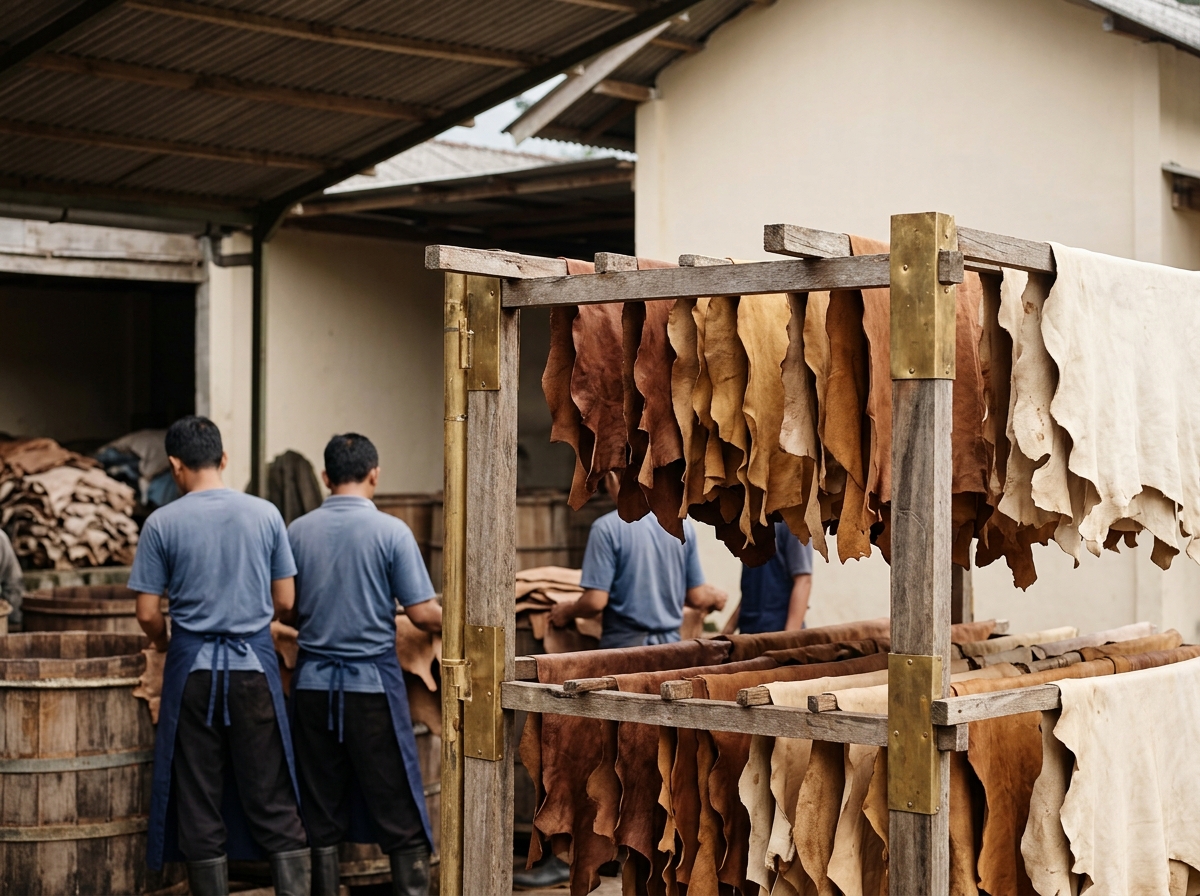
Garut, West Java, is Indonesia's primary tanning district. Tanneries there process calf, cow, and goat hides using both chrome and vegetable tanning methods. For dress shoe uppers, the most relevant outputs are:
- Full-grain calf and cow leather — suitable for cap-toe oxfords, Derby styles, and loafers when surface consistency is acceptable - Corrected-grain leather — more consistent finish, lower cost, appropriate for cemented or Blake construction at mid-market price points - Goat leather — lighter weight, used in some formal and semi-formal styles
Garut leather quality has improved significantly over the past decade. However, consistency across tanneries — and within a single tannery across batches — remains variable. Hide thickness, dye penetration, and temper can shift between lots.
When Factories Import European Hides
For Goodyear welt dress shoes targeting premium retail channels, many Indonesian factories import hides from European tanneries. Horween Leather (Chicago) is well-known in the market and sometimes specified by US buyers directly. French tanneries — including those in the Annonay and Mazamet regions — supply high-grade calf used in premium dress shoe uppers.
European hides add approximately two to four weeks to lead time due to import logistics and customs clearance. They also add meaningful cost per pair. Buyers should weigh this against the target retail price and whether the provenance story adds commercial value.
Factories near Cibadak have an advantage when using local Garut leather because proximity reduces transport cost and lead time for raw material delivery. For imported hides, port access via Jakarta or Surabaya is the relevant factor.
Quality Markers to Evaluate Before Placing a Production Order
Lasting Quality and Last Libraries
Lasting determines the three-dimensional shape of the finished shoe. Hand-lasted construction — where the upper is pulled over the last by hand and tack-set before lasting — produces more precise fit and better surface tension on the upper. Machine-lasted production is faster and suitable for volume programs.
For dress shoes, request hand-lasting for Goodyear welt styles. Machine-lasting is acceptable for cemented and Blake construction at volume MOQs.
Ask factories for their last library. A factory with an established library of lasts in US sizing gradations — including half sizes — is better positioned for export-ready production than one requiring custom last development from scratch.
Insole Board and Shank Materials
The insole board is the structural foundation of the shoe. For Goodyear welt construction, a genuine leather insole board (as opposed to fiberboard) is the correct specification. Check this during factory visits or through material declarations in the tech pack.
The shank — the stiffener between insole and outsole — should be steel for dress shoes. Plastic shanks are a downgrade indicator. Specify shank material and gauge in your tech pack explicitly.
Edge Dressing and Finish Standards
Export-quality dress shoes require clean, beveled welt edges with uniform edge paint or burnishing. Wavy or uneven edges are a production control failure. Request photos of the edge profile from production samples — not just the upper finish — when approving pre-production samples.
Sizing Standards and Last Libraries for US and European Export Markets
Indonesian factories commonly use Asian sizing conventions internally. Mapping these to US, UK, and EU grading is a critical step that must be documented in your tech pack before sample production begins.
Standard sizing equivalents (approximate):
| US Men's | UK | EU | JP (cm) |
|---|---|---|---|
| 7 | 6 | 39–40 | 25.0 |
| 8 | 7 | 41 | 26.0 |
| 9 | 8 | 42–43 | 27.0 |
| 10 | 9 | 43–44 | 28.0 |
| 11 | 10 | 45 | 29.0 |
Half-size availability varies. Mid-size export factories typically offer half sizes. Smaller artisan workshops may produce only full sizes. Width fittings — D (standard), E, and EE — are available at larger export factories but must be specified in advance. Not all factories maintain lasts in multiple widths.
Common sizing deviations occur at the half-size break and at the transition between size 9 and 10 US. Always order a pre-production fit sample in your target size and in the half size immediately above before approving production. Fit testing on an actual foot — not just a last — is the relevant standard.
MOQ Requirements by Construction Type and Factory Scale
| Construction Method | Artisan Workshop | Mid-Size Export Factory | Notes |
|---|---|---|---|
| Goodyear Welt | 50–100 pairs/style | 150–300 pairs/style | Higher tooling cost; last investment required |
| Blake Stitch | 30–75 pairs/style | 100–200 pairs/style | Widely available; faster lead time |
| Blake Rapid | 40–80 pairs/style | 120–220 pairs/style | Slightly higher MOQ than standard Blake |
| Cemented | 12–50 pairs/style | 100–150 pairs/style | Lowest entry point; broadest factory availability |
| Hand-Welted | 12–30 pairs/style | Rarely available at scale | Artisan workshops only; long lead times |
Style complexity raises MOQ. A plain cap-toe oxford in a single leather and colorway is easier to produce at lower MOQ than a brogue with decorative perfing and contrast welt. Consolidating colorways — running the same style in black and dark brown simultaneously — often allows MOQ negotiation because the upper pattern and last remain constant.
Sample orders typically cost two to five times the per-pair production price. Most factories credit sample costs against the first production run when the order exceeds a minimum threshold. Confirm this policy before ordering samples.
Key Indonesian Regions and How to Find Vetted Manufacturers
Bandung: Artisan and Small-Batch Formal Shoe Producers
Bandung is the craft center for Indonesian dress shoe production. Small workshops here produce hand-welted and Goodyear welt shoes with skilled finishing. MOQs are low, making Bandung suitable for premium private label programs and initial brand launches. Lead times are longer — typically 90 to 120 days for new styles — due to hand-process production.
Jalan Sriwijaya, produced in Indonesia, is a notable example of the quality ceiling achievable from this cluster. The brand is recognized internationally for Goodyear welt construction and Garut leather uppers at accessible price points — demonstrating that Indonesian dress shoe manufacturing can compete on quality, not just cost.
Surabaya and East Java: Export-Scale Factory Capacity
Surabaya hosts larger, more industrialized footwear factories oriented toward export volume. PT Gradial Perdana Perkasa is one example of an East Java-based manufacturer operating at export scale. These factories handle higher MOQs, maintain more formal quality systems, and are better positioned for ongoing wholesale programs.
For buyers needing 500 or more pairs per style per season, East Java factories are the realistic destination. Social compliance audits (BSCI, SMETA) are more commonly available from this factory tier.
Cibadak and the West Java Corridor
Cibadak and surrounding West Java areas benefit from proximity to Garut tanneries. Factories here can build tighter supply chains using locally sourced leather, reducing raw material lead time. This is a practical advantage for buyers prioritizing local leather content or shorter total production cycles.
Finding Vetted Factories Beyond Alibaba
- ✓APRISINDO member directory — association-vetted manufacturers with export history
- ✓IFEX (Indonesia International Furniture Expo) — footwear manufacturers participate in ancillary trade events
- ✓All That Sneakers trade fair — broader footwear network with formal shoe exhibitors
- ✓Bill of Lading databases (ImportGenius, Panjiva) — verify actual export history to US buyers
- ✓Factory referrals from non-competing brands already sourcing from Indonesia
- ✓Independent factory audit before first production order
Compliance, Certifications, and Export Documentation for US Buyers
Chemical and Safety Compliance
Leather footwear entering the US must comply with California Proposition 65 for listed chemicals including certain azo dyes and chromium compounds. REACH compliance — the EU chemical regulation — is increasingly requested by US retailers with global sourcing policies. CPSC regulations apply to footwear hardware and any component that could pose a consumer safety risk.
Request a test report from an accredited third-party laboratory (SGS, Bureau Veritas, Intertek) covering these parameters before bulk shipment.
Leather Traceability and CITES
Standard calf, cow, and goat leather from Garut tanneries does not trigger CITES restrictions. Exotic skins — crocodile, ostrich, certain lizard species — require CITES documentation and are a significant compliance risk. Avoid exotic skin specifications unless your factory can produce verified CITES permits for every hide used.
Factory Audit Types
| Audit Type | Covers | Relevant For |
|---|---|---|
| BSCI | Social compliance, labor standards | Retailers requiring supply chain ethics disclosure |
| SMETA (2-pillar/4-pillar) | Labor, health and safety (+ environment, business ethics) | US and EU brand compliance programs |
| ISO 9001 | Quality management systems | Buyers requiring documented QMS |
| Factory self-audit | Basic capability assessment | Initial screening only — not a substitute for third-party audit |
Mid-size export factories in Surabaya are more likely to hold BSCI or SMETA certifications than artisan workshops. Verify certificate validity directly with the issuing body — do not rely on factory-provided PDF copies alone.
Certificate of Origin and Duty Rates
Indonesia is eligible for the Generalized System of Preferences (GSP), though GSP status for specific product categories fluctuates with US trade policy. Leather dress shoes (typically HTS heading 6403) may qualify for duty preference depending on current GSP eligibility. A Certificate of Origin — Form E under ASEAN frameworks — documents Indonesian origin for customs purposes.
Confirm current duty rates and GSP status with a licensed US customs broker before finalizing landed cost calculations. Rates change and broker guidance is more reliable than static reference tables.
- ✓Third-party lab test report: Proposition 65 and REACH chemical compliance
- ✓Country of Origin documentation: Certificate of Origin verified
- ✓CITES clearance: confirm no restricted exotic skins in any component
- ✓Social compliance audit: BSCI or SMETA from accredited body
- ✓HTS classification confirmed with licensed customs broker
- ✓Leather traceability: tannery name and hide source documented
- ✓Factory audit completed before first production order
Frequently Asked Questions
What shoe brands are currently manufactured in Indonesia?
Several international and domestic brands produce in Indonesia. Jalan Sriwijaya is the most internationally recognized Indonesian dress shoe brand, known for Goodyear welt construction using local and imported leathers. Larger global athletic brands also produce in Indonesia, though in separate factory tiers from dress shoe specialists.
What makes Jalan Sriwijaya shoes unique compared to other Indonesian dress shoe makers?
Jalan Sriwijaya is notable for bringing Goodyear welt construction to an accessible price point using Indonesian manufacturing and Garut-sourced leather. The brand positions Indonesian craft as a quality story, not a cost story — demonstrating that leather dress shoes manufacturers Indonesia can serve premium market segments, not just volume production.
Does Indonesia produce dress shoes at commercial export scale?
Yes. Mid-size factories in Surabaya and East Java produce at export scale with formal quality systems and social compliance certifications. Bandung handles smaller-batch and artisan-grade production. The full range — from 12-pair artisan runs to multi-thousand-pair seasonal programs — is available depending on the factory tier.
What is a realistic MOQ per style from an Indonesian leather dress shoe factory?
For cemented construction: approximately 12 to 150 pairs per style depending on factory scale. For Blake stitch: approximately 30 to 200 pairs. For Goodyear welt: approximately 50 to 300 pairs. Artisan workshops are at the lower end; mid-size export factories are at the upper end.
Are shoes made in Indonesia considered original quality or a lower-tier alternative?
Indonesian formal footwear from established factories and skilled artisan workshops is genuine quality production — not a lower-tier substitute. Quality is a function of factory selection, construction method, leather grade, and specification detail. The same is true in any sourcing country. Buyers who invest in proper factory vetting and detailed tech packs consistently achieve export-quality output.
Which construction method — Goodyear welt, Blake, or cemented — is most widely available in Indonesian factories?
Cemented construction is the most widely available across all factory tiers. Blake stitch is broadly available at mid-size and artisan factories. Goodyear welt is available but concentrated in fewer factories — primarily in Surabaya and Bandung — and requires higher MOQ commitments. Hand-welted construction exists at small artisan workshops in Bandung at very low MOQs but long lead times.
Indonesia offers a credible, scalable sourcing option for leather dress shoes manufacturers Indonesia buyers across construction tiers — from hand-welted artisan batches in Bandung to export-volume Goodyear welt programs in East Java. Success depends on factory selection rigor, detailed tech packs with explicit material and construction specifications, and compliance documentation handled before the first shipment leaves port.
You now have the framework to evaluate Indonesian suppliers with the same analytical discipline you would apply to any other sourcing market. The next step is direct factory engagement with verified partners.
You have reviewed the construction options, leather sourcing trade-offs, quality benchmarks, and compliance requirements. The next step is matching your program specifications to the right Indonesian factory tier. Request verified factory profiles and MOQ quotes for leather dress shoe production today.
Request Factory Profiles →Need eyes on the ground in Indonesia?
MTS is an execution partner — supplier verification, manufacturing management, quality control and export logistics across Indonesia, Vietnam and China.
Related services
Related articles
Receive furniture sourcing insights across Asia.
One email per week. No spam.