Boutique Hotel Furniture Indonesia Custom: The Independent Owner's Complete FF&E Guide
14 min read
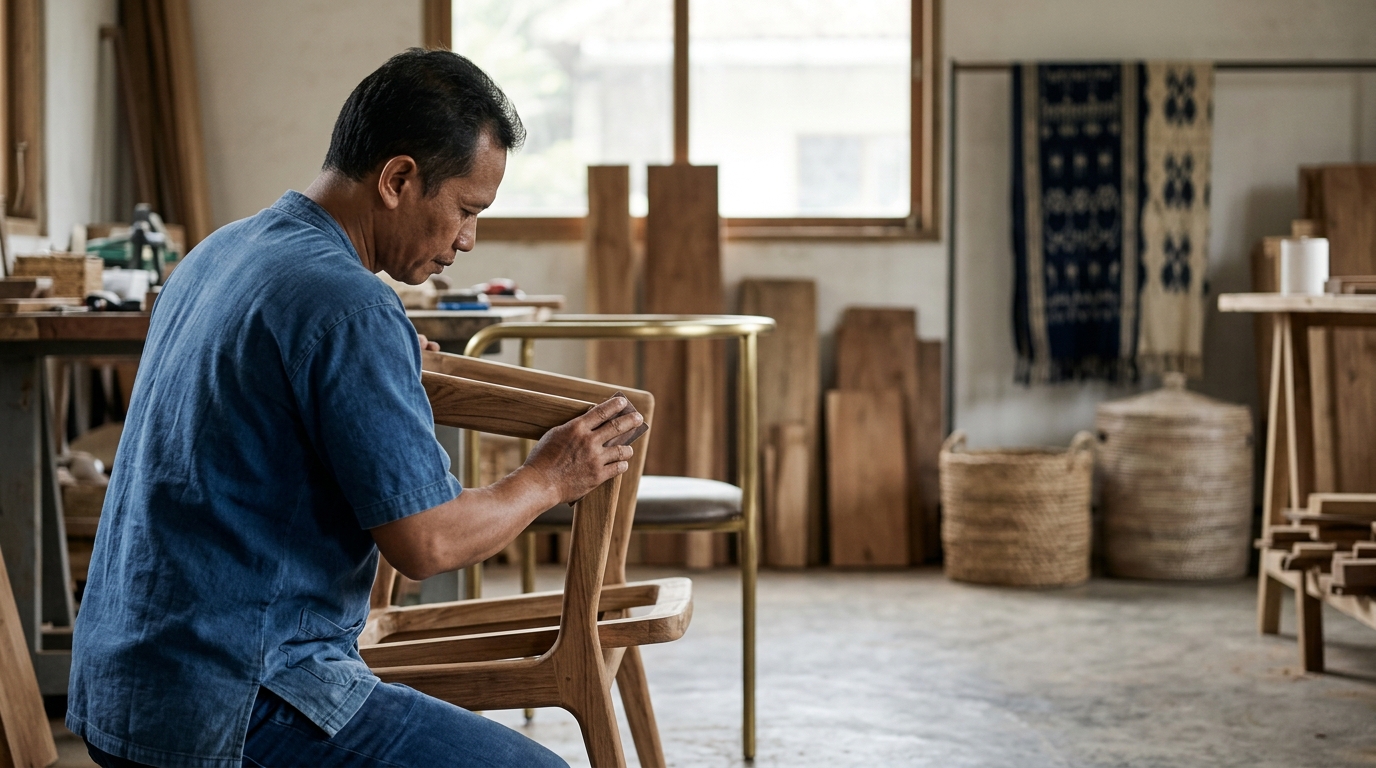
Sourcing boutique hotel furniture Indonesia custom is not the same as buying from a catalog. You are making design decisions, managing supplier relationships across 12 time zones, and committing significant capital before a single piece arrives.
Sourcing boutique hotelfurniture Indonesiacustom is not the same as buying from a catalog. You are making design decisions, managing supplier relationships across 12 time zones, and committing significant capital before a single piece arrives.
This guide focuses on the decisions that actually matter. It covers defining your design brief before approaching any manufacturer, planning realistic lead times, and mixing custom and catalog pieces to control costs. It also explains how to verify a supplier can deliver hospitality-grade work in small-lot quantities.
Indonesia — specifically the clusters in Jepara, Bali, and Cirebon — offers a compelling combination of craft heritage, material richness, and cost-to-value that is difficult to match from Europe or North America. But that advantage only materializes if you approach the sourcing process with discipline.
Why Independent Hotels Choose Indonesia for Custom Furniture
Indonesia sits in a distinct position among Asian furniture-producing countries. China dominates volume and automation. Vietnam has built a strong export base for solid wood dining and bedroom sets.
The Craft Clusters That Matter for Hospitality
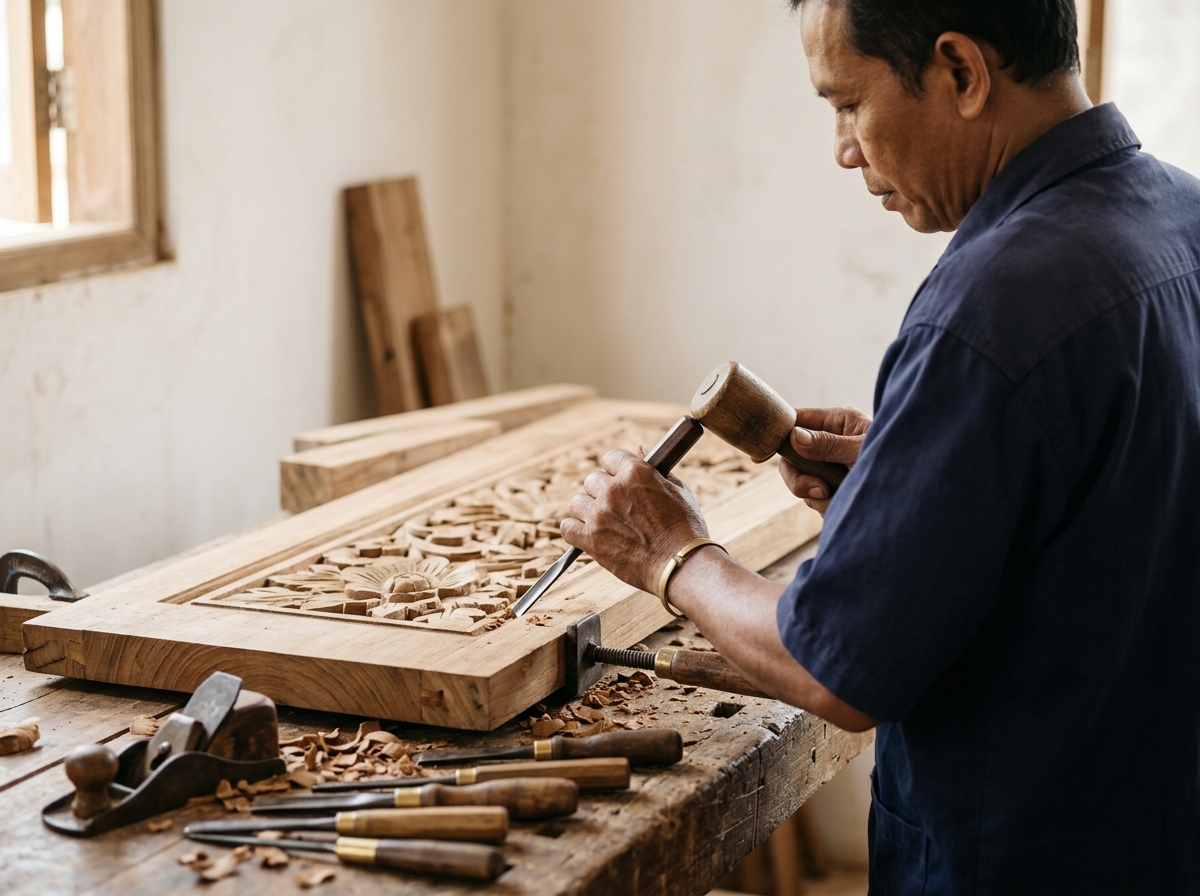
Three regions drive most hospitality-grade production. Jepara, in Central Java, is the country's largest woodworking cluster — known specifically for carved and solid teak and mahogany furniture. Bali hosts a concentration of luxury artisan workshops serving villa and resort clients, with stronger design sensibility and higher per-unit prices.
These are not interchangeable. A Jepara factory optimized for solid teak casegoods will not necessarily produce tight rattan weave to resort quality. Match the cluster to your material and category requirements before you start outreach.
Materials Available and Their Hospitality Suitability
| Material | Primary Source | Hospitality Advantage | Watch Points |
|---|---|---|---|
| Teak (old-growth) | Jepara, Java | Exceptional durability, oils naturally | Verify FSC or SVLK certification |
| Reclaimed teak | Java, Bali | High design value, sustainability story | Inconsistent sizing; factor in waste |
| Suar wood | Java | Wide slabs, dramatic grain | Prone to cracking without proper kiln-drying |
| Mahogany | Java | Cost-effective, stable | Lighter weight than teak; finish-dependent |
| Rattan | Cirebon | Lightweight, coastal aesthetic | Requires indoor or semi-covered application |
| Bamboo | Bali | Sustainable, low cost | Limited load-bearing use cases |
Sustainability Credentials Are Improving
FSC-certified supply chains exist in Indonesia, though coverage is not universal. The country also operates the SVLK (Sistem Verifikasi Legalitas Kayu) — a mandatory timber legality verification system required for wood product exports. SVLK compliance is a baseline; FSC certification indicates a higher standard of forest management.
The Small-Lot Reality: What 20–80 Keys Actually Means for Procurement
A 40-key boutique hotel might need approximately 40 bed frames, 80 nightstands, 40 desks, 40 desk chairs, 40 lounge chairs, and associated casegoods. That totals somewhere around 280 to 350 pieces across six or more SKUs. To a Jepara factory running 500-piece minimum order quantities for chain hotel programs, that is a small, fragmented, high-touch order.
MOQ Realities and Supplier Selection
Large OEM factories in Indonesia typically set MOQs at 50 to 100 pieces per SKU. Some mid-size factories that have built hospitality portfolios will accept 20 to 30 pieces per SKU for custom small-lot production — but they will price accordingly.
The practical implication: a boutique project often works best with a mid-size manufacturer that explicitly markets to the hospitality segment, rather than the largest factory in a cluster.
Per-Unit Cost at Small-Lot Scale
Small-lot custom runs carry higher per-unit costs than chain-scale orders. This is structural, not negotiable. Setup, tooling, sampling, and quality oversight costs spread across fewer pieces. A realistic approach is to benchmark your per-unit target against Indonesian pricing at small-lot scale — not against prices you may have seen quoted for 200-piece runs.
Negotiating Without Chain Purchasing Power
You cannot replicate chain leverage. You can, however, offer things smaller factories value: clear briefs, fast decision-making, timely deposits, and repeat order potential. Framing the relationship as long-term — even if this is your first project — gives a supplier reason to prioritize your run over larger but more demanding clients.
Defining Your Design Direction Before Approaching Any Manufacturer
Approaching an Indonesian manufacturer without a brief wastes time on both sides. The more defined your direction, the faster quoting and sampling move. This is especially true for boutiquehotel FF&Esourcing Indonesia, where design-led outcomes require upfront investment in specification.
What a Useful Brief Contains
At minimum, a workable brief includes:
- Mood board (3 to 5 reference images per furniture category) - Material palette with preferred species and finish direction - Dimension specs for each piece (overall dimensions, seat height, tabletop thickness) - Quantity by SKU - Delivery destination and target in-room date - Budget range per piece (FOB Indonesia)
Without dimensions and quantities, a manufacturer cannot quote accurately. Without mood boards, sample development becomes a guessing exercise.
Deciding What to Customize vs. Adapt
Not every piece needs to be fully custom. Consider which items carry the most design weight in the guest experience — typically the bed frame, lounge chair, and dining or desk chair. These are worth full custom development.
Common Design Styles Indonesian Manufacturers Execute Well
- Balinese: carved teak detailing, dark stains, canopy structures - Japandi: clean lines, natural linen, light suar or bamboo - Coastal Colonial: rattan accents, whitewashed finishes, plantation-style forms - Rustic Modern: reclaimed teak slabs, raw-edge tables, matte black hardware
Mixing Custom and Catalog Pieces as a Cost-Control Strategy
A common misconception among first-time independent hotel owners is that boutique hotel furniture Indonesia custom means every piece is bespoke. It does not. A disciplined mix of custom statement pieces and catalog adaptations is standard practice among experienced FF&E designers.
A Sample Cost-Split Framework for a 30-Key Property
Assume approximately 210 total pieces across a 30-key property.
| Category | Custom or Catalog | Approx. Share of FF&E Budget |
|---|---|---|
| Bed frames (statement design) | Full custom | 25–30% |
| Lounge and accent chairs | Full custom | 15–20% |
| Nightstands and side tables | Catalog with finish mod | 10–12% |
| Desks and desk chairs | Catalog with finish mod | 10–12% |
| Luggage racks, benches | Catalog standard | 5–8% |
| Public area and lobby pieces | Full custom | 15–20% |
| Contingency | — | 10% |
These splits are approximate and will shift based on your design priorities. The principle holds: concentrate custom spend where guests will notice it.
Maintaining Visual Coherence
Blending custom and catalog pieces risks visual fragmentation. Avoid it by specifying a consistent finish palette — stain tone, hardware metal, and upholstery fabric family — across all pieces regardless of whether they are custom or catalog.
Realistic Lead-Time Planning for Custom Indonesian Furniture
Custom furniture lead time Indonesia is frequently underestimated. Buyers focus on production time and overlook the cumulative weeks consumed by sampling, approval, and ocean freight.
A Backward Schedule From Opening Date
Assume a US East Coast hotel opening on 1 June. Working backward:
| Milestone | Timing From Opening |
|---|---|
| Furniture installed and punch-list complete | Week of 1 June |
| Trucking from port to property | Minus 1–2 weeks |
| US customs clearance | Minus 1–2 weeks |
| Ocean freight (East Coast) | Minus 6–8 weeks |
| Quality inspection and container loading | Minus 1 week |
| Production complete | Minus 10–14 weeks |
| Sample approval confirmed | Minus 14–18 weeks |
| First sample received and reviewed | Minus 16–20 weeks |
| Purchase order placed with 50% deposit | Minus 18–22 weeks |
That places your purchase order approximately 18 to 22 weeks before opening — roughly 5 to 6 months out, before accounting for design development. Start your brief development at least 6 to 8 months before your target opening.
- ✓Design brief finalized and shared with shortlisted suppliers
- ✓Samples requested and deposit paid
- ✓First samples received and reviewed
- ✓Sample revision (if required) confirmed
- ✓Purchase order placed with production deposit
- ✓Mid-production QC inspection scheduled
- ✓Final QC and loading confirmation received
- ✓Bill of lading and shipping documents obtained
- ✓Customs broker engaged and HTS codes confirmed
- ✓Delivery and installation crew scheduled
Setting Realistic FF&E Budgets Without Brand Standards
Independent boutique hotel furnitureprocurement Indonesiaoperates without the guardrails of a brand standards document. That means you set your own per-key FF&E target — and the range is wide.
Per-Key FF&E Spend Benchmarks
Per-key FF&E spend for independent boutique properties typically ranges from approximately $8,000 to $25,000 per key, depending on design intensity, material quality, and property positioning. Budget properties at the lower end often use catalog-dominant strategies.
Indonesian custom furniture typically prices at a meaningful discount to equivalent US domestic or European custom production — commonly 30 to 50 percent lower on a landed cost basis, after freight and duties. That differential is the core economic case for Indonesia sourcing.
Hidden Cost Line Items
Buyers routinely underestimate these line items:
- Samples: Initial samples from 3 to 4 suppliers can cost $1,500 to $4,000 in production and shipping fees - Revisions: Each revision round adds 2 to 4 weeks and may carry a small production charge - Quality control: A third-party pre-shipment inspection typically costs $300 to $600 per inspection day - Ocean freight: LCL and FCL rates fluctuate; budget approximately $3,000 to $7,000 per 20-foot container equivalent to US ports (rates vary significantly — get current quotes) - US import duties: See logistics section below - Contingency: Budget 10 percent of total FF&E for small-lot custom production; 15 percent if this is your first Indonesia sourcing project
Vetting Indonesian Furniture Manufacturers for a Boutique Project
Supplier verification is where many independent buyers make their most costly mistakes. An online presence, an Alibaba Gold badge, or a polished catalog does not confirm hospitality production capability.
Credentials to Verify Before Sampling
- Export experience to the US market specifically (ask for references) - Hospitality portfolio with named properties or verifiable project images - SVLK certification (mandatory for export; its absence is a hard red flag) - FSC chain-of-custody certification (if sustainability positioning matters to your project) - Ability to provide production photos and video during manufacturing
Questions to Ask Before Placing a Sample Order
- What is your minimum order quantity per SKU for custom hospitality furniture? - Can you share two or three references from US hotel buyers? - Who manages your export documentation and customs compliance? - What finish durability standards do you apply to hospitality pieces? - What is your current production queue, and when can you start a new custom run?
Red Flags in Supplier Communication
- Refusal to disclose whether they are a manufacturer, trader, or export agent - Quoting without asking for dimensions or quantities - Pressure to pay a large deposit before samples are approved - No hospitality portfolio — only residential catalog work - No SVLK documentation available
On-Site vs. Remote Quality Control
US-based buyers have two practical options. Remote QC relies on production videos and photos provided by the supplier, plus a third-party inspection agency conducting a pre-shipment check. On-site visits by the buyer or a Bali-based FF&E project manager provide deeper visibility but add travel cost and time.
Design Development and Sample Approval Across Time Zones
Indonesia is UTC+7 to UTC+9, depending on the island. A US West Coast buyer is 15 to 17 hours behind. East Coast buyers are 12 to 13 hours behind. This time difference is manageable but requires structured communication.
Managing Remote Design Iteration
Establish a weekly video call cadence during active sample development. Use async tools — WhatsApp voice notes, annotated photos — for day-to-day feedback. Expect one to two working days for response turnaround on detailed questions. Build this into your schedule assumptions.
What the Sample Approval Process Should Confirm
Before authorizing full production, your sample approval should document:
- Exact dimensions matching your brief - Finish color and sheen confirmed against a physical sample chip - Joinery method and structural integrity confirmed - Upholstery fabric and stitching pattern confirmed (if applicable) - Hardware specification confirmed
A formal sample approval sign-off — even an email exchange with explicit confirmation language — protects you if full-production pieces deviate from the approved sample. Make it explicit in your purchase order that production must match the approved sample.
When to Engage an Independent FF&E Consultant
If your project involves more than five custom SKUs, a total FF&E budget above approximately $300,000, or if this is your first Indonesia sourcing engagement, an independent FF&E consultant or Bali-based sourcing agent adds meaningful value. They can conduct factory visits, manage sample rounds, and handle pre-shipment inspection without requiring your personal travel.
Materials, Performance Standards, and Sustainability for Hotel Furniture
Indonesia teak hotel furniture has a long hospitality track record. But not all wood species or production methods are equally suited to hotel use.
Performance Requirements for Hospitality Grade
Hotel furniture endures significantly more stress than residential pieces. Key requirements:
- Joinery: Mortise-and-tenon or dowel joinery with wood glue; avoid furniture relying solely on screws through MDF - Finish durability: Catalyzed lacquer or oil finishes that resist moisture, cleaning chemicals, and abrasion; confirm minimum number of finish coats - Hardware: Specify soft-close drawer hardware, solid brass or stainless fittings; avoid zinc alloy hardware in coastal or humid environments - Kiln-drying: Wood moisture content should be 8 to 12 percent before production; suar wood is especially prone to cracking if not properly dried
Wood Species Assessment
| Species | Durability | Workability | Relative Cost | Best Use in Hotel |
|---|---|---|---|---|
| Old-growth teak | Excellent | Good | High | Casegoods, outdoor, bed frames |
| Reclaimed teak | Excellent | Moderate | High | Statement tables, accent pieces |
| Suar (rain tree) | Good | Good | Moderate | Dining tables, side tables |
| Mahogany | Good | Excellent | Moderate | Casegoods, carved pieces |
| Rattan (natural) | Moderate | High craft | Moderate | Chairs, headboards, accents |
Certification Schemes
- SVLK (Sistem Verifikasi Legalitas Kayu): Mandatory Indonesian timber legality verification for export. All Indonesian wood furniture exports should carry SVLK documentation. - FSC (Forest Stewardship Council): Voluntary, internationally recognized standard for responsible forest management. Request chain-of-custody certificates. - These are distinct schemes. SVLK confirms legal origin; FSC confirms sustainable forest management. For US buyers with sustainability commitments, FSC is the stronger claim.
Logistics, Import Duties, and US Customs for Indonesian Wood Furniture
This is the section most sourcing guides skip. It is also where unexpected costs appear late in the project.
HTS Codes and US Tariff Rates
Indonesian wood furniture is generally classified under HTS Chapter 94. Common subheadings include 9403.30 (wooden office furniture), 9403.50 (wooden bedroom furniture), and 9403.60 (other wooden furniture). As of current schedules, Indonesia is not subject to the Section 301 tariffs applied to Chinese goods.
LCL vs. FCL for Boutique Hotel Quantities
| Shipment Type | When to Use | Trade-Off |
|---|---|---|
| LCL (Less than Container Load) | Orders below approximately 10–12 CBM | Lower cost, slower transit, more handling risk |
| FCL (Full Container Load) | 20-key+ orders; approx. 25–33 CBM fills a 20-ft container | Higher upfront cost, faster and safer transit |
A 40-key property receiving approximately 300 pieces will typically fill one to two 20-foot containers. FCL is almost always preferable at this scale — reduced handling damage, lower per-CBM freight rate, and faster customs clearance.
Working With a Freight Forwarder
Engage a freight forwarder with documented furniture and hospitality import experience before your purchase order is placed. They will advise on HTS classification, assist with the Importer Security Filing (ISF, required 24 hours before vessel loading), and coordinate with the US customs broker on entry documentation.
Delivery and Installation Coordination
White-glove delivery — unpacking, debris removal, room-by-room placement — is not standard in furniture freight quoting. Budget for it separately, or confirm with your general contractor that their scope includes furniture placement. Establish a punch-list process at delivery: photograph damage, mismatched finishes, or dimension deviations immediately, before the freight carrier is released.
Frequently Asked Questions
Is furniture made in Indonesia good quality for hotel use?
Yes — when sourced from the right supplier type. Indonesia has a deep tradition of handcrafted hotel furniture Bali and Jepara have developed for luxury resort and villa markets over decades. The qualifier is supplier selection: a hospitality-focused manufacturer with an export portfolio will produce to a different standard than a residential workshop.
Who makes custom furniture for boutique hotels in Indonesia?
Production is concentrated in mid-size factories and artisan workshops in Jepara (teak and mahogany), Bali (luxury artisan and design-led), and Cirebon (rattan). The most reliable route for US buyers is a manufacturer with documented US export history, SVLK certification, and a verifiable hospitality client portfolio.
What wood species are Indonesian hotel furniture pieces typically made from?
Teak is the most prominent — both old-growth and reclaimed. Suar wood (also called rain tree) is widely used for slab tables and accent pieces. Mahogany is common for carved and casegood work. Rattan and bamboo appear in accent furniture and headboards.
How long does custom hotelfurniture from Indonesiatake to arrive in the US?
Allow 18 to approximately 22 weeks from purchase order to delivery for a US East Coast property, inclusive of production, sampling, QC, ocean freight, and customs clearance. West Coast transit is approximately two weeks faster.
What is the minimum order quantity for custom Indonesian hotel furniture?
It depends on the supplier type. Large OEM factories typically require 50 to 100 pieces per SKU. Mid-size hospitality-focused manufacturers often accept 20 to 30 pieces per SKU at a higher per-unit price. Artisan workshops can go as low as 10 pieces but may lack robust export documentation capability.
How do I verify an Indonesian furniture manufacturer's hospitality credentials?
Request a portfolio of completed hotel or resort projects with verifiable names or images. Ask for two to three US buyer references and contact them. Confirm SVLK export certification. If budget allows, engage a third-party inspection agency or a Bali-based sourcing agent to conduct an on-site factory audit before your purchase order.
Sourcing boutique hotel furniture Indonesia custom is a process-dependent discipline. Get the brief right, choose the correct supplier tier for small-lot custom work, build a backward schedule from your opening date, and account for the full landed cost — including duties, freight, and QC — before committing your FF&E budget.
You now have a clear framework for the decisions ahead. The logical next step is to put it to work with real suppliers.
You understand the process. Now validate the specifics for your project: per-piece pricing at your exact quantities, current production lead times, and sample availability. Request custom furniture samples and lead-time quotes from vetted Indonesian manufacturers today — with your brief in hand, you will get accurate answers fast.
Request Samples and Quotes →Need eyes on the ground in Indonesia?
MTS is an execution partner — supplier verification, manufacturing management, quality control and export logistics across Indonesia, Vietnam and China.
Related services
Related articles
Receive furniture sourcing insights across Asia.
One email per week. No spam.