Indonesian Basalt Stone Suppliers: Tiles, Slabs and Cut-to-Size Procurement Guide
12 min read
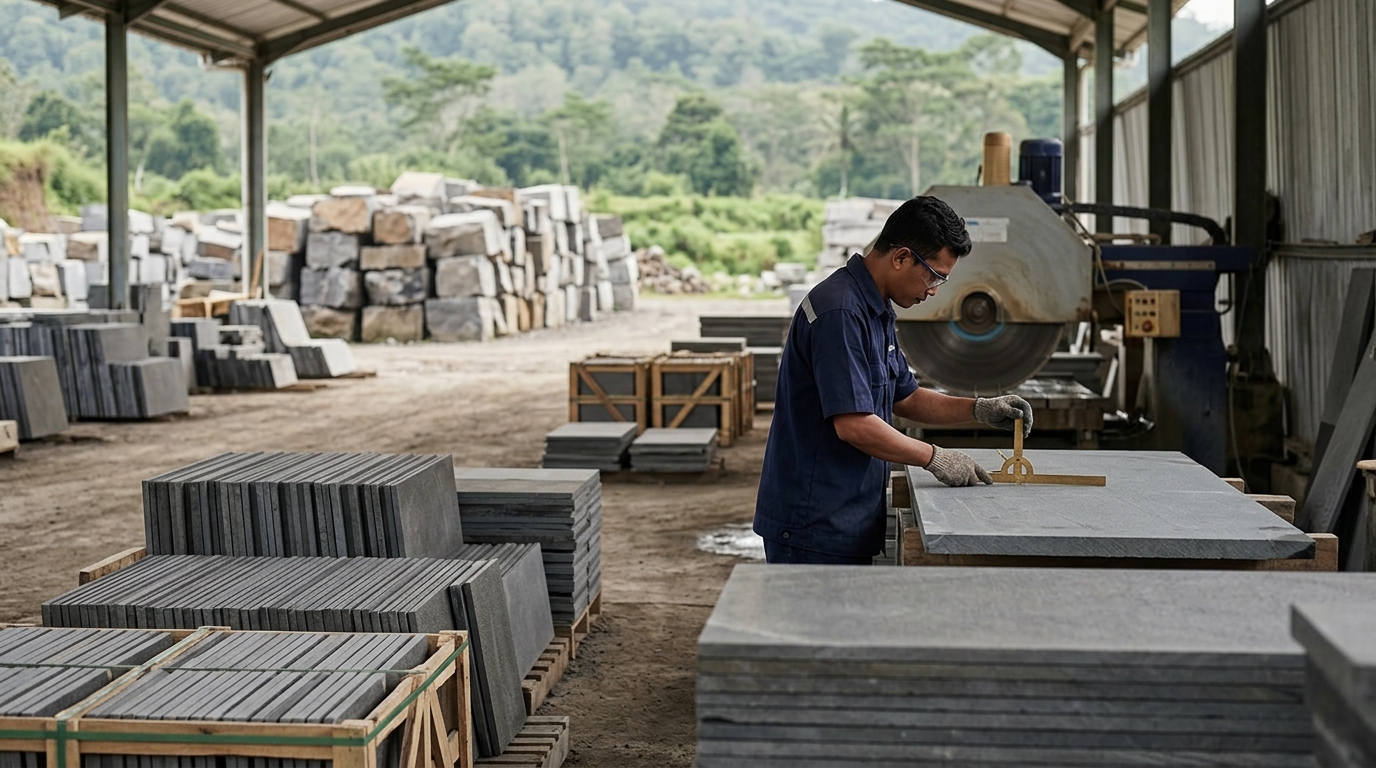
Sourcing basalt stone suppliers indonesia tiles slabs from overseas is a high-stakes decision. Specification errors, inconsistent batch colour, or a poorly vetted exporter can derail a commercial project timeline and inflate landed costs significantly. US buyers — whether procurement managers,…
Sourcing basaltstone suppliers indonesiatiles slabs from overseas is a high-stakes decision. Specification errors, inconsistent batch colour, or a poorly vetted exporter can derail a commercial project timeline and inflate landed costs significantly. US buyers — whether procurement managers, architectural specifiers, or stone importers — face these risks every time they engage a new Indonesian supplier remotely.
This guide addresses the full procurement decision: geology and product formats, surface finishes and technical specifications, supplier qualification, pricing structures, and US import cost implications. It covers what competitors omit — ASTM and EN benchmark testing, freeze-thaw suitability for northern US climates, and HTS code guidance for calculating true landed cost. Each section is structured around the questions buyers actually ask before committing to a container order.
Indonesia has emerged as a serious origin for commercial basalt. Its volcanic geology produces dense, low-absorption stone that competes directly with Chinese and Indian alternatives on quality — and often on price. Understanding where that stone comes from, how it performs, and how to qualify the supplier behind it is the difference between a successful import program and an expensive mistake.
Why Indonesian Volcanic Geology Makes It a Top Commercial Basalt Source
The geology behind high-density Indonesian basalt
Indonesia sits on the Pacific Ring of Fire. Centuries of volcanic activity across Java, Bali, and Sumatra have deposited extensive basalt formations. These geological conditions produce stone with high crystalline density — typically in the range of approximately 2.8 to 3.0 g/cm³ — which is competitive with basalt from most other global origins.
East Java is the most commercially significant quarrying region. Deposits near Malang and Pasuruan yield consistent dark grey to near-black basalt with tight grain structure. West Java produces lighter grey variants. Bali quarries supply smaller volumes, often preferred for architectural and hospitality projects where aesthetic variation is acceptable.
Competitive position against Chinese and Indian basalt
| Criterion | Indonesian Basalt | Chinese Basalt | Indian Basalt |
|---|---|---|---|
| Typical density (g/cm³) | ~2.8–3.0 | ~2.7–2.9 | ~2.7–2.95 |
| Colour consistency | Moderate–high | High (industrial scale) | Moderate |
| Factory processing capacity | Medium–large | Very large | Medium |
| FOB price position | Competitive | Lower on volume | Comparable |
| Freight to US West Coast | Moderate | Moderate | Higher |
| Artisan/custom CTS capability | Strong | Limited | Moderate |
Chinese basalt benefits from massive industrial output and lower unit pricing on very large orders. However, colour consistency from Indonesian quarries has improved markedly, and East Java suppliers increasingly offer calibrated tiles and slabs that meet hospitality-grade standards. Indian basalt is generally comparable in quality but carries higher ocean freight costs to US ports.
Primary end-use sectors
Indonesian basalt is regularly specified across:
- Hospitality: hotel lobby flooring, pool surrounds, outdoor terraces - Commercial interiors: retail floor tiles, featurewall cladding- Landscape architecture: pavers, stepping stones, water features - Residential high-end: exterior cladding, bathroom floors
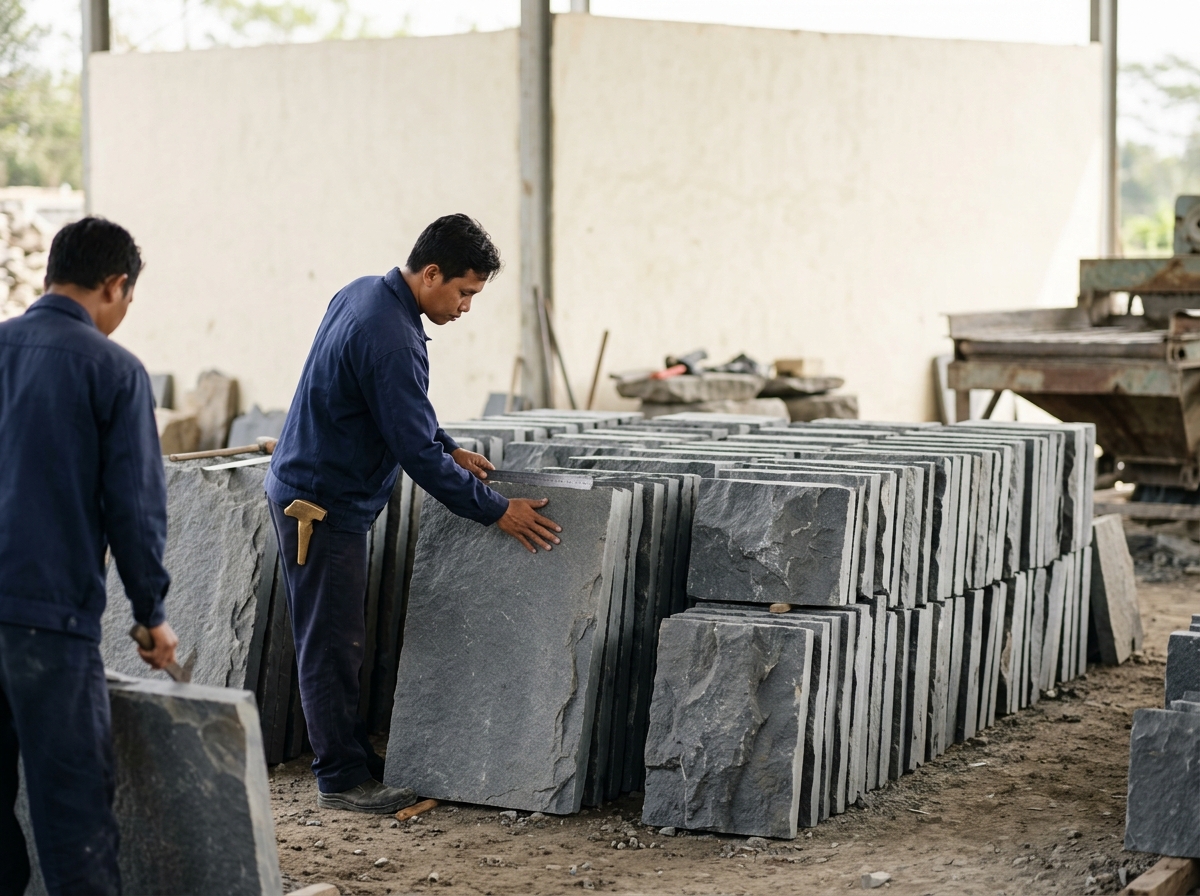
Grey vs Black Indonesian Basalt: Technical and Visual Differences That Matter to Buyers
Mineralogical and visual distinctions
Indonesian basalt occurs in two commercially dominant colour types: grey and black. The distinction is mineralogical, not cosmetic.
Grey basalt contains higher proportions of plagioclase feldspar, producing a medium to dark grey tone with subtle crystalline variation. It is the more commonly exported type from East Java and West Java.
Black basalt has a higher pyroxene and magnetite content. It reads as near-black under most lighting conditions. Bali and select East Java quarries produce this variant. It commands a modest price premium due to lower extraction volumes.
| Feature | Grey Basalt | Black Basalt |
|---|---|---|
| Primary minerals | Plagioclase-dominant | Pyroxene/magnetite-dominant |
| Colour range | Medium grey to charcoal | Charcoal to near-black |
| Typical density | ~2.80–2.95 g/cm³ | ~2.90–3.00 g/cm³ |
| Absorption rate | ~0.3–0.8% | ~0.2–0.5% |
| Best applications | Flooring, cladding, pavers | Feature walls, water features, premium interiors |
| Price premium vs grey | Baseline | Approximately 10–20% higher (indicative) |
Colour consistency and batch variation risks
Colour consistency varies by quarry depth and extraction batch. A single quarry can produce noticeably lighter or darker material as the seam is worked. For large commercial orders, request production samples from the specific batch — not showroom reference pieces. Ask suppliers to photograph material in natural daylight against a grey reference card.
For projects requiring strict colour matching across multiple containers, specify the quarry location, extraction zone (when possible), and request that the supplier hold stock from a single batch.
Product Formats Available From Indonesian Basalt Stone Suppliers: Tiles, Slabs, and Pavers
Standard tile sizes and calibration
Indonesian factories producing basaltstone suppliers indonesiatiles slabs offer standard formats including:
- 30 × 30 cm, 40 × 40 cm, 60 × 60 cm (most common export sizes) - 30 × 60 cm and 60 × 120 cm (available from larger facilities) - Thickness: typically 10 mm, 15 mm, or 20 mm for floor tiles; 8 mm for wall tiles
Calibration tolerance at reputable factories is generally ±1 mm in thickness and ±0.5 mm in dimension. Always request a calibration certificate or sample measurement report before approving production.
Slab dimensions for countertops and feature walls
Basalt slabs from Indonesia are less standardised than tiles. Typical slab dimensions range from approximately 180 × 60 cm to 260 × 140 cm, with thicknesses of 20 mm, 30 mm, or custom profiles up to 50 mm. Slab availability depends heavily on quarry yield — not all factories maintain consistent slab inventory.
Cut-to-size programs and paver formats
Cut-to-size (CTS) programs are available from mid-to-large Indonesian stone factories. Key parameters:
- MOQ: typically 50–100 m² per size/finish combination (indicative; varies by supplier) - Lead time: approximately 4–8 weeks from order confirmation, depending on factory load - Dimensional tolerance: ±1 mm standard; tighter tolerances (±0.5 mm) available at premium - Paver formats: commonly 20 × 20 cm, 30 × 30 cm, 40 × 40 cm, and irregular/crazy paving for landscape use; thickness 20–40 mm for load-bearing exterior applications
Surface Finishes for Indonesian Basalt and Their Best-Fit Applications
Indonesian suppliers offer five primary surface finishes. Each affects both aesthetics and technical performance.
| Finish | Texture | Slip Resistance | Best Application |
|---|---|---|---|
| Flamed | Rough, open pore | High | Pool decks, exterior paths, driveways |
| Honed | Smooth, matte | Moderate | Interior floors, wall cladding |
| Polished | Glossy | Low | Feature walls, reception areas |
| Bush-hammered | Heavily textured | Very high | Heavy-traffic exterior, rustic interiors |
| Sandblasted | Medium texture, aged look | High | Landscape, commercial façades |
Flamed finish is produced by applying high heat to the stone surface, causing surface minerals to fracture and create a coarse, non-slip texture. It is the standard recommendation for pool decks and exterior terraces. The thermal process does not compromise structural integrity for properly dense basalt.
Honed finish is the most commonly ordered format for interior commercial flooring. It provides a consistent matte surface that is easy to maintain and moderately slip-resistant when dry.
Polished finish increases water absorption risk on exterior applications. Use it only in covered or fully interior environments.
Technical Specifications US Buyers Must Verify Before Ordering Indonesian Basalt
This is where most buyers underinvest. Requesting a test report takes one email. Skipping it can result in stone failures in freeze-thaw climates or rejected shipments.
Key performance benchmarks
| Parameter | Indonesian Basalt (typical) | Test Standard to Request |
|---|---|---|
| Density | ~2.80–3.00 g/cm³ | ASTM C97 / EN 1936 |
| Water absorption | ~0.2–0.8% by weight | ASTM C97 / EN 13755 |
| Compressive strength | ~180–280 MPa (indicative) | ASTM C170 / EN 1926 |
| Modulus of rupture | ~15–25 MPa (indicative) | ASTM C99 / EN 12372 |
| Frost resistance | Pass (typically ≥25 cycles) | ASTM C880 / EN 12371 |
| Abrasion resistance | Low wear index | ASTM C241 / EN 14157 |
Standards to cite in your purchase order
- ASTM C615: specification for granite dimension stone (often used as a proxy benchmark for hard volcanic stone when ASTM C503 — marble — is inapplicable) - ASTM C503: dimension marble; note that basalt is harder and denser, but some buyers reference C503 thresholds as a floor for absorption and strength - EN 12057: modular tiles — dimensional tolerances and flatness requirements - EN 12371: freeze-thaw resistance test
Specify in writing which test reports are required before shipment approval. Reputable basalt stone suppliers indonesia tiles slabs operations will have current third-party lab certificates — not internally generated data sheets.
Evaluating Indonesian Basalt Supplier Quarry Capacity and Batch Consistency
Questions to ask every potential supplier
Before placing a trial order, qualify suppliers on these operational criteria:
- ✓Confirm monthly production capacity in m² for your specific format and finish
- ✓Request photos of current stockpile with batch reference numbers
- ✓Ask for calibration measurement reports from recent production runs
- ✓Confirm quarry location (East Java / West Java / Bali) and extraction zone
- ✓Request third-party lab test certificates for density, absorption, and frost resistance
- ✓Verify export licence (Nomor Induk Berusaha / NIB in Indonesia)
- ✓Ask about subcontracting — is cutting and finishing done in-house or outsourced?
- ✓Request two pre-production samples: one honed, one in your specified finish
- ✓Confirm container loading capability and current lead times
- ✓Ask for references from US or European buyers with verifiable order history
Red flags in supplier assessment
- Inconsistent slab thickness: variation beyond ±1.5 mm across a sample set indicates poor calibration equipment or inconsistent process control. - Showroom samples don't match production: always request samples cut from current stock, not marketing pieces. - Vague quarry sourcing: suppliers who cannot confirm the quarry region are likely trading, not manufacturing. - No test certificates: any supplier exporting to the US market should hold current third-party test data. Absence is a disqualifying signal. - Unreliable lead time communication: ask for a production schedule in writing. Vague responses indicate capacity constraints or poor planning systems.
Third-party QC options in Indonesia
Several international quality inspection firms operate in Indonesia. DUPRO (during production) and pre-shipment inspections are standard practice for US buyers without an in-country presence. Reputable manufacturers welcome these inspections. Reluctance to allow third-party inspection is a strong negative signal.
Pricing, FOB Terms, and US Import Costs for Indonesian Basalt Stone Slabs
Indicative FOB pricing ranges
Pricing from Indonesian suppliers is typically quoted FOB Surabaya or FOB Denpasar (Bali). The following are indicative market ranges only — actual pricing depends on format, finish, thickness, and order volume.
| Product Format | Indicative FOB Range (per m²) |
|---|---|
| Honed tiles 30×30 or 40×40 cm | Approximately USD 18–35 |
| Honed tiles 60×60 cm | Approximately USD 22–42 |
| Flamed pavers 20×20–40×40 cm | Approximately USD 20–40 |
| Slabs (honed, 20–30 mm) | Approximately USD 35–70 |
| Cut-to-size custom profiles | Premium of approximately 20–40% over standard tile pricing |
These ranges are indicative only. Volume orders (full container loads) command lower unit pricing. Always request itemised quotations including packaging and inland freight to port.
US import tariff and HTS codes
Key cost components beyond FOB:
- Ocean freight: approximately USD 2,500–4,500 per 20 ft container (Surabaya to US West Coast); USD 3,500–6,000 to US East Coast (indicative; rates fluctuate significantly with market conditions) - Transit time: approximately 18–28 days to US West Coast (Los Angeles / Long Beach); approximately 28–38 days to US East Coast (New York / Savannah) - US import duty: currently approximately 3.7–4.8% ad valorem onnatural stonetiles under most applicable HTS codes (verify with a licensed customs broker — rates are subject to change) - ISF filing, customs clearance, drayage: budget approximately USD 500–1,200 per container (indicative)
Container loading and payment terms
A standard 20 ft container carries approximately 18–22 metric tonnes of basalt tiles (depending on thickness and packaging density). A 40 ft container carries approximately 20–26 tonnes. For large-format slabs, wooden crating reduces loadable volume.
Common payment structures from Indonesian suppliers:
- 30% T/T deposit upon order confirmation; 70% T/T before shipment - L/C (Letter of Credit) available from established exporters; preferred for orders above approximately USD 50,000 - 50/50 T/T structures are common for first-time buyer relationships
How to Qualify and Vet Indonesian Basalt Suppliers Remotely Without an In-Country Presence
Documentation and certification signals
A credible Indonesian stone exporter should be able to provide:
- Nomor Induk Berusaha (NIB): Indonesia's business registration identifier — confirms legal operating status - Export licence documentation: absence suggests a trading intermediary rather than a direct manufacturer - ISO 9001 quality management certification: not universal among stone suppliers, but a positive signal where present - Third-party lab test certificates: dated within the past 12–24 months, from a recognised testing laboratory
Sample strategy for remote buyers
Request two sample stages before committing to a container:
1. Pre-production reference samples: small cut pieces (approximately 20 × 20 cm) in each specified finish. These establish colour range and surface quality expectations. 2. Production confirmation samples: cut from the actual production batch, sent before container loading. These confirm batch consistency.
Never accept FOB payment terms without a production sample approval step written into the purchase order.
Directories vs direct outreach
Platforms such as StoneContact and StoneAdd list Indonesian basalt exporters, but directory listings are self-reported and unverified. Use them for initial discovery only. Cross-reference any supplier against Indonesian customs export data (available through third-party trade intelligence platforms) to verify actual export history to the US or European markets.
Direct factory outreach via trade fair contacts (such as Xiamen Stone Fair or Covering trade show exhibitor lists) typically yields more production-capable suppliers than directory-only searches.
Frequently Asked Questions From US Buyers Sourcing Indonesian Basalt
Is Indonesian basalt frost-resistant enough for outdoor use in cold US climates?
Indonesian basalt with water absorption below approximately 0.5% by weight is generally suitable for freeze-thaw environments. Request EN 12371 or ASTM C880 test results. Stone with absorption above 0.8% carries meaningful freeze-thaw spalling risk in USDA zones 1–6. Always specify frost-resistance certification for any northern US exterior project.
What is the minimum order quantity for basalt tiles from Indonesian suppliers?
MOQs vary. Many Indonesian factories set minimums at approximately 50–100 m² per SKU (size and finish combination) for standard tile formats. Cut-to-size and custom dimension programs typically require 100 m² or more. Full container load orders (approximately 400–600 m²+ for 20 mm tiles) attract the best unit pricing.
How does grey Indonesian basalt compare to Chinese basalt in quality and price?
Quality is comparable for dense, well-calibrated material from established East Java producers. Chinese basalt benefits from larger factory scale and potentially lower unit prices at very high volumes. Indonesian grey basalt offers a tariff advantage (no Section 301 surcharges) and increasingly competitive calibration quality. For hospitality or architectural projects requiring custom CTS work, Indonesian suppliers often offer more flexible programs.
What surface finishes are available for Indonesian basalt, and which is best for pool decks?
Available finishes include flamed, honed, polished, bush-hammered, and sandblasted. For pool decks, flamed is the standard specification — it provides the highest non-slip rating and handles wet conditions well. Sandblasted is an acceptable alternative. Polished finish is not appropriate for pool surrounds or exterior wet areas.
How long does shipping from Indonesia to the US East or West Coast take?
Approximately 18–28 days to US West Coast ports (Los Angeles / Long Beach) and approximately 28–38 days to East Coast ports (Savannah, New York). These are transit-only estimates; add production lead time of 4–8 weeks for most orders.
What US import tariff codes apply to natural basalt stone tiles and slabs?
Basalt tiles and slabs are generally classified under HTS Chapter 68 (articles of stone). The most applicable heading is typically 6802.99 for worked stone not elsewhere specified. Confirm the precise 10-digit HTS code and current duty rate with a licensed US customs broker. Indonesia does not face Section 301 tariffs on stone, unlike Chinese suppliers, making the total duty burden materially lower for comparable products.
Indonesian basalt delivers a compelling combination of geological density, surface finish versatility, and competitive FOB pricing — provided buyers invest the time to verify specifications, qualify suppliers rigorously, and understand the full landed-cost picture before committing to shipment.
Procurement teams that treat supplier qualification as a one-time checkbox are the most exposed to batch inconsistency and technical failures. Building a repeatable vetting protocol — sample stages, third-party inspection, documented test certifications — converts a risky overseas purchase into a reliable supply program.
You now have the specification benchmarks, supplier qualification framework, and import cost structure to evaluate Indonesian basalt with confidence. The logical next step is to put that framework into action.
You have the specifications and the supplier qualification criteria. Now verify them against real material. Contact vetted Indonesian basalt exporters to request pre-production samples and current FOB pricing for your tile, slab, or cut-to-size program.
Request Basalt Samples and FOB Pricing →Need eyes on the ground in Indonesia?
MTS is an execution partner — supplier verification, manufacturing management, quality control and export logistics across Indonesia, Vietnam and China.
Related services
Related articles
Receive furniture sourcing insights across Asia.
One email per week. No spam.