Garden Stone Ornaments Suppliers Indonesia: B2B Sourcing Guide for Distributors
13 min read
US garden-centre buyers and landscape distributors face a concrete problem: sourcing durable, visually distinctive stone ornaments at margins that justify the import complexity. Indonesia answers that problem better than almost any other origin, but navigating its supplier landscape requires more…
US garden-centre buyers and landscape distributors face a concrete problem: sourcing durable, visually distinctive stone ornaments at margins that justify the import complexity. Indonesia answers that problem better than almost any other origin, but navigating its supplier landscape requires more than a quick Alibaba search.
This guide covers the full procurement picture for buyers targeting garden stone ornaments suppliers Indonesia: which stone materials work for which climates, how container weight math affects your freight cost, what lead times look like across product categories, and how to verify a supplier before committing to a 20-foot container. It also addresses the compliance details—HTS codes, phytosanitary rules, duty rates—that most competitor guides skip entirely.
The sections below are structured for scanning. Headings, tables, and bullet points surface the decision-critical data quickly. If you are placing your first order or renegotiating an existing supplier relationship, the logistics and pricing sections are where the financial leverage lives. Start there, then work backward into supplier qualification.
Why Indonesia Dominates the Garden Stone Ornaments Export Market
Indonesia holds a structural advantage in the global garden stone ornaments category. That advantage rests on three converging factors: raw material abundance, deep craft heritage, and competitive export logistics.
Volcanic Stone Reserves That Other Origins Cannot Match
The Indonesian archipelago sits on the Pacific Ring of Fire. This geology produces exceptional variety in workable stone.Lava stone(vesicular basalt) is abundant across Bali. Andesite deposits concentrate in Central Java. Paras stone—a soft volcanic tuff—clusters around Yogyakarta. Petrified wood comes from Sumatra and Kalimantan. East Java supplies substantial limestone reserves. No single competing origin offers this material diversity within one country's export infrastructure.
Craft Heritage and Competitive Cost Structure
Bali and Central Java have sustained stone-carving traditions for centuries. Artisan communities in these regions produce hand-carved lanterns, statues, and water features at wage rates that remain substantially below Chinese or European alternatives. The result for US distributors is a better landed-cost-per-visual-impact ratio than most competing origins deliver. Chinese machined stone is cheaper per unit at high volume, but Indonesian hand-carved ornaments command retail premiums that support better margin structures at garden-centre price points.
Export infrastructure is mature. Bali's Benoa port, Surabaya's Tanjung Perak terminal, and Semarang's port all handle container freight regularly. Consolidation services are widely available, which matters when you are mixing stone ornaments with lighter garden décor to optimize a container.
Core Product Categories Every Distributor Needs to Stock
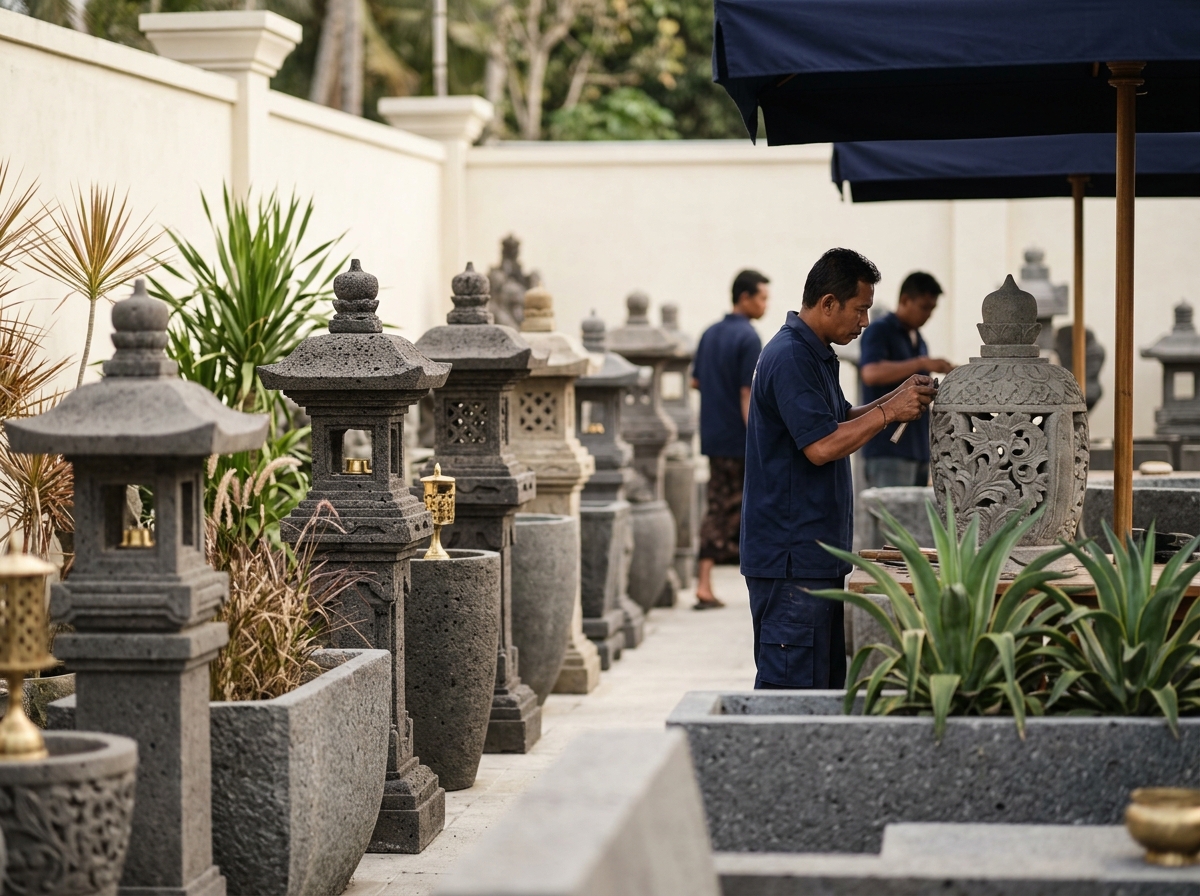
Wholesale garden stone ornaments suppliers Indonesia typically organize their catalogs into five functional groups. Understanding the weight and logistics profile of each category is as important as the aesthetic selection.
Stepping stones and paving sets Natural-face and bush-hammered pavers in andesite or limestone. Typically 5–25 kg per piece. Sold as individual pieces or coordinated sets. High reorder velocity at garden centres.
Hand-carved lanterns Japanese-style and Balinese lanterns in lava stone or andesite. Weight range approximately 15–80 kg for freestanding floor models. Tabletop variants run 5–15 kg. Among the highest-margin SKUs in the category.
Water features Tiered fountains, basins, and millstone drippers in andesite or limestone. Weight range approximately 30–200 kg per assembled unit. Often shipped disassembled. Require pump sourcing separately—confirm with supplier whether pumps are included or sourced locally.
Planters, urns, and pedestals Lava stone, paras stone, and limestone planters. Weight range approximately 8–60 kg. Frost resistance varies significantly by material—critical for northern US markets.
Decorative boulders and accent stones Natural or lightly dressed volcanic boulders. Weight 50–500 kg. Typically palletized rather than crated. Low per-unit cost but high freight weight per piece.
Hand-Carved vs Machined Production: What Buyers Must Understand
Artisan Hand-Carving
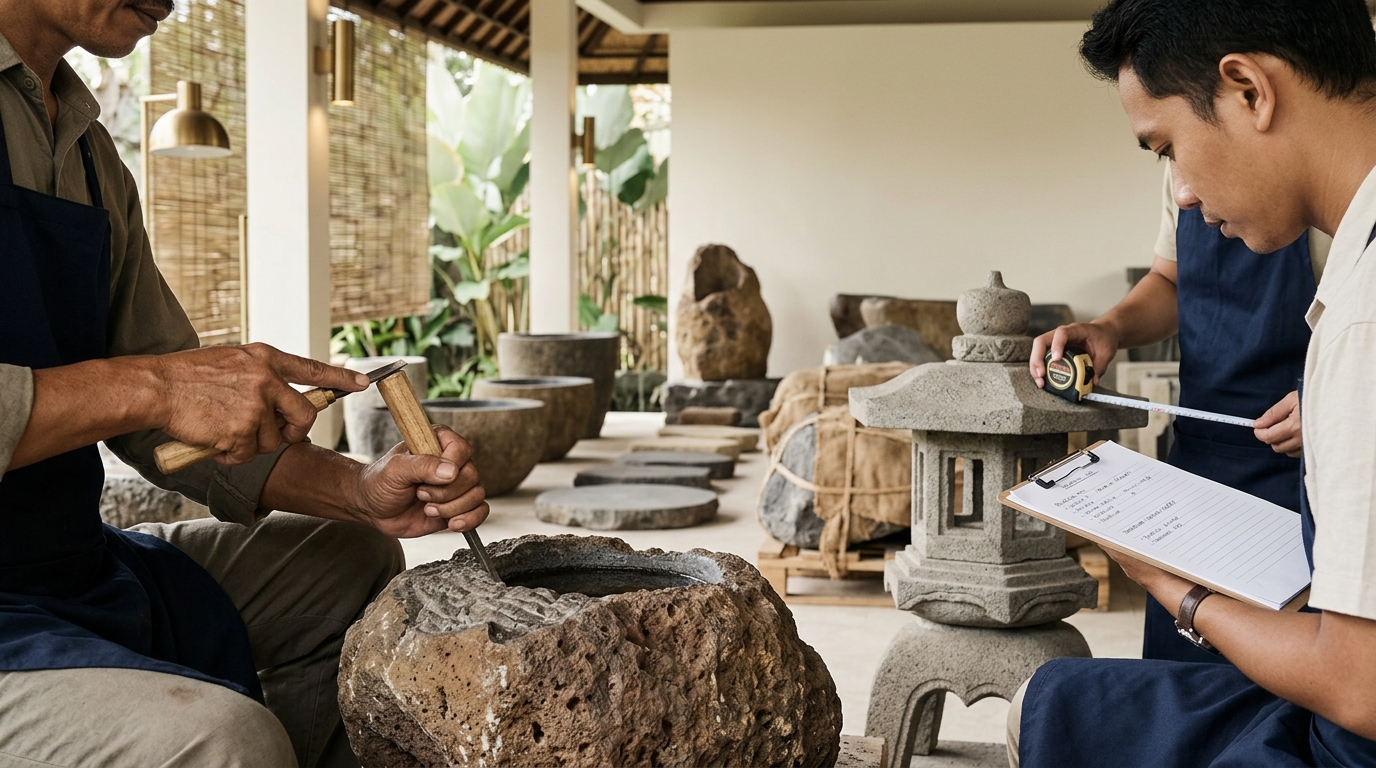
Hand-carving dominates in Bali and around Yogyakarta. Each piece carries minor dimensional variation—typically ±10–20 mm on decorative elements. Lead times run approximately 60–90 days ex-works. MOQs are lower, often 10–20 pieces per SKU. This production mode suits premium retail positioning and boutique landscape distributors. It also suits buyers who need story-value for their marketing. The trade-off is that tight dimensional tolerances cannot be guaranteed, and reorders may show slight variation from original samples.
Machine-Cut and CNC-Assisted Production
Central Java operates several facilities using CNC-assisted cutting alongside manual finishing. Tolerances tighten to approximately ±3–5 mm. Lead times run 30–45 days ex-works. Per-unit cost is lower at equivalent volumes. This suits stepping stones, paving sets, and standardized planters where dimensional consistency matters for installation. Reorder matching is more reliable.
Quality Grading and Finish Specification
Indonesian exporters commonly use two quality tiers:
- Export Grade (Grade A): No visible cracks, consistent finish, clean edges. Required for retail-facing products. - Grade B / Commercial Grade: Minor surface blemishes acceptable. Suitable for bulk paving and filler boulder sets.
Specify finish type explicitly in every purchase order. Common options:
- Rough split: Natural fractured face, maximum texture - Bush-hammered: Mechanically textured, slip-resistant, widely used for stepping stones - Sandblasted: Smooth matte surface, good for planters - Polished: High sheen, less common in garden stone but available in andesite
Stone Materials, Regional Origins, and Landscape Application Guide
The table below summarizes the four primary materials available from garden stone ornaments suppliers Indonesia. It covers buyer-critical attributes including frost resistance, which determines suitability for cold-climate US markets.
| Material | Primary Region | Typical Products | Weight Class | Frost Resistance | Approx. FOB Price Range |
|---|---|---|---|---|---|
| Lava stone (vesicular basalt) | Bali | Lanterns, small planters, wall cladding | Light–Medium (5–40 kg) | Moderate – avoid freeze-thaw cycles | Low–Mid |
| Andesite | Central Java | Pavers, boulders, water features, heavy planters | Medium–Heavy (15–200 kg) | Good – dense, low porosity | Mid |
| Paras stone (volcanic tuff) | Yogyakarta | Decorative statues, intricate carvings, relief panels | Light–Medium (5–50 kg) | Poor – high porosity, absorbs moisture | Low |
| Limestone | East Java | Stepping stones, garden walls, rough planters | Medium–Heavy (20–150 kg) | Variable – depends on density and finish | Low–Mid |
| Petrified wood | Sumatra, Kalimantan | Accent pieces, pedestals, decorative slabs | Medium (10–80 kg) | Good – fully mineralized | Mid–High |
Petrified wood from Sumatra and Kalimantan occupies a distinct niche. It is fully mineralized, making it dimensionally stable and frost-tolerant. It commands higher FOB pricing. It works well as accent pedestals or statement pieces for high-end landscape distributors.
How to Evaluate and Vet Indonesian Garden Stone Suppliers
Supplier verification is where most first-time buyers underinvest. Online platform status—whether on Alibaba, Made-in-China, or local platforms—does not substitute for direct qualification.
Business Registration and Export Licensing
Request the supplier's NIB (Nomor Induk Berusaha) business registration number. Exporters should also hold a valid export license (SIUP or its current equivalent under Indonesia's OSS registration system). Verify that their export commodity code covers stone products. A supplier who refuses to share registration documents is a high-risk counterparty.
Factory Evidence and Sample Process
- Request a video walkthrough of the production facility, not just product photos - Order a paid sample shipment before committing to a full container—typically 3–5 representative SKUs - Confirm the sample matches the finish specification you have written into the PO - Check sample weight against the supplier's stated weight per piece—discrepancies indicate poor production control
MOQ Benchmarks by Category
| Product Category | Typical MOQ (Hand-Carved) | Typical MOQ (Machined) |
|---|---|---|
| Lanterns | 10–20 pieces per SKU | 20–50 pieces per SKU |
| Planters and urns | 10–20 pieces per SKU | 25–50 pieces per SKU |
| Stepping stones | 50–100 pieces per set | 100–200 pieces per set |
| Water features | 5–10 units | 10–20 units |
| Decorative boulders | Often sold by weight (per ton) | Per ton or pallet |
Third-Party Pre-Shipment Inspection
Engage an independent inspection service before container loading. Inspectors check piece count, finish quality, dimensional compliance, and packing adequacy. This is non-negotiable for first orders and recommended on all orders above approximately USD 10,000 FOB value. Inspection fees are modest relative to the cost of a container of defective or misrepresented product.
Container Planning and Weight-Aware Logistics for Stone Products
Stone is among the densest product categories in garden décor. Payload limits, not cubic space, typically constrain your container fill strategy.
A standard 20-foot container has a maximum payload of approximately 28 metric tons. A 40-foot container allows approximately 26–28 metric tons payload (the tare weight of a 40-foot unit is heavier, reducing net payload). With dense andesite boulders or water features, you will hit weight limits well before you fill the volume.
Practical weight planning by product type:
- Stepping stone sets (andesite, 10 pieces): approximately 150–200 kg per set - Floor lanterns (lava stone, medium): approximately 25–40 kg each - Tiered fountains (andesite, 3-tier): approximately 80–180 kg assembled - Decorative boulders (medium): approximately 100–300 kg each
For crating: all carved ornaments should be individually wrapped in foam or bubble wrap, then crated in wooden frames. Crating timber must comply with ISPM 15 phytosanitary treatment requirements (heat treatment or fumigation) for entry into the United States. Confirm ISPM 15 compliance with your supplier before shipment—non-compliant wood packaging results in US Customs holds and costly fumigation on arrival.
Seasonal Ordering Cycles and Lead Times for US Garden Retailers
US garden-centre chains target a March–April floor-set for the main spring selling season. Working backward from a March 1 arrival target:
| Milestone | Target Date |
|---|---|
| Supplier selection and PO issue | August–September (prior year) |
| Sample approval | October |
| Production start (hand-carved) | October–November |
| Production start (machined) | November–December |
| Ex-works readiness (hand-carved, 60–90 days) | January–February |
| Ex-works readiness (machined, 30–45 days) | December–January |
| Ocean freight transit (approx. 25–35 days to US West Coast) | February |
| US customs clearance and drayage | Late February |
| Distribution center floor-ready | March |
Peak artisan capacity in Bali and Central Java runs through Q3–Q4. Placing orders in Q3 (July–September) captures artisan availability before the holiday period compresses production slots. Orders placed after November for hand-carved items carry meaningful risk of missing the March sell-in window.
For mid-season reorders, machined stepping stones and standard planters are the most reliable. Hand-carved custom SKUs cannot be reordered mid-season without accepting late-season delivery.
Pricing Benchmarks, MOQs, and Payment Terms to Expect
Indicative FOB Bali/Surabaya price ranges by category (approximate, subject to material, size, and finish):
| Product Category | Approx. FOB Price Range per Unit |
|---|---|
| Lava stone tabletop lantern (small) | USD 8–20 |
| Andesite floor lantern (medium) | USD 35–90 |
| Lava stone planter (medium) | USD 15–45 |
| Andesite stepping stone (single, bush-hammered) | USD 6–18 |
| Tiered andesite fountain (3-tier, approx. 120 kg) | USD 150–350 |
| Paras stone decorative statue (medium) | USD 20–70 |
| Petrified wood accent piece | USD 40–150 |
These are indicative ranges only. Actual pricing depends on dimension, finish complexity, and order volume.
Standard payment terms: - T/T 30% deposit on PO confirmation, 70% balance before shipment: most common for established relationships - T/T 50/50 for first orders from new buyers - Letter of Credit (LC at sight): available from larger exporters, adds bank cost but reduces counterparty risk
Landed cost components to model:
1. FOB price × quantity 2. Ocean freight (approximately USD 2,500–4,500 per 20-foot container to US West Coast, approximately USD 4,000–7,000 to East Coast—rates fluctuate) 3. US customs duty: HTS Chapter 68 applies to most stone ornaments. HTS 6802 covers worked decorative stone (duty rate approximately 3.2–4.9% ad valorem). HTS 6810 covers articles of artificial stone or concrete (generally 0%). Confirm classification with your customs broker—misclassification is common in this category 4. Customs broker fee: approximately USD 150–350 per entry 5. Drayage to distribution center: varies by port and distance 6. Inspection fee: approximately USD 200–400 per pre-shipment inspection
Compliance, Sustainability, and Import Documentation for Stone Ornaments
US Import Documentation Checklist
- ✓Commercial invoice (itemized by HTS code and FOB value)
- ✓Packing list (piece count, gross weight, net weight, dimensions per carton or crate)
- ✓Certificate of Origin (Form SKA or GSP Form A if applicable)
- ✓Bill of Lading (ocean or multimodal)
- ✓ISPM 15 phytosanitary certificate for wood crating and dunnage
- ✓Fumigation certificate if applicable
- ✓Pre-shipment inspection certificate (recommended)
- ✓Supplier's export declaration (PEB – Pemberitahuan Ekspor Barang)
ISPM 15 Wood Packaging Compliance
All wooden crates, pallets, and dunnage entering the United States must comply with ISPM 15. This requires heat treatment (HT) or methyl bromide fumigation, marked with the international IPPC stamp. Indonesian exporters serving US buyers are generally familiar with this requirement, but confirm it explicitly in your purchase order and check the mark on crates before container loading. Non-compliant shipments face USDA APHIS holds at the port of entry.
Sustainability and Responsible Sourcing
Responsible sourcing from Indonesian stone ornaments suppliers involves two distinct supply chain layers. First, quarrying practices: request confirmation that suppliers source from licensed quarries operating under Indonesian mining regulations. Second, artisan labor: cooperative and workshop-based producers in Bali and Yogyakarta often provide documentation of fair-wage practices, which supports sustainability narrative for US retail buyers increasingly required to document supply chain practices.
Petrified wood sourcing from Sumatra and Kalimantan carries additional due diligence requirements. Confirm that petrified wood is sourced from permitted deposits, not protected forest land. Request a CITES-equivalent or local forestry permit if the supplier characterizes the material as fossil wood from protected areas.
Frequently Asked Questions from US Buyers
Q: What is the typical lead time when ordering garden stone ornaments from Indonesia? Machined and CNC-assisted products: approximately 30–45 days ex-works. Hand-carved ornaments: approximately 60–90 days ex-works. Add approximately 25–35 days ocean freight to US West Coast ports, plus customs clearance time.
Q: How do I calculate container weight limits when mixing stone ornaments and planters? Start with your container's maximum payload (approximately 28 metric tons for a 20-foot unit). Sum the estimated gross weight of all stone items using per-unit weights from supplier packing lists. Fill remaining payload capacity with lighter goods. Never rely solely on cubic fill—stone will exceed weight limits before volume limits in most mixed loads.
Q: What stone materials are best suited for cold-climate US markets? Andesite is the most reliable choice for freeze-thaw environments. It is dense, low-porosity, and performs well in USDA zones 4–6. Petrified wood is also frost-tolerant. Avoid paras stone and high-porosity lava stone in zones 5 and below unless products are sealed and stored indoors over winter. Always request water absorption test data before specifying frost-sensitive materials.
Q: How do I find verified wholesale garden stone ornament exporters in Bali and Java? Start with Indonesian Trade Promotion Centers or the official BPEN (Indonesia Export Training Center) supplier databases. Trade shows such as the Bali International Handicraft Exhibition (Inacraft) and the Jakarta International Furniture Expo list verified exporters. Complement this with independent factory audits—online platform ratings are not a substitute for physical or video-verified facility inspection.
Q: What US import duties apply to Indonesian decorative stone ornaments? Most carved or workednatural stoneornaments fall under HTS Chapter 6802, with duty rates approximately 3.2–4.9% ad valorem under MFN/NTR status. Some sub-categories under HTS 6815 carry lower or zero rates. Classify each SKU before importing—consult a licensed customs broker. Indonesia does not currently have a US free trade agreement, so preferential duty rates do not apply.
Q: Can Indonesian suppliers produce custom-carved stone pieces to buyer specifications? Yes. Custom carving is a core competency of artisan workshops in Bali and Yogyakarta. Buyers typically supply a technical drawing, dimensions, and a reference image. Suppliers produce a sample for approval before full production. MOQs for custom pieces are generally lower than for machined production—often 5–15 pieces—but lead times are longer (90–120 days including sample approval). Budget for sample shipping costs and allow iteration time.
Indonesia's combination of raw material diversity, established craft infrastructure, and competitive export logistics makes it the most versatile single-origin source for garden stone ornaments in the category. Distributors who invest in proper supplier vetting, weight-aware container planning, and accurate HTS classification will find that Indonesian stone ornaments deliver stronger retail margins and better product differentiation than most competing origins.
Request supplier samples and container quotes from verified Indonesian garden stone exporters today. You now have the specification framework, the compliance checklist, and the logistics math to evaluate every response with precision.
You have the supplier evaluation criteria, container weight benchmarks, and compliance checklist. The next step is connecting with pre-vetted Indonesian stone ornament exporters who can deliver against your specifications, MOQs, and seasonal timeline. Request samples and FOB container quotes now.
Request Samples and Container Quotes →Need eyes on the ground in Indonesia?
MTS is an execution partner — supplier verification, manufacturing management, quality control and export logistics across Indonesia, Vietnam and China.
Related services
Related articles
Receive furniture sourcing insights across Asia.
One email per week. No spam.