Container Loading Furniture Indonesia 40ft: Maximize Cubic Utilisation on Every Shipment
19 min read
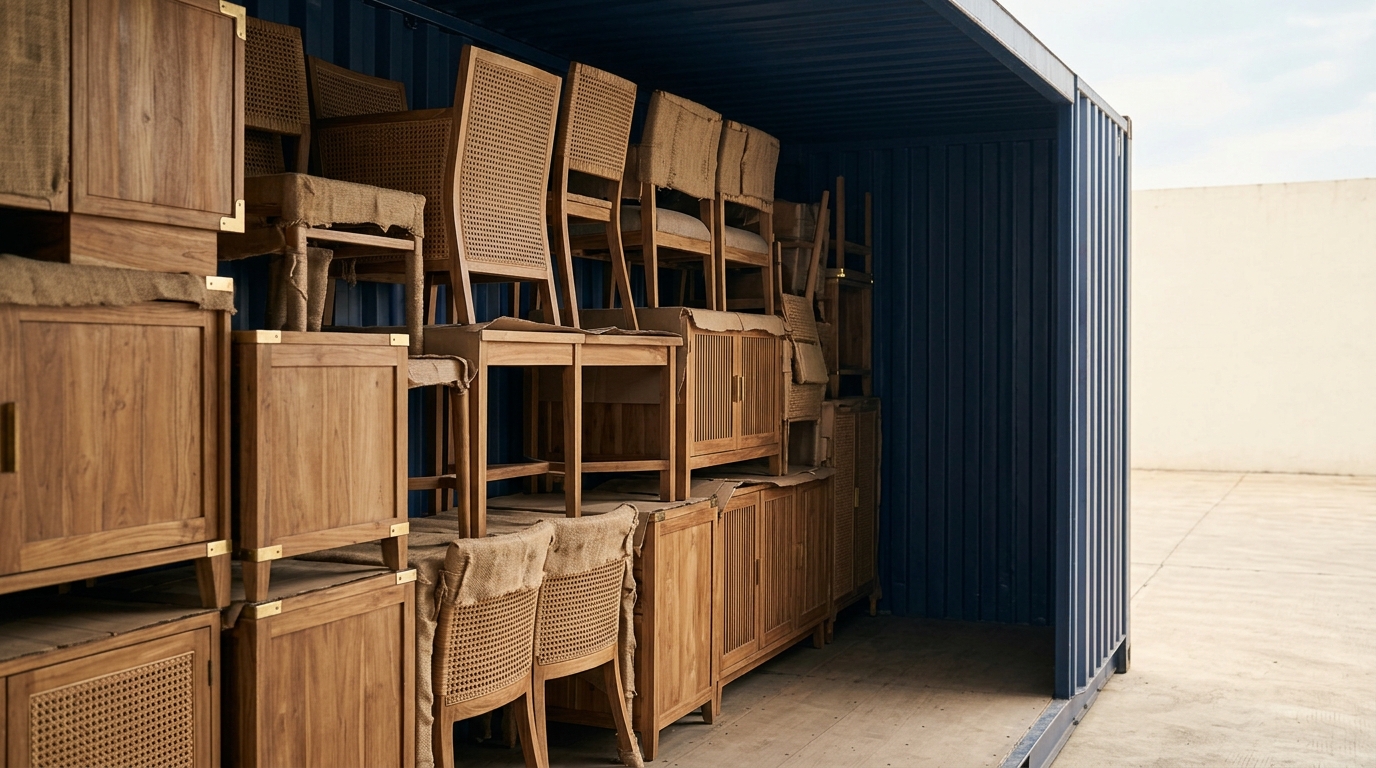
Deciding how to pack and plan a 40ft container from Indonesia is not a one-time logistics puzzle — it is a recurring commercial decision that directly shapes your landed cost per piece, your freight ROI, and your inventory cycle. Buyers who treat container loading as an afterthought routinely lose…
Deciding how to pack and plan a 40ft container from Indonesia is not a one-time logistics puzzle — it is a recurring commercial decision that directly shapes your landed cost per piece, your freight ROI, and your inventory cycle. Buyers who treat container loading as an afterthought routinely lose five to fifteen percent of usable volume to poor sequencing, over-packaging, and mismatched SKU combinations. Experienced importers treat container loading furniture Indonesia 40ft as a discipline in itself, one worth engineering before the first carton leaves the factory floor in Jepara or Cirebon.
This article covers everything a practised US importer needs to execute a tight Indonesia 40ft loading plan: exact interior dimensions and practical usable volume, a step-by-step loading sequence for mixed-category shipments, piece-count benchmarks by furniture type, packaging and compliance requirements under ISPM 15 and the US Lacey Act, a full cost-driver breakdown for Java-to-US lanes, and region-specific logistics nuances from Bali consolidations to Sulawesi rattan freight. The FAQ section at the end addresses the questions freight teams ask most often when planning FCL (Full Container Load) shipments from Indonesian suppliers.
Whether you are booking your third or your thirtieth container out of Tanjung Priok, the granular detail here is designed to help you shave cost, reduce damage claims, and build loading plans your customs broker and insurer will actually respect.
Why Indonesian Furniture Exporters Default to the 40ft Container for US Shipments
Indonesia's furniture export base — anchored in solid teak from Jepara, rattan from Cirebon, and upholstered hospitality pieces from Semarang and Surabaya — almost universally gravitates toward the 40ft container on Java-to-US West Coast lanes. The economics are straightforward: ocean freight on a 40ft rarely costs twice what a 20ft costs on the same lane, yet the 40ft delivers roughly double the cubic capacity. The cost-per-CBM advantage is meaningful, typically ranging from 15 to 30 percent lower on a per-cubic-metre basis compared with a 20ft on the same sailing, though rates fluctuate and you should always confirm with a licensed freight forwarder before booking.
Standard 40ft vs 40ft High Cube: What Indonesian Ports Actually Offer
At Tanjung Priok (Jakarta) and Pelabuhan Tanjung Emas (Semarang), both 40ft standard (GP) and 40ft high cube (HC) units are in regular circulation. The HC has become increasingly preferred by furniture exporters because the additional interior height — approximately 0.31 metres over the standard — accommodates tall wardrobes, four-poster bed frames, and stacked dining chair bundles without requiring horizontal re-orientation. However, HC availability can tighten during peak export seasons (typically Q3 and early Q4), so booking early and confirming equipment type with your freight forwarder at least three weeks before cargo ready date is standard practice among experienced shippers.
Product Mix That Justifies a Full Container Load
Indonesia's core export categories are well suited to filling a 40ft efficiently. Solid teak dining tables and bed frames are dense and stackable in KD (knock-down) form. Rattan armchairs and sofas can be nested or interlocked. Upholstered sofas, while voluminous, anchor the container's centre of gravity and allow lighter pieces to be loaded around and above them. A typical mixed FCL from a Jepara manufacturer might combine a bedroom suite, a dining set, several accent chairs, and occasional tables — a product mix that, when sequenced correctly, approaches 58 to 62 CBM of actual loaded volume.
Factory Direct vs LCL: The Mid-Volume Decision
For buyers ordering below roughly 15 CBM, LCL (Less than Container Load) consolidation through a Surabaya or Semarang freight station is usually the pragmatic choice. But for buyers ordering between approximately 20 and 35 CBM, the decision is less obvious. Factory-direct FCL locks in container integrity, reduces handling touchpoints, and eliminates co-loading damage risk from other shippers' cargo. LCL adds terminal handling charges, consolidation fees, and deconsolidation costs at the US destination. For most mid-volume importers sourcing from a single Indonesian cluster, moving to FCL once order volumes permit is a cost and risk decision, not merely a volume one.
Exact Interior Dimensions and Practical Usable Capacity of a 40ft Container
Understanding the gap between nominal container volume and actual loadable volume is foundational to any accurate loading plan for container loading furniture Indonesia 40ft shipments.
Interior Dimensions: Standard vs High Cube
| Specification | 40ft Standard (GP) | 40ft High Cube (HC) |
|---|---|---|
| Interior length | approx. 12.03 m | approx. 12.03 m |
| Interior width | approx. 2.35 m | approx. 2.35 m |
| Interior height | approx. 2.39 m | approx. 2.70 m |
| Gross volume (approx.) | ~67 CBM | ~76 CBM |
| Practical usable volume (furniture) | ~58–62 CBM | ~66–70 CBM |
| Door opening width | approx. 2.34 m | approx. 2.34 m |
| Door opening height | approx. 2.28 m | approx. 2.58 m |
| Max payload weight | ~26,500 kg | ~26,480 kg |
The practical usable volume figure — typically 58 to 62 CBM for a standard and 66 to 70 CBM for an HC — accounts for dunnage, bracing, airbags, and the unavoidable void space created by irregular furniture profiles. Furniture importers who plan against gross CBM consistently find themselves with unpacked pieces on the factory floor.
When the High Cube Is Worth the Premium
The HC becomes essential — not merely convenient — when your shipment includes items taller than approximately 2.2 metres in their packed state. Full-size wardrobes, canopy bed posts, tall bookcases, and bundles of dining chairs stacked four or five high often cannot be orientated on their side without risk of panel damage or joint stress. If even two or three SKUs in your mix exceed the standard door opening height of approximately 2.28 metres, upgrading to HC recovers cubic utilisation that would otherwise be completely lost.
Weight vs Volume: Which Limit Binds First for Furniture?
Solid teak and mahogany furniture shipments can be surprisingly heavy. A full 40ft loaded with solid teak dining tables and bedroom suites may approach 12,000 to 16,000 kg — well within the payload limit. Rattan and upholstered shipments are typically volume-constrained, not weight-constrained, often loading out at 4,000 to 8,000 kg while hitting the 58–62 CBM usable ceiling. In practice, mostIndonesian furnitureFCLs are cubed out before they approach the payload limit, making volume optimisation the primary lever.
A Step-by-Step Loading Sequence for Mixed Furniture Shipments from Indonesia
A well-engineered loading sequence is the single highest-leverage tactic in container loading furniture Indonesia 40ft optimisation. The following numbered checklist reflects standard practice among experienced Indonesian export factories and consolidators.
- ✓Step 1: Verify all cartons, bundles, and bare pieces against the packing list before the container arrives at the factory gate.
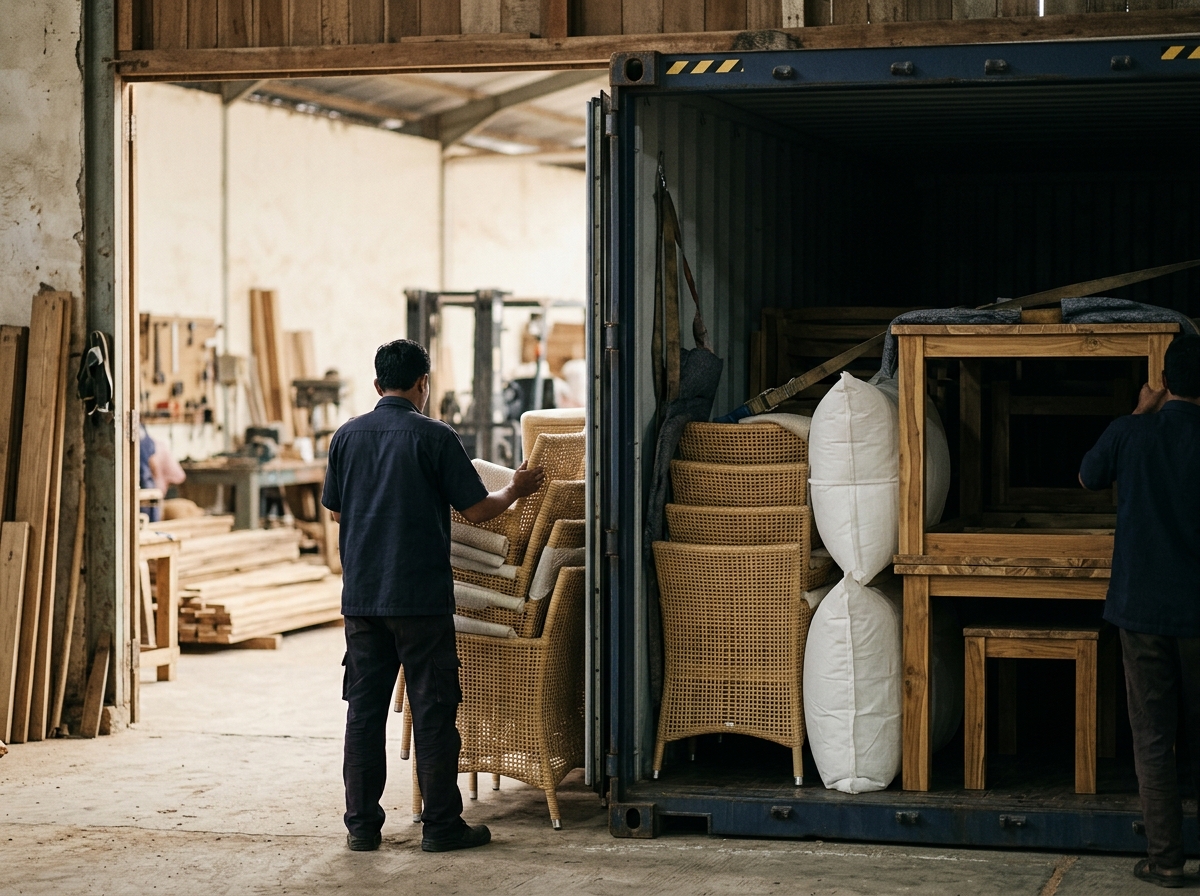
- ✓Step 2: Place the heaviest, densest items first — solid teak dining tables (KD flat-packed), bed bases, and solid wood cabinets — tight against the front wall (away from doors).
- ✓Step 3: Stack KD bed frames and table tops flat, with corner boards and foam sheet between each panel layer to prevent surface abrasion.
- ✓Step 4: Position upholstered sofas in the mid-section, standing on their base or laid on their back per manufacturer guidance, with stretch-film wrapping intact.
- ✓Step 5: Nest dining chairs and armchairs inside sofa seats or wardrobe carcasses where interior clearance allows — this is the single most impactful CBM-saving tactic for chair-heavy shipments.
- ✓Step 6: Fill vertical voids alongside sofas and wardrobes with boxed occasional tables, lamp bases, cushion packs, or rolled rugs.
- ✓Step 7: Insert airbags or foam blocks in all gaps larger than approximately 15 cm to prevent lateral shifting during ocean transit.
- ✓Step 8: Stack lighter carton goods (accessories, cushions, hardware bags) in any remaining upper-tier space.
- ✓Step 9: Secure the load with a minimum of two horizontal lashing straps across the full container width at mid-point and near the doors.
- ✓Step 10: Photograph the completed load from both the door end and mid-container before sealing — these images are required for insurance claims and are valuable for customs queries.
Knock-Down vs Ready-Assembled: The CBM Maths
KD (knock-down) packing is the single most powerful tool for improving CBM utilisation on Indonesian furniture exports. A solid teak dining table that occupies approximately 1.8 CBM assembled can be KD-packed into approximately 0.6 to 0.8 CBM when the top, legs, and aprons are separated and flat-stacked. Applied across a full container, the difference between an all-assembled and an all-KD loading plan can represent 15 to 25 CBM — the equivalent of eight to twelve additional dining chairs or two additional wardrobes in the same container.
The trade-off is assembly labour at the destination and, occasionally, structural risk at the joinery if repeated assembly degrades mortise-and-tenon fits. For large, flat-surfaced pieces (tables, bed bases, cabinet carcasses), KD is almost always the right call. For intricate rattan chairs or carved accent pieces where disassembly would damage the finish, ready-assembled with tight nested stacking is preferable.
Nesting and Interlocking: The Rattan and Chair Specialist Tactic
Indonesian rattan chairs present a spatial optimisation challenge because their organic profiles resist neat rectangular stacking. The solution is systematic nesting: seats of the same model rotated and stacked three to five high, then placed inside the cavity of a wardrobe carcass or within the U-shaped seating well of a sofa. A factory loading supervisor experienced with rattan exports will typically manage three to four additional chairs per container compared with a novice team simply stacking chairs in rows.
Documenting the Loading Plan for Customs and Insurance
A visual floor-plan loading diagram — showing placement of each SKU category within the container footprint — serves multiple downstream purposes. US Customs may request it as part of a cargo examination. Marine cargo insurance underwriters use it to assess packing adequacy when evaluating damage claims. Your customs broker needs it to cross-reference the commercial invoice and packing list. Request this document from your factory or freight forwarder in PDF format before the container is sealed, not after arrival.
Furniture-Specific Packaging and Securing Standards for Long-Haul Ocean Freight from Indonesia
ISPM 15 Compliance: Non-Negotiable for Solid Wood Exports
Any solid wood furniture — teak, mahogany, mango wood — packed using wooden crating, pallets, or solid wood dunnage must comply with ISPM 15 (International Standards for Phytosanitary Measures No. 15). This requires that all wooden packaging material be heat-treated or fumigated and marked with the IPPC logo, the country code (ID for Indonesia), the producer/treatment provider code, and the treatment method abbreviation (HT for heat treatment). US Customs and Border Protection enforces ISPM 15 at all entry ports; non-compliant wooden packaging is subject to treatment, re-exportation, or destruction at the importer's cost.
ISPM 15 applies to wooden crates and pallets, not to the furniture itself, but Indonesian exporters frequently use solid wood blocking and bracing inside the container — ensure your factory's packing specification calls for ISPM 15-compliant bracing material or uses alternative dunnage (cardboard, foam, airbags) instead.
Humidity and Mould Risk on Indonesia–USA Ocean Routes
The Indonesia-to-US West Coast sailing passes through tropical and subtropical humidity bands, with typical transit times of 18 to 25 days from Tanjung Priok to Los Angeles. Upholstered sofas, rattan weaves, and solid wood with open-grain finishes are all susceptible to mould growth if container humidity rises above approximately 70 percent relative humidity during transit.
Standard mitigation: silica gel desiccant placed inside each individually wrapped upholstered piece and throughout the container at a dosing rate of approximately 1 kg of silica gel per 2 to 3 CBM of container volume. This is a commonly applied guideline — your freight forwarder or packing specialist can refine the dosing based on the specific product mix and time of year. Avoid packing furniture that has not fully dried after finishing or waxing; moisture trapped under plastic stretch film is a leading cause of mould on Indonesian export furniture.
Securing Standards and US Coast Guard Compliance
Container cargo securing on vessels calling US ports is subject to the US Coast Guard's requirements under 46 CFR, which reference the CTU Code (Code of Practice for Packing of Cargo Transport Units). For furniture, this means: no loose items within the container, dunnage that prevents any piece from shifting more than approximately 5 cm in any direction, and lashing straps with documented working load limits appropriate to the cargo weight. Indonesian exporters shipping to experienced US buyers routinely use a combination of cardboard corner boards, foam blocks, and horizontal airbags — but it remains the importer's responsibility to specify these requirements in the purchase order or supplier packaging specification.
Calculating Piece Count: How Much Furniture Actually Fits in a 40ft Container
Piece-Count Benchmarks by Furniture Category
The table below provides approximate piece-count ranges for common Indonesian furniture categories loaded in a 40ft standard container. Figures assume KD packing where applicable and standard export carton packaging. Actual counts depend on specific product dimensions, packing method, and shipment mix.
| Furniture Category | Approx. CBM per Unit (packed) | Approx. Pieces per 40ft (58 CBM usable) | Notes |
|---|---|---|---|
| Solid teak dining table (6-seater, KD) | 0.6–0.9 CBM | 65–95 tables | Tables only; no chairs |
| Dining chair (solid wood, KD) | 0.12–0.18 CBM | 320–480 chairs | Chairs only; nesting adds ~15% |
| Dining set (table + 6 chairs, KD) | 1.3–1.9 CBM | 30–45 sets | Mixed load |
| 3-seater upholstered sofa (assembled) | 2.5–3.5 CBM | 16–23 sofas | Assembled; KD adds ~40% more |
| Rattan armchair (assembled, nested) | 0.25–0.40 CBM | 145–230 chairs | Nested stacking assumed |
| Queen bed frame (solid wood, KD) | 0.9–1.3 CBM | 45–65 frames | Headboard separated |
| Wardrobe / armoire (2-door, KD) | 1.8–2.8 CBM | 20–32 units | HC container recommended for height |
| Outdoor dining set (4 chairs + table) | 1.5–2.2 CBM | 26–38 sets | Teak or acacia |
| Accent / side table (small, KD) | 0.08–0.15 CBM | 385–725 tables | Fill-in SKU for mixed loads |
How to Get Accurate CBM Data from Indonesian Suppliers
Request the packed dimensions (length × width × height in centimetres) and gross weight for each SKU in its export carton or bundle. Many smaller Jepara and Cirebon factories will provide this data only after a sample production run — factor this into your development timeline. For repeat orders, maintain your own SKU-level CBM database rather than relying solely on supplier-provided data, which can drift as packaging specifications change between production runs.
Modelling Mixed SKU Combinations
A basic spreadsheet model — SKU name, packed CBM, quantity, total CBM, running cumulative total — is sufficient for most mixed loads. More sophisticated buyers use browser-based container loading software that generates a 3D stacking diagram, which also serves as the visual loading plan required for insurance documentation. The discipline of modelling before ordering prevents the common scenario where a buyer's order comes in at 65 CBM and either forces an expensive second container or requires last-minute quantity cuts.
Cost Breakdown: What Drives the Price of a 40ft Indonesia–USA Container
Ocean Freight Rates by Lane
Indicative ocean freight rates for a 40ft FCL from Jakarta (Tanjung Priok) or Semarang to US West Coast ports (Los Angeles, Long Beach) have historically ranged widely depending on market conditions, carrier, and contract status. Rates to Gulf Coast ports (Houston) and East Coast ports (New York, Savannah) via the Suez Canal or transhipment typically carry a premium over West Coast rates. These figures shift materially with global demand cycles — always verify current rates with a licensed freight forwarder or NVO before budgeting.
Origin Charges: What You Pay Before the Ship Leaves Java
| Charge | Description | Notes |
|---|---|---|
| THC (Terminal Handling Charge) | Tanjung Priok or Semarang port levy | Varies by carrier and terminal |
| Inland trucking (Java) | Factory to port, typically 1–4 hours from Jepara/Semarang | Distance and road toll dependent |
| Export documentation | SI (Shipping Instruction), B/L issuance | Per-container fee |
| Export customs clearance | Handled by local EMKL agent | Typically low cost |
| Certificate of Origin | Required for GSP or FTA claims if applicable | Issued by Kadin or Disperindag |
| ISPM 15 fumigation / HT certificate | Required for solid wood packaging | Issued by accredited treatment provider |
US Destination Costs
On the US side, key cost components include ISF 10+2 filing (mandatory, with penalties for late or inaccurate filing), customs clearance, customs bond, applicable import duties (furniture HS codes vary — upholstered seating, non-upholstered wood seating, and case goods each have different duty rates, and some Indonesian categories may qualify for reduced rates under GSP, subject to programme renewal), port drayage to your warehouse, and — for East or Gulf Coast delivery — potential transloading or rail costs.
Sourcing Regions in Indonesia and Their Logistics Implications for Container Loading
Jepara and Central Java: The Solid Wood Core
Jepara in Central Java is Indonesia's most concentrated furniture manufacturing cluster, specialising in solid teak, mahogany, and mixed tropical hardwood pieces. Its proximity to Semarang port (typically 1 to 2 hours by road) makes it the most logistics-efficient origin point for 40ft container shipments. Most mid-sized Jepara factories have direct relationships with EMKL (local freight forwarder/customs broker) agents and can coordinate container delivery to the factory gate, loading, and export documentation as an integrated service.
Bali Sourcing: Consolidation Logistics into a 40ft at Surabaya
Bali is home to a globally recognised luxury artisan furniture cluster — handcrafted pieces destined for high-end hospitality, resort, and retail buyers in the US. However, Bali's primary export port, Benoa, handles relatively modest container volumes and sailing frequency compared with Tanjung Priok or Semarang. Most experienced buyers sourcing from Bali consolidate their cargo as follows: furniture is produced in Bali workshops, trucked to Surabaya (typically an overnight road transit or short sea feeder to the Tanjung Perak terminal), consolidated into a 40ft at a Surabaya container freight station, and exported via Surabaya. This adds approximately 3 to 7 days to the origin logistics timeline and an incremental trucking and CFS fee, but provides access to far more frequent mainliner sailings to US ports. Factor this consolidation step into your cargo-ready-date planning when sourcing from Bali alongside Java-origin goods.
Sulawesi Rattan: Container Utilisation Challenges
Rattan raw material and semi-finished rattan furniture from Sulawesi presents a distinctive container utilisation challenge. Rattan's organic, curved profiles resist rectangular packing — a fully assembled rattan sofa or lounge chair occupies significantly more dead air space per unit than an equivalent solid wood piece. Buyers sourcing rattan from Sulawesi-based producers should expect practical usable volume to be 10 to 20 percent lower than benchmark figures for a wood-only shipment of equivalent piece count, and should model their container fill conservatively. Some buyers address this by sourcing Sulawesi rattan through Surabaya-based export houses that have specialist rattan packing teams.
Lead Times by Region and Their Impact on Container Booking
| Sourcing Region | Primary Port | Approx. Production Lead Time | Port to US West Coast (approx.) |
|---|---|---|---|
| Jepara / Central Java | Semarang | 45–75 days (custom orders) | 18–22 days |
| Surabaya / East Java | Tanjung Perak | 30–60 days | 20–25 days |
| Bali (via Surabaya) | Tanjung Perak | 45–90 days + 5–7 days consolidation | 20–25 days |
| Jakarta / West Java | Tanjung Priok | 30–60 days | 18–22 days |
| Sulawesi (via Surabaya) | Tanjung Perak | 60–90 days | 20–25 days |
Transit times are indicative; verify current schedules with your freight forwarder as routing and transhipment hubs affect actual port-to-port days.
Compliance, Documentation, and US Customs Requirements for Indonesian Furniture Imports
Core Export Documents for Every Shipment
Every Indonesia–US furniture FCL requires a complete document set: Commercial Invoice (with HS codes, unit values, and Incoterms), Packing List (with CBM and gross weight per carton or piece), Bill of Lading (original or telex release), and Certificate of Origin (Form A if claiming GSP, or standard CO for customs purposes). For solid wood furniture, the ISPM 15 phytosanitary certificate issued by an Indonesian government-accredited body must accompany the shipment — this is a hard requirement, not a recommendation.
The US Lacey Act: Timber Species Declaration for Indonesian Solid Wood
The US Lacey Act requires importers to file a Plant and Plant Product Declaration (PPQ 505 form) for any shipment containing wood products, including solid wood furniture. The declaration must identify the genus and species of each wood type, the country of harvest, and the quantity. ForIndonesian teak furniture, the correct declaration is Tectona grandis, harvested in Indonesia. For mahogany, the genus and species must be specified (Indonesian mahogany is commonly Swietenia macrophylla or Toona sureni — verify the exact species with your supplier). Penalties for inaccurate or missing Lacey Act declarations can include fines and cargo seizure. Ensure your Indonesian supplier provides a formal wood species declaration document as part of the order documentation package.
ISF 10+2: Filing Deadline and Common Furniture Importer Errors
ISF 10+2 (Importer Security Filing) must be filed with US Customs and Border Protection at least 24 hours before vessel departure from the last foreign port. For furniture importers, the most common filing errors are: incorrect or missing HS codes (particularly for mixed-category containers), missing or incomplete seller/manufacturer details (relevant when sourcing through an Indonesian trading house rather than directly from the factory), and missing country of origin for individual SKUs when the container contains goods from multiple Indonesian manufacturing locations. Each error or late filing carries a penalty of up to USD 5,000 per violation — work with a licensed customs broker who has specific experience with Indonesian furniture imports.
Frequently Asked Questions
How many pieces of furniture can fit in a 40ft container from Indonesia?
It depends on the product category and packing method. As a planning benchmark: approximately 30 to 45 KD dining sets (table + 6 chairs), 16 to 23 assembled 3-seater sofas, or 45 to 65 KD queen bed frames can fit in a single 40ft standard container with approximately 58 CBM of usable volume. Mixed loads require SKU-level CBM modelling to predict accurately. The piece-count table earlier in this article provides per-category benchmarks.
What is the difference between a 40ft standard and 40ft high cube container for furniture?
The high cube offers approximately 0.31 metres of additional interior height (roughly 2.70 m vs 2.39 m) and approximately 9 additional gross CBM. For furniture exporters, the HC is particularly valuable for tall wardrobes, canopy bed posts, and high-stacked chair bundles that cannot be safely laid on their side. If any packed item in your shipment exceeds approximately 2.2 metres in height, the HC is strongly recommended.
How do I get an accurate loading plan from myIndonesian furniture supplier?
Request packed dimensions (L × W × H in cm) and gross weight for each SKU at sample or pre-production stage. Ask the factory's export coordinator or your appointed EMKL agent to produce a floor-plan loading diagram in PDF format. For buyers who place regular orders, providing the factory with a standardised loading plan template (showing container interior dimensions and preferred category sequencing) produces more consistent results than leaving the plan entirely to the factory's discretion.
What does a full container load (FCL) offurniture from Indonesiacost to ship to the USA?
Total FCL cost is a combination of ocean freight, origin charges (THC, inland trucking, documentation), and US destination charges (ISF filing, customs clearance, drayage, duties). Ocean freight alone for a 40ft on Java–US West Coast lanes has ranged broadly depending on market conditions — always request a current quotation from a licensed freight forwarder. Budget for origin and destination charges to add a meaningful additional amount on top of the base ocean freight rate, and factor in applicable US import duties for your specific furniture HS codes.
What packaging standards are required for Indonesian furniture exports to the United States?
Wooden packaging material must comply with ISPM 15 (heat-treated and IPPC-marked). Solid wood furniture species must be declared under the US Lacey Act. Individual pieces should be wrapped in bubble wrap or stretch film with cardboard corner protection. Dunnage (airbags, foam blocks) must prevent shifting to comply with the CTU Code standards applicable to vessels calling US ports. Silica gel desiccant is strongly recommended for upholstered and rattan pieces on tropical-route ocean shipments.
How long does sea freight take from Tanjung Priok or Semarang to US ports?
Indicatively, Tanjung Priok (Jakarta) to Los Angeles is approximately 18 to 22 days on direct or minimal-transhipment routings. Semarang to Los Angeles is similar. Routings to Gulf Coast (Houston) or East Coast (New York, Savannah) typically add 5 to 10 days depending on the carrier's routing via Suez or transhipment hubs. These are vessel transit times only — add origin logistics (inland trucking, port handling) and US destination processing time for a realistic door-to-door estimate.
Maximising cubic utilisation on a 40ft Indonesia container shipment is ultimately a combination of three disciplines: accurate pre-shipment CBM planning at the SKU level, disciplined category sequencing and nesting at the factory loading stage, and full compliance documentation that protects your cargo from holds and damage claim disputes. Buyers who systematise all three consistently achieve lower landed costs per piece and fewer expensive surprises at the US port of entry.
Now that you have a complete framework for planning, sequencing, and costing your next Indonesia FCL shipment, the logical next step is to put it to work on your actual order mix.
You now have the sequencing logic, piece-count benchmarks, and compliance checklist — the template gives you a ready-to-fill spreadsheet and visual floor-plan diagram formatted for your Indonesian supplier, customs broker, and marine insurer. Start building your next optimised Indonesia shipment today.
Download the Free Loading Plan Template →Need eyes on the ground in Indonesia?
MTS is an execution partner — supplier verification, manufacturing management, quality control and export logistics across Indonesia, Vietnam and China.
Related services
Related articles
Receive furniture sourcing insights across Asia.
One email per week. No spam.