Beach Club Furniture Indonesia: The Complete Sourcing Guide for Venue Operators
13 min read
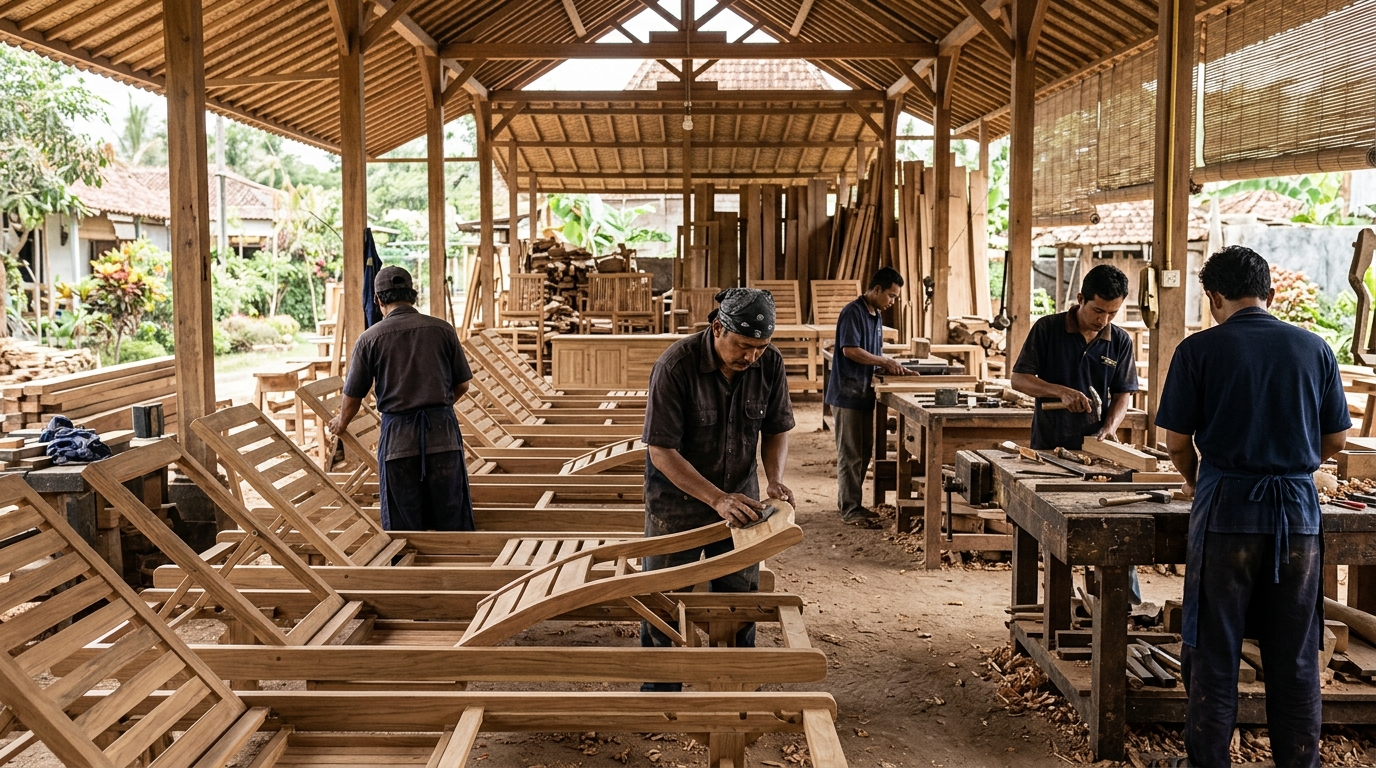
Sourcing furniture for a beach club is a capital decision, not a design exercise. You are selecting assets that must survive salt air, UV radiation, chlorinated water, and daily commercial use — then do it again for the next decade. Get the material spec wrong and you replace frames in year three.
Sourcing furniture for a beach club is a capital decision, not a design exercise. You are selecting assets that must survive salt air, UV radiation, chlorinated water, and daily commercial use — then do it again for the next decade. Get the material spec wrong and you replace frames in year three.
Indonesia has become the default sourcing destination for hospitality-grade outdoor furniture, and for measurable reasons: domestic teak supply, multi-generational craft infrastructure in Bali and Java, and export logistics built around the US market. But the sourcing decision still carries real risk. Supplier quality varies sharply between clusters.
This guide covers the full sourcing cycle for beach clubfurniture from Indonesia. It addresses materials, core piece specifications, custom branding timelines, container planning, supplier vetting, and total landed cost — including US import duty. It is written for operators planning a full fit-out or scheduled refresh, not for casual buyers.
By the end, you will have a working framework for evaluating Indonesian suppliers against compliance, durability, and cost criteria — before you commit a deposit.
Why Indonesian Manufacturers Lead the Global Beach Club Furniture Market
Indonesia's position in hospitality furniture is structural, not accidental. Three factors converge that no other single country replicates at the same price tier.
Domestic raw material access. Indonesia holds some of the world's largest managed teak plantations. Grade-A plantation teak, reclaimed teak, rattan, and bamboo are all sourced domestically. This eliminates the raw material import cost layer that Vietnamese or Chinese manufacturers carry when producing teak pieces.
Craft heritage with commercial scale. Jepara in Central Java has operated as a furniture manufacturing cluster for generations. Bali's Denpasar and Canggu areas concentrate on luxury artisan production. Both regions have supply chains — timber merchants, hardware suppliers, foam cutters, fabric converters — within short logistics distance of the factories. This density keeps lead times manageable and enables complex custom work.
Export infrastructure aligned to the US market. Ports at Surabaya and Semarang run regular container services to US West Coast and East Coast ports. Indonesian furniture exporters have worked with US hospitality buyers long enough to understand FOB documentation, HTS code classification, and phytosanitary certificate requirements.
The result: beach clubfurniture from Indonesiatypically lands at US ports at roughly 30–50% lower cost than comparable pieces from European or Australian manufacturers, once freight and duty are factored in.
Choosing the Right Materials for Salt Air, Sand, and Intense UV Exposure
Material selection is the single highest-leverage decision in any beach club fit-out. The wrong material in a coastal environment fails fast and fails expensively. Indonesian manufacturers produce across all the relevant material categories — but understanding each material's performance profile prevents misspecification.
Teak: The Baseline Standard for Structural Frames
Teak contains natural silica and oils that resist moisture absorption, salt corrosion, and UV degradation without surface treatment. Forsun loungers, daybeds, and structural frame components, teak beach club furniture remains the commercial benchmark. Plantation-grown Grade-A teak from Java carries consistent density and grain. Expect a frame lifespan of approximately 15–25 years under regular maintenance.
Powder-Coated Aluminium: Lightweight and Rust-Proof
Powder-coated aluminium frames offer a different value proposition. The material is roughly 60% lighter than teak, making it practical for high-turnover venues where staff reposition furniture constantly. Marine-grade powder coat applied over aluminium — typically at 60–80 microns dry film thickness — provides strong resistance to salt spray and UV fading. Frame lifespan runs approximately 10–15 years.
Synthetic HDPE Resin Weave: Durability for High-Contact Pieces
High-density polyethylene (HDPE) synthetic weave is UV-stabilised during extrusion, meaning colour is locked into the material rather than applied as a surface coating. It does not absorb water, does not crack in heat cycles, and cleans with a pressure washer.
Marine-Grade Solution-Dyed Acrylic Cushions: The Correct Cushion Spec
Standard outdoor fabric fails in a commercial beach environment within one to two seasons. The correct specification is solution-dyed acrylic — fabric where colour pigment is integrated into the fibre at the polymer stage, not printed or dyed after weaving.
| Material | Typical Lifespan | Maintenance Required | Primary Use Case |
|---|---|---|---|
| Grade-A Teak | 15–25 years | Annual oiling or patina acceptance | Lounger frames, daybeds, dining sets |
| Powder-Coated Aluminium | 10–15 years | Annual inspection, touch-up coating | Bar stools, high-tops, cabana frames |
| HDPE Synthetic Weave | 5–8 years | Pressure wash, weave panel replacement | Cabana chairs, ottomans, lounge seating |
| Marine-Grade Acrylic Cushions | 3–5 seasons (commercial use) | Cover wash, seasonal storage if possible | All seating and daybed cushion sets |
The Core Furniture Pieces a Full Beach Club Fit-Out Requires
A complete beach club venue typically covers four functional zones. Each zone has specific furniture requirements that Indonesian manufacturers are set up to supply as coordinated collections.
Sun lounger and daybed zone. Adjustable backrest loungers with integrated towel rails are the volume piece in any beach club. Teak slatted frames or powder-coated aluminium frames with HDPE weave slings are both proven formats. Daybeds — typically 200 cm × 200 cm double-width formats — require sturdy central support structures. Specify canopy rail compatibility at order stage if you plan canopy additions later.
Cabana and canopy zone. Cabana structures pair with side tables, ottomans, and shade fabric. Indonesian factories produce the timber or aluminium structural elements and can source or recommend fabric suppliers for the shade canopy. Coordinate finish and material specs across all cabana furniture at the sampling stage — mixing production runs later creates visible colour discrepancies.
Beach bar service zone. Bar stools with footrests, high-top tables with weather-resistant tops (teak, HPL laminate, or stainless), and full bar counter assemblies. Counter depth and height should be specified to your bar equipment layout. Indonesian manufacturers produce custom bar counter configurations regularly; this is standard OEM work for factories in Jepara.
Terrace and transition zone. Covered terrace areas need dining sets and lounge seating that bridge indoor and outdoor aesthetics. Reclaimed teak dining tables paired with powder-coated aluminium chairs are a common commercial format — durable, stackable, and visually coherent with a beach club identity.
Custom Branded Beach Club Furniture: OEM Process, MOQs, and Lead Times
Turning furniture into a brand asset requires working with factories that operate genuine OEM and ODM capability — not just factories that add a logo sticker. Indonesian manufacturers, particularly in Jepara and Bali, have supplied branded resort collections for international hospitality groups for decades. The process is structured.
What Custom Branding Actually Covers
Logo engraving into teak frames — typically CNC-routed to 2–4 mm depth — is standard on orders above approximately 50–100 units per SKU, though minimums vary by factory. Cushion covers can be embroidered or woven with logos; confirm whether the factory does in-house embroidery or subcontracts it.
Realistic Lead Times for Custom Runs
| Order Type | Typical Lead Time (from deposit) |
|---|---|
| Standard catalogue pieces, no customisation | 30–45 days |
| Custom colour powder coat, standard geometry | 45–60 days |
| Full custom geometry with logo engraving | 60–90 days |
| Bespoke canopy structures, complex OEM | 90–120 days |
These are approximate ranges based on normal factory loading. Peak season (Q3–Q4, when global hospitality buyers are active) can add 15– approximately 30 days. Build this into your venue opening timeline — not as a footnote.
Refresh Cycles and Long-Term Asset Management for High-Traffic Venues
Most operators plan the opening fit-out in detail and manage subsequent refresh orders reactively. That approach creates avoidable downtime and higher per-piece costs on small re-orders.
A structured refresh cycle treats beach club furniture as a depreciating asset with predictable replacement schedules. Cushion sets are the highest-frequency replacement item: marine-grade acrylic covers typically run 3–5 commercial seasons before UV fatigue and mechanical wear justify replacement. Weave panels on HDPE cabana chairs follow at the 5–8 year mark.
Stocking strategy. Negotiate a standing order for one full set of replacement cushion covers and weave panels with your Indonesian supplier at the time of the initial container order. Store them at the venue or in a regional warehouse. This eliminates the 45–60 day lead time on a re-order when a cushion set fails mid-season. The cost of pre-stocking one replacement cycle is marginal against a container-load order and significant against a mid-season venue shutdown.
Maintenance protocols. Teak frames require a decision at installation: oil annually to maintain warm colour, or allow natural weathering to silver-grey. Either is structurally valid. The mistake is inconsistent treatment — oiling some frames and not others creates visible colour variation across the venue. Powder-coated aluminium frames benefit from annual inspection for chips or scratches; touch-up coating prevents corrosion initiation at exposed metal. HDPE weave panels require no treatment but benefit from periodic pressure washing to prevent salt and organic debris accumulation in the weave structure.
Container Planning for a Complete Beach Club Fit-Out from Indonesia
Container economics are where beach club sourcing decisions are either validated or eroded. The unit economics of Indonesian furniture only work at container-load volumes. Under-filling a container — or mis-specifying packaging — drives up landed cost per piece materially.
Container Capacity and Piece Counts
A standard 20-foot container holds approximately 25–33 cubic metres of usable volume. A 40-foot High Cube container holds approximately 67–72 cubic metres. Flat-packed furniture maximises this; assembled or partially assembled pieces reduce it significantly.
Approximate piece counts for flat-packed beach club furniture in a 40-foot HC container:
| Furniture Type | Approximate Units per 40ft HC |
|---|---|
| Sun loungers (flat-packed teak) | 80–120 units |
| Daybeds (flat-packed, disassembled) | 30–50 units |
| Bar stools (nested or flat-packed) | 150–200 units |
| Dining chairs (stacked flat-packed) | 200–250 units |
| Dining tables (disassembled) | 40–60 units |
These are approximate figures. Actual counts depend on frame dimensions, packaging thickness, and whether cushions ship in the same container. Cushions compressed in vacuum bags recover volume significantly and can typically share container space with frames.
FOB Pricing and Packaging Standards
Negotiate FOB Surabaya or FOB Semarang pricing. These are Indonesia's primary furniture export ports. FOB transfers risk to the buyer at the point of loading — freight, marine insurance, and destination port charges are the buyer's responsibility from that point.
Packaging standards for a salt-humid container transit matter. Kiln-dried timber should be certified to below approximately 12% moisture content before packing. Metal components — powder-coated aluminium frames particularly — should be wrapped in VCI (Volatile Corrosion Inhibitor) film to prevent condensation corrosion during transit. Confirm both requirements in writing with your supplier before production begins.
Working with a Freight Forwarder
Use a freight forwarder with direct experience in Indonesian furniture export. They will handle the Bill of Lading, Certificate of Origin, phytosanitary certificates for timber, and customs clearance documentation at the US port. The SVLK certificate (see compliance callout below) travels with the shipment and must be presented at customs.
Vetting Indonesian Suppliers: Certifications, Audits, and Red Flags
Key Sourcing Clusters and What They Produce
| Cluster | Location | Craft Focus | Price Tier |
|---|---|---|---|
| Jepara | Central Java | Solid wood, teak, carved pieces, dining, OEM | Mid to premium |
| Cirebon | West Java | Rattan, synthetic weave, wicker | Mid-market |
| Semarang | Central Java | Outdoor, contract volume, aluminium frames | Mid-market |
| Surabaya | East Java | Mid-market, mixed materials, export logistics hub | Mid-market |
| Bali (Denpasar/Canggu) | Bali | Luxury artisan, resort, villa, high-design | Premium |
For beach club furniture at commercial scale, Jepara and Semarang offer the best combination of production capacity, outdoor furniture experience, and export infrastructure. Bali suppliers are appropriate for smaller luxury fit-outs where design differentiation justifies the higher price tier.
Factory Audit Checklist
- ✓Confirm physical factory address and visit or commission third-party audit
- ✓Verify SVLK certification number against Ministry of Environment and Forestry registry
- ✓Request moisture content test reports for kiln-dried timber (target: below 12% MC)
- ✓Request material data sheets for powder-coat specification and HDPE weave UV rating
- ✓Review production photos showing CNC machinery, kiln, and assembly floor
- ✓Confirm full-cycle production capability — not assembly-only operation
- ✓Request marine-grade cushion fabric specification and UV test rating
- ✓Confirm FOB port (Surabaya or Semarang) and standard lead times in writing
- ✓Check export history — request reference contacts from prior US hospitality buyers
- ✓Verify payment terms — T/T deposit (typically 30%) with balance on B/L is standard
Red flags. No physical factory address. Reluctance to provide material data sheets or fabric test reports. Inability to name the SVLK certificate number. Pricing significantly below market for the stated specification — this typically indicates material substitution. Factories that cannot show a kiln or lumber yard on-site are likely assembly-only operations, which carry higher quality risk for structural timber pieces.
Total Cost of Ownership: Modelling the Real Landed Cost from Indonesia
The ex-works price from an Indonesian factory is approximately 40–60% of your actual landed cost in the US. The remainder is freight, duty, port handling, and logistics administration. Understanding each component prevents budget overruns at the project approval stage.
Cost Component Breakdown
| Cost Component | Notes |
|---|---|
| Ex-works (EXW) factory price | Baseline — what the factory quotes |
| Inland freight to port | Jepara to Semarang or Surabaya — typically modest |
| FOB costs (loading, documentation) | Included in FOB price if negotiated correctly |
| Ocean freight (FCL, 40ft HC) | Varies by market conditions — obtain current quotes |
| Marine insurance | Typically 0.3–0.5% of cargo value |
| US import duty | Teak furniture: HTS Chapter 94 — confirm applicable rate with a licensed customs broker |
| Port handling and customs clearance | Destination port charges, customs broker fee |
| Inland freight to venue | Port to venue — distance-dependent |
The US HTS code for wooden furniture (Chapter 94) carries duty rates that vary by sub-category and country of origin status. Indonesia benefits from no Section 301 tariffs (those apply to China). Confirm the exact HTS classification and applicable rate with a licensed US customs broker before finalising your budget — misclassification is a common and correctable error.
Indonesia vs. Alternative Sourcing Options
Indonesian beach club furniture typically arrives at approximately 30–50% lower landed cost than comparable European alternatives and somewhat lower than Australian-manufactured equivalents. Vietnamese manufacturers offer competitive pricing on some outdoor categories but have a narrower teak heritage and less established beach club furniture track record.
The long-term relationship value of a reliable Indonesian supplier compounds over time. Repeat buyers typically receive preferred pricing on re-orders, priority production scheduling during peak periods, and faster sampling turnaround. Factor this into total cost of ownership — not just the first container.
Frequently Asked Questions
Is furniture made in Indonesia good quality for commercial beach club use?
Yes, when sourced from verified full-cycle factories in established clusters like Jepara or Semarang. Indonesia has multi-generational craft expertise in teak and outdoor furniture specifically. Quality varies between factories — factory audits and sample approval are necessary before committing to production.
What types of furniture are manufactured in Indonesia for hospitality venues?
Indonesian manufacturers produce the full range: teak sun loungers and daybeds, powder-coated aluminium frames, HDPE synthetic weave cabana chairs, rattan and bamboo pieces, bar stools, high-top tables, dining sets, and custom canopy structures. OEM and ODM capability is standard at most commercial-scale factories.
How long does it take to receive a full container of beach club furniture from Indonesia?
Allow approximately 60–90 days from deposit to vessel loading for custom orders, plus approximately 25–35 days ocean transit to US West Coast ports, or 30–40 days to East Coast ports. Total from deposit to venue delivery: approximately 90–130 days depending on order complexity and port of destination.
What certifications should Indonesian teak furniture suppliers have for US import?
SVLK (Timber Legality Verification System) certification is the mandatory requirement for Lacey Act compliance on teak imports. Additionally, confirm phytosanitary certificate issuance capability. Marine-grade cushion fabric should carry documentation of UV resistance testing. ISO certification at the factory level is a positive signal but not legally required for import.
How do I plan a container load for a complete beach club fit-out?
Start with a venue capacity plan — total lounger positions, daybed positions, bar seats, dining covers. Convert that to a piece count per SKU. Share dimensions with your Indonesian supplier and request a container-load plan showing flat-packed volumes. A 40-foot HC container is the standard unit for full fit-outs.
What is the best material for beach club furniture in a salt-air environment?
Teak frames for structural longevity. Marine-grade powder-coated aluminium for lightweight, high-turnover pieces. HDPE synthetic weave for high-contact seating. Solution-dyed acrylic cushions with quick-dry foam cores for all upholstered surfaces. Avoid standard steel frames, untreated softwood, and standard outdoor fabric — all fail within two to three seasons in a coastal beach club environment.
Indonesia's combination of raw material access, craft infrastructure, and export logistics makes it the most practical single-source destination for a complete beach club furniture fit-out. Operators who model the full landed cost — including duty, freight, and compliance documentation — consistently find the economics compelling against any comparable alternative.
You now have the specification framework, compliance checklist, and cost model to evaluate Indonesian beach club furniture suppliers with precision. The logical next step is a verified container-load plan priced to your venue's exact piece count — including FOB, freight estimates, and duty classification. Work with a sourcing partner who audits suppliers independently and holds no hidden factory commissions.
Request Your Container-Load Quote →Need eyes on the ground in Indonesia?
MTS is an execution partner — supplier verification, manufacturing management, quality control and export logistics across Indonesia, Vietnam and China.
Related services
Related articles
Receive furniture sourcing insights across Asia.
One email per week. No spam.