Safety Footwear Manufacturers Indonesia: A Sourcing Guide for U.S. Industrial Buyers
12 min read
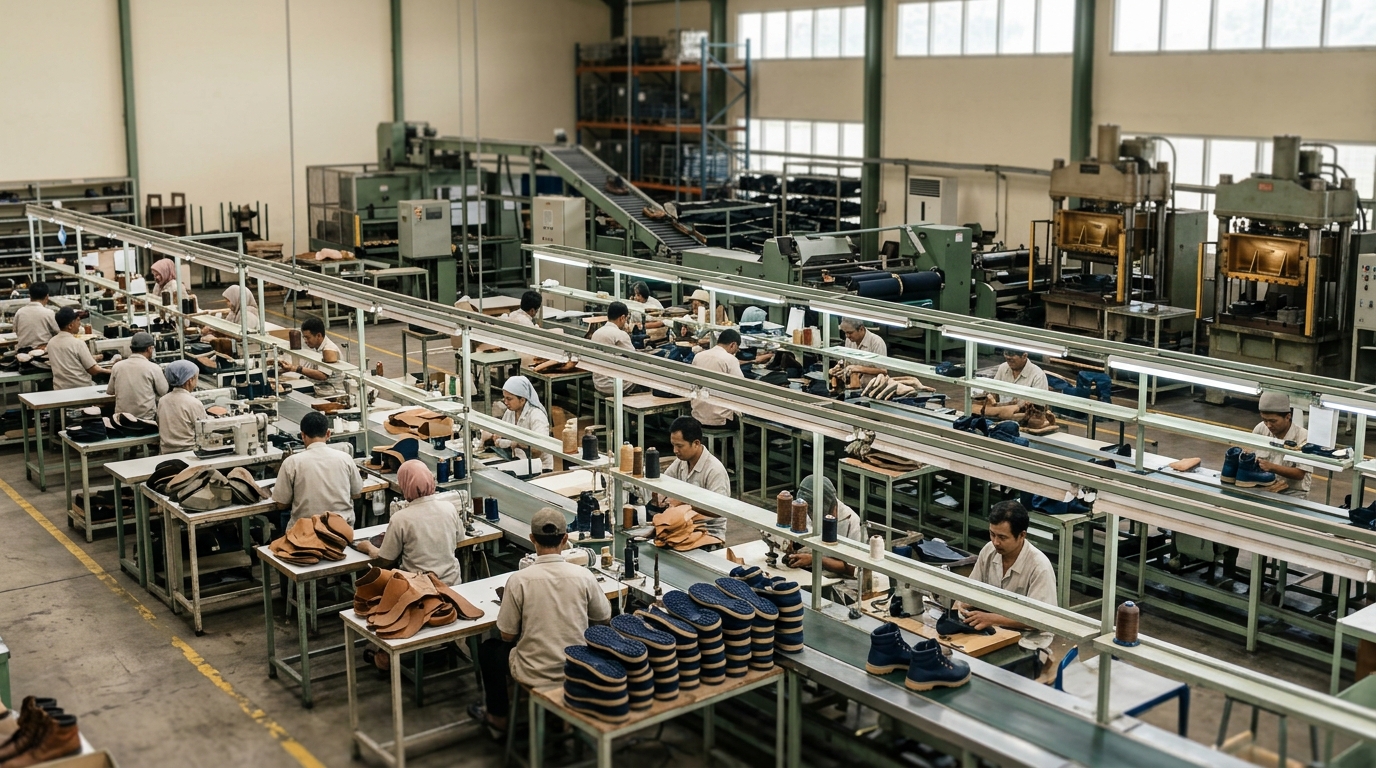
Procurement managers sourcing personal protective equipment face a clear decision: which country delivers certified, volume-ready safety footwear at a price point that works for large industrial contracts? Indonesia has become a serious answer to that question. The country ranks among the world's…
Procurement managers sourcing personal protective equipment face a clear decision: which country delivers certified, volume-ready safety footwear at a price point that works for large industrial contracts? Indonesia has become a serious answer to that question. The country ranks among the world's top five footwear exporters, and its manufacturing base has developed well beyond low-cost commodity production into certified, specification-compliant safety footwear built for demanding industrial environments.
This guide covers what U.S. buyers need to evaluate before placing orders with safety footwearmanufacturers Indonesia: certification requirements, product specifications, key factories, sizing programs, MOQ structures, and supplier vetting methods. The goal is to give procurement teams and industrial distributors a practical framework, not a promotional list.
Indonesia's advantage is structural. Labor costs remain competitive against Western suppliers. Raw material supply chains — leather tanning, rubber compounding, and polyurethane sole casting — are concentrated in Java and Surabaya, reducing component lead times. APRISINDO, the Indonesian Footwear Manufacturers Association, provides an industry governance framework and a directory of verified member manufacturers. These conditions make Indonesia a defensible sourcing choice for U.S. buyers managing large workforce safety programs.
Why Indonesia Competes at the Top Tier of Global Safety Footwear Supply
Manufacturing Infrastructure and Raw Material Access
Indonesia's footwear export capacity is supported by a dense cluster of tanneries, rubber processors, and PU chemical suppliers concentrated in East and Central Java. This proximity keeps input costs low and reduces dependency on imported components that add lead time and currency risk.
Full-grain leather — the preferred upper material for heavy-industry safety boots — is sourced domestically. Nitrile rubber and PU compounds for outsoles are processed locally. This vertical supply depth allows mid-to-large Indonesian factories to control material quality at every stage, a capability that matters when buyers specify SRC slip resistance or puncture resistance class P to EN ISO 20345.
APRISINDO and Industry Governance
APRISINDO (Asosiasi Persepatuan Indonesia) is the governing trade association for Indonesian footwear manufacturers. Membership signals a baseline commitment to industry standards and export practices. For U.S. buyers, APRISINDO's directory is a useful starting point for identifying established manufacturers, as it filters out trading companies and informal workshops that cannot support industrial compliance documentation.
Certifications to Require from Safety Footwear Manufacturers Indonesia
EN ISO 20345 vs. ASTM F2413: What U.S. Buyers Must Understand
Most Indonesian factories producing for export hold or can produce to EN ISO 20345, the European safety footwear standard. U.S. buyers need to understand where this aligns with ASTM F2413 — and where it does not.
| Requirement | EN ISO 20345 | ASTM F2413 |
|---|---|---|
| Toe impact protection | 200 joules (mandatory) | 75 ft-lb impact / 2,500 lb compression |
| Slip resistance | SRA, SRB, SRC classifications | Not explicitly classified (traction performance varies) |
| Puncture resistance | P (midsole, 1,100 N min) | Puncture resistance optional (PR designation) |
| Electrical hazard | ESD / antistatic class | EH designation (ASTM F2412 test method) |
| Metatarsal protection | Mt designation (optional) | Mt designation (optional) |
| Standard type | Performance-based, EU/global | Specification-based, U.S. domestic |
| Certification body | Notified body (e.g., TÜV, SGS) | ASTM-compliant lab test report |
Many established Indonesian safety shoe factories can produce to ASTM F2413 on request, particularly those with U.S. export experience. Always ask for the actual test report from a recognized third-party laboratory — not just a certificate number.
SNI and Domestic Compliance as a Baseline Signal
SNI (Standar Nasional Indonesia) is Indonesia's national standard system. An SNI mark on safety footwear indicates domestic compliance testing has been conducted. For U.S. buyers, SNI is a baseline signal that a factory operates within a structured quality framework — but it does not substitute for EN ISO 20345 or ASTM F2413 certification.
Verifying Certification Authenticity
Request the following from any candidate supplier before placing a trial order:
- Full test report from a recognized third-party lab (SGS, Bureau Veritas, Intertek, TÜV) - Certificate number traceable to the issuing body's online registry - Scope of certification: confirm it covers the exact product category and construction you are ordering - Date of last re-certification (standards require periodic renewal)
Steel Toe, Composite Toe, and Aluminum Toe: Sourcing Options from Indonesian Factories
Steel Toe Safety Shoes Indonesia
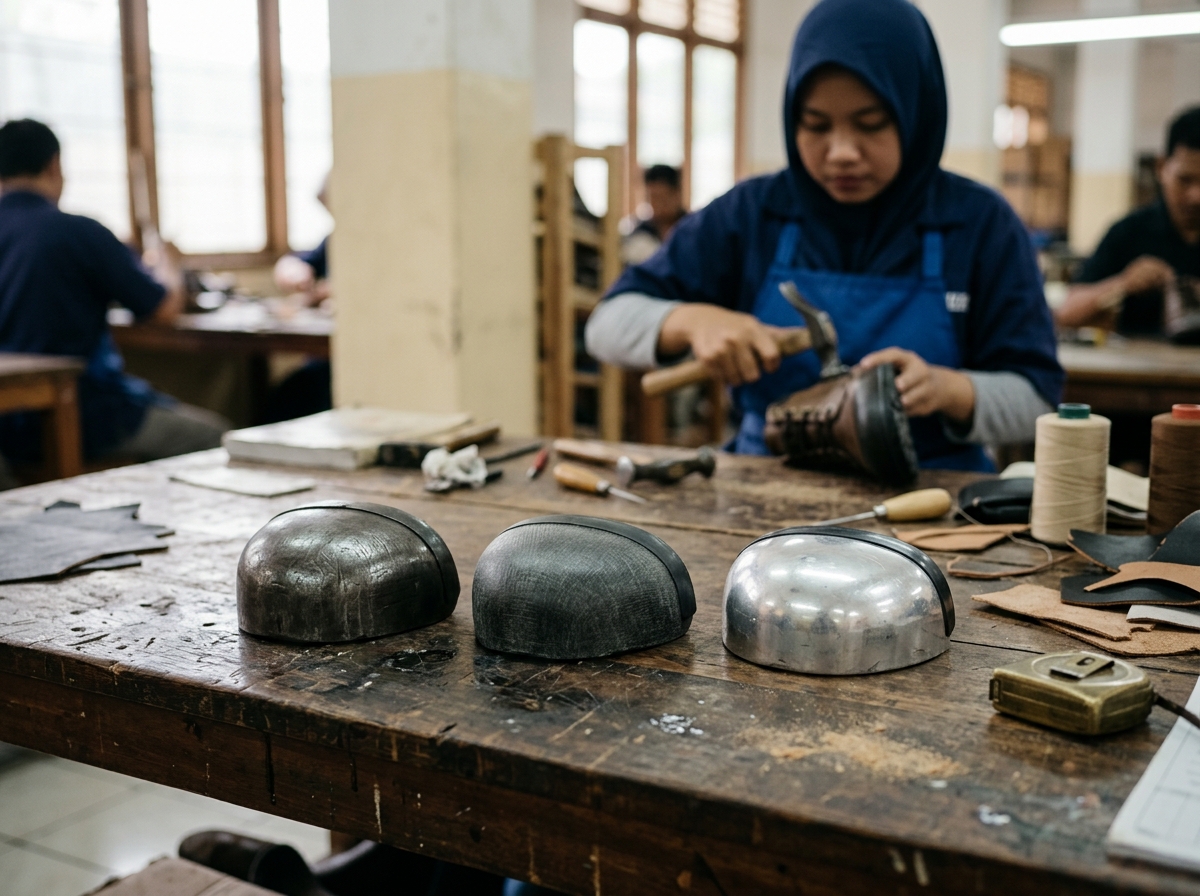
Steel toe caps remain the most widely produced toe protection type across Indonesian factories. They meet EN ISO 20345 impact and compression requirements at lower material cost than alternatives. Steel toe construction is well-suited for heavy manufacturing, construction, and logistics environments where weight is not a primary concern and metal-detector clearance is not required.
Volume pricing on steel toe safety shoes Indonesia is generally the most competitive of the three cap types. Most factories producing steel toe designs can accommodate FOB orders from approximately 500 pairs per style upward.
Composite Toe Safety Boots Indonesia
Composite toe caps — typically fiberglass, carbon fiber, or thermoplastic polymer — are non-metallic and pass through metal detectors unaffected. They are the preferred choice for aviation ground crew, electronics manufacturing, and electrical utility work. Composite toe safety boots Indonesia are produced by a narrower set of factories than steel toe, and material costs are higher, which is reflected in per-pair pricing and typically higher MOQs.
Aluminum Toe as a Middle Option
Aluminum toe caps offer weight savings over steel while retaining metallic construction. They clear metal detectors less reliably than composite but are lighter than steel by approximately one-third. Fewer Indonesian factories specialize in aluminum cap production; sourcing this type may require working with larger OEM facilities that serve multiple global markets.
Established Safety Footwear Manufacturers and Factories in Indonesia
The following manufacturers are recognized within the Indonesian safety footwear sector. Buyers should conduct independent verification and request current certifications directly.
Bata Industrials Indonesia operates within the global Bata Industrial network and produces a wide range of safety footwear including steel toe and composite toe constructions. The Indonesian operation serves both domestic industrial markets and export channels. Bata's global compliance infrastructure means documentation processes are generally well-organized for international buyers.
Grand Shoe Industry is among Indonesia's longer-established safety footwear producers, with a multi-decade track record in manufacturing for both domestic and export markets. The factory produces across multiple safety categories and has experience with European and regional Asian compliance standards.
Dr. OSHA Safety Shoes is an Indonesian-origin brand with a broad domestic distributor network and demonstrated export capability. The brand covers a range of safety classifications and has been positioned for industrial procurement buyers across Southeast Asia.
PT Gradial Perdana Perkasa (Gradial Shoes) and DCP Shoe Factory are production-oriented operations that function as OEM partners for distributors requiring private-label or house-brand safety footwear. Both are volume-focused and structured for large purchase orders rather than small-run sampling.
Mangla Plastic Industries specializes in PU sole safety shoes Indonesia, with outsole casting as a core competency. Buyers requiring specific PU density, hardness, or dual-density outsole constructions should evaluate Mangla as a specialist supplier within a broader sourcing program.
Performance Specifications to Include in Every Purchase Order
Generic purchase orders create quality disputes. Specify every performance parameter in writing before production begins.
Slip resistance: Specify the required rating.
- SRA: tested on ceramic tile with sodium lauryl sulfate solution - SRB: tested on smooth steel with glycerol - SRC: passes both SRA and SRB tests — the highest slip resistance classification under EN ISO 20345
Most industrial buyers sourcing for wet or oily floor environments should specify SRC minimum.
Sole material: Specify rubber, PU, nitrile rubber, or dual-density PU/rubber combination. Each has different performance profiles for heat resistance, chemical resistance, and durability.
Puncture resistance: Under EN ISO 20345, class P (sometimes listed as P1 or P2 depending on the version of the standard in use) requires a minimum penetration force through the midsole. Specify this explicitly for construction and demolition environments.
Electrical properties: ESD (electrostatic dissipative) and antistatic classifications are distinct. ESD footwear actively dissipates charge. Antistatic footwear limits charge buildup. For electronics manufacturing, ESD is typically required. Confirm the test method used and request the test report.
Upper material: Full-grain leather offers superior abrasion and cut resistance. Split leather reduces cost but sacrifices durability. Synthetic uppers (microfiber, nubuck-style synthetics) reduce weight and moisture absorption. Specify the material and minimum thickness in millimeters.
Water resistance and heat resistance: These are separate certifications under EN ISO 20345. Specify WR (water resistant upper) or HRO (outsole heat resistant to 300°C) where required.
- ✓Toe cap type and material (steel / composite / aluminum)
- ✓EN ISO 20345 or ASTM F2413 standard and class (S1 / S2 / S3)
- ✓Slip resistance rating (SRA / SRB / SRC)
- ✓Puncture resistance class (P / P1 / P2)
- ✓ESD or antistatic designation if required
- ✓Upper material and minimum thickness
- ✓Sole material and heat / chemical resistance rating
- ✓Water resistance designation (WR) if applicable
- ✓Country of origin documentation for U.S. import customs
- ✓Third-party test report required before shipment
Sizing Programs and Workforce-Scale Supply for Large Industrial Orders
Sizing Systems and Width Availability
Indonesian manufacturers typically offer EU sizing as the production default. Most factories with U.S. export experience can produce in U.S. sizing on request, and some offer UK sizing as a third option. Confirm this before sampling begins — retrofitting sizing conversions after tooling is established creates delays and rejection risk.
Width fittings are less standardized. Many Indonesian factories produce in a single standard width. If your workforce includes workers requiring wide or extra-wide fittings, ask suppliers upfront whether their lasts accommodate multiple width options. This is a common gap that procurement managers discover only after initial shipments.
Managing Size Run Distribution for Large Deployments
Large workforce deployments require a size run distribution plan, not just a total pair count. A typical industrial workforce follows a bell-curve size distribution weighted toward mid-range sizes. Work with your supplier to pre-agree the size run breakdown — for example, what percentage of a approximately 1,000-pair order ships in each size — and build this into the purchase order.
Build a safety stock of approximately 10–15% excess in the most common sizes to cover replacements without triggering a full reorder cycle. Lead times from Indonesian factories for repeat orders typically range from approximately 60 to 120 days, depending on factory load and whether tooling already exists.
Volume Pricing, MOQ, and Negotiation Levers for Distributors
MOQ Ranges and Price Tier Structure
Standard MOQs for safety footwear from Indonesian factories typically fall in the range of 500 to 1,200 pairs per style. Factories structured as OEM producers for export markets tend to require higher MOQs than smaller domestic-oriented manufacturers.
FOB pricing is the standard Incoterm for Indonesian factory exports. Price tiers typically break at volume increments — a higher per-pair price for the minimum order, with meaningful reductions at double or triple the minimum. Request a tiered pricing schedule upfront so your volume planning reflects actual cost curves.
Private Label and OEM Branding Options
Factories such as PT Gradial Perdana Perkasa and DCP Shoe Factory are structured for OEM production. This means they can produce footwear under your house brand or distributor label. Requirements typically include providing logo files, specifying label placement, and approving a branded sample before production begins. NDA agreements are standard practice; request one before sharing proprietary branding assets.
Payment Terms in Indonesian B2B Export
Common payment structures for Indonesian safety footwear exports include:
- Letter of Credit (L/C): Preferred by larger factories for first-time buyers. Protects both parties. Adds bank processing time. - Telegraphic Transfer (T/T): Typically structured as 30% deposit at order confirmation, 70% against shipping documents. Common with established relationships. - Escrow platforms: Used by some buyers for initial trial orders when trust is not yet established.
Avoid approximately 100% advance payment to unaudited factories regardless of the platform through which you found them.
How to Vet and Qualify an Indonesian Safety Footwear Supplier
Factory Audit Checklist
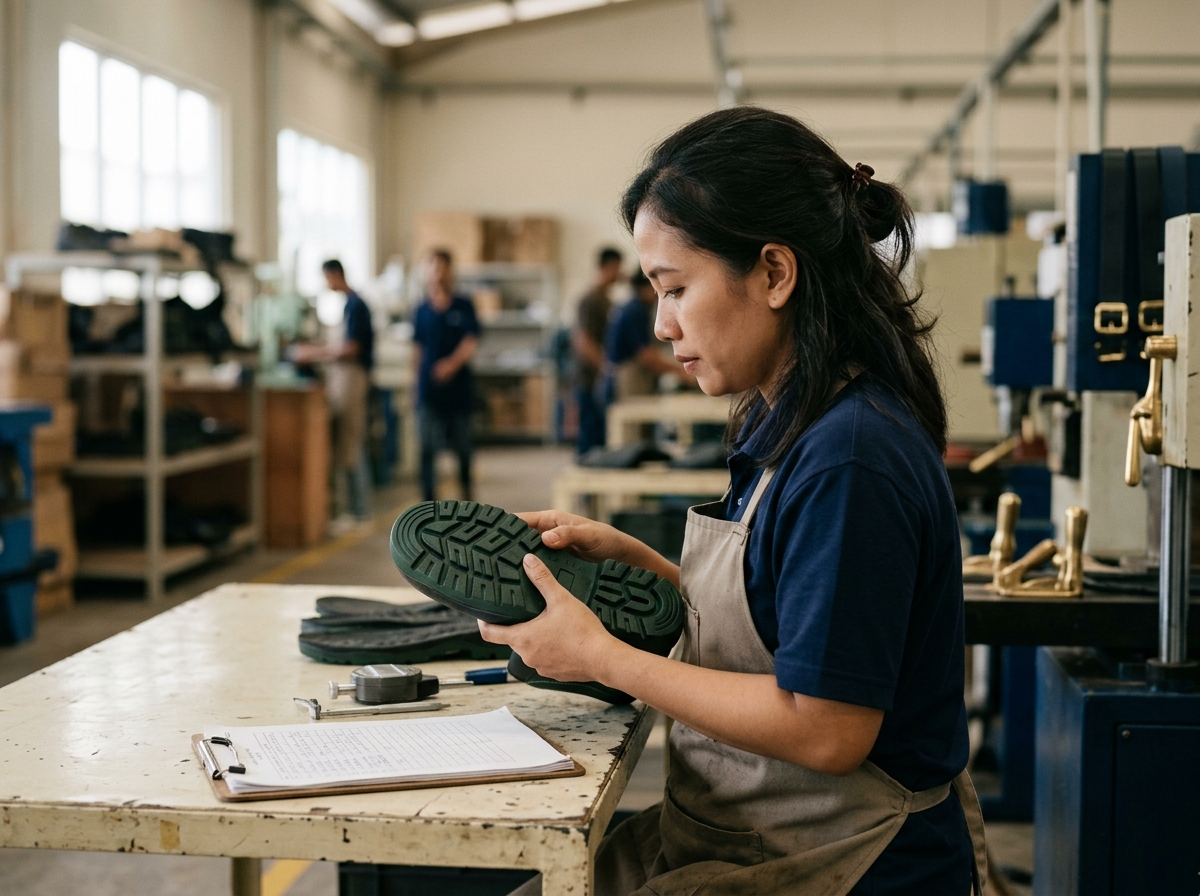
Before committing to a production order, request or conduct a factory audit covering:
- ISO 9001 quality management system certification (current, with scope confirmed) - Production capacity in pairs per day and monthly maximum output - Workforce size and turnover rate as a stability indicator - In-house testing equipment for slip resistance, puncture, and toe cap impact - Subcontracting disclosure — identify which components or processes are outsourced
Third-Party QC and Pre-Shipment Inspection
SGS, Bureau Veritas, and Intertek all operate inspection services in Indonesia. Use them for:
- DUPRO (during production inspection): Catches defects before full production run completes - Pre-shipment inspection: Confirms finished goods match specifications before container is loaded - Lab testing: Sends samples to accredited labs for EN ISO 20345 or ASTM F2413 performance verification
Third-party inspection costs are modest relative to the cost of a rejected container shipment.
Red Flags to Eliminate Suppliers Early
- Cannot provide original test certificates with traceable certificate numbers - Refuses to provide product samples before production - Gives vague lead times or changes lead times repeatedly in pre-order communication - Cannot or will not disclose whether they are a direct manufacturer or a trading company - Marketplace profile shows a very wide product range across unrelated categories — a signal of a trader, not a specialist factory
Frequently Asked Questions: Bulk Safety Footwear Sourcing from Indonesia
Which safety footwearmanufacturers in Indonesiaexport to the United States? Bata Industrials Indonesia, Grand Shoe Industry, Dr. OSHA Safety Shoes, PT Gradial Perdana Perkasa, and DCP Shoe Factory all have documented export activity. Buyers should confirm current U.S. export capability and compliance documentation directly with each manufacturer.
What certifications should Indonesian safety shoes have for U.S. industrial use? The primary standards are EN ISO 20345 (European, widely held by Indonesian exporters) and ASTM F2413 (U.S. standard, required for OSHA-compliant workplaces). SNI is a domestic baseline. Confirm which standard your end-user sites and insurers require before specifying to the factory.
What is the difference between EN ISO 20345 and ASTM F2413? EN ISO 20345 uses a performance-class system (S1 through S3 and beyond) covering toe protection at 200 joules, slip resistance (SRA/SRB/SRC), and puncture resistance (P class). ASTM F2413 specifies impact and compression resistance using different measurement units and does not include the same structured slip resistance classifications. See the comparison table earlier .
Which country is the largest producer of safety footwear globally? China produces the largest total volume of safety footwear globally. Indonesia competes strongly in quality-oriented, specification-compliant production, particularly for leather upper safety boots and PU sole safety shoes targeting regulated industrial markets.
What are the most reputable Indonesian safety shoe brands? Dr. OSHA Safety Shoes and Bata Industrials Indonesia are the most broadly recognized brands with established export infrastructure. For OEM and private-label production, PT Gradial Perdana Perkasa and DCP Shoe Factory are well-regarded production partners.
How do I order safety footwear in bulk from an Indonesian factory? Start with APRISINDO's member directory or verified B2B trade platforms. Request factory audit documentation, product samples, and third-party test reports before committing to a purchase order. Agree on sizing program, size run distribution, payment terms (T/T or L/C), and pre-shipment inspection protocol before production begins.
Indonesia's combination of raw material access, established factory infrastructure, and growing certification compliance makes it a credible long-term source for industrial safety footwear — particularly for U.S. distributors managing large-volume, spec-driven contracts. The key to successful sourcing is documentation discipline: require test reports, audit factories directly or through verified QC agencies, and build certification requirements into every purchase order before production begins.
You now have a clear framework for evaluating safety footwearmanufacturers Indonesia— from certification standards and product specifications to MOQs, sizing programs, and supplier red flags.
You understand the certifications, specifications, and supplier vetting criteria. The next step is connecting with Indonesian factories that can meet your volume and compliance requirements. Request quotes from verified Indonesian safety footwear manufacturers today.
Request Manufacturer Quotes →Need eyes on the ground in Indonesia?
MTS is an execution partner — supplier verification, manufacturing management, quality control and export logistics across Indonesia, Vietnam and China.
Related services
Related articles
Receive furniture sourcing insights across Asia.
One email per week. No spam.