Solid Wood Beds and Headboards: Sourcing From Indonesian Manufacturers
14 min read
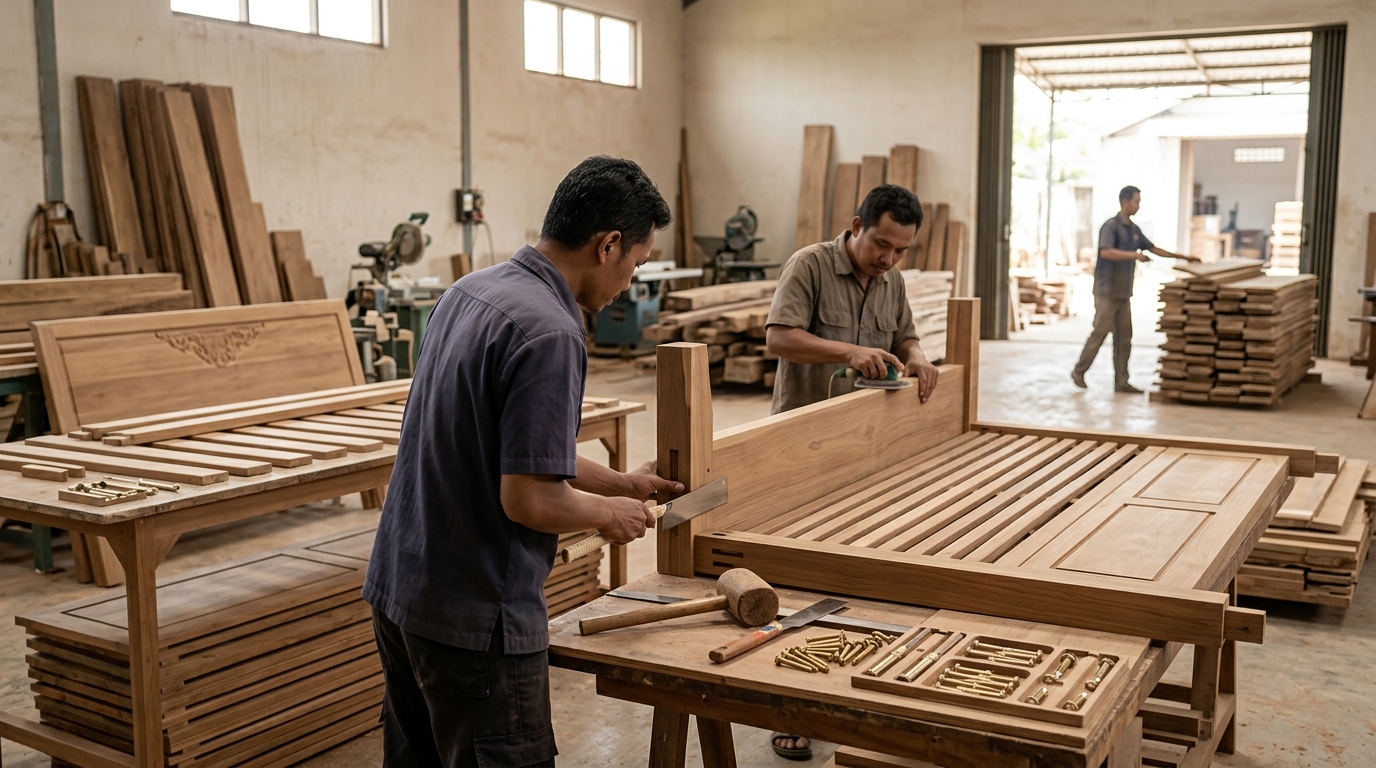
Retail buyers and hospitality procurement managers face a recurring problem when sourcing solid wood bed frames: they are choosing between manufacturers who look similar on paper but differ significantly in engineering capability, certification status, and logistics readiness. Indonesia sits at…
Retail buyers and hospitality procurement managers face a recurring problem when sourcing solid wood bed frames: they are choosing between manufacturers who look similar on paper but differ significantly in engineering capability, certification status, and logistics readiness. Indonesia sits at the centre of this decision for good reason.
This article works through the practical sourcing decision in technical sequence. It covers wood species selection, knock-down joinery engineering, per-market sizing standards, headboard customisation programs, compliance requirements, container logistics, and factory qualification criteria. The goal is to give buyers enough specification-level detail to write a credible RFQ and evaluate responses from solid wood beds headboardsmanufacturers Indonesiawith confidence.
One structural point before the first section: sizing and knock-down engineering are where most sourcing errors occur and where competing content provides the least guidance. Both topics receive detailed treatment here, including a comparative sizing matrix across the three primary destination markets.
Why Indonesia Dominates Global Solid Wood Bed Frame Sourcing
Indonesia's position as a leading source of solid wood beds and headboards is not primarily a cost story. It is a materials story reinforced by logistics infrastructure built over decades of furniture export.
The Hardwood Advantage
Indonesia holds commercial-scale access to four species that matter directly to bed frame buyers:
- Teak (Tectona grandis) — High natural oil content gives dimensional stability in humid and air-conditioned environments. The interlocked grain resists warping across wide headboard panels. Teak positions well for hospitality contracts where durability over a ten-year replacement cycle is a procurement requirement. - Mahogany (Swietenia macrophylla and Toona sureni) — A cost-effective hardwood with a straight, uniform grain that accepts stain and paint finishes cleanly. Widely used in mid-range retail bed frame programs. - Suar / Rain Tree (Samanea saman) — Fast-growing plantation species producing wide slabs. Ideal for statement headboard panels and platform bed bases where live-edge or book-matched aesthetics are a design requirement. -Reclaimed teakand merbau — Character markings, nail holes, and weathered patina are commercially valued by boutique hotel buyers and independent retailers. Reclaimed material also supports a sustainability narrative backed by documentation.
Export Infrastructure and Cluster Geography
Three production clusters handle the bulk of Indonesian solid wood bed exports:
- Jepara (Central Java) — The primary centre for carved and solid woodbedroom furniture. Dense concentration of small to mid-size factories (typically 50–500 workers) with deep expertise in teak and mahogany joinery. - Cirebon (West Java) — Mixed rattan and solid wood production; growing base of export-ready factories. - Surabaya / East Java region — Mid-market and higher-volume production; proximity to Tanjung Perak port reduces inland freight cost and lead time variance.
Certification and Compliance Positioning
Indonesia operates the SVLK (Sistem Verifikasi Legalitas dan Kelestarian) — a government-mandated timber legality verification framework. SVLK certification is a legal export requirement for Indonesian wood product manufacturers. It provides the documentation chain US importers need under the Lacey Act.
Cost Structure Relative to Competing Origins
North American and European solid wood bed frames are produced from comparable hardwood species at significantly higher labour and raw material costs. Vietnamese manufacturers compete on price but lack Indonesia's breadth of premium hardwood access.
Knock-Down Engineering and Container Fill-Rate Calculations for Solid Wood Beds
This section addresses the most under-documented aspect of sourcing solid wood bed frames from Indonesia: how the physical engineering of the product determines your landed cost.
Platform vs Slat vs Panel Systems
Three structural systems dominate the Indonesian export bed frame market:
| System | Primary Market Fit | Notes |
|---|---|---|
| Platform base (solid or slatted deck) | US, AU | Low-profile; suits foam and hybrid mattresses |
| Slatted system (sprung or fixed slats) | EU | Required by many EU mattress warranties |
| Panel bed (headboard + footboard + rails) | US, AU, UK | Most common retail SKU globally |
US and Australian buyers predominantly specify platform or panel beds. EU buyers — particularly German and Dutch retailers — often require a slatted base that meets the flex and spacing tolerances stated in mattress manufacturer warranties. Confirm the mattress specification at purchase order stage, not during sampling.
Knock-Down Joinery: Engineering Options
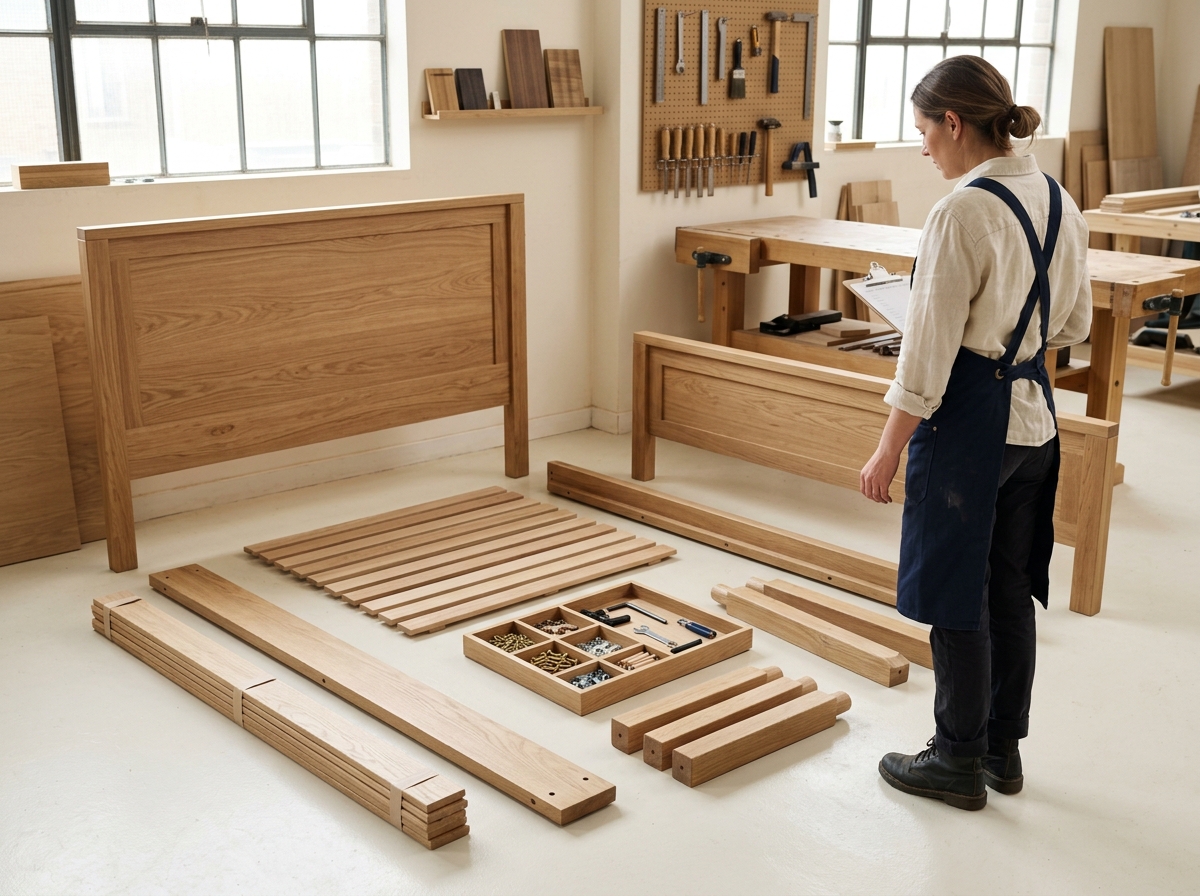
Knock-down (KD) construction allows a bed frame to ship flat-packed and be assembled at destination without specialist tools. This directly affects container fill rate and therefore landed cost per unit.
Common KD joinery systems used by Indonesian manufacturers:
- Cam lock and barrel nut — Fast assembly, low tooling cost, suitable for mid-market retail - Bolted mortise-and-tenon — Stronger connection; preferred for hospitality and heavier king-size frames - Knock-down dowel and cross-bolt — Hybrid system; common in Jepara factories producing for European accounts - Hook-and-rail system — Used on side rails; allows fast in-room assembly without tools
Container Fill-Rate Calculations
The difference between assembled and KD shipment is significant. Approximate comparisons (figures are indicative; confirm with your factory using actual packed dimensions):
| Configuration | 20ft Container | 40ft HQ Container |
|---|---|---|
| Assembled queen bed frame | ~8–12 units | ~20–28 units |
| KD queen bed frame (flat-packed) | ~40–60 units | ~90–120 units |
| KD king bed frame (flat-packed) | ~30–45 units | ~70–95 units |
KD packing can reduce freight cost per unit by approximately 60–70% compared to assembled shipment. For hospitality buyers placing 100+ unit orders, the logistics saving over a full program often exceeds the cost of custom KD tooling.
Structural Load and Centre-Rail Requirements
US building codes and consumer safety expectations (referenced against ASTM F1427 for bunk beds and general structural common practice) require:
- King-size frames (76×80in) and split-king configurations to include a centre support rail with at minimum one centre leg - Slat systems to maintain spacing of no more than approximately 3 inches between slats to prevent mattress sagging - All bolted connections to maintain rated load capacity — typically a minimum static load tolerance of approximately 500 lbs for residential frames, higher for hospitality specification
Request load-test documentation from any factory supplying hospitality accounts.
US, EU, and Australian Sizing Standards: A Comparative Matrix for Factory Tooling
This is the section most sourcing guides omit entirely. Dimensional misalignment between factory templates and destination-market mattress sizes causes costly remakes and delayed program launches.
Comparative Sizing Table
| Size Name | US Dimensions | UK / EU Dimensions | AU Dimensions |
|---|---|---|---|
| Single / Twin | 38 × 75 in (97 × 191 cm) | 90 × 190 cm | 92 × 188 cm |
| Full / Double | 54 × 75 in (137 × 191 cm) | 135 × 190 cm | 138 × 188 cm |
| Queen | 60 × 80 in (152 × 203 cm) | 150 × 200 cm (EU Queen / UK King) | 153 × 203 cm |
| King | 76 × 80 in (193 × 203 cm) | 180 × 200 cm (EU Super King) | 183 × 203 cm |
| Cal King | 72 × 84 in (183 × 213 cm) | Not standard | Not standard |
| Super King | Not standard | 180 × 200 cm (UK) | 203 × 203 cm |
Dimensions are nominal interior frame clearances. Add approximately 1–2 cm tolerance per side for mattress-to-frame fit. Confirm with each factory's engineering team.
Factory Tooling Implications
A manufacturer producing queen frames for the US market and king frames for an Australian buyer needs separate jig sets for each SKU. Higher-capability factories in Jepara and Surabaya maintain per-market tooling programs. During factory qualification, ask to see the template library and confirm which market sizes are in active production versus made-to-order.
Headboard Customisation Programs From Indonesian Solid Wood Manufacturers
Headboards are often a separate sourcing decision from the bed frame base. Indonesian factories — particularly in Jepara — have developed structured customisation programs that go well beyond standard panel options.
Panel Construction and Style Options
| Style | Construction | Typical Market |
|---|---|---|
| Vertical slat / spindle | Solid wood rails and dowels | US retail, hospitality |
| Carved relief panel | Solid teak or mahogany, hand or CNC routed | Boutique hotel, luxury retail |
| Live-edge suar slab | Natural edge book-matched panel | High-design retail |
| Upholstered over wood frame | Solid wood frame, foam and fabric applied at factory | US and AU hospitality |
| Floating panel (wall-mount) | Solid wood panel with French cleat system | EU and AU apartment market |
Upholstered-over-wood-frame headboards are increasingly produced in Indonesia, with fabric sourcing handled domestically or via buyer-supplied material (COM — customer's own material). Confirm the factory's COM capability and whether they can handle fabric sourcing independently.
MOQ and Customisation Program Structures
Custom headboard SKUs typically carry the following minimum order quantities:
- Standard catalogue design, standard finish: approximately 20–30 units per SKU - Modified catalogue design (size change, finish change): approximately 30–50 units per SKU - Fully custom design (new tooling, new panel construction): approximately 50–100 units per SKU
These ranges are approximate and vary by factory scale. Larger mid-market factories (100–500 workers) often have lower effective MOQs on custom SKUs because they spread tooling cost across multi-client runs. Smaller artisan workshops may accept lower MOQs but carry higher per-unit cost and longer sample development timelines.
Finish Options and Brand Programs
Standard finish options from Indonesian headboard manufacturers:
- Oil finish — Penetrating, enhances natural grain; standard for teak - Lacquer — High build, durable; available in matte, satin, and gloss sheens - Stain + topcoat — Allows colour matching to RAL or Pantone references - Whitewash — Popular for coastal and Scandinavian-influenced retail programs - Painted — Opaque finish; requires primer coat on open-grain species
Higher-capability factories offer logo inlay programs — CNC-routed recesses filled with resin, metal, or contrasting wood species — and brand etching via laser or hand-carving. These programs suit hospitality buyers building a room identity program across headboard, nightstand, and case goods.
Certification and Compliance Requirements for US Importers of Indonesian Wood Beds
SVLK — Indonesia's Mandatory Timber Legality Framework
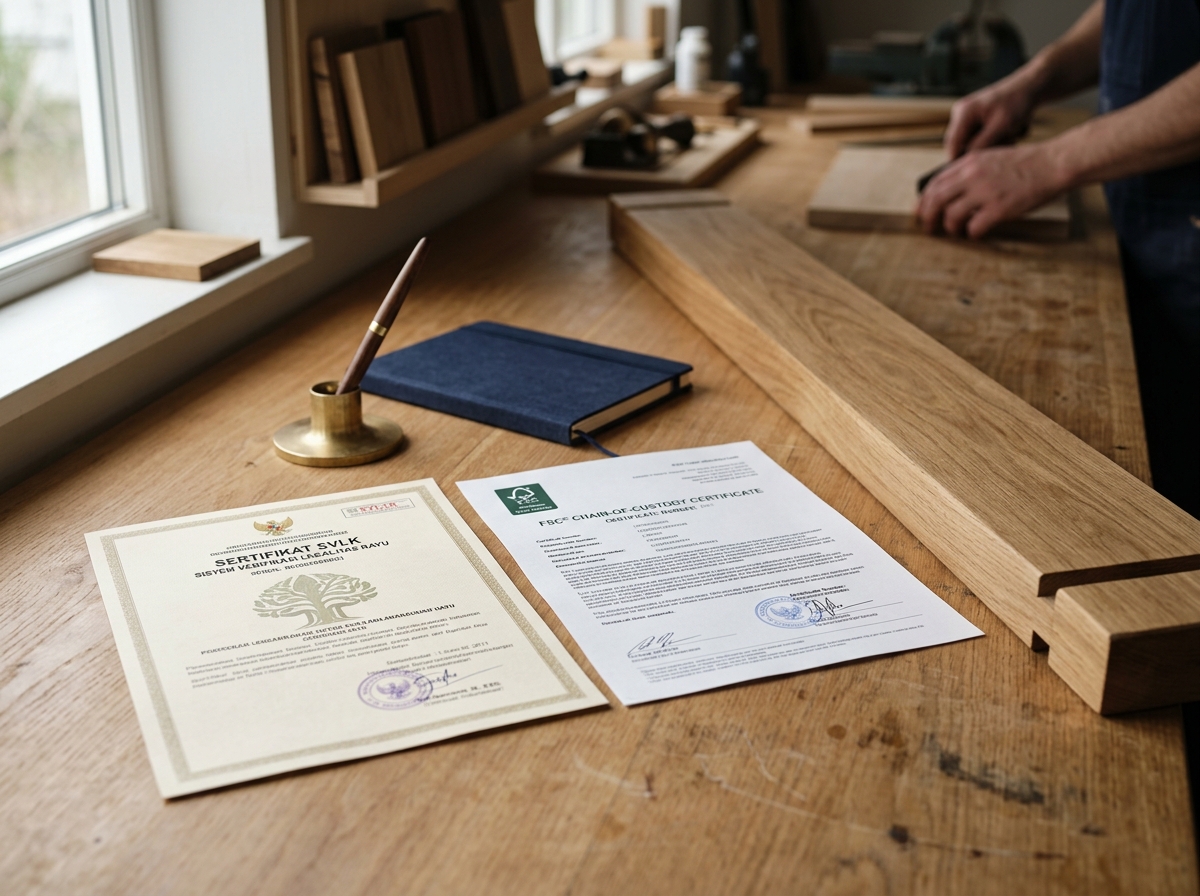
SVLK (Sistem Verifikasi Legalitas dan Kelestarian) is not optional for Indonesian wood product exporters. It is a government-mandated verification system. An SVLK-certified factory can provide a V-Legal document with each shipment. For US Lacey Act compliance, this document — combined with species identification on the import declaration — constitutes the primary legal documentation chain.
Lacey Act Requirements for US Importers
The US Lacey Act (16 U.S.C. § 3372) requires importers to declare the scientific name, country of harvest, and quantity of plant material in imported wood products. Practical requirements for buyers:
- Require species verification documentation from the factory before placing an order - Confirm the declared species matches physical timber used — not just what appears on an invoice - Teak, mahogany, and merbau all have specific scientific names; ensure the factory can provide these consistently
A factory that cannot provide species documentation is a Lacey Act compliance risk for the US importer, not just a quality concern.
FSC, PEFC, and Chain-of-Custody
FSC and PEFC certification require a documented chain of custody from forest to finished product. Not all Indonesian factories carry these certifications — the subset that do typically serves EU retail chains and hospitality groups with specific procurement policies. If your buying program requires FSC, filter for it at the RFQ stage.
CARB Phase 2 and Composite Components
Solid wood beds with composite parts—MDF, particleboard, or plywood—must meet CARB Phase 2 formaldehyde standards. This applies if goods are sold in California. It also covers shipments to retailers with national distribution. CARB Phase 2 limits formaldehyde emissions from composite wood panels.
- ✓SVLK V-Legal document per shipment
- ✓Species scientific name declared on Lacey Act import form
- ✓FSC or PEFC chain-of-custody certificate (if required by buyer policy)
- ✓CARB Phase 2 test report for any composite components
- ✓Moisture content report (target 8–12%) for solid wood components
- ✓Country of origin documentation consistent with all components
Container Logistics, Lead Times, and Freight Planning for Indonesian Bed Programs
Packing Standards for Solid Wood Beds and Headboards
KD bed frame components require protective packaging that prevents transit damage to finished surfaces. Standard packaging specifications from higher-capability Indonesian exporters:
- Corner guards (foam or cardboard) on all leg and rail ends - PE foam sheet wrapping for finished panel faces - Vacuum-sealed non-woven fabric bag for upholstered headboard panels - Cardboard layer separation between stacked components within master carton - Pallet or bundle strapping for container load stability
Specify packaging standards in your purchase order, not verbally. Surface damage on solid wood beds from inadequate packaging is a common claim issue on first shipments.
Lead Times by Order Type
| Order Type | Typical Lead Time |
|---|---|
| Catalogue product, standard finish | 30–45 days |
| Modified catalogue (size or finish change) | 45–60 days |
| Full custom, new tooling required | 60–90 days |
| First order from new factory (includes proto sample approval) | 75–105 days total |
These are approximate production timelines from purchase order confirmation to cargo ready date. Add transit time (approximately 18–25 days ex-Surabaya to US West Coast; approximately 25–35 days to US East Coast) for landed delivery planning.
Incoterms and Port Selection
The two primary export ports for Indonesian solid wood bed programs:
- Tanjung Perak (Surabaya) — Preferred for Jepara-based factories. Inland road transit from Jepara to Tanjung Perak is approximately 5–7 hours. FOB Tanjung Perak is the most common Incoterm used. - Tanjung Priok (Jakarta) — Serves West Java and Cirebon cluster factories. FOB Tanjung Priok.
CIF and CNF terms are available from some larger exporters but FOB is recommended for buyers who have established freight forwarder relationships and want cost transparency.
How to Qualify Indonesian Bed Frame and Headboard Manufacturers Before Placing an Order
Factory Audit Criteria
A structured factory audit for solid wood bed and headboard suppliers should verify:
- Kiln-drying equipment — Target moisture content (MC) for export-grade solid wood is 8–12%. Timber above this range will move dimensionally in destination-market humidity, causing joint failure and surface cracking. Ask for MC certificates per batch. - CNC and joinery machinery — Consistent mortise-and-tenon dimensions require CNC or dedicated jig equipment. Hand-cut joinery introduces tolerance variance that affects KD assembly at destination. - Finishing room — Enclosed spray booth with temperature and humidity control. Open-air finishing is a red flag for finish consistency on high-gloss or colour-matched orders. - Export history — Request a list of destination countries and, where possible, customer references. Factories with active US and EU accounts have demonstrated familiarity with compliance documentation requirements.
Sample Order Workflow
A standard two-stage sample process:
1. Proto sample — First physical interpretation of the design brief. Used to confirm proportions, joinery type, and finish direction. Not for approval of production quality. 2. Pre-production sample (PPS) — Produced from confirmed production materials and tooling. This is the approval-stage sample. KD assembly should be demonstrated on the PPS. Approve PPS in writing before releasing production.
Red Flags in Supplier Evaluation
- No MC data or inability to specify kiln-drying protocol - Cannot provide species verification documentation (scientific name, harvest origin) - No export history or only domestic sales references - Finished samples show joint gaps, finish runs, or surface roughness inconsistent with the stated specification - MOQ claims that seem implausibly low for custom tooling — often signals a trading company, not a manufacturer
Trade Channels for Supplier Discovery
- IFEX Jakarta — Indonesia's primary furniture export trade show. Held approximately every two years. Direct contact with factory principals, not intermediaries. - High Point Market (North Carolina) — Several Indonesian manufacturers and export groups maintain showroom presence. Useful for first-contact relationship building. - Verified B2B directories — Filter aggressively for factories with documented export history, SVLK certification listed, and factory (not trading) classification.
Frequently Asked Questions
What is the minimum order quantity for custom solid wood bed frames from Indonesian manufacturers?
MOQs vary by factory scale and customisation depth. Standard catalogue frames typically start at approximately 20–50 units per SKU. Fully custom designs requiring new tooling generally start at approximately 50–100 units. Mid-size OEM factories (100–500 workers) are the most flexible tier for custom program development.
How do Indonesian bed frame sizes align with US queen and king mattress standards?
A US queen mattress is 60×80 inches (approximately 152×203 cm). A US king is 76×80 inches (approximately 193×203 cm). Indonesian factories serving US accounts tool their jigs to these dimensions. Always provide a mattress specification sheet — not just the size label — at the RFQ stage. Australian and EU buyers use different nominal dimensions for identically named sizes.
What wood certifications should US retailers require fromIndonesian furnituresuppliers?
At minimum: SVLK V-Legal documentation and species identification for Lacey Act compliance. If your retail policy or EU destination requires it: FSC or PEFC chain-of-custody certification. For any composite components in the frame: CARB Phase 2 test documentation.
How are knock-down bed frames engineered for container shipping efficiency?
KD frames ship as flat-packed component sets — rails, headboard panel, footboard, and a hardware pack. Cam lock, bolted mortise-and-tenon, and hook-and-rail joinery systems are the most common configurations. A KD queen frame typically packs at approximately 4–6× the unit count of an assembled frame in the same container space, directly reducing freight cost per unit.
Can Indonesian manufacturers produce headboards in custom sizes and upholstered finishes?
Yes. Factories in Jepara and Surabaya produce upholstered-over-wood-frame headboards, carved panel headboards, live-edge suar slab headboards, and floating wall-mount panels. Custom sizing and COM (customer's own material) programs are available from mid-size and larger factories. MOQ for fully custom headboard SKUs is typically approximately 50–100 units.
What is a realistic lead time for a first production run of solid wood beds from Indonesia?
Plan for approximately 75–105 days from purchase order to cargo-ready date on a first production run. This includes proto sample development and pre-production sample approval. Subsequent repeat orders on approved tooling typically run 45–60 days production lead time, plus transit.
Sourcing solid wood beds and headboards from Indonesian manufacturers rewards technical preparation. Buyers who specify KD engineering requirements, confirm sizing templates per destination market, and require SVLK and species documentation from the outset avoid the most common and costly program failures.
You now have the specification framework to evaluate solid wood beds headboards manufacturers Indonesia rigorously. The logical next step is to put verified suppliers in front of that framework.
Connect with verified Indonesian bed frame and headboard manufacturers — including factory audit data, certification status, and per-market sizing capability. Request a wholesale catalogue and factory profile to begin your supplier evaluation.
Request Supplier Profiles →Need eyes on the ground in Indonesia?
MTS is an execution partner — supplier verification, manufacturing management, quality control and export logistics across Indonesia, Vietnam and China.
Related services
Receive furniture sourcing insights across Asia.
One email per week. No spam.