Teak Bookcases and Bookshelves Wholesale from Indonesia: A Complete Buyer's Guide
14 min read
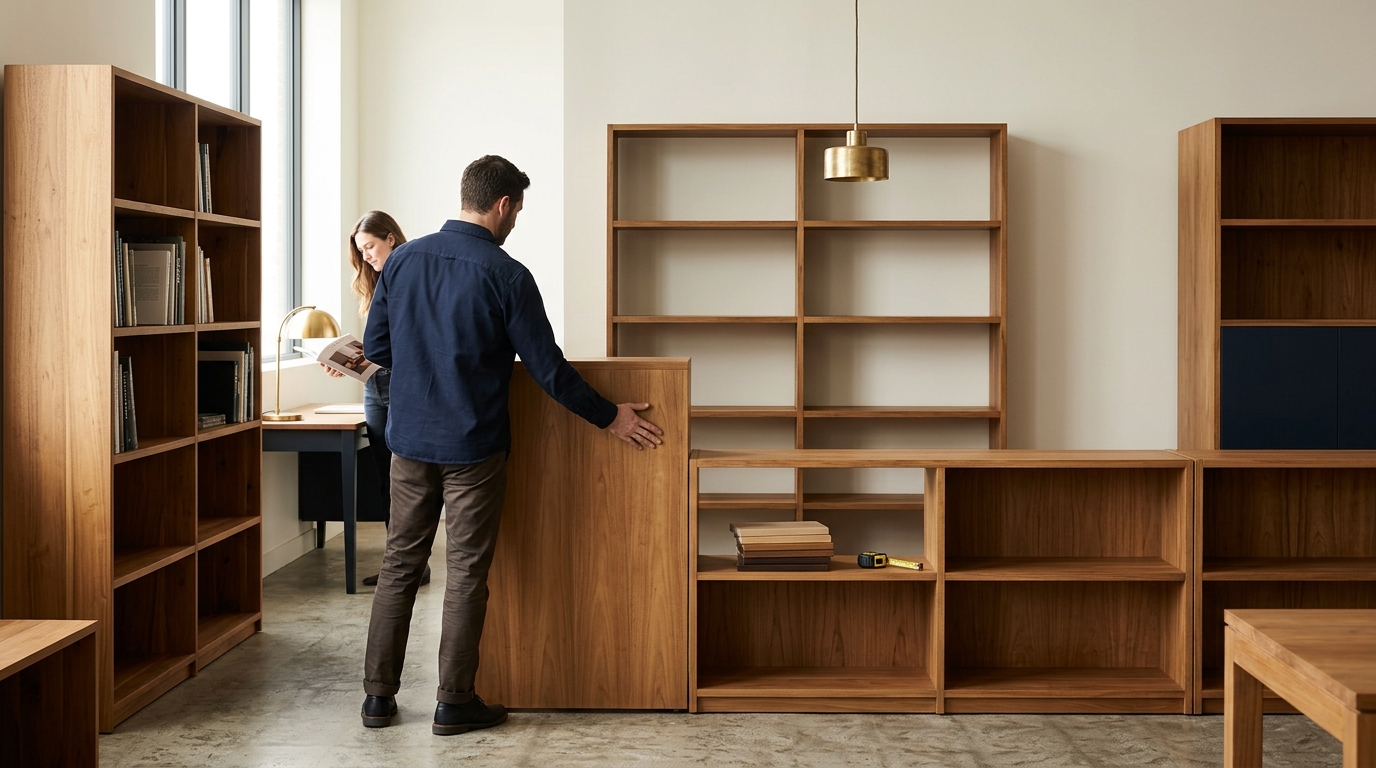
Sourcing teak bookcases bookshelves wholesale from Indonesia involves more than selecting a wood species and placing a purchase order.
Sourcing teak bookcases bookshelves wholesale from Indonesia involves more than selecting a wood species and placing a purchase order.
This guide covers the full procurement chain. It addresses shelf deflection standards, adjustable versus fixed joinery, wall-anchoring requirements, modular system configurations, kiln-drying specs, container-filling strategies, and manufacturer vetting. Every section is oriented toward commercial-grade purchasing decisions, not retail browsing.
Indonesian teak has anchored the global institutional shelving market for decades. The reasons are structural: the wood's density, natural oil content, and dimensional stability under load make it a rational choice for library stacks, retail display walls, and law office cabinetry.
Why Serious Wholesale Buyers Source Teak Bookcases from Indonesian Manufacturers
The Material Case for Teak in Commercial Shelving
Teak (Tectona grandis) carries a high natural silica content and secretes teak oil throughout its cell structure. Both properties resist moisture absorption, dimensional movement, and surface degradation under sustained load. For bookcases and bookshelves holding dense archival or retail stock, this matters more than aesthetics.
Solid teak shelves at commercial spans — typically 900 mm to 1,200 mm — show significantly lower creep deflection over time compared with engineered wood alternatives at equivalent thicknesses. The wood's Janka hardness (approximately 1,070 lbf for plantation-grown teak) also resists surface denting from metal hardware and heavy volumes.
Jepara and Central Java as the Export Production Center
Indonesia's teak case goods industry is concentrated in Jepara,Central Java, and the surrounding satellite towns of Blora and Rembang. This cluster operates at export scale, with factories ranging from vertically integrated mid-size mills to smaller craft workshops producing hand-carved or custom joinery pieces.
Jepara manufacturers have decades of documented export history to the US, Europe, and Australia. Infrastructure for container stuffing, export documentation, and third-party inspection access is well-established. FOB shipments typically depart from Semarang port, roughly 80 km from the Jepara production zone.
Sustainable Sourcing: SVLK and FSC Credentials
Indonesia's SVLK (Sistem Verifikasi Legalitas Kayu) is the government-mandated timber legality verification system. AllIndonesian teak furnitureexporters are required to hold SVLK certification. It is a baseline compliance credential, not a premium differentiator.
FSC (Forest Stewardship Council) certification for plantation teak is available from a subset of Indonesian suppliers. FSC-certified material commands a modest price premium but satisfies institutional procurement policies at universities, government agencies, and LEED-oriented commercial fit-outs.
Cost Position Versus US Domestic and European Alternatives
Factory-direct Indonesian teak wholesale pricing is materially lower than equivalent solid teak case goods sourced domestically in the US or imported from European manufacturers. The cost gap widens further for large-volume container orders, where per-unit manufacturing costs are fixed and freight is amortized across full loads.
Shelf Load Capacity and Deflection Standards Every Commercial Buyer Must Specify
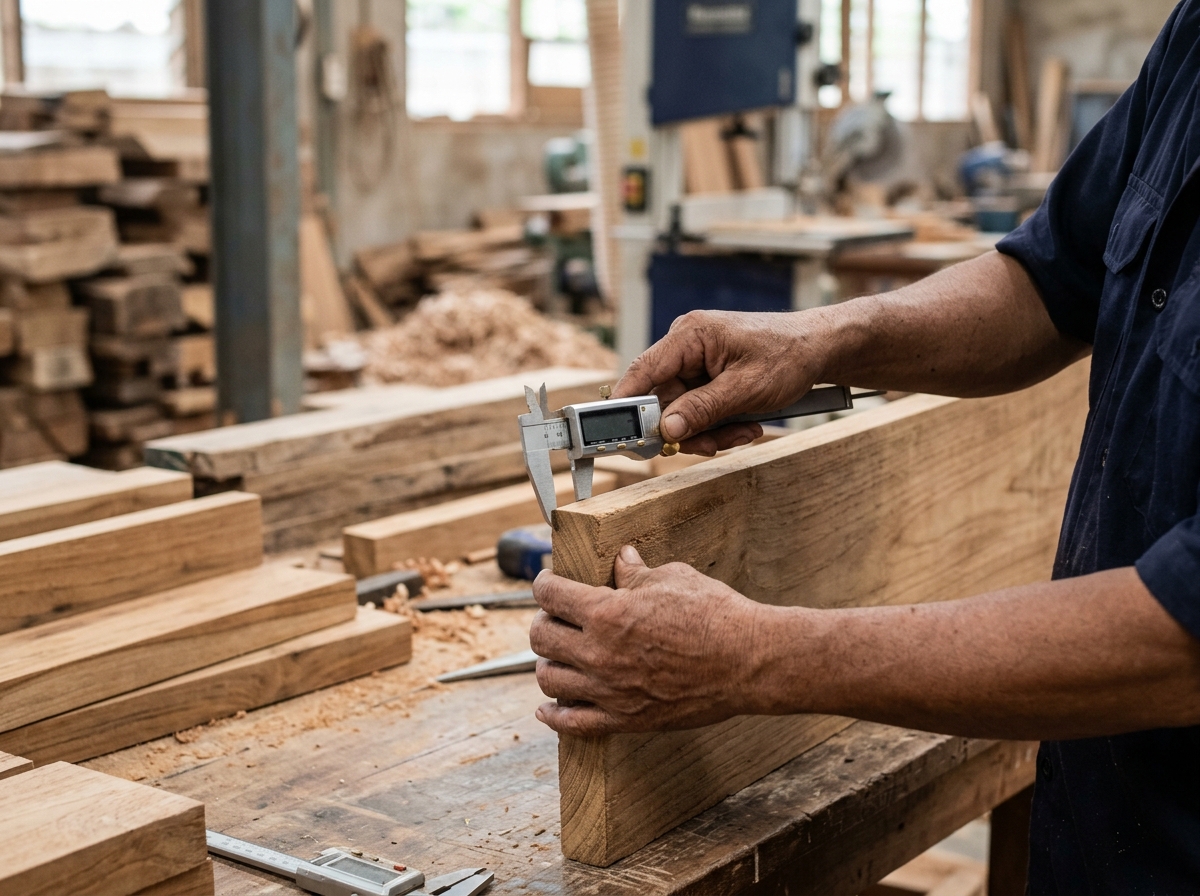
Reference Standards for Commercial Installations
Two standards serve as practical benchmarks for commercial teak shelving procurement in the US:
- ANSI/BIFMA X5.9 covers storage and shelving units used in office environments. It defines deflection limits and structural integrity requirements under load. - BS EN 14073-2 is the European equivalent for office furniture storage. Many Indonesian export manufacturers reference it because European buyers require it. US buyers can use it as a cross-reference.
Neither standard is automatically applied by Indonesian factories unless the buyer explicitly specifies it in the purchase order. Request factory load-test certificates or sample deflection data before committing to volume.
Solid Teak Shelf Thickness vs Span vs Safe Load: Reference Table
The values below are approximate, based on solid teak's modulus of elasticity (typically around 12,600–13,000 MPa for plantation-grown material) and a maximum allowable deflection of span/360 — a commonly accepted threshold for bookshelf applications.
| Shelf Thickness | Shelf Span | Approx. Safe UDL (books/kg per shelf) | Deflection at Full Load |
|---|---|---|---|
| 25 mm solid teak | 900 mm | ~25–30 kg | Within span/360 |
| 25 mm solid teak | 1,200 mm | ~12–16 kg | Approaches limit |
| 30 mm solid teak | 900 mm | ~38–45 kg | Well within span/360 |
| 30 mm solid teak | 1,200 mm | ~22–28 kg | Within span/360 |
| 38 mm solid teak | 900 mm | ~60+ kg | Minimal deflection |
| 38 mm solid teak | 1,200 mm | ~35–42 kg | Within span/360 |
These figures are approximate and assume clear-grain plantation teak, straight-grain shelf orientation, and simple-span shelf conditions. Commission independent load testing for library-grade or archive installations.
Requesting Load Certification
Ask manufacturers for DUPRO (during production) inspection records and any third-party lab test data covering deflection performance. Established Jepara exporters serving institutional buyers can typically provide this. If a factory cannot supply any load documentation, treat that as a sourcing risk signal.
Adjustable vs Fixed Teak Shelving Systems: A Specification Guide for Commercial Orders
Pin-and-Hole vs Dado-Routed Adjustable Systems
Pin-and-hole systems use a vertical row of 5 mm or 7 mm drilled holes on the inner face of each upright. Shelf pins engage these holes to support removable shelves. The 5 mm diameter is standard in European hardware (compatible with Häfele, Grass, and similar branded shelf supports).
Dado-routed adjustable systems use a series of parallel horizontal grooves cut into the uprights at fixed intervals. They offer more bearing surface than pin systems but limit shelf positioning to the dado spacing — typically 25 mm or 32 mm on commercial furniture grids.
For commercial library shelving, pin-and-hole systems on 32 mm grid spacing are the most practical. Specify 5 mm diameter holes if the installation will use European shelf supports. Confirm the drilling pattern in your technical drawing, not in a verbal brief.
Fixed-Shelf Joinery for Heavy-Duty Applications
Fixed teak bookshelves eliminate shelf movement risk entirely. Preferred joinery methods for institutional loads:
- Mortise-and-tenon: The traditional benchmark for structural integrity in solid teak. Provides resistance to racking and vertical load. - Through-dado: Shelf runs the full depth of the unit, seated in a routed channel. Strong for UDL loads but requires precise milling tolerances. - Through-dovetail: Used for top and bottom panels primarily. Resists pulling apart under load.
Fixed-shelf units are preferable for library stacks carrying archival material, law book collections, or retail display stock exceeding 30 kg per shelf. Specify joinery method and glue type (exterior-grade PVA or urea-formaldehyde) in the purchase order.
Wall-Anchoring Safety Requirements for Tall Teak Bookcase Units
Applicable US Standards
Two regulatory references matter for retail and institutional buyers placing tall teak bookcases:
- ASTM F2057 covers clothing storage units but is frequently cited as a reference standard for anti-tip performance in freestanding tall furniture. Libraries and retailers stocking floor-to-ceiling units should understand its anti-tip force thresholds. - California TB 13 (California Bureau of Electronic and Appliance Repair, Home Furnishings and Thermal Insulation) sets anti-tip labeling and hardware requirements for furniture sold or installed in California. It is mandatory for product sold into California retail channels.
Indonesian manufacturers primarily export to residential markets and may not be familiar with TB 13 by name. Communicate requirements in engineering terms: pre-drilled anchor points at specified heights, included anti-tip hardware (L-bracket and wall fastener sets), and compliant instruction documentation.
Design Features to Specify
When ordering teak bookcases for retail floor display or library installation, require the following in your technical brief:
- Pre-drilled anchor holes in the top rail or back panel at specified centers - Recessed or full back panels (6 mm minimum teak ply or MDF) to provide wall-anchoring substrate - Anti-tip strap brackets or L-brackets packed with each unit - Load rating label or data plate on each unit (for institutional compliance documentation)
KD vs Assembled Units: Anchoring Implications
Knock-down (KD) units ship flat-packed and assemble on-site. They typically achieve denser container packing — more units per 40-ft container — but require careful assembly instructions and verified joinery hardware. Fully assembled units arrive ready to position and anchor but consume more container volume.
For library fit-outs where on-site labor is constrained, pre-assembled units with factory-fitted back panels and pre-drilled anchor points reduce installation risk. For retail roll-outs across multiple locations, KD reduces freight cost per unit.
Modular and Ladder-Compatible Teak Bookcase Systems for Large Commercial Fit-Outs
Rolling Library Ladder Rail Compatibility
Floor-to-ceiling teak bookcase walls intended for rolling library ladder access require a top-mounted rail system. The rail attaches to the top rail of the bookcase run. Standard ladder hardware from suppliers such as Häfele or Sugatsune specifies rail channel dimensions and load ratings.
Specify rail channel routing (typically an aluminum extrusion set into the top rail of the bookcase) as part of the factory brief. Do not assume a Jepara factory will include this by default — it requires a separate hardware specification and sourcing step.
Bay-and-Panel Modular Systems
Modular teak bookcase systems use a repeating bay width — commonly 900 mm or 1,000 mm — with shared vertical panels between adjacent bays. This reduces material cost per linear meter compared with freestanding individual units.
When ordering modular systems from Indonesianteak furniture wholesalemanufacturers, specify:
- Bay width and depth - Panel sharing (single or double-panel between bays) - Base plinth height and style - Crown molding profile (if required for the installation aesthetic) - Bridging components for mixed heights within a single run
Stack-On Units and Mixed Heights
Stack-on units — open top sections that mount on a lower enclosed base — allow mixed-height configurations within a single container order. A typical commercial configuration pairs a 900 mm enclosed base with a 600 mm open-shelf stack-on, producing a approximately 1,500 mm total unit.
Ordering a mixed-height configuration from a single factory run enables you to fill a 40-ft container with complementary components rather than identical units. This increases the fit-out flexibility on arrival.
Lead Times: Custom vs Catalogue
| Configuration Type | Typical Production Lead Time |
|---|---|
| Off-the-shelf catalogue units | 30–45 days from order confirmation |
| Standard catalogue with finish variation | 45–60 days |
| Custom modular with new rail or joinery spec | 60–90 days |
| Full bespoke design with new tooling | 90–120 days |
Lead times are approximate and exclude ocean freight transit (typically 25–35 days to US West Coast ports from Semarang/Surabaya).
Finishes, Kiln-Drying Standards, and Reclaimed vs Plantation Teak for Export
Finish Options for Commercial Wholesale Orders
| Finish Type | Appearance | Suitable For | Notes |
|---|---|---|---|
| Natural teak oil | Open grain, warm amber | Hospitality, high-end retail | Requires periodic maintenance |
| Matte waterborne lacquer | Flat, modern | Office, library | Low VOC, stable in HVAC environments |
| Semi-gloss waterborne lacquer | Slight sheen | Branded retail | Easier to clean |
| Unfinished / sanded | Raw wood | US-side finishing | Saves cost; requires controlled shipping |
| RAL/Pantone color-matched stain | Custom color | Branded environments | Add 10–15 days and color-match sample approval |
Kiln-Drying and Moisture Content Requirements
Export-grade teak shelving should arrive at 8– approximately 12% moisture content (MC). This range is appropriate for US interior environments, where ambient humidity typically averages 30–50% RH. Teak shipped above approximately 14% MC risks checking, warping, and joint failure during acclimatization.
Require kiln-drying certificates from the factory. Some Jepara exporters operate in-house kilns; others use third-party drying facilities. Both are acceptable if the certificate specifies the final MC reading and the kiln cycle duration.
Reclaimed vs Plantation Teak
| Parameter | Reclaimed Teak | New-Growth Plantation Teak |
|---|---|---|
| Color consistency | High variation (grey, brown, tan patina) | More uniform golden-brown |
| Character | Nail holes, checks, saw marks | Cleaner grain, fewer marks |
| Density | Often higher (old-growth) | Slightly lower |
| Price | Typically higher per m³ | Lower per m³ at volume |
| SVLK/FSC status | SVLK required; FSC less common | FSC plantation teak available |
| Best for | Design-forward retail, hospitality | Library, office, volume commercial |
Reclaimed teak bookshelves wholesale orders require explicit agreement on acceptable character marks. Establish a golden sample before production — nail holes, checks, and color range approved in writing.
MOQs, Mixed-Container Ordering, and Logistics for Indonesian Teak Wholesale
MOQ Structures
Minimum order quantities for teak bookcases from Indonesian manufacturers vary by factory size and configuration complexity:
| Order Type | Typical MOQ |
|---|---|
| Single SKU, catalogue item | 20–50 units per SKU |
| Full 20-ft container | Approximately 40–80 mid-size bookcases (assembled) |
| Full 40-ft HQ container | Approximately 90–180 mid-size bookcases (assembled) |
| KD units, 40-ft HQ | Higher unit count; depends on flat-pack dimensions |
| Custom modular system | Often 1 container minimum per configuration |
These are approximate thresholds. Factories vary. KD packing increases unit count per container materially.
Mixed-Container Strategy
Combining teak bookshelves with complementary case goods — filing cabinets, sideboards, writing desks — in a single container is standard practice among experienced Indonesian teakfurniture wholesalebuyers. It allows you to reach container thresholds on smaller per-SKU quantities and reduces per-unit freight cost.
Specify a container loading plan (CBM per SKU, packing method, and stacking limits) in the purchase order. Request a stuffing photo and packing list before the container is sealed.
Incoterms and Payment
| Incoterm | Indonesian Factory Responsibility | Buyer Responsibility |
|---|---|---|
| FOB Semarang/Surabaya | To vessel rail at named port | Freight, insurance, import duty |
| CIF US West Coast | To named US port, insured | Import duty, inland freight |
| EXW Jepara | Nil — goods collected at factory | Everything from factory gate |
FOB Semarang or FOB Surabaya is the most common and recommended term for experienced wholesale buyers. It gives the buyer control over freight carrier selection and marine insurance.
Payment terms typically follow: 30% T/T deposit on order confirmation, 70% T/T against shipping documents or bill of lading. Letters of credit (LC) are available from larger factories but may add processing time.
Vetting Indonesian Teak Bookcase Manufacturers: A Wholesale Buyer's Checklist
Certifications to Verify
- ✓SVLK certificate — verify issuer and validity date
- ✓FSC chain-of-custody number — check on FSC certificate database
- ✓BSCI or Sedex audit report — confirm audit date within 24 months
- ✓Kiln-drying facility certification or equipment documentation
- ✓Load test data or ANSI/BIFMA reference compliance records
- ✓Export license and NPWP (Indonesian tax ID) match on invoice
Factory Audit Red Flags
Common quality risk signals when evaluating teak shelving manufacturers in Jepara:
- Inconsistent grain direction across shelves within a single unit - Visible filler in open joints or surface voids (indicates under-grade timber selection) - Spongy or light-feeling stock (indicates under-drying or substandard wood) - Hardware that does not align or self-aligns poorly (indicates jig tolerance problems) - Certificates with mismatched company names or expired dates
A documented pattern in Indonesian furniture wholesale is the sample bait-and-switch: a high-quality sample is produced on the main factory floor, but bulk production is subcontracted to a smaller workshop without QC controls. Counter this with a DUPRO (during production) inspection, ideally by a third-party inspection agency operating in Central Java.
Evaluating Samples
When evaluating a teak bookcase sample, check these parameters:
- Dimensional tolerance: ±1 mm on all stated dimensions is a reasonable commercial standard - Finish adhesion: Cross-hatch scratch test on lacquered surfaces; no flaking at 24 hours - Joint strength: Apply lateral racking force manually; no creaking or movement in mortise-and-tenon or dado joints - Hardware quality: Shelf pins should insert and remove cleanly; no burrs or misaligned holes - Moisture content: Measure with a pin-type MC meter on multiple points; target 8–12%
Trade Show and Sourcing Channel Access
Established channels for identifying verifiedIndonesian teak furnituremanufacturers include:
- IFMAC Jakarta — Indonesia's primary international furniture and woodworking machinery show - High Point Market (North Carolina) — Indonesian manufacturers and their US agents exhibit regularly - Trade sourcing platforms — Verified exporter directories through Indonesia's Ministry of Trade export portal - Independent sourcing agents operating in Jepara and Semarang, engaged on a fee basis rather than supplier commission
Frequently Asked Questions
What is the minimum order quantity for teak bookcases wholesale from Indonesia? Per-SKU minimums at established Jepara factories typically start at 20–50 units. Full container thresholds — 20-ft or 40-ft HQ — are the more practical planning unit.
How do I verify that Indonesian teak furniture meets US anti-tip and load safety standards? Indonesian factories do not automatically design to ASTM F2057 or California TB 13. Specify required anti-tip hardware, pre-drilled anchor points, and any labeling requirements in your technical purchase order.
Can I mix teak bookcases with other case goods in a single container order? Yes. Mixing teak bookshelves with cabinets, desks, or sideboards in a single container is standard practice. It is the most cost-effective way to reach container thresholds on smaller per-SKU quantities.
What moisture content and kiln-drying standards should I require for export-grade teak shelving? Specify 8–12% MC for US interior environments. Require a kiln-drying certificate per shipment. Include MC verification — using a calibrated pin meter at point of inspection — as a mandatory step in your pre-shipment inspection protocol.
How long does production and shipping take for a wholesale teak bookcase order from Indonesia to the US? Catalogue units: approximately 30–45 days production. Custom modular configurations: 60– approximately 90 days. Add approximately 25–35 days ocean freight from Semarang or Surabaya to US West Coast ports.
What is the difference between adjustable and fixed-shelf teak bookcases for library fit-outs? Fixed-shelf units use mortise-and-tenon or dado joinery and carry higher UDL ratings at equivalent spans. They are preferred for archive and library applications with predictable, heavy, static loads.
Sourcing teak bookcases bookshelves wholesale from Indonesia delivers a defensible combination of material performance, craft depth, and factory-direct cost structure — provided the buyer specifies correctly and verifies rigorously. The technical gaps that create quality failures are almost always traceable to under-specified purchase orders and skipped pre-shipment inspections.
With load standards defined, anti-tip requirements documented, container logistics planned, and manufacturer credentials verified, you are positioned to execute a wholesale order that performs in commercial installation without revision cycles.
You now have the specification framework to evaluate Indonesian teak manufacturers with precision. The logical next step is to put those specs in front of a verified supplier and get a costed container plan. Request a wholesale quote and sample container plan from a verified Indonesian teak manufacturer today — with your shelf thickness, load rating, finish, and Incoterm requirements already defined.
Request a Wholesale Quote →Need eyes on the ground in Indonesia?
MTS is an execution partner — supplier verification, manufacturing management, quality control and export logistics across Indonesia, Vietnam and China.
Receive furniture sourcing insights across Asia.
One email per week. No spam.