Top Indonesian Teak Furniture Suppliers for US and EU Buyers: A Strategic Sourcing Guide
14 min read
Sourcing premium teak furniture from Indonesia is one of the most consequential decisions a furniture importer, DTC brand founder, or procurement professional will make. The stakes are real: choose the wrong supplier and you risk receiving a container of poorly crafted pieces that fail quality…
Sourcing premium teak furniture from Indonesia is one of the most consequential decisions a furniture importer, DTC brand founder, or procurement professional will make. The stakes are real: choose the wrong supplier and you risk receiving a container of poorly crafted pieces that fail quality inspections, carry no legal timber documentation, and eat into your margins before a single unit sells. Choose the right partner and you unlock access to some of the finest woodworking craftsmanship in the world, backed by decades of export experience and a material — Tectona grandis — that has commanded premium pricing in Western markets for generations.
This guide is designed specifically for US and EU buyers who are past the research phase and ready to make sourcing decisions. You will find a practical framework for vetting Indonesian teak furniture suppliers, a candid breakdown of pricing structures and landed cost considerations, a walkthrough of US import compliance including the Lacey Act and relevant HTS codes, and strategies for building supplier relationships that produce consistent quality over the long term. Where competitors offer generic manufacturer directories, this article offers a procurement professional's playbook.
Whether you are placing your first container order or renegotiating terms with an existing partner, understanding the Indonesian teak supply chain from Jepara to your distribution center is a durable competitive advantage. The sections that follow build that understanding systematically, beginning with why Indonesia remains the world's dominant source of commercial teak furniture.
Why Indonesian Teak Furniture Dominates the Global Furniture Export Market
Jepara's Unmatched Woodworking Heritage
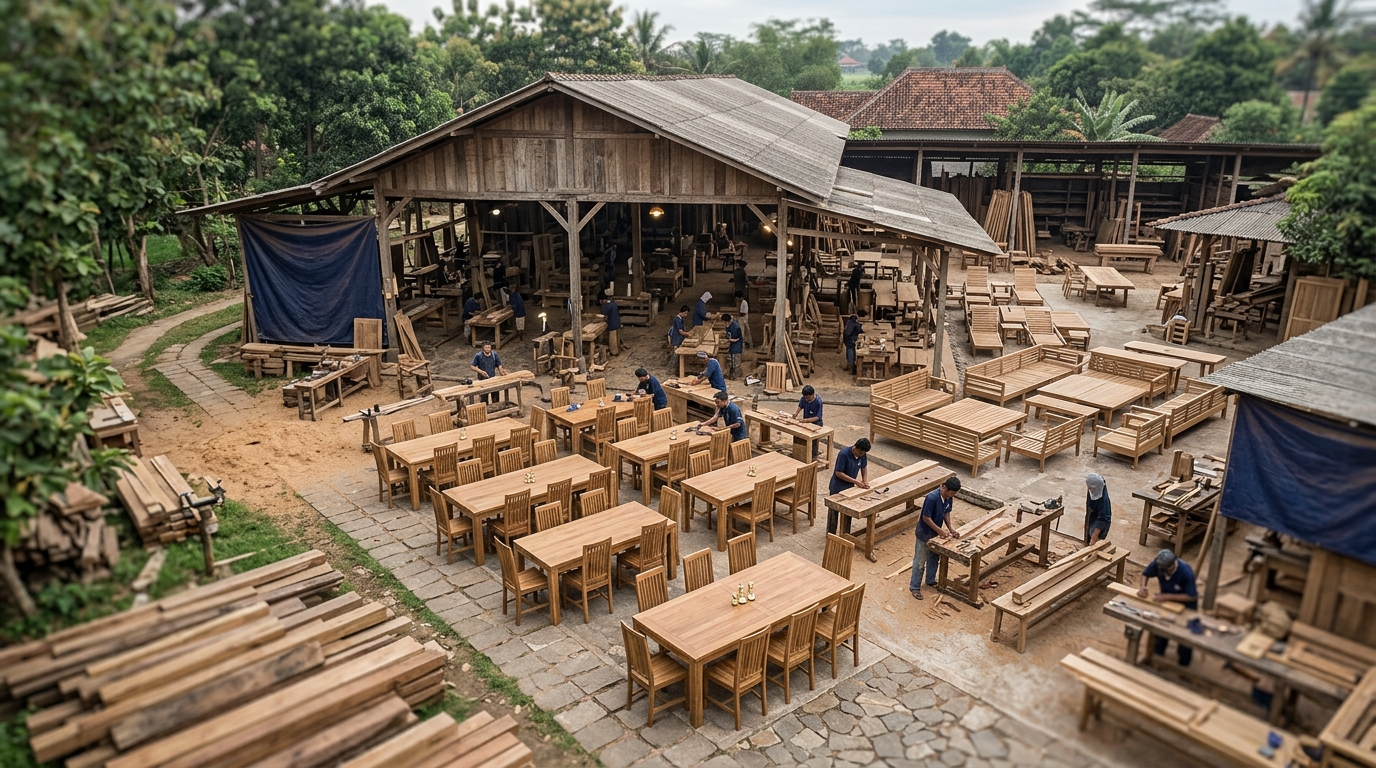
The city of Jepara in Central Java is not simply a manufacturing hub — it is the gravitational center of an entire craft tradition that stretches back centuries. Woodworking knowledge is passed from parent to child across generations, meaning that even factory workers entering the trade bring with them an intuitive understanding of timber behavior, joinery technique, and finish application that no trade school curriculum fully replicates. This accumulated human capital is the invisible asset behind every well-executed Indonesian teak piece, and it is why buyers from the United States, the European Union, the United Kingdom, and Australia have consistently returned to this region rather than diversifying to lower-cost alternatives.
The infrastructure around Jepara reinforces the advantage. Sawmills, hardware suppliers, finishing workshops, and freight consolidators are all concentrated within a relatively compact geography, reducing lead times and enabling the small-batch flexibility that DTC brands and boutique importers increasingly require. Semarang port, the primary export gateway for Central Java production, handles significant volumes of furniture containers annually and has established logistics relationships with freight forwarders experienced in US and EU documentation requirements.
Indonesia's Position in the Global Teak Trade
Indonesia is the world's largest managed source of plantation teak, operating state-owned and private forestry programs that have been cultivating Tectona grandis for well over a century. Unlike Burma — historically another major source — Indonesian teak exports operate within a regulated legal framework that has become increasingly important as importing countries tighten timber legality requirements. The US Lacey Act and the EU Timber Regulation have made traceability documentation not merely desirable but legally mandatory, and Indonesia's SVLK certification system (Sistem Verifikasi Legalitas Kayu) was specifically designed to produce that documentation at scale.
The result is a supply chain that offers Western buyers both quality and compliance in combination that few other origin countries can match at equivalent price points.
Is Indonesian Teak Real Teak — and How Does the Quality Compare?
Botanical Identity and Grading Standards
A question that surfaces frequently in sourcing conversations is whether Indonesian teak is genuinely Tectona grandis — the same species as the Burmese teak long considered the gold standard. The answer is unambiguously yes. Indonesian teak is botanically identical to Burmese teak. The species is the same; what varies is growth conditions, stand age, and silvicultural management, all of which influence density, grain tightness, and natural oil content in the finished timber.
Understanding the grading system that Indonesian suppliers use is essential for buyers placing specifications. The three-tier system operates roughly as follows:
| Grade | Characteristics | Best For |
|---|---|---|
| Grade A | Tight grain, high natural oil, minimal knots, heartwood dominant | Premium indoor and outdoor furniture, DTC flagship lines |
| Grade B | Some knots, slight color variation, mixed sapwood | Mid-range retail, contract hospitality |
| Grade C | Visible knots, wider grain, sapwood present | Budget outdoor pieces, painted finishes |
Plantation Teak vs. Old-Growth Teak for Commercial Buyers
Old-growth teak, harvested from trees that matured over many decades in natural forest settings, produces timber with extremely tight growth rings, dense heartwood, and very high natural oil content. Plantation teak, grown under managed conditions over shorter rotations, produces timber that is lighter in color, slightly less dense, and occasionally more susceptible to surface checking if improperly dried.
For the vast majority of commercial furniture applications — outdoor dining sets, indoor case goods, contract hospitality pieces — well-managed plantation teak is entirely fit for purpose. The practical performance difference between quality plantation teak and old-growth teak, when the furniture is properly finished and maintained, is marginal for end consumers. The compliance difference, however, is significant: old-growth teak sourced outside certified forestry programs carries Lacey Act risk. Plantation teak supplied with SVLK documentation does not.
How to Vet Indonesian Teak Furniture Suppliers Before Committing Capital
Certifications That Signal a Legitimate Operation
The certification landscape for Indonesian teak furniture suppliers is navigable once you know what to look for. Three credentials carry the most weight for US and EU buyers:
SVLK (Sistem Verifikasi Legalitas Kayu): Indonesia's mandatory timber legality verification system. Suppliers exporting to the US are expected to carry SVLK documentation as part of Lacey Act due diligence. Suppliers exporting to the EU should carry an equivalent chain-of-custody document under the EU Timber Regulation framework. Always request the current, unexpired certificate and verify it against the Indonesian Ministry of Environment and Forestry's public database.
FSC Certification: Forest Stewardship Council certification provides an additional, internationally recognized layer of chain-of-custody assurance. FSC-certified Indonesian teak furniture is increasingly requested by EU buyers and by US retailers with published sustainability commitments. FSC certification is not universal among Indonesian manufacturers, but its presence meaningfully reduces due diligence burden.
ISO 9001: An ISO 9001 quality management certification indicates that a supplier has documented and audited production processes. It does not guarantee product quality, but it does indicate that the supplier has the organizational infrastructure to deliver consistent output.
Factory Audit Considerations
- ✓Verify current SVLK and FSC certificates against source databases
- ✓Request production capacity documentation and current order book
- ✓Confirm minimum order quantity (MOQ) in writing and per SKU
- ✓Assess dry kiln and finishing facilities during facility walk-through
- ✓Review a minimum of three completed export orders with shipping records
- ✓Request references from at least two US or EU importers
- ✓Examine quality control documentation for a recent production run
- ✓Confirm lead times for standard vs. custom production
Evaluating Samples Before Placing Bulk Orders
No credible supplier will resist a sample request from a buyer placing a meaningful order. Always evaluate samples against your finished specification, not against a general impression of quality. Measure joint tolerances. Check finish adhesion by applying tape and pulling. Inspect end grain for checking. Confirm that hardware — hinges, drawer slides, fasteners — meets your market's quality expectations. The cost of a sample order is negligible relative to the cost of a rejected container.
A Practical Comparison of Indonesian Teak Furniture Supplier Types
The Indonesian teak export market is not monolithic. Suppliers specialize, and matching supplier type to your business model is as important as any other vetting criterion.
| Supplier Type | Typical MOQ | Lead Time | Key Strength | Best Fit For |
|---|---|---|---|---|
| Outdoor furniture specialists | Low to medium | Moderate | Weatherproof construction, certified teak | Garden retailers, patio brands |
| Indoor/custom manufacturers | Medium | Longer | Custom design, fine finishing | DTC brands, interior trade |
| Full-catalog exporters | Medium to high | Moderate | Breadth of range, established logistics | Multi-category importers |
| Contract/project suppliers | High | Varies | Volume capacity, hospitality experience | Hotel groups, large retailers |
| Small-batch artisan workshops | Very low | Shorter | Design flexibility, direct communication | Boutique DTC, sample development |
Jepara-based manufacturers represent the greatest concentration of export-ready capacity, but buyers should also evaluate suppliers from the Yogyakarta region and Surabaya area, where furniture manufacturing clusters serve different specializations and sometimes offer competitive pricing for specific product categories.
Understanding Indonesia Teak Furniture Pricing and How to Calculate Your True Landed Cost
Factory-Direct Price Ranges and What Drives Them
Indonesian teak furniture pricing at the factory level varies considerably based on grade, complexity, finish specification, and order volume. As broad orientation: simple outdoor benches and side tables typically carry lower unit prices, while large dining sets, upholstered indoor pieces, and custom-designed case goods command meaningfully higher factory prices. Custom finish programs, branded hardware, and proprietary packaging add further cost.
MOQ structures directly influence unit economics. Suppliers running mixed containers for buyers with lower volume requirements typically apply a premium per unit relative to full-container, single-SKU orders. If your business model requires variety rather than depth, factor this premium into your cost modeling from the outset.
FOB vs. CIF Pricing and Landed Cost Calculation
A practical landed cost framework for US importers sourcing from Jepara:
FOB Semarang → add ocean freight to US West Coast or East Coast port → add marine insurance → add US Customs duties (calculated against the applicable HTS code for wooden furniture, typically in the range covered under Chapter 94 of the Harmonized Tariff Schedule) → add customs broker fees → add drayage and inland freight to your warehouse → add any third-party inspection costs incurred pre-shipment.
The sum of these additions over the FOB price is commonly referred to as the landed cost multiplier. For buyers new to Indonesian imports, this multiplier is frequently underestimated, which compresses margins on early orders. Build a detailed cost model before negotiating factory prices, so you know the ceiling FOB price that keeps your target retail margin intact.
Seasonal Pricing and Rate Locking
Freight rates from Southeast Asia to US ports fluctuate meaningfully across the calendar year and in response to broader global shipping market conditions. Indonesian teak furniture suppliers may also apply raw material surcharges during periods when timber prices spike. Buyers with sufficient volume and relationship depth can negotiate fixed-price agreements for a defined forward period, providing budget certainty. For buyers without that leverage, building a modest buffer into landed cost models is prudent.
Navigating US Import Compliance When Sourcing Indonesian Teak Furniture
The Lacey Act and What It Requires of Importers
The Lacey Act is the primary US federal statute governing the import of wood products, and its requirements apply directly to buyers importing Indonesian teak furniture. Under the Lacey Act, importers are required to declare the genus and species of wood contained in their products, the country of harvest, and the quantity and value of the imported goods. False declarations — whether intentional or due to inadequate due diligence — carry significant civil and criminal penalties.
For Indonesian teak furniture, the declaration is straightforward when proper documentation exists: the species is Tectona grandis, the country of harvest is Indonesia, and the SVLK certificate provides the chain-of-custody evidence that supports the declaration. The compliance burden is manageable — but only if documentation is collected systematically rather than retroactively.
HTS Codes and Duty Rates
Wooden furniture imported into the United States is classified under Chapter 94 of the Harmonized Tariff Schedule. The specific HTS code applicable to your products depends on the furniture type — seating, bedroom furniture, dining furniture, and outdoor furniture each have distinct subheadings. Duty rates vary by classification, and misclassification is a common and costly error.
Work with a licensed customs broker experienced in furniture imports to confirm the correct HTS code for each SKU in your catalog before your first shipment. The cost of a classification ruling request from US Customs and Border Protection is modest relative to the cost of post-entry duty assessments and penalties.
Freight and Logistics from Semarang to US Ports
Shipping timelines from Jepara through Semarang port to US West Coast ports typically run in the range of several weeks for ocean transit, with additional time for inland transport from Jepara to the port, customs clearance at destination, and last-mile delivery. East Coast port deliveries add transit time depending on routing. Factor these timelines into your inventory planning, particularly for seasonal product lines where late delivery has a direct revenue consequence.
Engage a freight forwarder with documented experience in Indonesian furniture exports. They will be familiar with Semarang port operations, Indonesian export documentation requirements, and the specific fumigation and phytosanitary certificates that some product types require.
Building Long-Term Supplier Partnerships That Deliver Consistent Quality
Co-Developing Private-Label Teak Lines With Indonesian Factories
One of the most underutilized strategies among DTC brands sourcing from Indonesia is co-development: working directly with a capable Jepara manufacturer to design exclusive products that competitors cannot replicate from the same factory. Many established Indonesian teak furniture manufacturers have in-house design teams that can translate a mood board or rough sketch into production-ready technical drawings. The intellectual property arrangement — who owns the design, whether the supplier can sell the same design to other buyers — must be negotiated explicitly and documented in a written agreement before sampling begins.
For DTC brands, a private-label teak line developed with an Indonesian factory partner offers margin protection, catalog differentiation, and a story about craft provenance that resonates with premium consumers.
Quality Control: In-Production and Pre-Shipment Inspections
Relying solely on factory self-reporting for quality is a risk that experienced importers do not take. Commission independent pre-shipment inspections through a third-party inspection firm with Indonesian operations. For large or custom orders, consider adding an in-production inspection at a defined production milestone — typically when approximately seventy percent of the order is complete — so that defects can be corrected before finishing rather than after.
Define acceptance criteria in writing, in your purchase order, before production begins. Vague standards produce vague outcomes.
Communication, Payment Terms, and Risk Mitigation With New Suppliers
Time zone differences between Indonesia and the United States or Europe are significant but manageable with agreed communication windows and disciplined use of written summaries after any verbal discussion. Establish a single point of contact on each side of the relationship and document all specification changes in writing.
For first-time orders with a new supplier, payment term structures that balance supplier cash flow needs against buyer risk typically involve a deposit at order confirmation and the balance against shipping documents or after pre-shipment inspection. Letter of Credit arrangements provide additional protection for larger orders but add administrative complexity. As the relationship matures and trust is established, payment terms can evolve to reflect that trust.
- ✓Commission a third-party factory audit before placing any order
- ✓Request and verify references from two existing US or EU buyers
- ✓Start with a partial or trial order before committing to full container volume
- ✓Include detailed quality specifications and acceptance criteria in the purchase order
- ✓Obtain all SVLK and FSC documentation before the container departs Semarang
- ✓Use a licensed customs broker familiar with Indonesian furniture for your first shipment
- ✓Retain all timber legality documents for a minimum of five years for Lacey Act records
Frequently Asked Questions About Indonesian Teak Furniture Suppliers
Is Indonesian teak real teak — the same species as Burmese teak?
Yes. Indonesian teak is botanically Tectona grandis, the same species as Burmese teak. The geographic origin affects growth conditions and timber characteristics, but the species is identical. Well-graded Indonesian plantation teak from certified sources is a fully legitimate commercial teak.
Is Indonesian teak furniture good quality compared to other origins?
Indonesian teak furniture from reputable suppliers is consistently competitive with or superior to teak furniture from other origins in terms of craftsmanship, finish quality, and customization capability. Jepara's woodworking tradition produces artisan-level quality at commercial scale — a combination that no other geography has replicated at equivalent price points.
Which country produces the best teak wood?
This is partly a matter of definition. Burma historically produced old-growth teak with very tight grain and high oil content, but export restrictions and legality concerns have reduced its commercial availability. Indonesia produces the world's largest volume of legally certified plantation teak, and its furniture manufacturing infrastructure is the most developed globally. For buyers prioritizing compliance alongside quality, Indonesia is the practical answer.
Where can US buyers purchase authentic Indonesian teak furniture?
US buyers can source directly from Indonesian teak furniture suppliers through factory-direct relationships, through Indonesian furniture export platforms, or via established importers and wholesale distributors who maintain warehouse stock in the United States. Direct factory relationships offer the best pricing but require import infrastructure. Wholesale importers offer convenience but at compressed margins.
What certifications should Indonesian teak suppliers have?
At minimum, look for current SVLK (Sistem Verifikasi Legalitas Kayu) certification for timber legality. FSC certification adds a further layer of chain-of-custody assurance. ISO 9001 certification indicates documented quality management processes. All certificates should be current, verifiable against issuing body databases, and provided in full — not just referenced in a marketing document.
How much does Indonesian teak furniture cost at factory-direct prices?
Factory-direct pricing varies by product type, grade, finish specification, order volume, and supplier. Outdoor furniture pieces — benches, side tables, chairs — typically carry lower unit prices than complex indoor case goods or custom upholstered pieces. The most useful approach is to request itemized FOB quotes from multiple suppliers for your specific product list, then calculate full landed cost for each before making comparisons.
Sourcing successfully from Indonesian teak furniture suppliers comes down to three durable principles: verify before you commit, document everything, and build relationships rather than transact. Buyers who invest in due diligence on the front end — certifications, factory audits, sample evaluation, and landed cost modeling — consistently outperform those who optimize solely for the lowest factory price.
You now have a practical framework for every stage of the sourcing process, from evaluating supplier credentials to navigating US customs compliance. The logical next step is to put that framework to work.
You understand what separates a reliable Indonesian teak partner from a costly mistake — now connect with a supplier who meets the standard. Request a free quote from a vetted Indonesian teak furniture supplier today and take the first step toward a sourcing relationship built on quality, compliance, and consistency.
Request Your Free Quote →Need eyes on the ground in Indonesia?
MTS is an execution partner — supplier verification, manufacturing management, quality control and export logistics across Indonesia, Vietnam and China.
Related services
Related articles
Receive furniture sourcing insights across Asia.
One email per week. No spam.