Coworking Space Furniture Indonesia: The Complete Operator's Sourcing Guide
14 min read
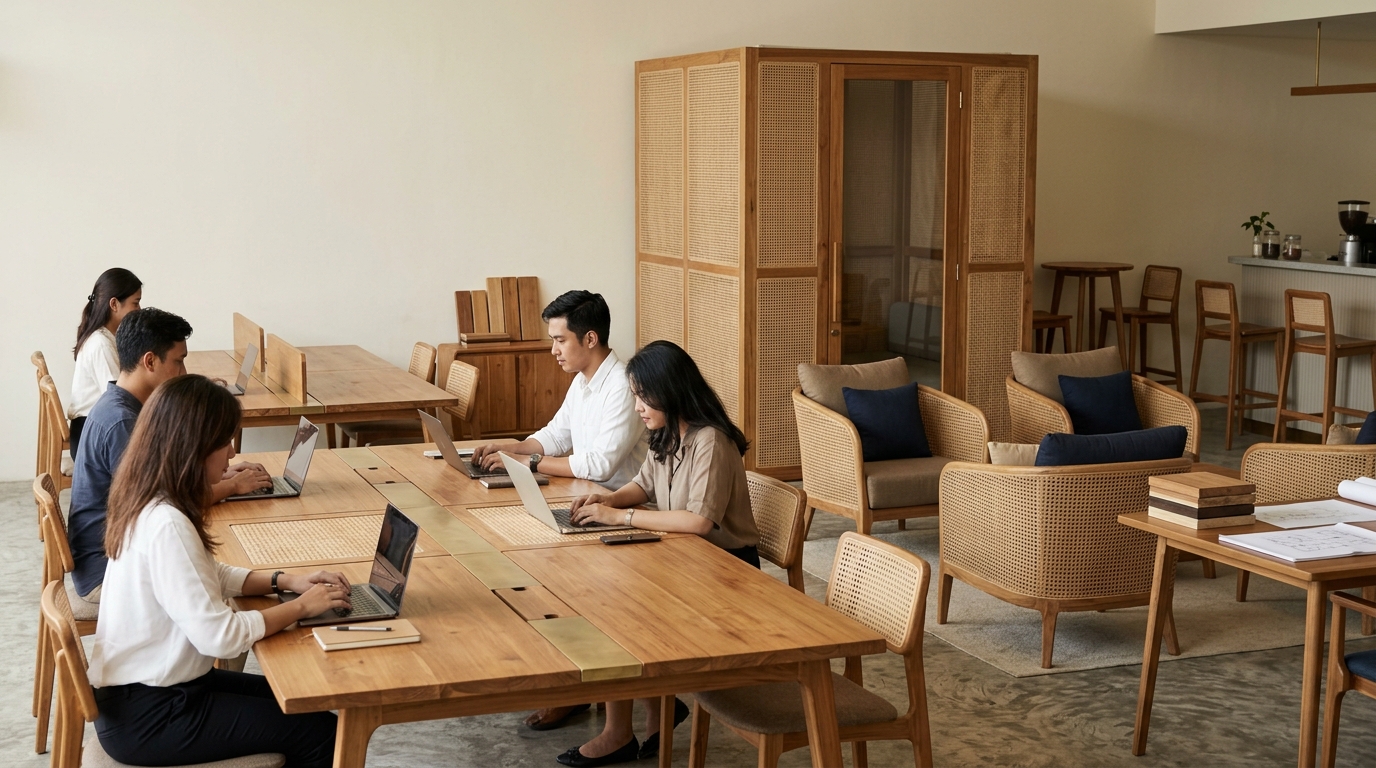
Furnishing a coworking or flex office location is a capital-intensive decision with long operational consequences. Choose the wrong supplier and you face warped desk surfaces by month six, lounge chairs that fail under daily rotation, and acoustic pods that arrive without power integration.
Furnishing a coworking or flex office location is a capital-intensive decision with long operational consequences. Choose the wrong supplier and you face warped desk surfaces by month six, lounge chairs that fail under daily rotation, and acoustic pods that arrive without power integration.
Coworking space furniture Indonesia has emerged as a serious procurement category for North American flex-office operators. Indonesia's furniture industry is built on tropical hardwoods — teak, suar, and reclaimed teak — combined with strong craft traditions in Java and Bali and export-ready factories that have shipped to US buyers for decades.
This guide covers the full decision stack for coworking fit-outs. Topics include material specs, modular systems, acoustic considerations, and lounge zone coordination. It also addresses phased logistics, supplier vetting, and total landed cost analysis including tariffs. Each section is written for operators making commercial procurement decisions, not one-off purchases.
By the end, you will have a sourcing framework that matches Indonesia's production strengths to the specific durability, reconfigurability, and logistics requirements of a coworking environment.
Why Indonesian Factories Win on Coworking Furniture Cost and Material Quality
The Cost-Quality Position Relative to China and Europe
Indonesia sits in a distinct position in the global furniture supply chain. China offers the broadest factory base and the highest automation, but quality consistency at commercial grade requires careful vetting, and post-2018 tariff exposure under Section 301 adds landed cost risk for US importers.
Indonesian production combines material quality with competitive manufacturing cost. Labor-intensive processes — hand-finishing teak, rattan weaving, custom joinery — are built into the production culture, particularly in Jepara (Central Java), which is Indonesia's primary solidwood furniturecluster.
Timber Resources That Match Commercial Use Requirements
Three materials define Indonesian coworking space furniture at the commercial grade:
- Teak (Tectona grandis): Dense, naturally oily, resistant to moisture and surface impact. Plantation teak from Java is available at scale under legal certification. Ideal for desk frames, cafe tables, and lounge bases. - Reclaimed teak: Sourced from decommissioned structures. Offers visual character, dimensional stability, and a sustainability narrative. Higher price per unit but strong in hospitality-facing coworking environments. -Suar wood(Albizia saman): Wide slabs, prominent grain, lower price point than teak. Common in cafe counter tables and feature desking. Requires proper kiln drying to reach 8–12% moisture content before export — verify this with any supplier.
Engineered wood tops with HPL laminate surfaces are also produced in Indonesian factories for operators prioritizing surface uniformity and lower unit cost.
Export Infrastructure and MOQ Flexibility
Java-based factories, particularly around Jepara, Semarang, and Surabaya, have established trade routes to the US, EU, and Asia-Pacific. Many operate as merchant exporters or work through export management companies.
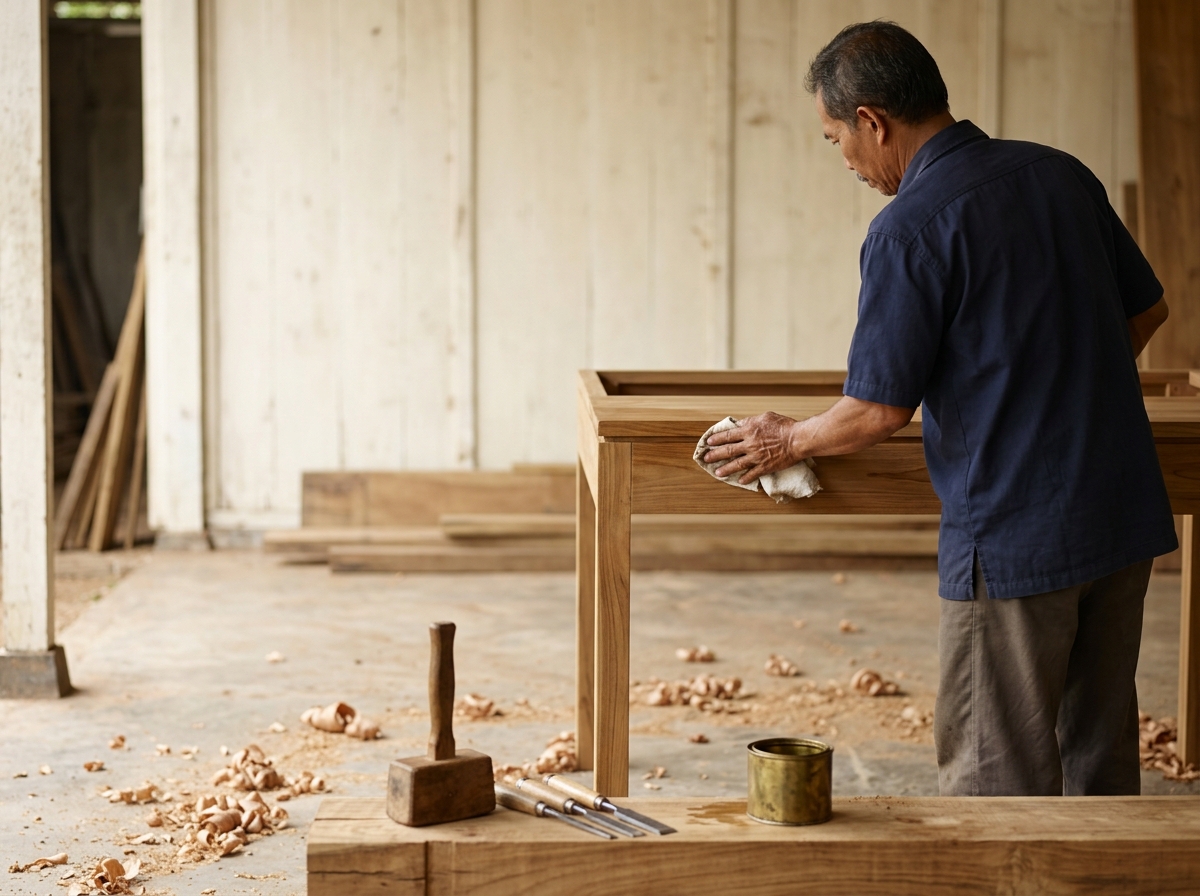
Hot-Desk Tables for Coworking: Material Specs That Survive Daily Shared Use
Surface Material Options Compared
The desk surface takes the most abuse in any hot-desk environment. Material choice drives cost, maintenance burden, and replacement cycle.
| Surface Material | Durability (Commercial Use) | Relative Unit Cost | Lead Time Impact | Best Application |
|---|---|---|---|---|
| HPL laminate on MDF/HMR core | High scratch/stain resistance | Low–Medium | Neutral | High-density open-plan |
| Solid teak | Very high impact resistance | High | +2–4 weeks for drying | Premium zones, feature desks |
| Reclaimed teak | High; character marks acceptable | Medium–High | Variable by stock | Hospitality-style coworking |
| Suar wood slab | Medium; needs sealing | Medium | +1–3 weeks | Cafe corners, reception desks |
| Engineered wood + veneer | Medium; edge-chip risk in shared use | Low | Neutral | Budget hot-desk rollouts |
Frame Specifications for Stability and Weight Load
Powder-coated steel frames are the default for high-density hot-desk configurations. They handle load consistently, resist racking, and allow cable management channels to be integrated at the fabrication stage. Solid wood frames offer a warmer aesthetic but add weight and cost. For bench-style desking running four to eight positions, steel is the practical choice.
Standard sizing conventions for hot-desk tables in coworking environments:
- Single: approximately 120 cm × 60 cm - Double (back-to-back): approximately 120 cm × 120 cm - Bench run (4-seat): approximately 240 cm × 80 cm with central cable spine
Cable Management and Grommet Standards
Open-plan desking in a flex office generates dense cable loads. Specify grommet diameter (commonly 60–80 mm), number per surface, and whether cable trays or raceways attach to the frame underside. Indonesian factories producing commercialoffice furniturecan integrate these at production — but you must specify them in your purchase order.
Modular and Reconfigurable Coworking Furniture Systems From Indonesian Suppliers
Flex office operators need furniture that moves. A training room becomes a workshop space. A private office converts to a collaboration zone. Modular office furniture Indonesia sourced correctly can handle these transitions without requiring replacement cycles.
Interlocking Table Systems
Interlocking or bolt-together table systems allow operators to reshape zones without tools or custom fabrication. Look for:
- Standardized leg socket systems that accept multiple top configurations - Consistent module widths (typically 60 cm or 80 cm increments) for combinability - Consistent finish batches across production runs so future add-on orders match existing stock
Indonesian factories in the mid-market commercial segment can produce these systems, but confirm that your supplier maintains consistent finish formulations across reorders. Batch color variation is a known risk with hand-applied stain finishes.
Modular Storage and Space Division
Modular shelving units that double as spatial dividers serve two functions in open coworking floors: storage and zone delineation without hard construction. Teak or suar shelving on steel frames is available from Indonesian suppliers and handles the dual-use brief. Specify anti-tip hardware for freestanding units in high-traffic zones.
Stackable and Folding Options for Event-Ready Spaces
For multipurpose rooms that shift between event and work configurations, stackable chairs and folding tables are essential. Indonesian factories produce both in commercial grades. Specify stack height limits per chair model, and confirm that folding table mechanisms meet the load ratings your members will place on them.
Custom Sizing for Non-Standard Floor Plans
Many coworking locations occupy irregular footprints — converted shophouses, heritage buildings, or industrial warehouses. Custom sizing is a practical strength of Indonesian workshops, particularly in Jepara where handcraft production supports non-standard specifications. Build a detailed technical drawing package before engaging suppliers.
Phone Booths and Focus Pods: Acoustic Furniture Sourcing From Indonesia
This is where coworking space furniture Indonesia sourcing gets technically complex. Acoustic performance in enclosed pods depends on mass, absorption, and seal — and Indonesia's hardwood-dominant production tradition creates specific trade-offs.
Acoustic Performance: Hard Materials vs. Upholstered Panels
Solid teak and suar wood panels provide mass, which blocks sound transmission. But mass alone does not absorb sound inside the pod. Without internal upholstered surfaces, a hardwood pod reflects internal audio — voices sound louder and calls are less clear.
Indonesian workshops in Bali and Java can fabricate both elements. The key procurement challenge is sourcing acoustic foam at appropriate thickness and density locally. Many Indonesian pod fabricators import acoustic foam from regional suppliers. Confirm your supplier has an established supply relationship for this material rather than sourcing it ad hoc per order.
Ventilation and Power Integration
Enclosed pods without active ventilation become uncomfortable within minutes in tropical climates — and in US office environments with HVAC. Specify:
- Passive ventilation channels in the structural design - Active fan units if pod volume exceeds approximately 1.5 cubic meters - Pre-wired cable entry points for power outlets and USB ports - Lighting fixture mounting provisions
These requirements must be in your technical specification before production begins. Retrofitting power integration after manufacturing is costly.
Semi-Assembled Pod Components for Local Assembly
Full pod assembly in Indonesia followed by container shipping creates dimensional challenges — pods take up significant container volume. An alternative: source semi-assembled components (panels, frames, hardware kits) from Indonesian factories and complete final assembly locally in the US. This reduces container cube usage and avoids complex customs classifications for fully assembled booths.
Lounge Zones and Cafe Corners: Durability Meets Coworking Aesthetics
Upholstery Grades for High-Rotation Shared Seating
Lounge seating in a coworking environment turns over many times daily. Specify upholstery fabrics rated for commercial use — commonly expressed as Martindale abrasion cycles. For hot-desk lounge zones, specify a minimum of approximately 50,000 Martindale cycles. For cafe-adjacent seating with food and beverage exposure, specify stain-treated or vinyl-coated fabrics that Indonesian workshops can source and apply.
Rattan, Teak, and Suar Frames: The Indonesian Aesthetic Advantage
Indonesia's furniture identity is built on rattan, teak, and suar. For coworking operators who want a distinctive, non-corporate aesthetic — increasingly common in hospitality-influenced flex office concepts — these materials are a genuine differentiator.
Cafe-Height Bar Stools and Counter Tables
Hospitality-grade bar stools from Indonesian producers typically use teak or suar frames with machined joint construction rather than dowel-only assembly. Specify mortise-and-tenon or bolted metal inserts at leg joints for commercial durability. Counter tables should be specified with a surface finish rated for food and beverage contact.
Coordinating Multiple Zones Under One Supplier Program
Running hot-desk, lounge, and cafe zones under a single Indonesian supplier simplifies logistics significantly. One purchase order, one shipment, one quality inspection, one container. This coordination requires a supplier with genuine category breadth — solid wood desking, upholstered seating, and cafe furniture in a single production facility or closely managed sub-contractor network.

Phased Fit-Out Supply from Indonesia: Planning Orders Across Multiple Locations
This is the logistics dimension that most sourcing guides skip. Coworking operators rarely fit out one location at a time. You may have three sites opening across 18 months. Your Indonesian supplier needs to accommodate rolling production schedules, not a single consolidated order.
Structuring Phased Purchase Orders
Work with your factory to establish a master framework agreement that covers:
- Total estimated volume across the fit-out program - Release schedule: which SKUs ship with which location's container - Price lock or price review mechanisms tied to raw material indices - Production queue priority for your release orders
Factories that operate on a first-in-first-out queue without reserved capacity are a poor fit for phased programs. Confirm how your supplier handles capacity reservation before signing.
Lead Time Benchmarks
Approximate lead times forIndonesian furnitureshipped to the US West Coast:
| Stage | Typical Duration |
|---|---|
| Production (standard SKUs) | 45–75 days |
| Production (custom or large volume) | 60–90 days |
| Third-party quality inspection | 3–5 days |
| Sea freight (Indonesia to US West Coast) | 18–28 days |
| Port clearance and inland delivery | 5–15 days |
| **Total approximate lead time** | **75–120+ days** |
Plan your fit-out schedule backward from opening date using the upper end of these ranges.
Container Optimization for Mixed SKU Shipments
Coworking furniture is dimensionally diverse. Flat-pack components, nested chairs, and pre-assembled frames require deliberate container loading planning. Work with your freight forwarder or sourcing partner to create a load plan before production begins. Inefficient loading wastes container space and increases per-unit freight cost.
US Warehousing and 3PL Buffering
Sea freight arrival windows are not precise. A 3PL warehouse near your primary installation market buffers timing risk. Receive and inspect furniture at the 3PL, then stage deliveries to each site as construction milestones are reached. This decouples your furniture delivery from your build schedule — a critical operational safeguard when working with overseas production timelines.
- ✓Master framework agreement with capacity reservation confirmed
- ✓Release schedule mapped to site opening dates
- ✓Knock-down specifications approved for container optimization
- ✓Third-party inspection booked for each production run
- ✓3PL warehouse secured near primary installation market
- ✓Customs broker briefed on HTS codes and duty rates
- ✓Freight forwarder load plan approved before production closes
Vetting Indonesian Coworking Furniture Suppliers: A Practical Checklist
Certifications to Require
Three certifications matter for Indonesian timber furniture exports to the US:
- SVLK (Sistem Verifikasi Legalitas Kayu): Indonesia's mandatory timber legality verification system. Required for legal timber export. Any compliant Indonesian factory should hold this. - FSC certification: Confirms timber sourced from responsibly managed forests. Not universally held but increasingly requested by US commercial buyers. Strengthens your sustainability reporting. - ISO 9001: Quality management system certification. Indicates documented production processes and quality controls. Relevant for factories supplying commercial-grade furniture at volume.
Request current certificates, not copies of expired ones. Verify certificate numbers directly with the issuing body where possible.
BIFMA Equivalence and Commercial Durability Testing
US commercial furniture procurement commonly references BIFMA (Business and Institutional Furniture Manufacturer's Association) standards for structural durability and load testing. Most Indonesian factories do not hold BIFMA certification directly. However, factories producing for established US importers often conduct equivalent internal testing or commission third-party tests to BIFMA-aligned protocols.
Request durability test reports for the specific products you are purchasing. If a factory cannot provide test documentation for commercial-grade desk and seating products, that is a risk signal.
Factory Audit Options in Java and Bali
Third-party inspection companies operate across Java and Bali and can conduct factory audits covering:
- Production capability verification (full-cycle vs. assembly-only) - Kiln drying and moisture content controls - Finish quality and material verification - Social compliance and labor standards
Treat an audit as a standard procurement step for any supplier receiving a significant first order. The cost is marginal relative to the value of a multi-location furniture program.
Red Flags in Supplier Communications and Sample Quality
- Inability to provide a factory address or resist an audit request - Samples with visible moisture-related defects (checking, joint gaps) - No SVLK documentation for timber products - Lead time quotes significantly below industry benchmarks (may indicate subcontracting to unverified workshops) - Finish inconsistency between sample and production photos
Total Cost of Ownership: Indonesian Furniture vs. US Domestic Sourcing
Landed Cost Components
The unit price from an Indonesian factory is the starting point, not the total cost. Calculate landed cost by adding:
- Ocean freight: Typically quoted per CBM or per container. Mixed-SKU coworking orders vary significantly. - Import duties: Officefurniture from Indonesiato the US generally falls under HTS Chapter 94. Rates for wooden office furniture commonly fall in the range of approximately 0% to around 5.3% depending on the specific HTS code and product classification. Confirm exact codes with your customs broker — misclassification creates compliance risk. - Customs broker fees - Port handling and drayage - 3PL receiving and storage - Inland delivery to site
Indonesian Furniture vs. US Domestic: Qualitative Cost Position
For volume fit-outs — typically dozens to hundreds of pieces — Indonesian sourcing at commercially competitive quality is generally significantly less expensive per unit than equivalent domestic US commercial furniture. This holds true even after adding freight, duty, and logistics overhead. The cost advantage compresses on small orders where freight becomes a larger proportion of landed cost.
Warranty and Replacement Part Logistics
Overseas sourcing creates warranty complexity. Structure your supplier agreement to address:
- Replacement parts shipped separately (not requiring a full container) - Defect claim documentation requirements and response timelines - Finish batch codes retained by the factory for reorder matching
Lifecycle Durability: Tropical Hardwood vs. MDF
Solid teak and suar furniture, properly dried and finished, outlasts MDF-core alternatives in commercial use environments. MDF absorbs moisture, edges chip under repeated impact, and structural integrity degrades with heavy-load cycling. Teak's natural oil content resists surface damage and moisture penetration.
Frequently Asked Questions
What is the typical lead time for coworking furniture orders from Indonesia?
Expect approximately 45–90 days of production depending on order volume and customization, plus 18–28 days of sea freight to the US West Coast, plus port clearance. Total lead time commonly falls in the 75–120-day range. Plan for the upper bound.
Can Indonesian furniture suppliers accommodate phased or rolling purchase orders?
Yes — but you must confirm capacity reservation terms before committing. Not all factories hold queue priority for phased release orders. Negotiate a framework agreement that specifies your release schedule and the factory's production commitment to it.
How do I ensure Indonesian office furniture meets US commercial durability standards?
Request third-party test reports benchmarked against BIFMA structural standards for each product category. Commission a pre-shipment inspection for each production run. Specify moisture content certification for all solid wood components.
What timber certifications should I require from an Indonesian furniture supplier?
Require SVLK as a baseline — it is mandatory for legal timber export from Indonesia. FSC certification is a stronger signal of responsible sourcing and supports your sustainability reporting. ISO 9001 indicates documented quality management processes.
Are phone booth and acoustic pod components available from Indonesian manufacturers?
Yes. Workshops in Java and Bali produce structural pod components in hardwood and upholstered panel assemblies. Sourcing semi-assembled components for local final assembly in the US is a practical container optimization strategy. Verify acoustic foam sourcing and NRC/STC test data before committing.
What import duties apply to office furniture shipped from Indonesia to the United States?
Wooden office furniture typically falls under HTS Chapter 94, with duty rates varying by subheading. Indonesia does not face the Section 301 tariffs that apply to Chinese goods. Confirm the precise HTS code and applicable rate with a licensed US customs broker for each SKU before importing.
Indonesian furniture sourcing is a viable, cost-effective strategy for flex office operators at scale. It requires clear material specifications, verified supplier credentials, and a solid logistics plan. That plan must account for phased delivery, container optimization, and landed cost accuracy.
You now have the framework to evaluate suppliers on the criteria that matter in a commercial coworking context. The next step is connecting with manufacturers who can match your specification, timeline, and volume requirements.
You have a sourcing framework — now connect it to production. Submit your project brief and receive quotes from verified Indonesian furniture manufacturers experienced in commercial coworking fit-outs across hot-desk, lounge, and cafe zones.
Request a Supplier Quote →Need eyes on the ground in Indonesia?
MTS is an execution partner — supplier verification, manufacturing management, quality control and export logistics across Indonesia, Vietnam and China.
Related services
Related articles
Receive furniture sourcing insights across Asia.
One email per week. No spam.