Furniture Factory Capacity Planning and Production Scheduling in Indonesia: An Operational Guide for Import Managers
14 min read
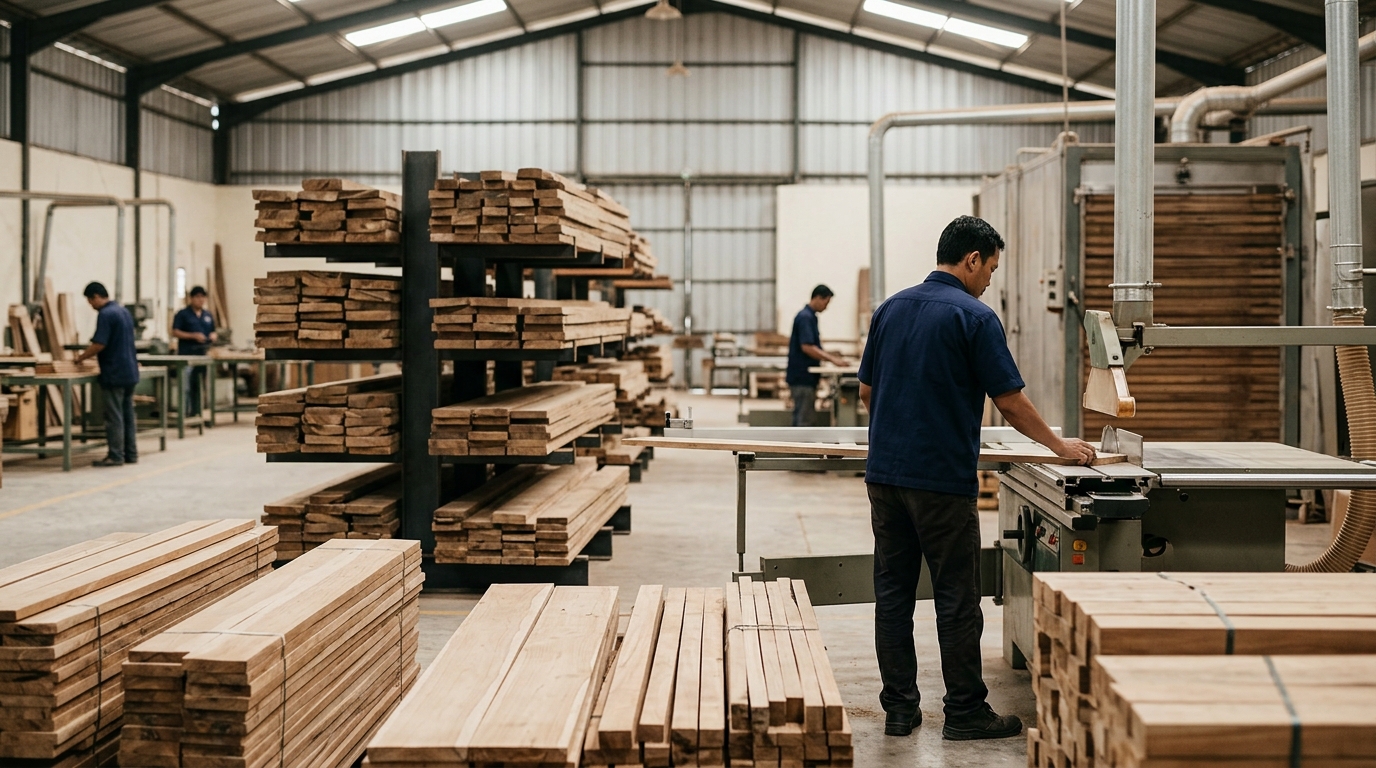
Getting production scheduling wrong with an Indonesian factory is expensive. Missed container windows, last-minute airfreight upgrades, and half-filled containers waiting on delayed SKUs are the most common consequences.
Getting production scheduling wrong with an Indonesian factory is expensive. Missed container windows, last-minute airfreight upgrades, and half-filled containers waiting on delayed SKUs are the most common consequences.
This guide coversfurniture factorycapacity planning and production scheduling in Indonesia with the operational specificity experienced import managers need. It covers auditing real factory capacity before ordering. Indonesia's holiday calendar disrupts production twice yearly. You'll learn to book production slots, understand kiln-drying timelines, and write contracts with financial recourse.
The Indonesian furniture sector is not monolithic. Jepara inCentral Javadominates solid wood and teak carving. Cirebon anchors rattan production. Surabaya serves mid-market assembled case goods. Each cluster operates with different capacity norms, lead times, and seasonal sensitivities. Your scheduling strategy has to account for which cluster you are sourcing from—not just Indonesia as a country.
Why Indonesian Factory Capacity Is Rarely What the Sales Team Describes
The gap between stated output and available slots
Indonesian furniture factories commonly report capacity in units per month. That figure almost always reflects theoretical maximum output under full shift operation with no material delays. It does not reflect available capacity for your order, which depends on how many other buyers have already committed to that same production window.
Mid-scale export factories—typically 100 to 500 workers—commonly serve between three and ten active international buyers simultaneously. A factory floor that looks open during your sales visit may have purchase orders already queued for the next twelve weeks. The sales team often has limited visibility into the master production schedule, and they are motivated to confirm availability.
Why facility type changes every assumption
There are three meaningfully different production tiers operating in Indonesia:
| Facility Type | Workforce (approx.) | MOQ Norms | Transparency | Export Compliance |
|---|---|---|---|---|
| Craft workshop / artisan | 2–30 workers | Very low | Low | Often needs exporter intermediary |
| Mid-scale SME factory | 50–200 workers | Moderate | Variable | Common, but inconsistent |
| Export-grade facility | 200–500+ workers | Higher | Better | ISO 9001, BSCI, FSC typical |
Craft workshops in Jepara and Bali produce premium, low-volume work. They cannot scale to container volumes on short notice. Export-grade facilities have more process discipline but less scheduling flexibility because they carry larger concurrent order loads. Know which tier you are dealing with before discussing lead times.
How to Map Real Factory Capacity Before Placing an Order
On-site audit signals that reveal true throughput
Request an on-site visit or commission a third-party factory audit before your first significant order. The audit should document:
- Number of operational CNC machines, band saws, edge-banders, and hand-finishing stations - Workforce headcount by shift and department - Number and capacity of drying kilns (critical—see the kiln section below) - Number of active buyer accounts and their approximate order volumes - Visible WIP (work-in-progress) volume on the floor—heavy WIP suggests an already-committed factory
Ask to see the production board or schedule whiteboard. Most mid-scale Indonesian factories use physical scheduling boards. If the factory refuses to show you current order load, treat that as a red flag.
Calculating realistic output by product category
A useful cross-check: estimate output by multiplying workstation count by average cycle time per unit for your specific product. A solid wood dining chair requires significantly more hand-finishing time than a flat-pack case good. Factories in Jepara typically produce hand-carved solid wood pieces at slower rates than factories in Surabaya producing semi-automated panel furniture.
- ✓Confirm workforce headcount by shift
- ✓Count operational drying kilns and total cubic meter capacity
- ✓Request master production schedule for next 12 weeks
- ✓Verify number of active buyer accounts
- ✓Inspect WIP volume on factory floor
- ✓Request sample production milestone report from a recent order
- ✓Confirm export certification status: ISO 9001, BSCI, FSC
- ✓Ask for port loading history — frequency of container bookings
Indonesia's Seasonal Production Peaks and How They Reshape Your Schedule
This is where furniture factory capacity planning and production scheduling in Indonesia diverges sharply from other sourcing origins. Two seasonal events compress factory availability in ways that catch first-time and experienced managers alike.
Lebaran and Ramadan: the six-week production compression
Ramadan falls approximately ten to eleven days earlier each Gregorian year, so it shifts across your annual calendar. During Ramadan, productivity in most Indonesian factories drops noticeably as workers observe fasting. Output rates often decline in the final two weeks of Ramadan.
Factory floors in Jepara, Cirebon, and Surabaya can be effectively empty for two to four weeks around Lebaran. Workers return gradually—often over one to two additional weeks—and quality in the first week back tends to be inconsistent.
Practical implication: Any order requiring shipment within eight weeks of Lebaran should be treated as high-risk unless production completed before the holiday period began.
Year-end Q4 surge and what it competes against
US and European holiday import demand creates a Q4 surge that fills Indonesian factory slots from approximately August through October for goods shipping in October and November. This is your highest-competition window. Factories that serve multiple Western buyers simultaneously face compressing capacity at the same time your order needs to move.
Chinese New Year raw material disruption
Indonesia sources hardware components, MDF panels, and certain hardware items from Chinese suppliers. Chinese New Year—typically in late January or early February—creates a regional supply gap. Factories that ordered materials late find themselves with assembly capacity but no components. Build raw material confirmation into your pre-production checklist.
12-Month Production Risk Calendar
| Month | Risk Level | Primary Driver |
|---|---|---|
| January | Medium | Post-New Year restart; Chinese New Year material gap risk |
| February | Medium–High | Chinese New Year (varies); raw material delays |
| March | Variable | Ramadan start (year-dependent) |
| April | High | Ramadan peak productivity decline; Lebaran prep |
| May | Critical | Lebaran shutdown; 2–4 week floor closure |
| June | High | Return lag; inconsistent post-holiday quality |
| July | Medium | Normal production resumes |
| August | Medium–High | Q4 US/EU order surge booking fills slots |
| September | High | Peak slot competition; factories heavily committed |
| October | High | Final pre-holiday shipment window |
| November | Medium | Post-peak; new calendar planning begins |
| December | Medium–High | Year-end closures; skeleton crew at some facilities |
Note: Ramadan and Lebaran dates shift annually. Confirm exact dates each year using the Indonesian government's official calendar.
Production Slot Booking: How to Secure Your Position on the Factory Floor
What a slot commitment actually means in practice
In Indonesian factory culture, a production slot is an agreement that the factory will begin your order on a specified date and maintain dedicated capacity for a defined period. This differs from a Western purchase order acknowledgment. Without a formal written slot confirmation and a deposit to back it, the factory retains full discretion to accept a larger or more favored buyer's order and push yours.
Booking timelines by season
| Order Type | Recommended Advance Booking |
|---|---|
| Off-peak standard order | 8–10 weeks before required start |
| Off-peak complex custom order | 10–14 weeks before required start |
| Peak season (Q4 / pre-Lebaran) | 14–18 weeks minimum |
| Large volume or multi-container order | 16–20 weeks for peak; 12–16 weeks off-peak |
These ranges reflect common industry practice and should be validated with your specific factory and product category.
Deposit structures that create real priority
A deposit of typically 30% of total order value is standard in Indonesianfurniture exportcontracts. Paying this deposit early—at slot confirmation, not at sample approval—signals commitment and moves your order up the priority queue. Some factories in Jepara offer explicit slot-fee arrangements for peak-season priority, separate from the production deposit.
Written versus informal agreements
Informal WhatsApp confirmations are common and often how initial scheduling conversations happen. They are not enforceable. A written slot confirmation signed by a factory manager or director, referencing your purchase order number and the production start date, is the minimum standard for high-value orders. For orders above a threshold your legal team defines, a formal contract addendum is appropriate.
Kiln-Drying Bottlenecks: The Hidden Delay Most Import Managers Miss
Why kiln-drying governs your actual shipping date
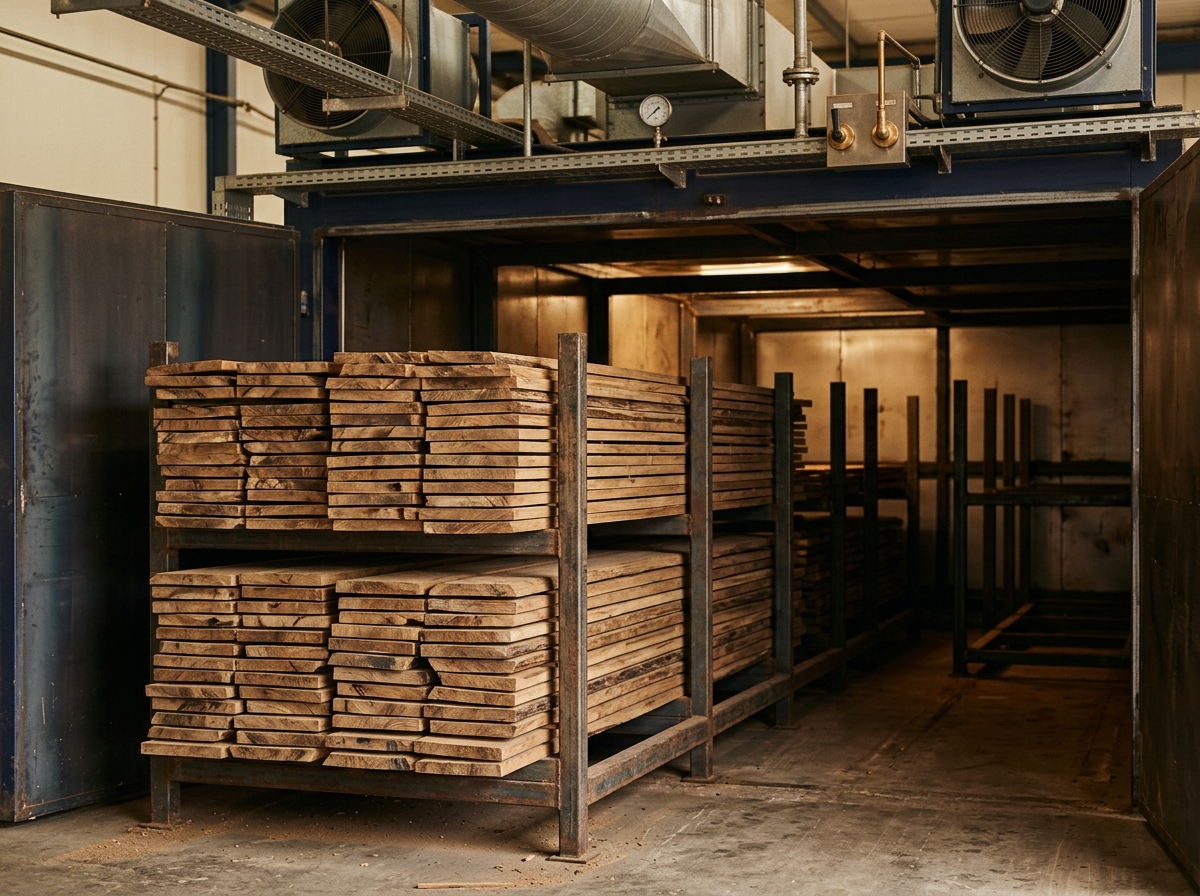
Kiln-drying is not a finishing step. It is a throughput constraint that sits at the front of the production process for solid wood furniture. Timber must reach an equilibrium moisture content (EMC) of approximately 6–8% for furniture destined for the US market. The US interior climate—particularly in air-conditioned environments—is significantly drier than Indonesian ambient conditions.
A single kiln cycle for solid teak or mahogany typically runs seven to fourteen days, depending on timber thickness and kiln type. If your factory shares kiln access with other buyers or uses a third-party kiln facility—common among smaller Jepara workshops—you face a queue you have no visibility into.
EMC standards for the US market
The 6–8% EMC target is the widely accepted industry standard for furniture exported to US indoor environments. Some US climate zones—particularly arid western states—may require the lower end of that range. Confirm the target EMC with your factory in writing and request kiln batch records as part of your pre-shipment documentation.
Negotiating kiln access in your supply agreement
For factories using third-party kilns, add a clause to your supply agreement that requires the factory to confirm kiln booking dates at the same time as production slot confirmation. For high-volume or repeat orders, explore whether dedicated kiln time or a priority queue arrangement is negotiable. Some larger export-grade facilities in Central Java operate captive kilns—this is worth confirming during your factory audit.
Building Realistic Schedule Buffers Into Your Production Timeline
Furniture factory capacity planning and production scheduling in Indonesia requires buffers that account for real operational variability—not optimistic straight-line projections.
Buffer standards by product complexity
| Product Category | Baseline Lead Time (approx.) | Recommended Buffer |
|---|---|---|
| Flat-pack RTA panel furniture | 45–60 days | 7–10 days |
| Semi-assembled case goods | 60–75 days | 10–14 days |
| Solid wood dining / bedroom sets | 75–100 days | 14–21 days |
| Hand-carved or custom artisan pieces | 90–120 days | 21–30 days |
These are approximate industry ranges. Confirm actual lead times with each factory for your specific SKUs.
Milestone-based check-ins as scheduling anchors
Build a production milestone schedule into your purchase order. Standard milestones for solid wood furniture:
1. Raw material confirmation — timber sourced and kiln booking confirmed 2. Rough milling complete — components cut and dimensioned 3. Kiln cycle complete — EMC test results provided 4. Assembly complete — pre-finishing inspection 5. Finishing and packaging complete — DUPRO inspection window 6. Container loading — packing list and photos
Use the third-party QC inspection as a hard scheduling anchor. Book the pre-shipment inspection date before production starts. This creates a fixed endpoint that the factory schedules toward.
Penalty Clauses and Contractual Protections for Late Delivery from Indonesian Factories
Standard penalty structures in Indonesian export contracts
Late-delivery penalty clauses are accepted practice in Indonesian furniture export contracts. A common structure is a daily or weekly penalty equal to a percentage of the delayed shipment value, capped at a total maximum (often 5–10% of order value). Without a cap, factories are reluctant to sign. Without a floor, the clause lacks deterrent value.
Example clause language (adapt with legal counsel):
> "In the event that the Supplier fails to complete production and deliver goods ready for loading by the confirmed shipment date, the Supplier shall pay the Buyer a late delivery penalty of [X]% of the FOB value of the delayed goods per week of delay, up to a maximum of [Y]% of the total order value."
Force majeure under Indonesian commercial law
Indonesian commercial contracts are governed by the Indonesian Civil Code (Kitab Undang-Undang Hukum Perdata). Force majeure provisions under Indonesian law are interpreted broadly. Factories may invoke force majeure for events including labor unrest, raw material shortages, or government-mandated shutdowns. Buyer-side contracts often define force majeure more narrowly.
Practical approach: Negotiate a force majeure clause that requires the factory to provide written notice within 48 to 72 hours of any qualifying event, with documentation. A blanket force majeure claim submitted after the shipment date has passed is a warning sign.
Combining financial penalties with milestone bonds
For orders above your defined value threshold, consider structuring a portion of the payment—typically 10–15%—as a milestone-release bond held until on-time completion of each production stage. This is more effective than a back-end penalty because it creates ongoing financial accountability throughout production rather than a dispute at the end.
Communication Protocols That Keep Production on Schedule
Establishing the right contact at the factory
Insist on a named production coordinator as your primary contact—not the sales manager. The sales team's incentive ends at order confirmation. A production coordinator has daily visibility into the factory floor and can flag delays before they compound.
Weekly status report templates
A functional weekly production update for Indonesian factories should include:
- Current production stage against milestone schedule - Units completed versus units planned for the week - Any raw material, kiln, or labor issues flagged - Updated expected completion date if any change from original
Factories in Central Java and West Java are generally comfortable providing this format via WhatsApp with photos attached. Some larger facilities accept ERP portal access or shared Google Sheets dashboards.
Escalation paths when communication goes silent
If factory updates stop or become vague:
1. Contact the production coordinator directly before escalating 2. Request a video call showing current WIP on the floor 3. If no response within 48 hours, escalate to the factory owner or general manager 4. Activate your third-party QC agent for an unscheduled floor visit 5. If the order is within four weeks of the shipment date, notify your freight forwarder of a potential delay and protect your container booking
Practical Scheduling Strategies for Multi-Factory Orders Across Indonesia
Splitting a large order across multiple factories reduces concentration risk but introduces coordination complexity.
Choosing the right factory clusters
| Cluster | Specialization | Coordination Risk |
|---|---|---|
| Jepara, Central Java | Solid wood, teak, carving | Artisan-heavy; kiln bottlenecks common |
| Cirebon, West Java | Rattan, wicker, natural fiber | Material sourcing risk in wet season |
| Surabaya, East Java | Mid-market assembled goods | More factory capacity; better logistics |
| Semarang, Central Java | Outdoor furniture | Port access; reasonable lead times |
When the same SKU is produced across multiple factories, quality consistency becomes the primary risk. Provide each factory with identical technical drawings, finish samples, and tolerance specifications. Use a single third-party QC standard applied at every factory.
Container consolidation timing
When factories complete at different times, consolidation at an Indonesian port becomes a scheduling puzzle. A freight forwarder with an on-ground presence in Indonesia—particularly in Semarang or Surabaya—can act as a production monitor and coordinatecontainer consolidation. Communicate the latest acceptable ready-date for each factory to your forwarder at order placement.
Frequently Asked Questions: Indonesian Furniture Production Scheduling
What is a realistic lead time for custom solid wood furniture from an Indonesian factory?
For custom solid wood case goods or dining sets from Jepara or similar Central Java factories, plan for 75 to approximately 100 days from deposit payment to production-complete. Add kiln time—typically seven to fourteen days—if it falls outside the stated lead time. For complex hand-carved pieces, 90 to approximately 120 days is more realistic.
How far in advance should I book production slots before Indonesian peak seasons?
For Q4 US holiday demand (goods shipping October–November), book slots by late July at the latest—ideally earlier. For orders that must ship before Lebaran, confirm slots at least fourteen to eighteen weeks before the Lebaran date for that year.
What moisture content standard should Indonesian furniture meet for US importation?
Target 6–8% equilibrium moisture content (EMC). Request kiln batch records confirming this range before approving shipment. For furniture going to arid US markets (Southwest, Mountain West), target the lower end of that range.
How do I enforce a late-delivery penalty clause with an Indonesian supplier?
Enforcement begins at contract drafting, not dispute. The clause must be in a signed written contract—not just a purchase order. Indonesian courts will apply the Indonesian Civil Code. For practical enforcement, the most effective lever is the milestone-release bond structure: withhold payment tranches tied to on-time completion rather than relying on a post-shipment penalty claim.
What is production scheduling and how does it differ from capacity planning in a factory context?
Capacity planning determines the maximum output a factory can sustain over a period. Production scheduling assigns specific orders to specific time slots within that capacity. A factory may have capacity for 500 dining chairs per month but already have that capacity scheduled for other buyers. Furniture factory capacity planning and production scheduling in Indonesia require you to verify both dimensions—not just overall capacity.
Which Indonesian cities or regions are the mainfurniture manufacturinghubs?
The primary clusters are Jepara (Central Java) for solid wood and teak, Cirebon (West Java) for rattan, Surabaya (East Java) for mid-market production, Semarang (Central Java) for outdoor furniture, and Bali for luxury artisan pieces. ASMINDO (the Indonesian Furniture Industry Association) provides industry-level data on the sector and represents most significant export-oriented producers.
Effective sourcing from Indonesia demands treating capacity planning and production scheduling as separate verification tasks—one answers whether a factory can do the work, the other answers whether your order has an actual place in the queue.
You now have a framework for building tighter, more defensible production schedules with Indonesian factories. The next practical step is applying it systematically to your supplier onboarding process.
You have the scheduling framework — now put it into practice. Our Indonesian furniture sourcing checklist covers factory audit criteria, slot booking documentation, kiln-drying verification steps, and contract clause templates in one ready-to-use reference.
Download the Checklist →Need eyes on the ground in Indonesia?
MTS is an execution partner — supplier verification, manufacturing management, quality control and export logistics across Indonesia, Vietnam and China.
Related services
Related articles
Receive furniture sourcing insights across Asia.
One email per week. No spam.