Contract Furniture Manufacturing Indonesia: Building Long-Term Production Partnerships
14 min read
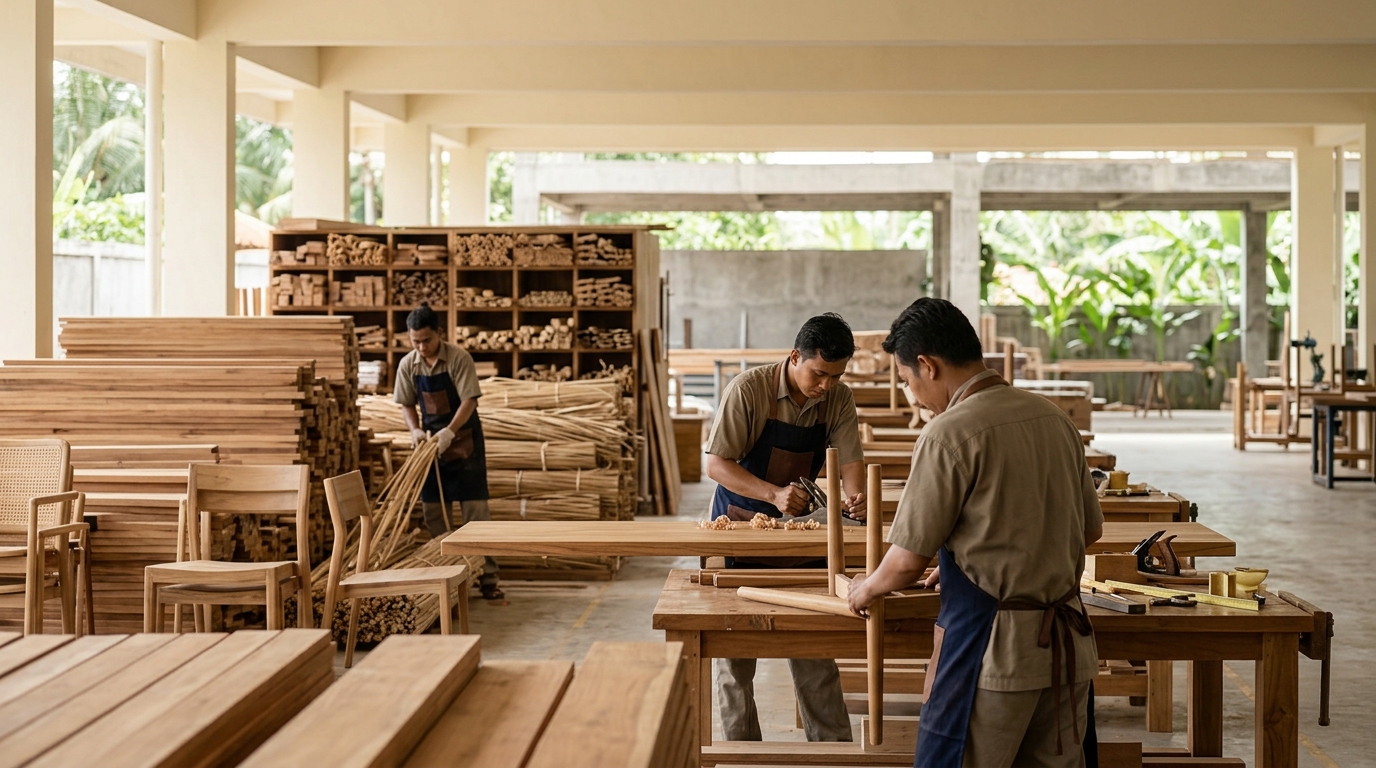
US furniture brands and hospitality procurement teams face a recurring problem: transactional sourcing from Indonesia produces inconsistent results. One shipment arrives on time. The next is delayed by six weeks. Finish quality varies across production runs. The factory prioritizes another buyer's…
US furniture brands and hospitality procurement teams face a recurring problem: transactional sourcing from Indonesia produces inconsistent results. One shipment arrives on time. The next is delayed by six weeks. Finish quality varies across production runs. The factory prioritizes another buyer's order during peak season.
Contractfurniture manufacturing Indonesiais not a variation of placing a custom order. It is a distinct operating model. It involves capacity reservations, SLA-defined quality thresholds, dedicated production lines, raw-material buffer programs, and governance frameworks that hold both parties accountable across multi-year timelines.
This article addresses the structural, contractual, and operational mechanics of building a long-term production partnership in Indonesia. It covers agreement components, SLA design, raw-material buffer financing, quarterly business reviews, compliance requirements, and factory vetting.
Why Indonesia Remains a Strategic Hub for Contract Furniture Manufacturing
Indonesia's position in globalfurniture sourcingis built on material access, labor economics, and export infrastructure — not geography alone.
Raw Material Access at Scale
Indonesia holds some of the world's most commercially significant hardwood and natural fiber resources. Teak grown inCentral Java's managed plantation estates is internationally recognized for density, durability, and grain consistency. Rattan sourced from Kalimantan and Sulawesi feeds a mature processing cluster centered around Cirebon.
FSC (Forest Stewardship Council) and SVLK-certified material is available at commercial scale. SVLK — Sistem Verifikasi Legalitas Kayu — is Indonesia's national timber legality verification system, mandatory for wood product exports. For US buyers managing Lacey Act due diligence, this documentation chain is foundational.
Labor Cost Competitiveness and Cluster Depth
Indonesia's manufacturing labor costs remain competitive relative to China and, increasingly, Vietnam. The Jepara cluster in Central Java concentrates skilled solid-wood craftspeople across hundreds of factories. Surabaya handles mid-market volume production. Cirebon specializes in rattan and woven natural fiber.
This cluster depth means a contract buyer can source teak case goods, rattan accent pieces, and upholstered seating within a single regional supply chain — reducing logistics complexity for multi-SKU hospitality rollouts.
Export Infrastructure and Compliance Networks
Major ports — including Tanjung Priok (Jakarta) and Tanjung Perak (Surabaya) — handle regular container volume to US East and West Coast ports. Established freight forwarders with furniture-specific expertise operate across these hubs. Export documentation networks for SVLK, phytosanitary certificates, and fumigation compliance are mature.
| Factor | Indonesia | Vietnam | China |
|---|---|---|---|
| Teak / Rattan availability | High | Low | Low |
| Labor cost vs. China | Lower–comparable | Lower | Baseline |
| SVLK timber legality system | Yes | No | No |
| Jepara artisan cluster depth | Unique | None | Limited |
| FSC-certified material access | Yes | Partial | Partial |
| Port infrastructure for US export | Tanjung Priok / Perak | Cat Lai / Hai Phong | Guangzhou / Shanghai |
Contract vs. Custom Order: Understanding What Changes When You Commit
A one-off custom order gives you a product. A contract manufacturing relationship gives you a production system oriented around your business.
The distinction matters operationally. In a transactional model, the factory schedules your order around its existing workload. Lead times are estimated, not guaranteed. Pricing is quoted per order. Quality standards are communicated via a spec sheet, not enforced through an SLA with defined remedies.
In a contract model, the factory allocates specific production capacity to your account. Minimum order quantities are defined per period — monthly or quarterly — not per SKU. Lead-time guarantees are contractual commitments, often with penalty provisions for breach.
When a Brand Is Ready to Make the Transition
Readiness indicators for transitioning from sampling to contract manufacturing:
- You have completed at least two to three production runs with the factory and have baseline quality data. - Your annual volume with a single factory is approaching the level that justifies a dedicated line allocation. - You are experiencing lead-time inconsistency that is damaging your delivery commitments to end customers. - Your product line is stable enough to warrant tooling investment and SKU-level exclusivity discussions. - Your procurement team can commit to minimum purchase volumes on a rolling quarterly basis.
Premature entry into a contract manufacturing agreement — before volume and design stability are established — creates obligations that constrain your flexibility without delivering the operational benefits.
Core Components of a Furniture Contract Manufacturing Agreement in Indonesia
Capacity Reservation and Dedicated Production Line Terms
A capacity reservation clause defines the production bandwidth — expressed in units, container equivalents, or machine-hours per month — that the factory commits to hold for your account. A dedicated production line goes further: it designates specific machinery, operators, and floor space exclusively to your SKUs.
Dedicated lines are operationally significant for the factory. They reduce flexibility to absorb other orders during your low seasons. Expect factories to require a volume floor — typically defined as a minimum monthly container commitment — to justify that allocation.
Exclusivity Provisions
Exclusivity inIndonesian furniturecontracts typically takes three forms:
- Territory exclusivity — the factory will not produce your SKU designs for buyers selling in defined markets (e.g., the United States). - SKU exclusivity — the factory will not produce specific designs for any other buyer globally. - Design exclusivity — broader IP protection covering silhouettes, joinery details, and finish specifications.
Exclusivity provisions increase the factory's risk and are usually tied to volume commitments or premium pricing. Negotiate the scope carefully. Full global SKU exclusivity on a high-volume item is a strong ask — expect to compensate for it.
SLA Definitions and Quality Governance
SLAs in a furniture manufacturing context define measurable, enforceable performance standards. Core elements:
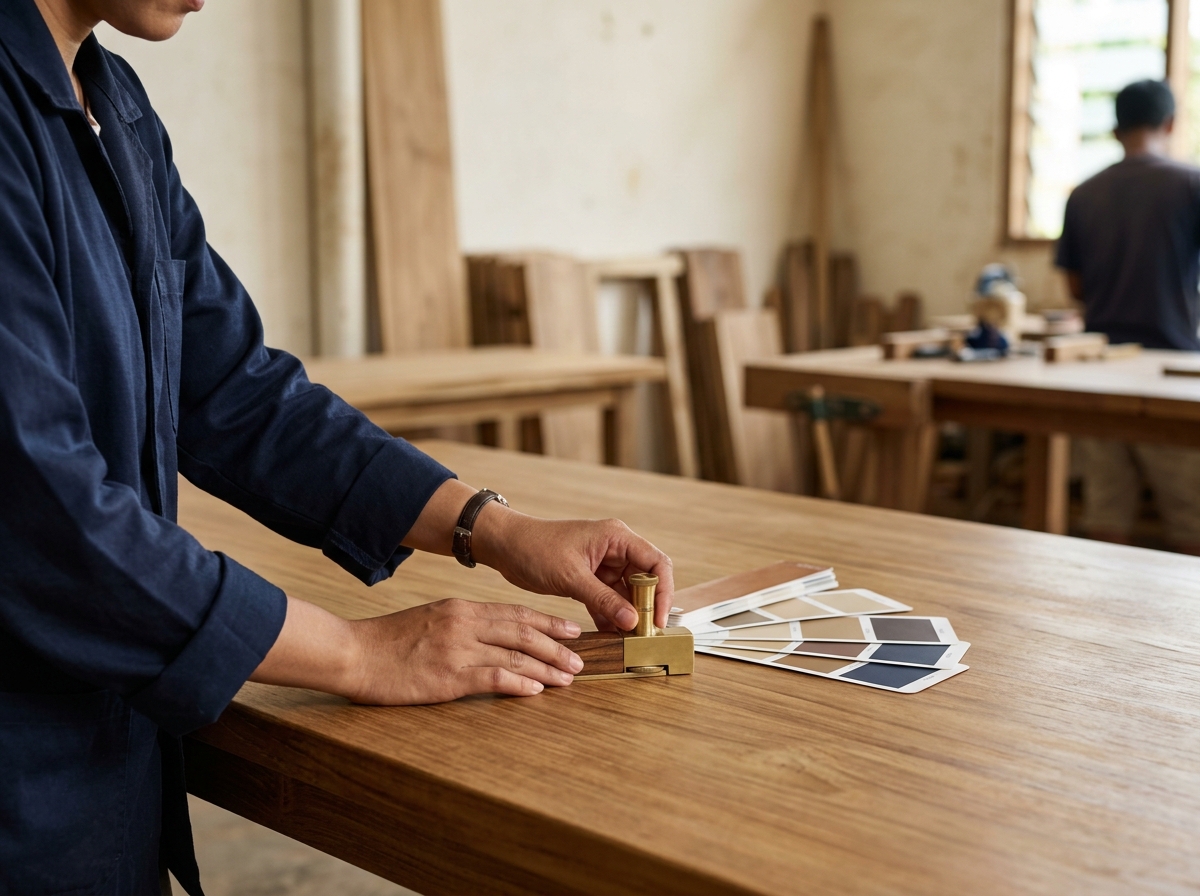
- On-time delivery (OTD) rate — percentage of shipments leaving the factory by the contracted ready-to-ship date. - AQL defect threshold — acceptable quality level per MIL-STD- approximately 1916 or ISO 2859, expressed as the maximum allowable defect rate per inspection lot. - Finish consistency standard — color, grain matching, and surface quality tolerances defined by approved physical samples. - Inspection protocol — which inspection stages are mandatory (in-line, pre-shipment, container loading) and who conducts them.
IP Protection and Tooling Ownership
Include explicit clauses on: who owns custom tooling (jigs, molds, CNC programs) developed for your designs; restrictions on using your tooling for other customers; and what happens to tooling upon contract termination. Indonesian law recognizes contractual IP protections, but the clause must be explicit.
Structuring Raw-Material Buffer Programs With Your Indonesian Factory Partner
Supply disruptions for teak and certified rattan are real operational risks. A raw-material buffer program is a contractual arrangement that maintains a pre-agreed inventory of key materials at the factory, sized to cover a defined production period — commonly four to twelve weeks of forward demand.
Who Holds the Stock and Who Finances It
Buffer programs can be structured three ways:
| Model | Who Holds Stock | Who Finances It | Risk Allocation |
|---|---|---|---|
| Factory-funded buffer | Factory | Factory | Factory absorbs holding cost; buyer pays premium |
| Buyer-funded buffer | Factory premises | Buyer | Buyer owns material; factory has no capital risk |
| Shared financing | Factory premises | Pro-rata split | Risk shared; requires clear ownership documentation |
Buyer-funded buffers require a material ownership agreement and clear audit rights. If the factory encounters financial difficulty, your material must be clearly ring-fenced from their assets.
Linking Buffer Programs to Demand Forecasts
Buffer size should be calculated against your quarterly purchase order forecast, not a fixed number. Build a rolling 13-week forecast cadence into the contract. The factory draws from buffer stock as production orders are confirmed. You replenish to the agreed buffer level with each PO.
SVLK and FSC Requirements for Buffered Wood
All teak and other regulated timber in the buffer must carry valid SVLK documentation. If your end market or retail channel requires FSC chain-of-custody certification, confirm the factory holds a valid FSC CoC certificate — and that the certificate covers the specific material species you are buffering.
Negotiating Dedicated Production Lines and Long-Term Capacity Agreements
What a Dedicated Line Commitment Means for the Factory
A factory agreeing to a dedicated line is accepting constraint. That line's machinery and operators cannot be flexibly redeployed to fill gaps when your orders run below the committed floor. The factory is trading utilization flexibility for revenue predictability. Your contract must make that trade worthwhile.
Volume Thresholds That Justify Dedicated Allocation
There is no universal threshold, but mid-market Indonesian factories exporting to the US typically require a committed floor of approximately two to four 40-foot containers per month before they will discuss dedicated line terms. Larger factories with 300-plus workers may set higher floors.
Frame your negotiation around annual TEU commitments, not individual order quantities. A factory can plan around an annual volume guarantee with quarterly POs more effectively than around unpredictable spot orders.
Penalty and Incentive Structures
A well-structured capacity agreement includes both directions:
- Buyer shortfall penalty — if you deliver less than 80% of the committed quarterly volume, you pay a shortfall fee (typically a percentage of the unfulfilled value). - Factory delivery bonus — if the factory achieves OTD rates above the SLA target for a full quarter, a modest incentive payment reinforces performance. - Force majeure carve-outs — define which events excuse both parties from penalties without dispute.
Multi-Year vs. Rolling Annual Contracts
| Structure | Pros | Cons |
|---|---|---|
| Multi-year (3–5 years) | Price stability; deeper investment by factory; tooling cost amortization | Reduced flexibility; harder exit if relationship deteriorates |
| Rolling annual | Easier renegotiation; adapts to market shifts | Less factory investment commitment; pricing volatility at renewal |
Most established hospitality procurement operations favor multi-year agreements with annual pricing review mechanisms — providing stability while creating a structured path for cost adjustment.
SLA Design and Quality Governance for Ongoing Production Contracts
A production SLA is only as strong as its measurement and enforcement mechanisms.
Key Performance Indicators for Furniture Production
| KPI | Definition | Typical Target |
|---|---|---|
| On-time delivery (OTD) rate | % of shipments ready by contracted date | ≥ 95% |
| AQL defect rate | Defects per inspection lot at agreed AQL level | AQL 2.5 or 1.5 depending on product |
| Finish consistency | Delta between approved sample and production finish | Defined by physical sample standard |
| Corrective action closure rate | % of CARs closed within agreed timeframe | ≥ 90% within 30 days |
| Container loading accuracy | % of confirmed units loaded vs. PO quantity | ≥ 99% |
Third-Party Inspection Integration
Embed inspection checkpoints into the production schedule, not as an afterthought. Three standard stages:
1. In-line inspection (DUPRO) — conducted at approximately 30–50% production completion. Identifies defects before full production is committed. 2. Pre-shipment inspection (PSI) — conducted on finished goods before packing. Uses AQL sampling protocol. 3. Container loading supervision (CLS) — confirms correct quantities, packing, and load integrity.
Specify in the contract which inspection stages are mandatory, who appoints the inspector, and who bears the cost.
CAR Workflows and Escalation
When an inspection fails, a corrective action request documents the defect, requires a root-cause analysis from the factory, and sets a deadline for corrective implementation. Define escalation paths: if a CAR remains unresolved after approximately 30 days, it escalates to a senior contact.
Digital Monitoring and ERP Integration
Some Indonesian contract manufacturers — particularly larger exporters in Surabaya and Semarang — now offer production milestone data via shared portals or ERP API connections. Require production milestone reporting (cutting complete, assembly complete, finishing complete, QC passed) with date-stamped updates.
Quarterly Business Reviews: Turning Supplier Meetings Into Strategic Alignment
A quarterly business review (QBR) is not a courtesy call. It is a structured management tool that governs the health of the contract manufacturing partnership.
QBR Agenda Framework
A 90-minute QBR with an Indonesian factory partner should cover:
1. Production performance review — OTD rate, AQL results, CAR closure rate vs. SLA targets. 2. Cost and pricing review — raw material price movements, labor cost adjustments, pricing implications for the next quarter. 3. Capacity and scheduling review — upcoming volume forecast, any line allocation adjustments needed. 4.
Metrics to Present at Each QBR
Bring your own data, not just the factory's. Cross-reference their production records against your receiving reports. Discrepancies in OTD calculation — what the factory considers on-time versus what you received — are common and must be resolved by contractual definition, not negotiation at each meeting.
In-Person vs. Remote QBR Formats
US-based brands typically conduct QBRs remotely for routine quarterly cycles and in-person annually — often timed with market visits to Indonesia, potentially aligned with trade events or factory audits. In-person reviews allow for production floor walkthroughs and relationship investment that remote formats cannot replicate.
Navigating US Compliance and Export Regulations in Indonesian Furniture Contracts
SVLK, Lacey Act, and Timber Documentation
SVLK is mandatory for Indonesian wood product exports. Factories must hold a valid V-Legal certificate issued by an accredited verification body. For US import, the Lacey Act requires an import declaration (PPQ Form 505) identifying the plant species, country of harvest, and quantity.
US Tariff Classification and GSP
Indonesian furniture imports are classified under HTS Chapter 94. Duty rates vary by product type and material. Indonesia has historically benefited from the US Generalized System of Preferences (GSP), though GSP program status has been subject to periodic US legislative review.
CARB Phase 2 and California Prop 65
Furniture containing composite wood panels — MDF, plywood, particleboard — must comply with CARB Phase 2 formaldehyde emission standards. Require factories to provide CARB-compliant panel documentation for every order that uses composite components.
Selecting and Vetting the Right Contract Manufacturing Partner in Indonesia
Factory Audit Checklist
Before signing a contract manufacturing agreement, conduct or commission a factory audit covering:
- ✓Production capacity (daily/weekly unit output by category)
- ✓Machinery condition and CNC/finishing equipment capability
- ✓Workforce stability (turnover rate, skilled worker retention)
- ✓SVLK and FSC certificate validity and scope
- ✓Existing customer references (minimum 2–3 comparable US buyers)
- ✓Financial stability indicators (years in operation, export history)
- ✓IP and tooling ownership track record
- ✓Sub-contractor usage and transparency
- ✓In-house QC department and inspection records
- ✓ERP or production tracking capability
Regional Capability Differences
| Region | Specialization | Best For |
|---|---|---|
| Jepara (Central Java) | Solid teak, carved wood, handcrafted | Hospitality case goods, artisan dining |
| Cirebon (West Java) | Rattan, woven natural fiber | Accent chairs, outdoor, woven collections |
| Surabaya (East Java) | Mid-market volume, mixed materials | Retail volume programs, mixed-SKU contracts |
| Semarang | Outdoor furniture, teak garden | Large-format outdoor hospitality |
| Bali | Luxury artisan, resort furniture | Ultra-premium, design-forward hospitality |
Red Flags in Contract Proposals
Reject or escalate any contract proposal that contains: undefined SLA metrics; no AQL level specification; tooling ownership that defaults to the factory; no IP protection clause; no CAR process; no termination procedure; or exclusivity language that is geographically vague.
From Pilot Order to Full Contract: Building a Partnership Roadmap
Typical Timeline and Phased Structure
A disciplined transition from first contact to signed contract manufacturing agreement typically spans six to twelve months.
| Phase | Duration | Milestones |
|---|---|---|
| Discovery and audit | 4–8 weeks | Factory audit, reference checks, sample request |
| Sample and pilot production | 8–16 weeks | Sampling, revision, pilot run (typically 1 container) |
| Trial volume period | 3–6 months | 2–4 production runs; SLA measurement begins |
| Contract negotiation | 4–8 weeks | Draft agreement, commercial terms, SLA annex |
| Full contract activation | Month 9–14 | Dedicated line allocation, buffer program launch, QBR cadence begins |
Co-Developing the Product Roadmap
A mature contract manufacturing partnership includes joint product development planning. Share your 12-to-18-month SKU pipeline with your factory partner during QBRs. This allows them to plan tooling investments, material sourcing, and workforce capacity in alignment with your launch schedule.
Measuring Partnership Health Beyond KPIs
OTD rates and AQL scores tell you what happened. They do not tell you why, or what is coming.
Cultural alignment matters in Indonesia. Factory management in Jepara operates within relationship-based business norms. Regular communication, respectful escalation of issues, and acknowledgment of performance improvements all build the relational capital that makes SLA enforcement less adversarial.
Long-term contract furniture manufacturing Indonesia partnerships deliver measurable advantages — price stability, consistent quality, and supply chain resilience — but only when they are built on precise contractual architecture, active governance, and a phased commitment structure that both parties can sustain. The contract is the foundation.
You now have the structural components to evaluate, negotiate, and manage a contract manufacturing relationship with an Indonesian factory. The next step is to put a specific proposal on the table.
You understand the contract structure, the SLA requirements, and the compliance landscape. Connect with a vetted Indonesian furniture factory ready to discuss capacity agreements, exclusivity terms, and buffer programs tailored to your volume and product category.
Request a Contract Manufacturing Proposal →Frequently Asked Questions
What is the minimum order volume required to negotiate a dedicated production line in Indonesia?
There is no fixed industry standard, but mid-scale Indonesian exporters typically require a committed floor of approximately two to four 40-foot containers per month to justify dedicated line allocation. Smaller Jepara workshops may accept lower volumes at premium pricing.
How do exclusivity clauses work in Indonesian furniture contract manufacturing agreements?
Exclusivity can cover territory (your markets only), specific SKUs, or broader design IP. Factories treat exclusivity as a commercial risk — they are restricting their ability to sell similar products to other buyers. Expect exclusivity to require a volume commitment floor or a pricing premium.
What certifications should my Indonesian contract manufacturer hold for US export compliance?
At minimum: a valid SVLK V-Legal certificate for wood products; FSC chain-of-custody certificate if your channel requires it; CARB Phase 2 compliant panel documentation for composite wood components; and capability to provide complete species documentation for Lacey Act declarations. For upholstered products, confirm California Prop 65 chemical compliance documentation.
How is a raw-material buffer program typically financed between buyer and factory?
Three inventory financing models are common. Factory-funded means the factory holds stock and the buyer pays a carrying cost premium. Buyer-funded and shared financing models also exist, each requiring ownership agreements, audit rights, or a pro-rata cost split with jointly agreed documentation.
What should a quarterly business review with an Indonesianfurniture factoryinclude?
A structured QBR should cover production SLA performance, including OTD, AQL, and CAR closure. Pricing, raw material costs, capacity alignment, compliance status, and new SKU pipeline must also be reviewed. Close with open issues assigned to owners with clear deadlines.
How do US tariffs and Indonesia's SVLK system affect long-term furniture sourcing contracts?
Indonesian furniture is classified under HTS Chapter 94 with duty rates that vary by product type. Indonesia's GSP status has historically reduced duties on qualifying products, but GSP eligibility is subject to US legislative review — do not lock multi-year pricing assumptions to GSP without contingency language.
Need eyes on the ground in Indonesia?
MTS is an execution partner — supplier verification, manufacturing management, quality control and export logistics across Indonesia, Vietnam and China.
Related services
Related articles
Receive furniture sourcing insights across Asia.
One email per week. No spam.