How to Run a Furniture RFQ Process with Indonesian Suppliers: A Step-by-Step Procurement Guide
13 min read

Sourcing furniture from Indonesia without a structured process is expensive. Informal spec discussions produce inconsistent quotes, vague material descriptions, and price drift that surfaces only after production begins. For procurement managers buying teak dining sets, rattan resort furniture, or…
Sourcingfurniture from Indonesiawithout a structured process is expensive. Informal spec discussions produce inconsistent quotes, vague material descriptions, and price drift that surfaces only after production begins. For procurement managers buyingteak diningsets, rattan resort furniture, or mahogany casegoods at volume, the cost of a poorly managed furniture RFQ process supplier quotations Indonesia can exceed any savings from the low bid.
This guide covers every operational stage. It walks through building a spec-complete RFQ package, qualifying a supplier long-list, and issuing the RFQ with a defined communication protocol. It also covers normalising quotations across FOB terms, spotting red flags in low bids, and locking in terms before production starts. The approach is grounded in Indonesian manufacturing realities — specific wood species, port logistics, SVLK timber certification, and cluster-level capacity norms.
Whether you are sourcing from the handcraft workshops of Jepara, the mid-market factories of Surabaya, or the outdoor furniture producers around Semarang, the same structured framework applies. A rigorous furniture RFQ process supplier quotations Indonesia is not optional at scale — it is the mechanism that converts supplier interest into comparable, auditable, decision-ready offers.
Why Indonesian Furniture Manufacturing Demands a Formal Quotation Process
The scale and diversity of Indonesian clusters
Indonesia's furniture industry is not monolithic. Jepara in Central Java is the dominant cluster for solid teak and mahogany — characterised by hundreds of small-to-medium workshops, many operating as cooperatives. Surabaya serves a mid-market, higher-volume segment with more mechanised production. Semarang anchors outdoor furniture manufacturing. Bali caters to luxury artisan and resort-specification work. Cirebon specialises in rattan.
This diversity means a single RFQ sent to ten suppliers can land at factories with radically different capabilities, material access, and cost structures. Without a formal process, you are not comparing ten quotations — you are comparing ten different interpretations of your product.
Compliance context you cannot ignore
Indonesia operates the SVLK (Sistem Verifikasi Legalitas Kayu) timber legality verification system. SVLK is mandatory for Indonesian wood product exporters. It provides chain-of-custody documentation proving timber was legally harvested. FSC (Forest Stewardship Council) certification adds an internationally recognised sustainability layer on top. The EU Timber Regulation (EUTR) and equivalent US Lacey Act requirements mean that your supplier's SVLK or FSC status directly affects US import compliance.
A formal furniture RFQ process supplier quotations Indonesia must require these documents upfront. Suppliers who cannot provide them create downstream legal exposure.
How a formal RFQ prevents scope creep and price drift
A written, spec-complete RFQ creates a contractual baseline. It freezes the scope at issue date. Any supplier deviation — a different wood species, a changed finish, an omitted carton spec — becomes visible and auditable. Without it, price escalation between quotation and pro-forma invoice is common, and disputes are difficult to resolve.
Building a Spec-Complete RFQ Package That Indonesian Factories Can Actually Use
Core document components
Every RFQ package forfurniture sourcingfrom Indonesia should include the following:
- ✓Technical drawings with dimensions (mm preferred, not inches only)
- ✓Exploded view or assembly diagram where applicable
- ✓Material callout sheet: wood species, grade, moisture content target
- ✓Finish schedule: sheen level, colour reference code, base coat specification
- ✓Hardware schedule: brand or specification, finish, source preference
- ✓Packing specification: KD or assembled, carton grade (5-ply minimum for export), foam type and thickness
- ✓MOQ per SKU and per order
- ✓Sample requirement: pre-production sample, golden sample retention
- ✓Target FOB price range (optional but useful for filtering non-competitive suppliers)
- ✓Delivery port and target lead time
- ✓Quality inspection access: third-party allowed or required
Specifying wood species to prevent substitution
Indonesia produces teak (Tectona grandis), mahogany (Swietenia spp. or African Khaya as substitute), mindi (Melia azedarach), and suar (Albizia saman). These species vary significantly in density, colour, grain, and price. Vague descriptions like 'tropical hardwood' invite substitution.
Specify the Linnean species name where possible. Add a note requiring the supplier to confirm availability and provide SVLK documentation for the stated species. If you accept a substitute, name it explicitly and set a price adjustment protocol.
Surface finish notation
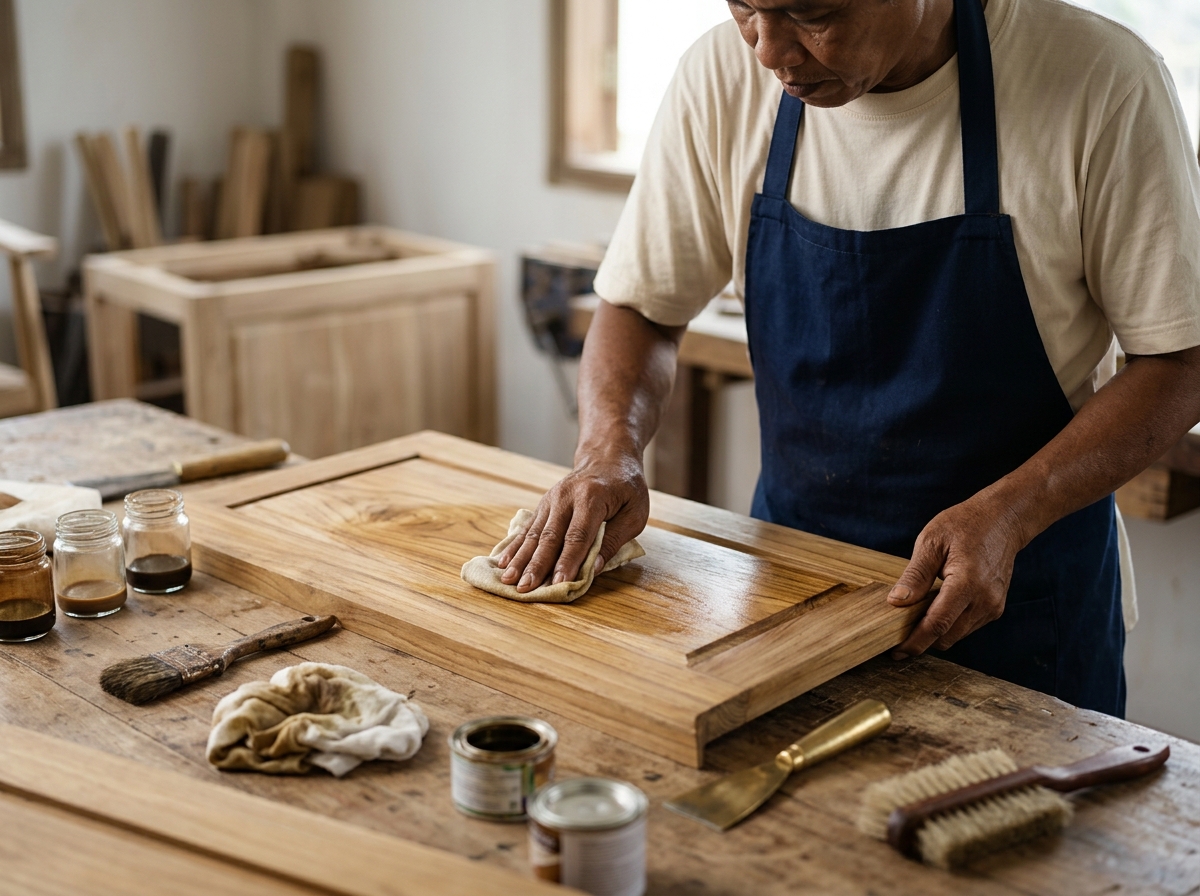
Indonesian factories work across a wide finish range — natural teak oil, PU lacquer, water-based lacquer, stain-over-oil, and catalysed finishes. Use specific notation:
- Sheen level: matte (5–10° gloss), satin (20–35°), semi-gloss (50–60°) - Colour: reference a RAL, Pantone, or NCS code, or provide a physical chip - Base specification: state whether a grain-filler pass is required before topcoat
Suppliers in Jepara frequently default to natural oil finishes. Surabaya factories are more accustomed to lacquered production-run work. Misalignment here is one of the most common sources of sample rejection.
Selecting and Qualifying Your Supplier Long-List Before the RFQ Goes Out
How many suppliers and where to find them
A practical long-list for anIndonesian furnitureRFQ contains approximately 8–12 suppliers. This gives you enough competition to normalise price and enough volume to absorb drop-outs without restarting the process. Your final bid pool — the suppliers you engage for detailed negotiation — should narrow to 3–5.
Sources for verified Indonesian furniture exporters include:
- Indonesia Furniture Industry and Craftsmen Association (HIMKI) directories - Trade fair contacts from IFEX (Indonesia International Furniture Expo) - Customs data platforms (ImportGenius, Panjiva) to verify actual export history - Verified profiles on Global Sources or Alibaba, cross-referenced against customs data - Referrals from freight forwarders active in Semarang and Surabaya
Qualification criteria before long-list inclusion
Screen every candidate against this set before issuing the RFQ:
| Criterion | Minimum threshold |
|---|---|
| Export licence | Active, verifiable |
| SVLK certification | Current, issued by accredited verifier |
| FSC CoC (if required) | Confirm scope covers your species |
| Factory audit history | BSCI, Sedex SMETA, or client audit within 3 years |
| Export track record | Demonstrable US or EU shipments in customs data |
| Product category fit | Matching category: solid wood, outdoor, rattan, upholstered |
| MOQ alignment | Factory's stated MOQ compatible with your order volume |
Suppliers who cannot provide SVLK documents, who lack an export licence, or whose customs data shows no relevant category shipments should not reach your long-list.
Issuing the RFQ: Timeline, Format, and Communication Protocol
Realistic timelines
A well-run furniture RFQ process supplier quotations Indonesia takes 10– approximately 21 days from issue to receipt of comparable offers. Allow the longer end for complex multi-SKU packages or suppliers in artisan clusters like Jepara where manual costing is standard. Compressing this window produces rushed, incomplete quotes that are harder to normalise.
Recommended timeline structure:
| Phase | Duration |
|---|---|
| RFQ issue + supplier confirmation of receipt | Day 1–2 |
| Q&A window (structured, written only) | Day 3–7 |
| Q&A responses issued to all suppliers simultaneously | Day 8 |
| Quote submission deadline | Day 14–18 |
| Clarification and normalisation | Day 19–21 |
Structured Q&A protocol
This is where most buyers create information asymmetry without realising it. If one supplier asks a clarifying question by phone and gets an answer, and another supplier does not ask, you are no longer comparing quotes against the same specification.
The rule is simple: all questions submitted in writing by a set deadline, all answers distributed to every supplier on the long-list simultaneously. Use email with a clearly labelled Q&A log attached. This is standard practice in formal procurement and protects your process from bias claims.
Quote submission format
Request a line-item spreadsheet, not a free-form PDF. The spreadsheet should require separate line entries for:
- Unit material cost - Labour and finishing - Inland freight to port - Export carton and packing materials - QC inspection allowance - FOB port charge
Free-form PDF quotes cannot be normalised without manual reconstruction. Line-item spreadsheets can be dropped directly into your comparison matrix.
Managing time-zone and language barriers
Indonesia is UTC+7 to UTC+9 depending on island. For US-based teams, this means a working overlap of approximately 1–3 hours with the US West Coast and near-zero overlap with the East Coast during standard hours. Plan accordingly. Set deadlines at end-of-day Indonesia time, not US time. Assign a single point of contact on your side who handles all supplier communication to prevent contradictory signals.
Normalising Quotations Across Materials, Finish, Packing, and FOB Terms
Normalisation is the analytical core of a rigorous furniture RFQ process supplier quotations Indonesia. Without it, you are selecting on headline price, not true cost.
Building a normalisation matrix
Create a spreadsheet with one row per supplier and columns for every cost variable. The goal is to convert every quote to a single comparable unit: landed cost per piece at a common FOB port.
Port-specific cost adjustments
Indonesian furniture exports primarily ship from three ports:
| Port | Primary cluster served | Typical cost differential |
|---|---|---|
| FOB Semarang | Jepara, Central Java outdoor | Base reference |
| FOB Surabaya | East Java, Surabaya mid-market | Approximately similar; verify inland truck cost from supplier location |
| FOB Tanjung Priok (Jakarta) | West Java, Bali (via consolidation) | May carry higher port charges; verify per shipment |
A supplier quoting EXW factory gate rather than FOB requires you to add estimated inland freight, port handling, and export documentation costs before comparison. Request FOB quotes as standard. If a supplier only quotes EXW, obtain a local freight estimate from your forwarder for that factory location.
Reconciling finish and hardware variables
If Supplier A has quoted with natural teak oil and Supplier B has quoted with PU lacquer (because your spec was ambiguous), add the estimated cost delta to equalise. Your freight forwarder or a local QC agent in Indonesia can provide labour rate benchmarks for the finishing region. Apply the same logic to hardware — a Blum hinge versus a no-name equivalent can represent a meaningful per-unit cost difference that should be made visible, not hidden in the headline price.
Red Flags in Low Indonesian Furniture Quotes: What the Bid Often Hides
Low quotes are not always competitive quotes. In Indonesianfurniture procurement, several patterns consistently signal future problems.
Material substitution signals
- Quote uses the term 'teak-like wood', 'similar hardwood', or 'local wood' without naming the species - Species is named but no SVLK documentation is offered - Moisture content is not stated (poorly dried timber is a primary cause of joint failure in export climates)
Missing line items
A quote that omits inland freight, export cartons, or QC inspection fees is not cheaper — those costs will reappear in the pro-forma invoice or as disputes at shipment.
Check every quote for:
- ✓Inland freight to nominated FOB port
- ✓Export carton specification and cost
- ✓QC inspection fee or allowance
- ✓Export documentation (SVLK V-Legal document, packing list, commercial invoice)
- ✓Port handling and THC
- ✓Sample cost and courier charge
Unrealistic lead times
Jepara handcraft workshops typically run 60–120 days for solid teak production runs, depending on complexity and order size. A supplier quoting approximately 30 days for a complex solid teak bedroom set is either planning to subcontract without disclosure or quoting a lead time that reflects the sales conversation, not production reality. Surabaya larger-run factories can achieve shorter cycles for simpler, more standardised products — but still rarely below approximately 45 days for a first production run.
Lead times below these norms should trigger a direct question about subcontracting and current production schedule.
Price escalation triggers
Read the payment terms and sample approval clauses carefully. Common escalation mechanisms:
- 'Price subject to material cost at time of production confirmation' - 'Sample approval cost deducted from first order only if order value exceeds X' - Payment milestone changes inserted into the pro-forma that were not in the quotation
Evaluating Bids and Selecting the Right Indonesian Furniture Supplier
Weighted scoring model
Do not select on normalised price alone. Use a weighted matrix:
| Criterion | Suggested weight |
|---|---|
| Normalised FOB price competitiveness | 35% |
| Quality capability (audit, samples, references) | 25% |
| Compliance (SVLK, FSC, export track record) | 20% |
| Lead time credibility | 10% |
| Communication responsiveness | 10% |
Adjust weights for your category. A hospitality FF&E buyer may weight compliance and lead time credibility higher than a wholesale brand running commodity lines.
Sample orders and pre-production approval
Award a sample order before committing to a full PO. Specify the golden sample process: the supplier produces one pre-production unit, you approve it in writing, and that approved sample becomes the physical reference standard for production inspection. This step is not optional. It eliminates the most expensive category of disputes.
Negotiation etiquette with Indonesian suppliers
Indonesian business culture generally values relationship continuity and face-saving communication. Direct rejection of a quote without explanation damages the relationship and can close off future negotiation. Instead, share your normalised comparison with the supplier and ask them to review specific line items. Frame it as a collaborative cost review, not an ultimatum. This approach consistently produces better outcomes than aggressive pressure tactics.
Document your award decision in writing — the scoring matrix, the normalisation output, and the rationale for selection. This protects against internal audit questions and provides a reference point if the relationship needs to be reviewed.
Post-Award: Locking In Terms Before Production Begins
Pro-forma invoice alignment
The pro-forma invoice is the moment of truth. Compare every line against your accepted quotation before issuing the deposit payment. Check: species and grade, finish specification, packing spec, FOB port, unit price, and payment milestones. Discrepancies at this stage are common and must be resolved in writing before funds transfer.
Payment milestones
Standard payment terms with Indonesian furniture factories typically follow this structure:
| Milestone | Typical percentage |
|---|---|
| Deposit on PO confirmation | 30% |
| Balance against Bill of Lading (BL) | 70% |
Some suppliers request a 50/50 split. For first orders with an unaudited supplier, consider retaining a small percentage until post-shipment inspection is completed — this requires negotiation but is not unusual with established buyers.
Pre-shipment inspection
Third-party QC services operate in all major Indonesian furniture clusters. Use them. A pre-shipment inspection (PSI) conducted against the golden sample and your packing specification catches defects before the container is sealed. The cost is modest relative to the expense of a non-conforming container arriving at a US port.
Incoterms confirmation and US customs preparation
Confirm Incoterms approximately 2020 in writing on both the pro-forma invoice and the purchase order. FOB is the standard for Indonesian furniture exports to the US. Verify the HS code classification for your product category before shipment — misclassification triggers delays and potential penalties at US Customs and Border Protection. For teak and other regulated timber species, ensure the SVLK V-Legal document accompanies the shipment documentation to satisfy Lacey Act requirements.
Frequently Asked Questions About the Indonesian Furniture RFQ Process
How long does the furniture RFQ process typically take with Indonesian suppliers? From RFQ issue to receipt of comparable, normalised quotations: approximately 10–21 days. Add 5–7 days for internal evaluation and supplier clarification. Total process from issue to award decision is typically 3–4 weeks.
What documents should a spec-complete RFQ package include? Technical drawings, material callout sheet with species names, finish schedule with colour references, hardware schedule, packing specification, MOQ per SKU, sample requirements, and your target FOB port. See the checklist in the second section.
How do I compare FOB quotes from different Indonesian ports? Convert all quotes to a common FOB port using inland freight estimates from your local forwarder. Semarang, Surabaya, and Tanjung Priok each carry different inland transport costs depending on the factory location. Build a normalisation matrix with port adjustment as a separate column.
What are the most common red flags in a low Indonesian furniture quote? Vague species names, missing line items (inland freight, export carton, QC), lead times below realistic cluster benchmarks, and price escalation language in payment terms or sample clauses.
Which certifications should I require from Indonesian furniture exporters? SVLK V-Legal certification is mandatory for Indonesian wood product exports and satisfies US Lacey Act due-diligence requirements. FSC Chain of Custody is required if your buyers demand it. For social compliance, BSCI or Sedex SMETA audit reports are useful additional signals.
How many suppliers should I include on an Indonesian furniture RFQ long-list? Approximately 8–12 for initial issue. Narrow to 3–5 for detailed bid evaluation and negotiation. Below 3 you lose meaningful price competition; above 12 you create administrative burden without proportional benefit.
A structured furniture RFQ process supplier quotations Indonesia is the single most effective lever a procurement team has for controlling costs, managing compliance exposure, and building a reliable Indonesian supply base. Spec completeness prevents substitution; normalisation reveals true cost differences; and rigorous supplier qualification reduces the probability of a compliance or quality failure mid-production.
Download our RFQ template to start issuing spec-complete quotation requests to Indonesian furniture factories today — every checklist, normalisation matrix column, and line-item spreadsheet format from this guide is pre-built and ready to issue.
You now have the framework for a structured furniture RFQ process with Indonesian suppliers. The next step is putting it into practice with a ready-to-issue spec package. Download our RFQ template — including the normalisation matrix, line-item quote spreadsheet, and supplier qualification checklist — and issue your first compliant quotation request today.
Download the RFQ Template →Need eyes on the ground in Indonesia?
MTS is an execution partner — supplier verification, manufacturing management, quality control and export logistics across Indonesia, Vietnam and China.
Related services
Receive furniture sourcing insights across Asia.
One email per week. No spam.