Furniture Product Sourcing Services Indonesia: The Managed Partner Model Explained
14 min read
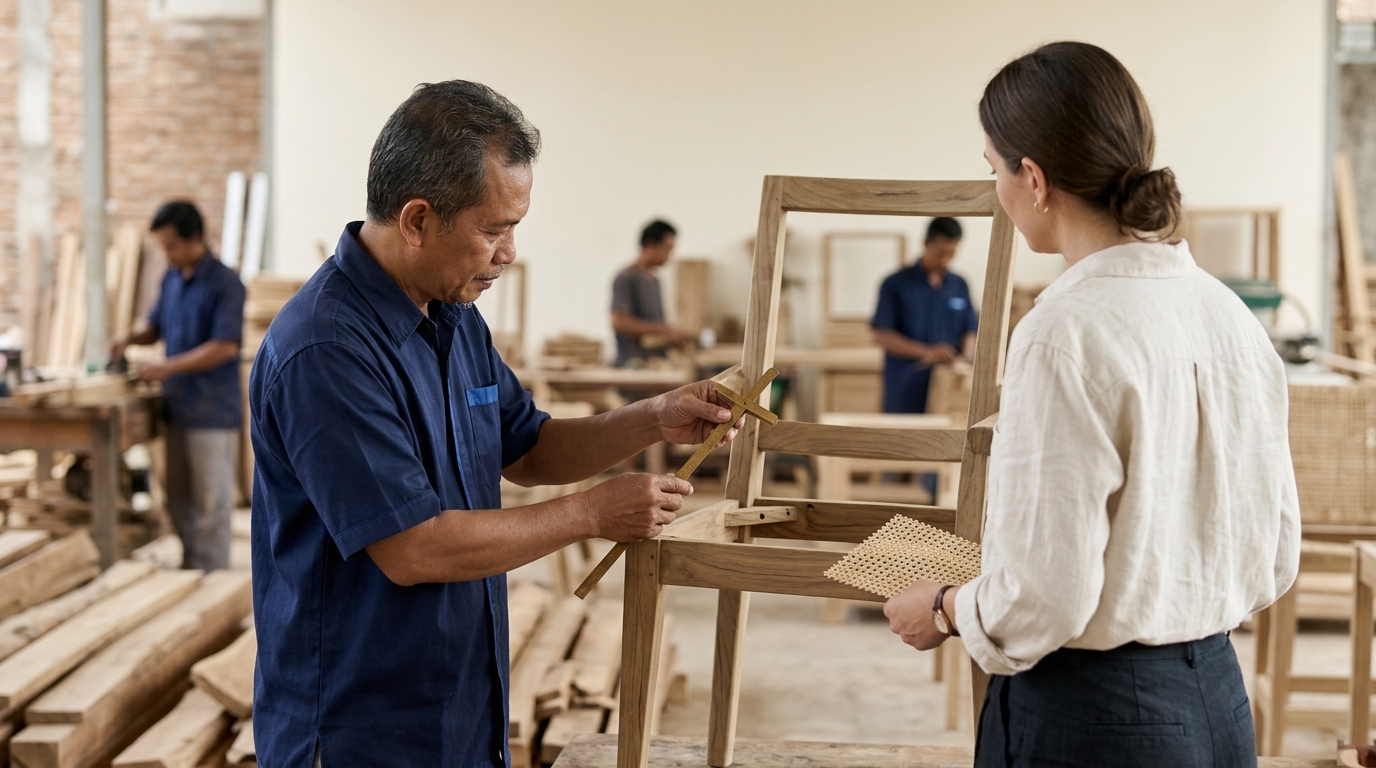
US retailers and wholesale buyers sourcing furniture from Indonesia face a consistent set of operational problems. Language barriers, time zone gaps, opaque factory networks, and compliance requirements create friction at every stage of procurement. Many buyers start by managing Indonesian…
US retailers and wholesale buyers sourcingfurniture from Indonesiaface a consistent set of operational problems. Language barriers, time zone gaps, opaque factory networks, and compliance requirements create friction at every stage of procurement. Many buyers start by managing Indonesian suppliers directly. Most find the process harder than anticipated.
This article explains what managedfurniture sourcingservices in Indonesia actually deliver. It also covers how engagements are structured and when outsourcing procurement makes clearer commercial sense than handling it in-house. It covers supplier discovery, RFQ management, sample coordination, and production follow-up. It also covers fee structures and US import compliance. Particular attention is given to areas where most buyers have limited internal expertise.
Indonesia is one of the world's leading sources of solid wood, teak, rattan, and handcrafted furniture. The country's manufacturing clusters produce everything from artisan resort pieces to mid-market dining collections. But the supplier ecosystem is fragmented. Many factories export through merchant intermediaries. Quality and certification levels vary sharply between producers. Buyers who enter without local knowledge routinely over-pay, under-specify, or engage the wrong tier of supplier entirely.
The sections below address each stage of the managed sourcing cycle and close with a practical decision framework for evaluating whether to engage a professional service.
What Furniture Product Sourcing Services in Indonesia Actually Deliver
The managed model versus direct procurement
A managed furniture sourcing service operates as an extension of your procurement team on the ground in Indonesia. It is not a freight forwarder. It is not a trading company that buys and resells goods. It is not a single-factory agent with an undisclosed margin baked into the FOB price.
The managed model covers the full procurement lifecycle. This includes vetting suppliers, managing RFQs, coordinating samples, issuing POs, monitoring production, and preparing export documentation.
Freight forwarders handle cargo movement. Trade agents often represent specific factories and earn undisclosed commissions from suppliers — not buyers. Neither provides full-cycle procurement management. The distinction matters because misaligned incentives produce misaligned outcomes.
Core service pillars
A professional sourcing partner typically delivers across six functional areas:
- Supplier discovery: Identifying factories in the relevant cluster with the right production capability and export experience - Supplier vetting: Auditing production capacity, certifications, compliance history, and quality systems - RFQ management: Structuring and distributing quote requests, then normalizing responses into a comparable matrix - Sample coordination: Managing counter-samples, proto-samples, and pre-production approvals - PO and production follow-up: Milestone tracking, in-line inspection coordination, and delay management - Consolidated reporting: Delivering real-time visibility across multiple suppliers and purchase orders simultaneously
Consolidated reporting as a differentiator
Most competitor sourcing services focus on transactional outputs — quotes, samples, shipments. A full-service partner adds a reporting layer aggregating PO status, quality inspection findings, and documentation readiness. This covers every active supplier relationship and is presented in a single dashboard view. Buyers managing multiple SKUs or parallel production runs across different Indonesian factories need this visibility. It is operationally significant in those situations. It eliminates the need to chase status updates across multiple suppliers in different time zones.
How Qualified Indonesian Furniture Factories Are Found and Vetted
Key manufacturing clusters
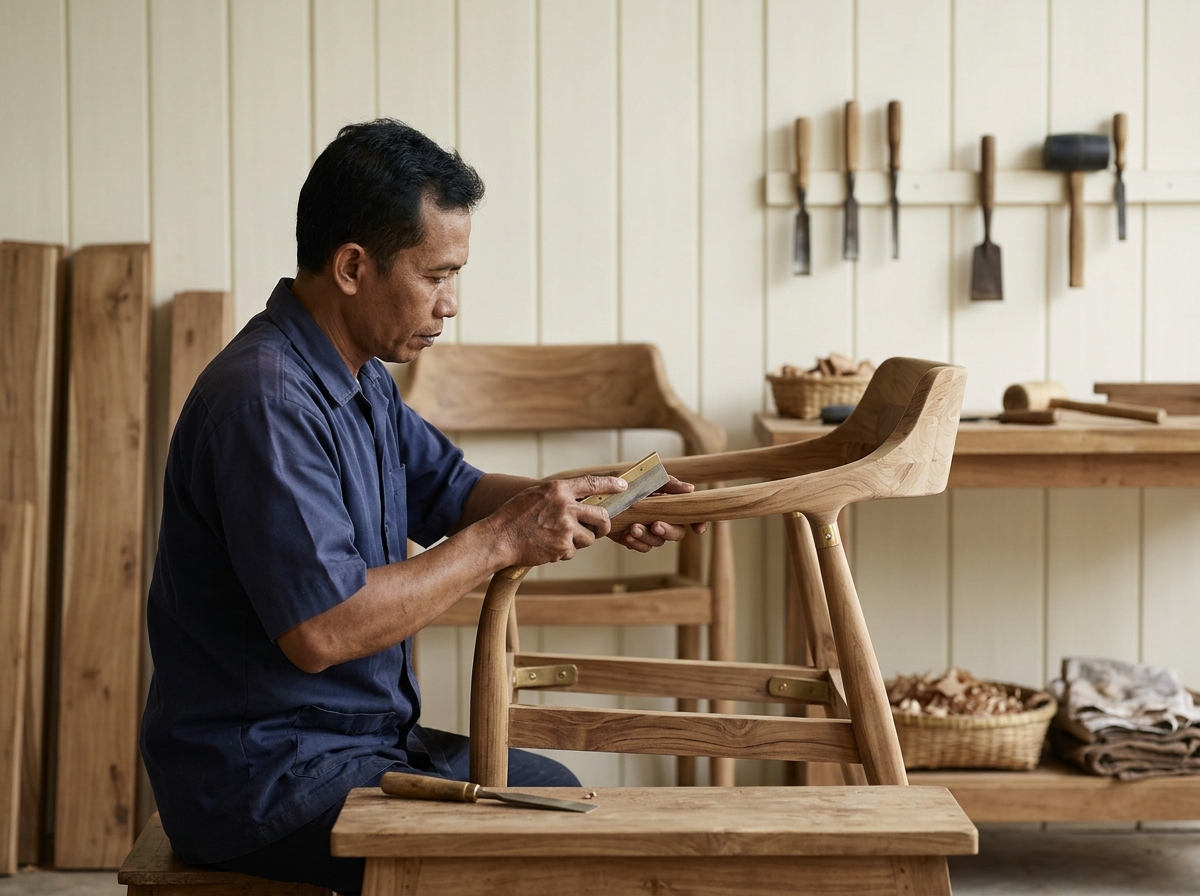
Indonesia's furniture industry is geographically concentrated. Each cluster has a distinct product identity:
| Cluster | Province | Primary Product Category |
|---|---|---|
| Jepara | Central Java | Solid wood, teak, carved furniture |
| Cirebon | West Java | Rattan, woven furniture |
| Bali | Bali | Luxury artisan, resort, hospitality |
| Semarang | Central Java | Outdoor furniture |
| Surabaya | East Java | Mid-market mixed production |
West Java suppliers around Cirebon tend to specialise in natural fiber and rattan collections. Jepara dominates solid teak. Bali factories serve high-end hospitality and premium retail buyers. Understanding which cluster matches a product category is foundational to effective supplier discovery.
Due-diligence criteria and vetting failure points
A professional sourcing service maintains a pre-qualified vendor database built on documented due diligence. Key criteria include:
- FSC (Forest Stewardship Council) certification for wood species traceability - SVLK (Sistem Verifikasi Legalitas Kayu) — Indonesia's national timber legality verification system - Active US export history (HTS code 9403 shipment records) - Production capacity relative to order volume - In-house versus subcontracted manufacturing - QC systems and inspection readiness
Buyers self-sourcing from Indonesia routinely encounter several failure patterns documented in supplier ecosystems across Asia. Factories present shared showrooms as their own production facilities. Certificates are presented without verification against the issuing body's records. Samples are produced in a quality-controlled facility, while production orders are subcontracted to a lower-tier workshop.
A sourcing partner with an established vendor database and audit history eliminates most of these risks before a buyer commits capital. Certificate numbers are verified directly against FSC and SVLK registries. Factory visits — including unannounced audits — confirm that the production facility shown during initial engagement is the one that will actually manufacture the order.
RFQ Management and Price Benchmarking Across Indonesian Suppliers
How RFQs are structured and distributed
A sourcing partner structures RFQs with the technical specificity that Indonesian factories need to return accurate quotes. Generic product briefs produce incomparable responses. A professional RFQ package typically includes:
- Material specifications (species, grade, finish type) - Dimension tolerances - Joinery and construction method requirements - Packaging requirements (export carton, foam density, labeling) - MOQ tiers (commonly ranging from 50 to 500 units per SKU depending on category) - Target FOB port (typically Tanjung Priok, Jakarta, or Semarang) - Required certifications
The same RFQ is distributed simultaneously to multiple pre-qualified suppliers in the relevant cluster. This parallel process compresses the time from brief to first quotes and ensures that pricing is genuinely competitive.
Price benchmarking and the hidden cost variables
The sourcing partner normalizes responses into a quote matrix that allows direct comparison. Benchmarking addresses material costs, labor rates, and MOQ-driven price breaks. But the more valuable analytical work involves surfacing hidden cost variables that buyers miss when evaluating quotes independently:
- Finishing: Lacquer type, coat count, and UV resistance specifications materially affect unit cost and are frequently underspecified - Hardware: Imported versus locally sourced hardware has different lead time and quality profiles - Packaging: Export-grade packaging for US import often adds meaningful cost that factories exclude from initial quotes - Inland freight: Factory-to-port costs vary significantly between Jepara and Surabaya versus Bali
Delivering a normalized, fully-loaded quote matrix allows buyers to make decisions based on total landed economics rather than FOB sticker prices.
Sample Coordination: From First Prototype to Pre-Production Approval
Sample workflow stages
Sample management in Indonesia follows a three-stage workflow:
1. Counter-sample: Factory interprets the buyer's brief and produces its own version for concept alignment 2. Proto-sample (prototype): Buyer-approved direction is built to specification for dimensional and material confirmation 3. Pre-production sample (PP sample): Final approval sample produced from the exact materials, processes, and tooling that will be used in the production run
Each stage requires structured feedback. Vague revision notes produce avoidable rework cycles and extend total sample lead times.
Lead times and compression strategies
Typical sample lead times in Indonesia commonly range from three to six weeks per stage, depending on material sourcing and factory workload. A sourcing partner compresses this timeline by maintaining relationships with factories holding pre-approved material inventories. It also translates buyer feedback into precise technical language and manages sample shipment logistics to the US directly.
Sample cost recovery
Sample costs in Indonesia are typically charged to the buyer at cost, with the expectation of cost recovery against the first production order above an agreed minimum value. How this is handled varies by service agreement. A transparent sourcing partner documents sample cost recovery terms explicitly in the engagement agreement before samples are ordered.
Purchase Order Management and Production Follow-Up During Manufacturing
PO issuance and payment structures
Indonesian furniturefactories typically require a deposit on PO confirmation. This commonly ranges from 30% to 50%, with the balance due against shipping documents or before loading. Payment terms are negotiated during the PO process. A sourcing partner ensures milestone payment schedules align with verified production milestones rather than arbitrary calendar dates.
In-line and pre-shipment inspection
A managed sourcing service coordinates third-party quality inspections at two stages:
- In-line inspection (DUPRO): Conducted during production, typically when 20–30% of units are complete. Identifies quality deviations early enough to correct them without delaying shipment. - Pre-shipment inspection (PSI): Final inspection before container loading confirms that production output matches the approved PP sample.
Inspection findings are reported to the buyer with photographic documentation and a pass/fail determination against agreed AQL (Acceptable Quality Level) criteria.
Documentation management
US-bound Indonesian furniture shipments require a specific documentation package. A sourcing partner manages the preparation and verification of:
- Commercial invoice and packing list - Bill of lading - Certificate of origin (Form E or general CO) - Phytosanitary certificate (for solidwood furniture) - SVLK V-Legal document (required for Indonesian wood product exports) - CARB ATCM Phase 2 compliance documentation (for composite wood components)
Errors or omissions in this documentation cause customs delays. A sourcing partner with active US import experience maintains document checklists and reviews every shipment package before freight release.
Engagement Models and Fee Structures for Indonesia Furniture Sourcing Services
Three common fee models
| Fee Model | Structure | Best Suited For |
|---|---|---|
| Percentage of FOB value | Typically 5–10% of FOB; varies by order size and complexity | Buyers with regular, high-value order flow |
| Flat project retainer | Fixed fee per sourcing project or SKU development cycle | Buyers with defined, bounded projects |
| Hybrid | Retainer covering baseline activity + percentage on orders placed | Buyers scaling from initial sourcing into ongoing production |
Percentage rates commonly vary based on order size, as larger orders typically attract lower percentages. They also vary by product complexity and service scope, since custom OEM designs and full production management require more labor.
ROI comparison: in-house versus managed sourcing
Consider a US buyer placing approximately USD 300,000 in annual FOB orders from Indonesia. Managing procurement internally requires, at minimum, a part-time coordinator with Indonesia expertise and periodic factory travel. It also requires auditing tools and absorbing the cost of quality failures from under-vetted suppliers.
When internal costs are aggregated — salary allocation, travel, error correction, and opportunity cost of delayed market entry — they commonly exceed a 7% sourcing fee. This applies on the same order volume. The ROI case for managed sourcing strengthens further when the buyer is new to Indonesia, expanding SKUs rapidly, or recovering from a supplier quality failure.
Red flags in low-cost sourcing service agreements
US Import Compliance: Tariffs, Timber Legality, and Documentation Requirements
HTS codes and current tariff landscape
Indonesian wooden furniture imported into the US is primarily classified under HTS code 9403. Indonesian furniture is generally not subject to Section 301 tariffs applied to Chinese-origin goods. This makes Indonesia a strategically relevant sourcing market for US buyers managing tariff exposure. Applicable duty rates vary by specific HTS subheading and product composition. Buyers should confirm current rates with a licensed customs broker before committing to landed cost models.
Lacey Act compliance and SVLK
The Lacey Act requires US importers to declare the genus, species, country of harvest, and quantity of plant materials in imported wood products. Non-compliance carries significant civil and criminal penalties.
SVLK — Sistem Verifikasi Legalitas Kayu — is Indonesia's government-mandated timber legality verification system. It requires Indonesian wood product exporters to hold a V-Legal certificate confirming that timber was legally harvested and processed. SVLK documentation directly supports Lacey Act compliance by providing chain-of-custody records for Indonesian wood species.
A sourcing partner with active Indonesian export experience verifies SVLK certificate status for every supplier. They also ensure Lacey Act declaration forms are completed accurately before shipment.
CARB ATCM Phase 2 and FSC requirements
Furniture containing composite wood components — MDF, particleboard, hardwood plywood — must comply with CARB ATCM Phase 2 formaldehyde emission standards. This applies to all such products sold in the US. Suppliers must hold current CARB certification from a third-party certifier. FSC certification provides additional chain-of-custody assurance for retailers with sustainability commitments. It also supports sourcing policies that require certified wood.
A sourcing partner verifies both CARB and FSC certificate validity against issuing body registries — not supplier-provided PDFs — before approving a factory for US-bound production.
When to Engage a Professional Sourcing Service Instead of Sourcing Directly
Volume and scenario thresholds
Managed sourcing typically delivers positive ROI at annual FOB order volumes above approximately USD 150,000–200,000 from Indonesia. Below that threshold, a flat-fee project engagement may still deliver value for specific scenarios even if percentage-based fees are less obviously justified.
Scenarios where managed sourcing delivers clear commercial value include:
- New market entry: No existing supplier relationships, no in-country audit capability - SKU expansion: Adding new product categories that require different factory clusters or material expertise - Vendor diversification: Reducing single-supplier dependency across a growing Indonesia portfolio - Quality remediation: Recovering from a supplier failure where the root cause is not yet diagnosed
Internal capability gaps
The decision to engage a sourcing partner is most often justified by capability gaps rather than volume alone. If your team cannot assess an Indonesian factory audit report, verify an SVLK certificate, or identify an inflated MOQ, you face material risk. The same applies if you cannot distinguish a V-Legal document from a fraudulent copy.
Decision framework
| Factor | Signal for Managed Sourcing | Signal for In-House |
|---|---|---|
| Indonesia supplier experience | None or limited | Established relationships |
| Internal compliance expertise | No Lacey Act / CARB knowledge | Documented compliance process |
| Annual order volume | Growing or variable | Stable, predictable |
| SKU complexity | Custom OEM, multiple categories | Standard reorder of known SKUs |
| Quality failure history | Recent or unresolved | Clean history |
| Time zone / travel capacity | No in-country presence | Resident team in region |
Frequently Asked Questions
How much does a furniture sourcing service in Indonesia typically charge?
Fee structures vary by model. Percentage-of-FOB arrangements commonly range from 5% to 10%, with lower rates for larger order values. Flat retainers and hybrid models are also used. The total cost should be evaluated against the internal cost of equivalent procurement management. This includes salary allocation, travel, and quality failure risk.
What is the minimum order value that justifies hiring a sourcing partner in Indonesia?
There is no universal threshold, but managed sourcing typically becomes cost-positive on an ROI basis at annual FOB volumes above approximately USD 150,000–200,000. Smaller buyers undertaking a first Indonesia sourcing project may still benefit from a scoped project engagement. This helps establish supplier relationships and compliance documentation correctly from the outset.
How long does the full sourcing cycle take from brief to first shipment in Indonesia?
A complete cycle — from initial brief through supplier selection, sampling, production, and shipment — commonly ranges from four to seven months. Sample stages account for the largest variable. Buyers who compress the brief-to-approval cycle by providing detailed technical specifications and prompt sample feedback can reduce total cycle time meaningfully.
What certifications should Indonesian furniture suppliers hold for US import compliance?
At minimum, wood products require SVLK V-Legal certification. Composite wood components require CARB ATCM Phase 2 certification, plus FSC chain-of-custody where your sourcing policy or retail channel requires it. Phytosanitary certification is required for solid wood furniture. All certificates should be verified against issuing body registries.
How does a sourcing agent differ from a trading company or buying house in Indonesia?
A sourcing agent represents the buyer and earns a service fee. A trading company buys and resells goods, earning margin on the transaction. A buying house is typically an in-house procurement arm of a large retailer. A managed sourcing partner does not take ownership of goods and earns no undisclosed commissions from suppliers. It also manages the full procurement lifecycle rather than a single transaction.
Can a sourcing service handle custom orOEM furnituredesigns with Indonesian factories?
Yes. OEM and custom design projects are standard engagements for professional sourcing services in Indonesia. The sourcing partner manages technical specification development, factory selection for OEM capability, sample revision cycles, and pre-production approval. Custom projects typically require longer sample lead times and more intensive revision management than standard reorder programs.
Managed furniture sourcing services in Indonesia deliver value across three dimensions. These are operational efficiency and commercial accuracy through transparent price benchmarking. The third is compliance protection through verified documentation. Buyers evaluating a professional sourcing partner should weigh not just the fee, but the cost of managing Indonesian procurement without in-country expertise. The risk of operating without established supplier relationships should also be considered.
Ready to move from evaluation to execution? You now understand what a managed Indonesia sourcing engagement covers and how it is structured commercially. Request a scoped sourcing proposal from our Indonesia furniture team today — and receive a clear outline of service scope, fee structure, and recommended supplier clusters for your specific product category.
Tell us your product category, target FOB volume, and compliance requirements. Our Indonesia team will outline a service scope, fee structure, and recommended supplier clusters within five business days.
Request a Sourcing Proposal →Need eyes on the ground in Indonesia?
MTS is an execution partner — supplier verification, manufacturing management, quality control and export logistics across Indonesia, Vietnam and China.
Related services
Related articles
Receive furniture sourcing insights across Asia.
One email per week. No spam.