Lizard Leather Goods Suppliers Indonesia: A Compliance-First Sourcing Guide
13 min read
[[BLOCK:NOTE title="Regulatory Disclaimer" body="CITES permit requirements, Indonesian export quotas, and US Fish & Wildlife Service procedures change periodically. Verify all current requirements with a licensed customs broker and qualified legal counsel before placing orders or importing goods."]]
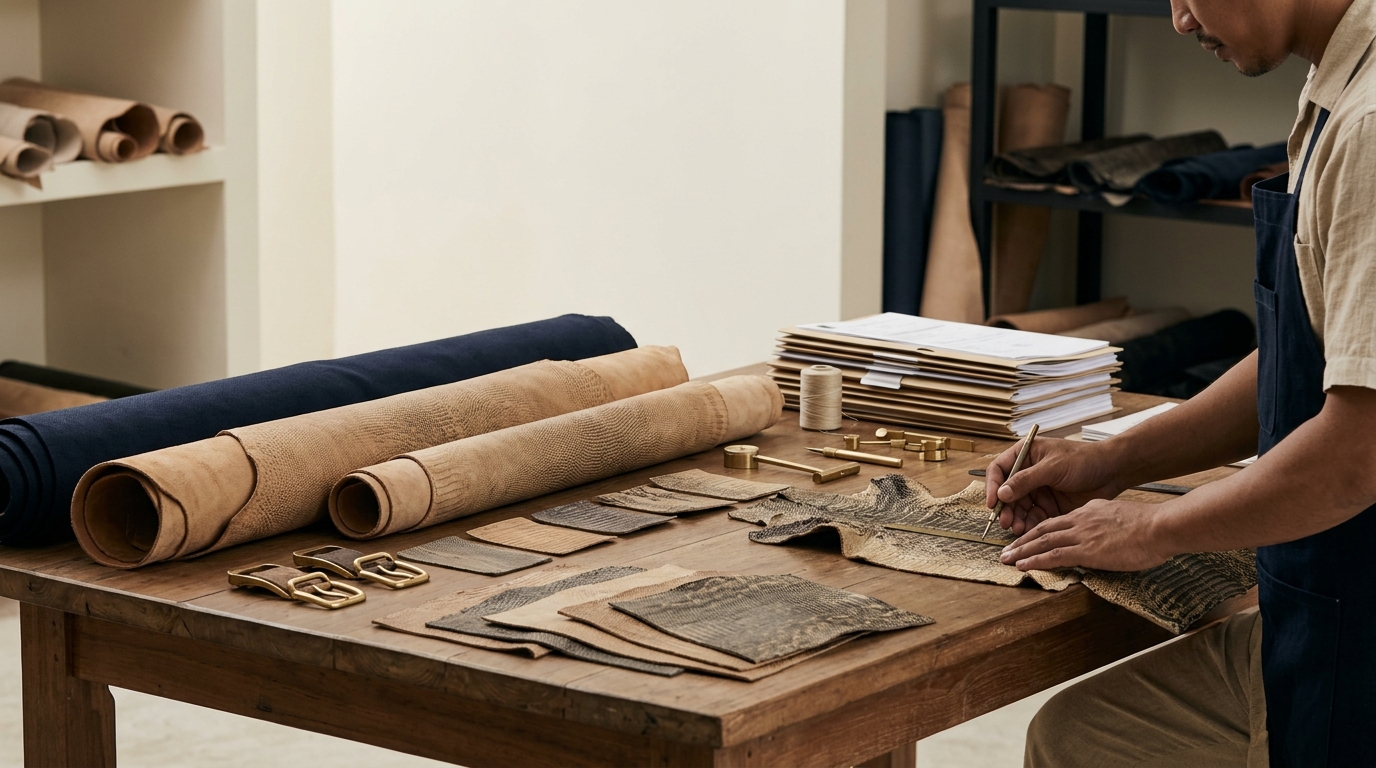
Procurement managers sourcing lizardleather goods suppliers Indonesiaface a market that is simultaneously well-developed and heavily regulated. Indonesia is the world's largest legal exporter of Varanus salvator (water monitor) skins. That position creates real commercial opportunity.
This guide covers the full sourcing cycle: Indonesia's regulatory framework, the CITES Appendix II permit chain, annual export quota mechanics, legal-origin documentation, captive-breeding alternatives, ring-mark grading, product specifications, finishing options, and supplier qualification. Every section is written for a buyer who understands leather sourcing but is new to exotic-species compliance.
Before reaching the first supplier call, you need a working understanding of how Indonesian lizard leather enters legal commerce. That starts with Indonesia's unique position in the global supply chain.
Why Indonesia Dominates the Global Monitor Lizard Leather Supply Chain
Geographic Concentration and Tannery Clusters
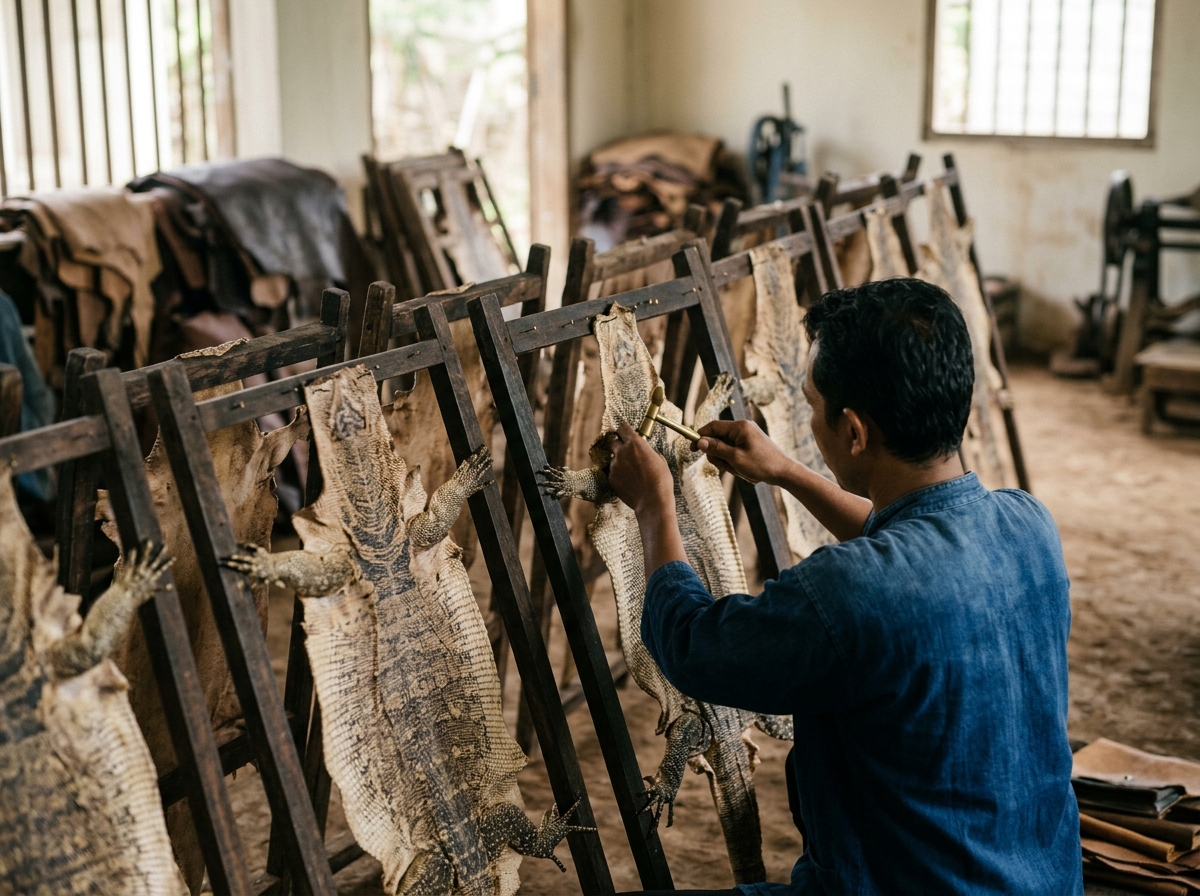
Indonesia's dominance in exotic lizard leather is structural, not accidental. Varanus salvator thrives across Java, Sumatra, and Kalimantan. Population density in these regions supports a well-established wild-harvest system operating under government quota. Java hosts the largest concentration of tanneries, with clusters around Yogyakarta and East Java. Sumatra supplies significant raw skin volume.
Tanneries in these clusters have supplied European luxury houses for decades. Many have ISO-adjacent quality processes. Several hold direct relationships with Italian and French finishing houses that re-export finished goods to the US market.
Scale and Relevance to Luxury Small-Goods Brands
Indonesia's legal annual export allocation for Varanus salvator skins is set by BKSDA (Balai Konservasi Sumber Daya Alam) and approved through KLHK (Kementerian Lingkungan Hidup dan Kehutanan). The quota covers both raw skins and finished goods. No other country matches this output at the same legal scale for this species.
For US luxury small-goods brands, this means Indonesia is not one option among many. It is the primary source. Alternatives — farmed crocodilian leather, python from Vietnam or Malaysia — involve different species, different permit chains, and different aesthetic profiles.
Wild-Harvest Quota Skins vs. Captive-Breeding Sources
These two origin types are legally and commercially distinct. Wild-harvest skins enter commerce under annual species-level quotas. Captive-breeding operations registered with CITES generate skins outside the quota system, under a separate permit category. The distinction matters at US customs. It affects documentation, pricing, and supply-chain risk.
CITES Appendix II Status and What Every US Importer Must Know
Varanus salvator is listed under CITES Appendix II. This means trade is controlled, not prohibited. The species is not endangered. However, every commercial cross-border transaction requires permits from both the exporting and importing country.
Indonesian Export Side
The Indonesian exporter must hold a valid CITES export permit issued by KLHK. This permit references the quota allocation, the specific skins or finished goods in the shipment, and the licensed facility. Without this document, the shipment cannot leave Indonesia legally.
US Import Side
US importers must file a declaration with the US Fish & Wildlife Service (USFWS) using Form 3-177 (Declaration for Importation or Exportation of Fish or Wildlife). This form must accompany every shipment of lizardleather goodsinto the United States. Filing occurs at a designated USFWS port of entry.
The importer of record is responsible for Form 3-177 accuracy. Errors, omissions, or mismatches between the Form 3-177 and the CITES export permit are grounds for seizure.
Re-Export Certificates and Third-Country Routing
Many Indonesian lizardleather goods suppliers indonesiaroute finished goods through Italy, Hong Kong, or Singapore for additional finishing or consolidation. Each transit country that takes legal possession of the goods must issue a CITES re-export certificate.
Lacey Act and Endangered Species Act Penalties
Non-compliant imports trigger liability under two federal statutes. The Lacey Act prohibits trade in wildlife taken, possessed, transported, or sold in violation of any law — including foreign law. The Endangered Species Act (ESA) enforces CITES obligations domestically. Civil penalties under the Lacey Act can reach tens of thousands of dollars per violation.
How the Indonesian Export Quota System Works — and Why Timing Is Everything
BKSDA Annual Quota Setting
Each year, BKSDA sets species-level harvest and export quotas for Varanus salvator. The quota is based on population surveys, habitat assessments, and prior-year harvest data. KLHK formally approves and publishes the allocation. Quotas cover both raw skins and finished goods as separate line items.
The quota cycle aligns with the Indonesian fiscal year. Buyers who place orders early in the cycle have access to the full allocation. Buyers who wait until mid-year risk finding that preferred suppliers have exhausted their quota and cannot export additional units until the following cycle.
How Quotas Are Allocated to Exporters
Licensed exporters and tanneries apply for quota allocations. Allocation reflects historical export volume, facility compliance record, and species management data. A tannery with a multi-year export track record typically receives a larger allocation than a newer entrant.
This structure means that established lizardleather goods suppliers indonesiawith long compliance histories are more reliable partners than newer exporters who hold small or uncertain allocations.
Raw Skin Quotas vs. Finished Goods Quotas
These are tracked separately. A supplier who has exhausted their raw skin quota may still have allocation for finished goods (for example, watch straps or wallets) if those are categorised differently in their permit. Conversely, a tannery that processes skins for third-party manufacturers may hold raw skin quota but no finished goods allocation.
Quota Exhaustion Risk in Practice
When a supplier's annual quota is exhausted, they cannot legally export more units regardless of your order commitment. This is the single most common cause of delivery failure in exotic leather sourcing.
The Legal-Origin Documentation Chain from Harvest to Finished Goods
Required Documents at Each Stage
A compliant shipment of Indonesian lizard leather goods requires a sequential document chain. Missing any link invalidates legal origin.
| Stage | Document | Issuing Authority |
|---|---|---|
| Wild harvest | Harvest permit (Surat Izin Pengambilan) | Local BKSDA office |
| Tannery processing | Processing certificate | Licensed tannery / KLHK |
| Export | CITES export permit | KLHK (CITES Management Authority) |
| Transit country | CITES re-export certificate | Transit country CITES authority |
| US import | Form 3-177 declaration | Filed by US importer with USFWS |
| Health/sanitary | Phytosanitary or health certificate | Indonesian Agriculture Ministry |
What Auditors and Customs Officers Look For
Chain-of-custody auditors verify that permit numbers on each document reference consistently to the same skins. The CITES export permit cites the harvest permit number. The re-export certificate cites the original export permit. Skin count and weight must reconcile across all documents.
US Fish & Wildlife Service inspectors at port of entry cross-check Form 3-177 entries against the CITES export permit attached to the shipment. Discrepancies in species description, quantity, or origin facility trigger a hold.
Red Flags in Supplier Documentation
Any of the following signals a non-compliant supply chain:
- CITES permit with no quota allocation number - Permit issued by an authority other than KLHK - Harvest permit predating the quota year cited on the export permit - Supplier unable to provide processing certificate from a named tannery - Permit shows a different species name than what appears on the finished goods invoice
- ✓CITES permit with no quota allocation reference
- ✓Harvest permit and export permit from different quota years
- ✓Processing certificate from an unlicensed facility
- ✓Supplier cannot name the specific BKSDA regional office
- ✓Re-export certificate absent on third-country routed shipments
- ✓Species description inconsistent across invoice and permit
Captive-Breeding Sources: Lower Regulatory Risk for Luxury Brands
How CITES Treats Captive-Breeding Operations
CITES-registered captive-breeding operations occupy a distinct legal category. Skins from registered facilities are not counted against wild-harvest quotas. They travel under a separate permit designation that identifies the source as a registered captive operation. This reduces the quota-exhaustion risk entirely and simplifies the documentation chain for US importers.
To qualify as a CITES-registered operation, an Indonesian facility must register with KLHK and receive a unique registration number from the CITES Secretariat. The registration is publicly searchable in the CITES trade database.
Quality and Consistency Advantages
Captive-bred Varanus salvator skins tend to show more consistent scale pattern, fewer field scars, and more uniform thickness than wild-harvest skins. Feed-controlled environments reduce the scarring and parasite marks common on wild individuals.
Verifying Captive-Origin Registration Numbers
Request the CITES-registered operation number from your supplier. Cross-check it against the CITES Trade Database (cites.org) and the KLHK registered facility list. Do not accept verbal assurances. A legitimate captive-breeding supplier will provide the registration number in writing and on all commercial documents without hesitation.
Ring-Mark Grading and Scale Pattern Selection for Small Goods
Understanding Grade A, B, and C Classifications
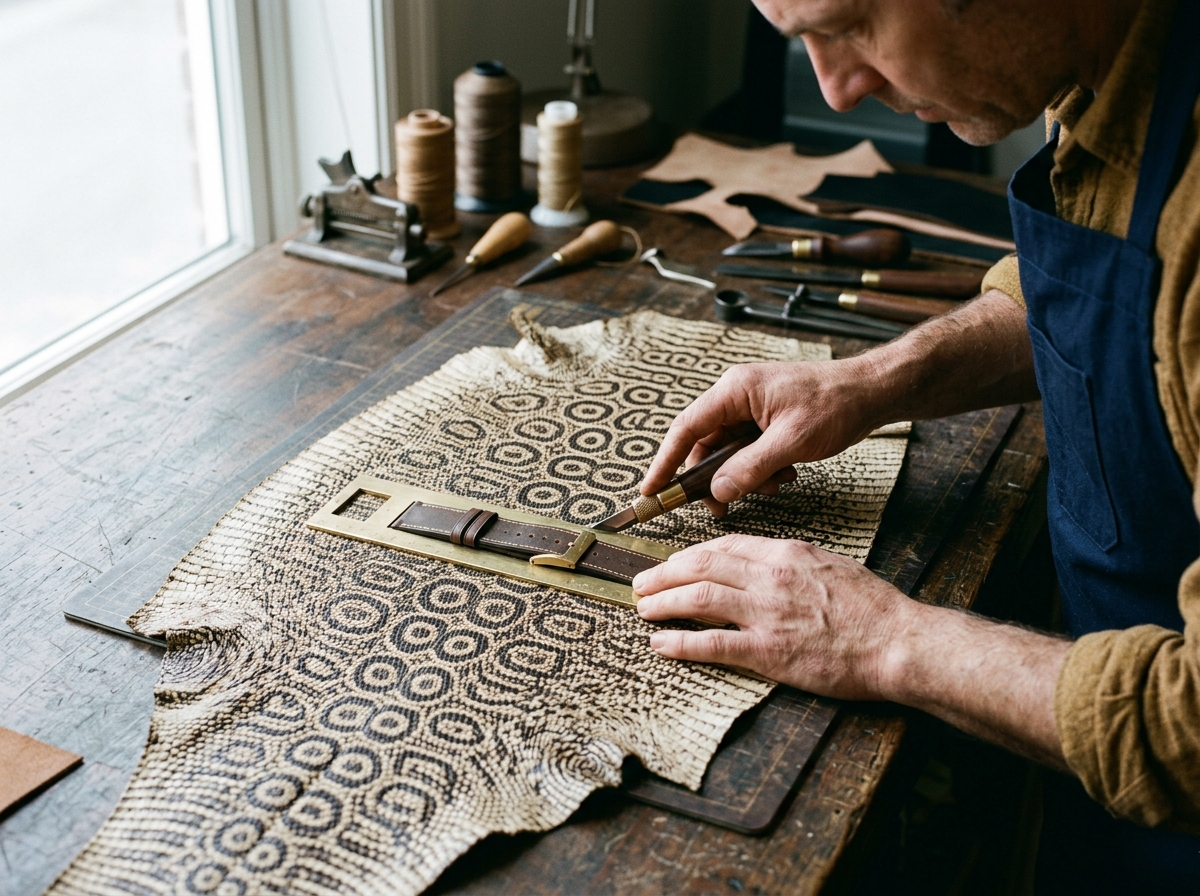
Indonesian lizard leather is graded primarily on ring-mark clarity and skin integrity.
| Grade | Ring-Mark Clarity | Defects Allowed | Typical Application |
|---|---|---|---|
| A | Sharp, symmetrical, consistent | None in centre panel | Watch straps, card holders |
| B | Moderate clarity, minor asymmetry | Minor edge scarring | Wallets, small panels |
| C | Irregular pattern, visible scarring | Multiple surface marks | Linings, secondary panels |
Belly cuts show the distinctive circular ring-mark pattern associated with monitor lizard leather luxury goods. Back cuts display a more irregular scale texture and are typically graded B or C regardless of skin quality.
Scale Pattern Continuity for Watch Straps
Watch straps require uninterrupted ring-mark continuity across the full strap length — typically 110mm to 130mm for standard deployments. A single break in pattern continuity (caused by a scar, parasite mark, or tannery processing defect) disqualifies the panel for strap use. Specify this requirement explicitly in your purchase order grading notes.
Yield Calculation from a Single Graded Skin
A single adult Varanus salvator belly panel typically yields a limited number of usable watch strap blanks depending on skin width and pattern distribution. Yield is further reduced by the symmetry requirement. Calculate yield before agreeing unit pricing.
Communicating Grading Specifications in Purchase Orders
Purchase orders for lizard leather goods should specify: grade (A/B/C), cut origin (belly vs. back), minimum skin length, minimum panel width at narrowest point, acceptable defect zones (edge only vs. none), and ring-mark continuity requirements. Vague POs result in mixed-grade deliveries that require expensive re-sorting on arrival.
Watch Straps, Wallets, and Small-Goods Applications: Product Specification Guide
Watch Strap Specifications
Standard luxury watch strap dimensions for monitor lizard leather:
| Parameter | Specification |
|---|---|
| Lug width | 18mm, 20mm, 22mm, 24mm |
| Long piece length | 110–120mm (approx.) |
| Short piece length | 70–80mm (approx.) |
| Finished thickness | 1.8mm–2.5mm (lined strap) |
| Lining material | Calf or synthetic, buyer-specified |
Suppliers typically offer straps pre-lined and stitched, or as unlined single-layer panels for in-house assembly. Unlined panels require buyers to specify stitch specification and lining material separately.
Panel Layout for Wallets and Cardholders
Bifold wallets require larger continuous belly panels than watch straps. A typical bifold layout needs approximately 90mm × 180mm of Grade A or B material. Cardholders can be cut from shorter belly sections. Key fobs and zip-pull tags can be cut from Grade B and C offcuts, improving per-skin yield economics.
Minimum Order Quantities and Lead Times
Minimum order quantities among established lizard leather goods suppliers indonesia vary by product type. Finished goods MOQs are commonly:
- Watch straps: approximately 50–200 pairs per colourway - Wallets: approximately 50–100 units per style - Cardholders: approximately 100 units per style
Lead times from order confirmation to export-ready goods typically run 8–14 weeks. Add 2–4 weeks for CITES permit processing. Add transit time to US port of entry.
Sampling and Prototype Approval
Request graded leather samples before committing to production. Evaluate ring-mark pattern, thickness consistency, and finish quality on the actual production-grade skins — not showroom samples. Approve a sealed prototype before production begins. Include sample approval sign-off in your purchase agreement.
Finishing Options Available from Indonesian Lizard Leather Tanneries
Indonesian tanneries serving the export market offer a wide finishing range. Standard options include:
- Natural/uncoated: preserves scale texture; requires buyer-side finishing - Matte lacquer: low sheen, tactile finish; common for understated luxury goods - Semi-gloss lacquer: balanced reflectivity; most common for watch straps - High-gloss lacquer: mirror finish; high-fashion applications
Dyeing capabilities at established tanneries cover a standard luxury palette — navy, cognac, black, burgundy, forest green, and tan — plus custom colour matching against Pantone or physical swatch references. Custom colour matching typically requires minimum sample quantities and adds 2–4 weeks to development timelines.
Antique and two-tone hand-finishing is available from specialist tanneries. These techniques apply contrasting pigment into scale recesses. They require skilled hand labour and are priced accordingly.
Chemical Compliance for the US Market
If your brand sells into California, Proposition 65 chemical thresholds apply to dyes and finishes that remain on finished goods. EU REACH compliance is relevant if goods are also sold into European markets. Request Safety Data Sheets for all dyes and lacquers used in your production run.
How to Vet and Qualify Compliant Indonesian Lizard Leather Suppliers
- ✓CITES exporter licence number — verify against KLHK registry
- ✓Current-year BKSDA quota allocation letter with remaining balance
- ✓Tannery processing certificate from a named, licensed facility
- ✓Sample CITES export permit from a recent shipment
- ✓REACH or Prop 65 chemical compliance documentation for finishes
- ✓Reference contact from an existing US or EU buyer
- ✓Willingness to provide captive-origin registration number if claiming captive source
- ✓Factory audit report or third-party inspection record
Factory Audit Standards for Exotic Leather
No single audit standard is universally mandated for Indonesian exotic leather tanneries. However, buyers can benchmark against adjacent frameworks. The Leather Working Group (LWG) audits conventional tanneries on environmental and traceability metrics.
Request a recent third-party audit report. If none exists, commission an independent factory audit before placing a first production order. This is non-negotiable for brands with US retail distribution.
Questions to Ask During Supplier Qualification Calls
- What is your current BKSDA quota allocation for this calendar year, and what balance remains? - Can you provide CITES export permits from your three most recent shipments to US buyers? - Do you source from captive-breeding operations? If so, provide your CITES registration number. - Which USFWS-designated port have your shipments historically entered through? - Do you route goods through any third-country processing facility? If yes, how do you handle re-export certificates? - What chemical compliance documentation do you provide for dyes and lacquers?
Building Long-Term Supplier Relationships to Secure Quota Priority
Suppliers with limited quota allocations prioritise long-term buyers. Consistent annual order volume, early placement in the quota cycle, and prompt payment history position your brand for preferential quota access. Frame your first order as the beginning of a multi-year relationship, not a transactional test run.
Frequently Asked Questions
Is it legal to import monitor lizard leather goods into the United States from Indonesia?
Yes. Varanus salvator is listed under CITES Appendix II — controlled trade, not prohibited trade. Legal import requires a valid CITES export permit from Indonesia and a completed Form 3-177 declaration filed with the US Fish & Wildlife Service at a designated port of entry. Full documentation compliance is mandatory.
How do annual Indonesian export quotas affect order lead times and availability?
Quotas are set annually by BKSDA and can be exhausted before year-end. Orders placed early in the quota cycle face lower supply risk. If a supplier's quota is exhausted, they cannot export legally until the next cycle opens. Build quota confirmation into your PO process and add a 60–90 day lead time buffer for permit processing.
What is the difference between Appendix I and Appendix II CITES status for reptile leather?
Appendix I lists species threatened with extinction. Commercial trade is generally prohibited. Appendix II lists species that may become threatened if trade is uncontrolled. Commercial trade is permitted with valid permits. Varanus salvator is Appendix II. Some other monitor species are Appendix I — confirm species identification on every shipment.
Can I source lizard leather from captive-bred animals to simplify compliance?
Yes. CITES-registered captive-breeding operations in Indonesia generate skins outside the wild-harvest quota system. Documentation is simpler and quota-exhaustion risk is eliminated. Verify the supplier's CITES registration number against the public CITES registry before ordering.
What documents must accompany a shipment of lizard leather goods at US customs?
At minimum: CITES export permit (original), re-export certificate if routed through a third country, commercial invoice, packing list, and Form 3-177 filed by the US importer with USFWS. A phytosanitary or health certificate is also typically required. Missing any document triggers a hold or seizure.
How does ring-mark grading affect the price per skin for luxury applications?
Grade A belly skins command significantly higher prices than Grade B or C. The premium reflects lower defect rates, higher per-skin yield for watch straps, and pattern symmetry requirements. For watch strap applications, the yield difference between Grade A and Grade B can make Grade B economically inefficient even at a lower per-skin cost.
Sourcing monitor lizard leather from Indonesia is commercially viable and legally achievable — but only through a disciplined compliance infrastructure. Buyers who treat CITES documentation, BKSDA quota verification, and Form 3-177 filing as standard operating procedure will build supply chains that survive regulatory scrutiny.
You now understand the regulatory framework, documentation chain, quota mechanics, grading standards, and supplier qualification criteria needed to source Indonesian lizard leather responsibly. The logical next step is connecting with suppliers whose compliance records have already been verified.
Request verified supplier profiles and compliance documentation for Indonesian lizard leather today — including CITES exporter licence numbers, BKSDA quota allocation status, and tannery audit records.
Request Supplier Profiles →Need eyes on the ground in Indonesia?
MTS is an execution partner — supplier verification, manufacturing management, quality control and export logistics across Indonesia, Vietnam and China.
Related services
Related articles
Receive furniture sourcing insights across Asia.
One email per week. No spam.