Leather Wallets and Small Goods Wholesale from Indonesia: A Sourcing Guide for US Buyers
13 min read
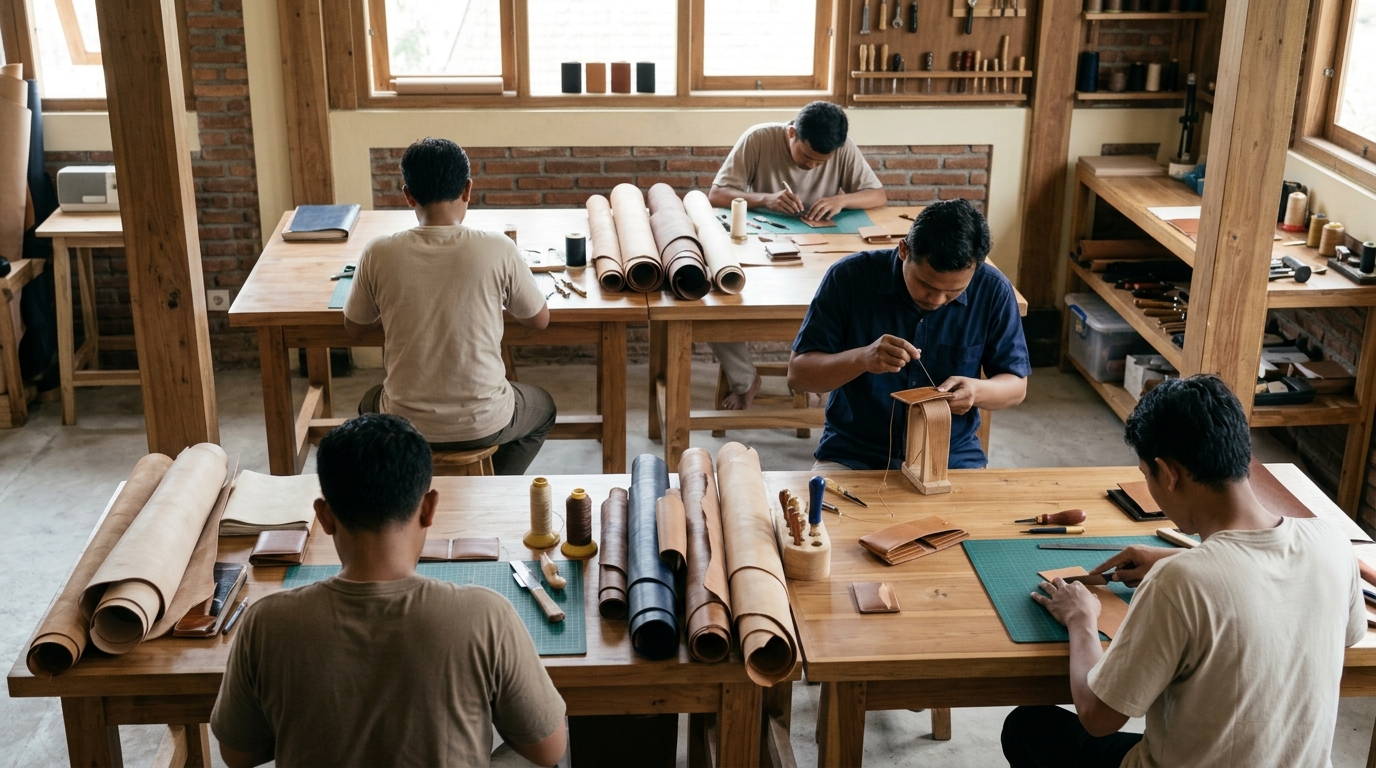
Sourcing leather wallets and small goods wholesale from Indonesia is a practical decision for US accessories brands and corporate gift buyers — but only if you approach it with the right framework. The market is fragmented. Factories range from full-cycle exporters with ISO documentation to small…
Sourcing leather wallets and small goods wholesale from Indonesia is a practical decision for US accessories brands and corporate gift buyers — but only if you approach it with the right framework. The market is fragmented. Factories range from full-cycle exporters with ISO documentation to small craft workshops that cannot reliably hit a 500-unit order. Knowing the difference before you wire a deposit is the core challenge.
This guide covers the full procurement cycle. You will find pricing benchmarks, MOQ structures, personalization options including embossing and laser engraving, material grades, packaging requirements for Amazon FBA and retail, quality control checkpoints, and US import duty references. Each section is written for buyers at the specification and decision stage — not for general browsing.
Indonesia has built a credible export infrastructure over decades. The country combines artisan-level craftsmanship with scalable factory capacity, competitive labor costs, and access to quality bovine leather. The sections below give you the criteria and checklists to evaluate suppliers, structure orders, and land product that meets US retail standards.
Why Indonesia Commands a Leading Position in Leather Goods Manufacturing
Four Manufacturing Hubs Worth Understanding
Indonesia'sleather goodssector is geographically concentrated. Each hub has a distinct profile:
- Yogyakarta — the dominant center for leather wallets, small goods, and handcrafted accessories. Long-established workshops with multi-generational craft knowledge and growing export capacity. - Bandung (West Java) — stronger on fashionleather goods, bags, and contemporary wallet designs. More design-oriented, with faster trend adaptation. - East Java (Surabaya / Sidoarjo) — industrial-scale tanneries and mid-market leather goods factories. Better for volume orders requiring consistent output. - Bali — premium artisan workshops producing design-forward small goods for the luxury and hospitality segment. Higher per-unit cost, lower scalable volume.
Cost Structure and Raw Material Access
Labor costs in Indonesia remain competitive relative to comparable Asian manufacturing countries, though they have increased over the past decade. Indonesian tanneries process bovine hides domestically, giving local factories reliable access to full-grain and top-grain leather without lengthy import lead times.
Indonesia is not a significant exporter of exotic leathers through legal commercial channels. Buyers seeking bovine leather goods — wallets, card holders, passport covers, belts — are well-served. Factories sourcing certified bovine hides from domestic or Brazilian supply chains can provide traceability documentation on request.
Export Infrastructure for US Importers
Indonesia has established export procedures and trade compliance systems. Major ports include Tanjung Priok (Jakarta) and Tanjung Perak (Surabaya). Both handle LCL (less than container load) and FCL (full container load) shipments to US West Coast and East Coast ports. Indonesian exporters are generally familiar with US Customs documentation requirements, including certificates of origin and commercial invoices formatted for CBP entry.
Full Product Range Available Through Indonesian Leather Goods Wholesale
Wallets, Card Holders, and Money Accessories
Indonesian factories producing leather wallets and small goods wholesale cover a wide SKU range:
- Bifold wallets — the most common format; available in slim and standard profiles - Trifold wallets — higher card capacity; popular in men's corporate gift programs - Slim card holders — 4–8 card slots; often paired with RFID blocking liners - Money clips — leather-wrapped or combination leather and metal - Zip-around wallets — higher complexity, longer lead times
Travel and Document Organizers
- Passport covers — single and family formats - Document organizers and travel pouches - Boarding pass holders - Multi-pocket travel wallets with pen loops
Belts, Key Fobs, and Accessories
Leather belts, key fobs, luggage tags, watch straps, and pen cases are all producible within the same factory ecosystem. Belts and straps require consistent hide thickness — specify in millimeters during sampling.
Gender-Segmented Wallet Lines
Factories can produce distinct men's and women's lines. Women's leather wallets for wholesale often feature interior zip pockets, wrist loops, and brighter colorways. Men's styles prioritize slim profiles and RFID blocking. Specify gender segmentation clearly in your tech pack — do not assume a factory's default bifold suits both lines.
Genuine vs. Vegan Leather: Material Selection Affects Pricing and Positioning
Leather Grade Hierarchy
| Grade | Description | Typical Use Case | Relative Cost |
|---|---|---|---|
| Full-grain | Outermost hide layer, natural surface | Premium wallets, corporate gifts | Highest |
| Top-grain | Sanded and finished surface | Mainstream genuine leather wallets | Mid-range |
| Corrected-grain | Embossed pattern over sanded hide | Entry-level genuine leather | Lower |
| Bonded leather | Leather fiber + polyurethane binder | Not recommended for wholesale | Lowest |
Full-grain leather develops a patina over time. It is the correct specification for premium positioning. Top-grain is the industry standard for mid-market genuine leather wallets wholesale programs.
Vegan and PU Leather Options
Several Indonesian factories offer PU and microfiber vegan alternatives. These are viable for corporate gift programs with sustainability messaging, provided you verify the factory's actual material sourcing. PU leather degrades faster than full-grain bovine leather — factor this into your product warranty or return policy.
Certifications US Retail Buyers Should Request
- Leather Working Group (LWG) audit rating for tanneries supplying the factory — gold or silver rated tanneries indicate better environmental compliance - REACH compliance for hardware and dye components (relevant for EU-facing brands, increasingly referenced by US retailers) - ISO 9001 for factory quality management systems
Wholesale Pricing, MOQ Programs, and Volume Order Structures
Typical Wholesale Price Ranges
Prices below are approximate FOB Surabaya or FOB Semarang ranges for genuine leather goods. Actual quotes depend on design complexity, leather grade, hardware, and personalization:
| Product | Full-Grain FOB (approx.) | Top-Grain FOB (approx.) |
|---|---|---|
| Bifold wallet | $12–$28 | $7–$15 |
| Slim card holder | $8–$18 | $5–$10 |
| Passport cover | $10–$22 | $6–$12 |
| Trifold wallet | $14–$30 | $9–$18 |
| Leather belt | $15–$35 | $9–$20 |
These ranges reflect plain production without personalization. Add approximately $1.50–$4.00 per unit for embossing setup amortized over a standard run, depending on die complexity.
Low-MOQ Programs
Several Indonesian factories and export agents offer low-MOQ leather goods supplier programs starting from approximately 50–100 units per SKU. These programs typically carry a per-unit premium of 15–30% over standard volume pricing. They are useful for market testing or initial corporate gift orders.
Tiered Pricing and Volume Thresholds
| Order Quantity | Pricing Tier |
|---|---|
| 50–99 units | Low-MOQ rate (highest per unit) |
| 100–499 units | Standard rate |
| 500–999 units | Tier 2 discount (typically 8–12% below standard) |
| 1,000+ units | Tier 3 / contract pricing (negotiated) |
Factory-Direct vs. Trading Company Pricing
Factory-direct pricing is typically 10–20% lower than trading company pricing for equivalent goods. However, trading companies often provide better English communication, consolidated shipping across multiple product types, and easier sample management. For buyers new to Indonesia, a trading company or sourcing intermediary reduces operational risk during the first one or two orders.
Personalization Services: Embossing, Laser Engraving, and Debossing for Corporate and Brand Programs
Embossing and Foil Stamping Options
Indonesian leather factories offer several personalization methods relevant to leather wallets small goods wholesale for corporate clients:
- Blind embossing — raised or debossed logo impression without ink or foil; most common for corporate gifts - Foil stamping — gold, silver, or custom-color foil applied over embossed die; increases perceived value - Debossing — impression pressed into the leather surface; clean, minimal aesthetic
Tooling costs for custom dies typically range from approximately $30–$120 per die depending on complexity and size. Dies are reusable across multiple orders.
Laser Engraving Capabilities
Laser engraving is available at mid-to-large Indonesian factories with modern equipment. It produces high-precision results on smooth top-grain and full-grain surfaces. It is the preferred method for detailed logos, QR codes, and individual name personalization in corporate gift programs.
MOQ and Lead Times for Personalized Orders
- Embossed logo programs: typically 100-unit minimum per SKU - Laser engraving: minimums vary; some factories accept 50 units for text-only engraving - Artwork setup: allow 5–10 business days for die production and artwork approval - Production lead time with personalization: typically 35–55 days from artwork sign-off
Private Label and OEM Programs for Accessories Brands
How OEM and ODM Programs Work
OEM (Original Equipment Manufacturing) means the factory produces to your exact design specification. ODM (Original Design Manufacturing) means the factory offers existing designs you can modify and brand. Most Indonesian leather factories support both models.
For leather wallets small goods wholesale under a private label program, ODM is faster and lower-risk for new buyers. OEM gives full design control but requires complete tech packs including dimensions, card slot counts, hardware specs, thread color, lining material, and edge finish.
Brand Identity Elements to Specify
- Interior lining: fabric, suede, or raw leather - Hardware: zipper brand and finish (brushed nickel, antique brass, matte black) - Thread color and stitch count per inch - Edge finish: painted, burnished, or raw - Logo placement: exterior, interior, or both
Protecting Design Exclusivity
Indonesian contract law does not automatically provide IP exclusivity. Request a design exclusivity clause in your supply agreement if you are developing proprietary colorways or silhouettes. Some factories will accept a minimum annual volume commitment in exchange for design exclusivity. Have a local legal contact or sourcing intermediary review the agreement before signing.
Retail-Ready Packaging for Imported Indonesian Leather Goods
Standard Packaging Configurations
| Format | Use Case |
|---|---|
| Rigid gift box | Premium retail, corporate gift sets |
| Soft pull-out box | Mid-market retail |
| Hang tag + poly bag | General retail, department stores |
| Dust bag | Premium positioning, reduces scratch risk |
| Header card + poly bag | Low-cost retail or e-commerce |
Custom Branded Packaging
Most factories can print buyer logos on boxes, tags, and tissue paper. Provide print-ready files (vector format preferred). Minimum quantities for custom printed packaging typically align with the wallet order MOQ — confirm this during sampling.
Amazon FBA Compliance
For Amazon FBA, packaging must meet specific requirements. Key points:
- Poly bags must include a suffocation warning if the opening exceeds 5 inches - Barcodes (FNSKU or UPC) must be scannable on the outer packaging - Units must be packaged to survive 3-foot drop tests - No loose loose items inside cartons without individual packaging
Confirm with your factory that they have fulfilled FBA-compliant orders previously. Request photos of prior FBA-ready packing as part of your audit process.
Sustainable Packaging Options
Indonesian suppliers increasingly offer FSC-certified paper boxes, soy-based inks, and recycled fill materials. If sustainability is a brand pillar, request an eco-packaging specification sheet during initial supplier conversations.
Quality Control Processes and Standards to Require from Indonesian Suppliers
Three Inspection Checkpoints
1. Pre-production inspection — verifies leather grade, hardware samples, lining material, and color against approved samples before cutting begins 2. Inline inspection — conducted at 30–50% production completion; catches stitching and assembly defects early 3. Final random inspection (FRI) — conducted before packing; uses AQL 2.5 sampling standard for general defects, AQL 1.5 for critical defects
Key Defect Categories for Leather Small Goods
- Stitching: skipped stitches, uneven tension, thread color deviation - Edge finishing: uneven paint, rough burnishing, delamination - Hardware: misaligned snap closure, zipper binding, loose rivets - Leather grain: visible scarring, color variation between panels, surface coating inconsistency
Third-Party Inspection Services
SGS and Bureau Veritas both operate inspection services in Indonesia. Both can conduct factory audits and pre-shipment inspections for leather goods. Fees typically range from approximately $250–$400 per man-day. For first-time orders or new suppliers, a third-party final inspection is a sound investment relative to the cost of a rejected shipment.
Documentation Checklist for US Customs
- ✓Commercial invoice with HS code and unit values
- ✓Packing list with carton dimensions and weights
- ✓Certificate of Origin (Form A or general CO for GSP eligibility check)
- ✓Bill of lading or airway bill
- ✓Any applicable test reports (REACH, material content)
- ✓Supplier declaration for leather content and hide origin
A Step-by-Step Framework for Vetting and Onboarding Indonesian Suppliers
Where to Find Verified Suppliers
- Trade shows: Inacraft (Jakarta), Trade Expo Indonesia, and Bali trade events attract verifiedleather goods manufacturers. These are the most reliable venues for initial face-to-face supplier qualification. - B2B platforms: Established platforms list Indonesian leather goods exporters. Verify independently — platform listings are self-reported and not audited. - Sourcing intermediaries: Independent sourcing partners operating in Indonesia can pre-screen factories against your spec before you commit to samples.
Factory Audit Checklist
Before placing a bulk order, verify the following:
- Does the factory own its production equipment, or is it an assembly-only operation subcontracting core processes? - What is the monthly production capacity for the SKU you need? - Does the factory have documented QC procedures, or is inspection informal? - What is the workforce size, and does the factory comply with Indonesian labor law (BPJS registration, minimum wage compliance)? - Can the factory provide references from current US or European buyers?
Sample Evaluation Before Bulk Commitment
Request a production-representative sample, not a showroom sample. Specify that the sample must use the same leather grade, hardware, and stitching as the bulk order. Evaluate:
- Edge finish consistency across all panels - Hardware alignment and function after 50 open/close cycles - Stitch tension and spacing (count stitches per inch and compare to spec) - Card slot depth and width against intended card dimensions
Payment Terms and Incoterms
Standard terms for Indonesian leather goods export orders:
- Payment: 30% deposit on order confirmation, 70% balance before shipment (T/T) - Incoterms: FOB (Free on Board) Indonesian port is most common for US buyers with their own freight forwarder; CIF (Cost, Insurance, Freight) is available but gives the buyer less freight control - Letters of credit are accepted by larger factories for orders above approximately $15,000–$20,000
Shipping, Lead Times, and US Import Logistics for Leather Small Goods
Production Lead Times
| Order Type | Typical Lead Time |
|---|---|
| Plain stock (no personalization) | 25–40 days from PO confirmation |
| Embossed or debossed logo | 35–50 days |
| Full custom OEM with new design | 50–70 days |
| Rush order (if factory capacity allows) | 20–30 days with surcharge |
Sea Freight vs. Air Freight
| Mode | Transit Time (Indonesia to US West Coast) | Cost per kg (approx.) | Best For |
|---|---|---|---|
| Sea freight (FCL) | 18–25 days | Lowest | Orders above approximately 300–400 kg |
| Sea freight (LCL) | 22–30 days | Low-mid | Mid-size orders |
| Air freight | 5–8 days | High | Urgent reorders, samples, low-weight orders |
LCL consolidation is practical for most startup and mid-size buyers. Partner with a freight forwarder experienced in Indonesian exports to manage documentation.
US Import Duties and HS Codes
Indonesia is not currently a US Free Trade Agreement partner, so GSP preferences should be verified against current US trade program status at time of import. Work with a licensed customs broker to confirm classification before your first shipment.
Frequently Asked Questions
How much do genuine leather wallets cost at wholesale from Indonesia? FOB wholesale pricing for top-grain bifold wallets typically ranges from approximately $7–$15 per unit. Full-grain wallets range from approximately $12–$28 depending on design complexity, hardware, and personalization. These are factory-gate prices before freight, duties, and packaging costs.
What is the minimum order quantity for custom leather wallets from Indonesian factories? Low-MOQ leather goods supplier programs in Indonesia commonly start at 50–100 units per SKU for standard designs. Custom OEM designs with new tooling typically require 100–300 units minimum. Personalized embossed corporate programs generally require 100 units per logo die.
Which Indonesian regions are best known for leather wallet manufacturing? Yogyakarta is the most recognized center for handcrafted leather wallets and small goods. Bandung is strong for contemporary fashion leather goods. East Java (Surabaya / Sidoarjo) supports higher-volume industrial production.
Can Indonesian suppliers provide embossing and laser engraving for corporate gifts? Yes. Blind embossing, foil stamping, debossing, and laser engraving are all available from mid-to-large Indonesian factories. Tooling costs for embossing dies are approximately $30–$120 per die. Laser engraving requires no tooling cost and is suited to individual name personalization.
What quality control measures should US buyers require when sourcing from Indonesia? Require three inspection checkpoints: pre-production, inline, and final random inspection using AQL 2.5. Specify defect criteria in writing. For first orders, use a third-party inspector such as SGS or Bureau Veritas. Request a certificate of origin, packing list, and material declarations for US customs.
How do payment norms in Indonesia affect B2B supplier transactions? Standard B2B export payment terms are T/T (telegraphic transfer): 30% deposit, 70% balance before shipment. Letters of credit are accepted by larger factories for higher-value orders. Indonesian suppliers generally do not accept open account terms for new buyer relationships. Build payment terms into your cash flow planning from the start.
Sourcing leather wallets and small goods wholesale from Indonesia is commercially viable for US buyers who apply structured evaluation criteria. The key variables — supplier type, leather grade, personalization capability, packaging compliance, and logistics routing — are all manageable with the right framework in place.
You now have the pricing benchmarks, MOQ data, quality standards, and import logistics reference points to move from research to active supplier engagement. The logical next step is to validate what you have read against real factory samples.
Request a free sample pack from vetted Indonesianleather goods supplierstoday. Confirm material grades, stitching quality, and personalization execution in hand before committing to a bulk order — that is the decision that separates a profitable program from an expensive correction.
You have the criteria. Now test the product. Request sample packs from pre-screened Indonesian suppliers and evaluate genuine leather quality, embossing precision, and packaging compliance before your first bulk order.
Request Your Sample Pack →Need eyes on the ground in Indonesia?
MTS is an execution partner — supplier verification, manufacturing management, quality control and export logistics across Indonesia, Vietnam and China.
Related services
Related articles
Receive furniture sourcing insights across Asia.
One email per week. No spam.