Solid Wood Doors from Indonesian Manufacturers: A Complete Project Guide
14 min read
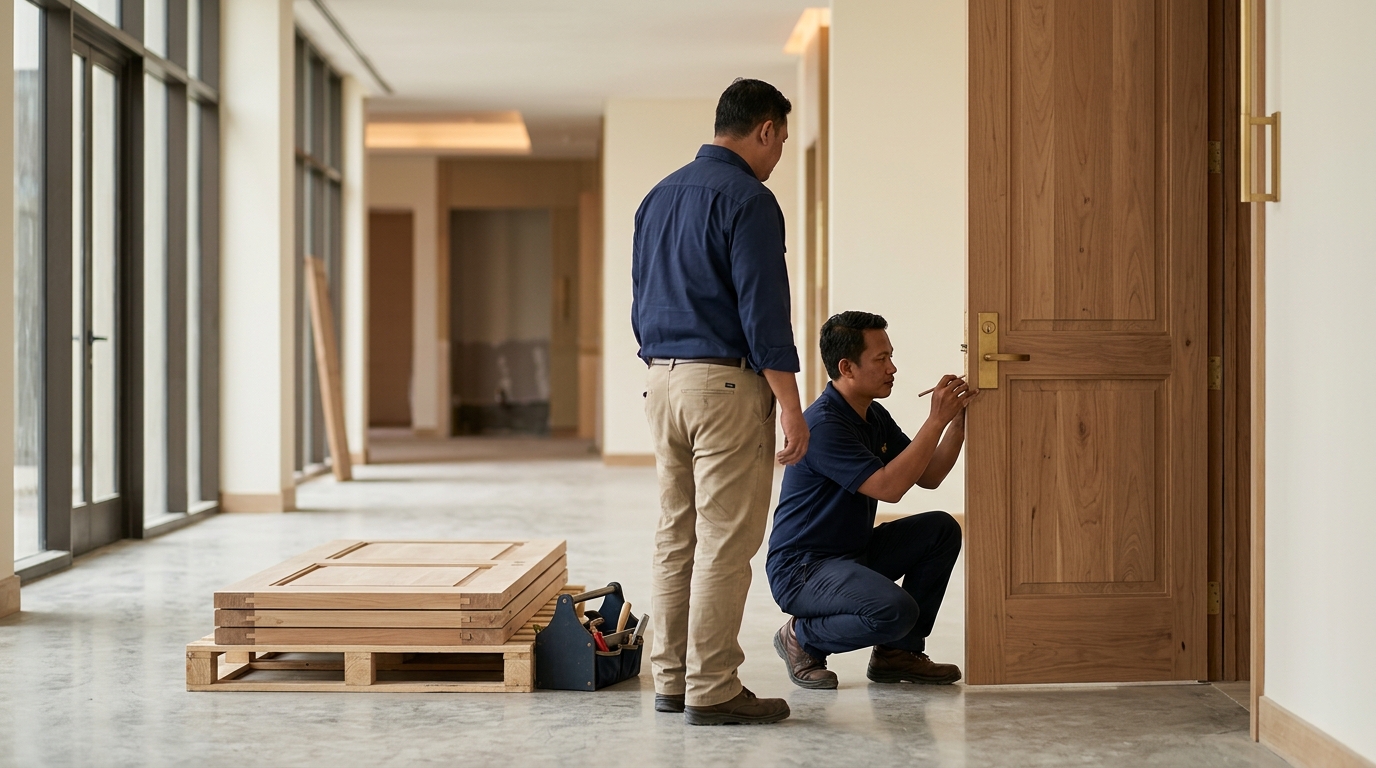
Commissioning a large-scale door program from Indonesia requires more than selecting a species and a finish. Procurement professionals and main contractors face a layered set of decisions: construction type, fire rating, hardware prep standards, US import compliance, and phased delivery scheduling…
Commissioning a large-scale door program from Indonesia requires more than selecting a species and a finish. Procurement professionals and main contractors face a layered set of decisions: construction type, fire rating, hardware prep standards, US import compliance, and phased delivery scheduling — all before the first unit ships.
This guide addresses each decision point in sequence. It covers solid core versus engineered construction, Indonesian hardwood species selection, fire-rated door pathways, ANSI/BHMA hardware prep, finishing systems, and critical-path scheduling from factory to US jobsite.
The guide is written for door importers, main contractors, and hotel developers sourcing solid wood doorsmanufacturers Indonesiaprojects of 200 units and above. If you are evaluating Indonesian suppliers for the first time or benchmarking an existing program, the sections below give you the operational framework to do it rigorously.
Why Indonesian Factories Dominate Large-Scale Solid Wood Door Programs
Indonesia holds a structural advantage in solid wood door manufacturing that competing regions have not replicated. The country sits on some of the world's most commercially valuable tropical hardwood reserves. Teak, merbau, bengkirai, and suar are harvested and processed domestically, eliminating the cross-border timber logistics that inflate costs in Vietnam and India.
Production Scale and Cluster Geography
Industrial door factories in Central Java — particularly around Semarang and Surabaya — operate at monthly capacities ranging from approximately 10,000 to 60,000 units. This scale is sufficient for large hotel fit-out programs without splitting the order across multiple suppliers. Jepara remains the centre of gravity for solid teak and mahogany production, combining artisan craftsmanship with export-ready infrastructure.
Vietnam offers competitive panel-door manufacturing but lacks Indonesia's depth in solid hardwood species. China can match volume but not the species portfolio or the hand-finishing quality expected in prestige hospitality. India has the craft base but inconsistent industrial capacity and less developed export documentation systems.
Certifications That Matter to US Buyers
Three certification frameworks are relevant for US procurement:
- FSC (Forest Stewardship Council): Chain-of-custody certification confirming legal, sustainably managed timber sourcing. Required by many hotel brand standards and increasingly by US general contractors. - SVLK (Sistem Verifikasi Legalitas Kayu): Indonesia's mandatory timber legality verification system. All Indonesian wood product exports require SVLK documentation. It satisfies EU Timber Regulation requirements and supports Lacey Act due diligence. - CARB Phase 2: Relevant for composite cores. Any door using MDF, particleboard, or plywood components destined for the US must meet California Air Resources Board Phase 2 formaldehyde emission limits — which effectively set the national standard for US commercial projects.
Solid Core vs. Engineered Core: Matching Construction to Project Requirements
The construction choice drives weight, acoustic performance, fire-rating potential, dimensional stability, and cost. No single construction type is optimal across all applications.
| Core Type | Approx. Weight (per m²) | Acoustic Rating | Fire-Rating Potential | Cost Tier |
|---|---|---|---|---|
| Stave core solid wood | High (approx. 40–55 kg/m²) | Good (Rw ~32–36 dB) | FD30–FD60 with intumescent | Premium |
| Finger-jointed laminate | Medium-high (approx. 35–48 kg/m²) | Good (Rw ~30–34 dB) | FD30 achievable | Mid–Premium |
| Falcata / sengon engineered | Low-medium (approx. 18–28 kg/m²) | Moderate (Rw ~26–30 dB) | Limited (FD30 with treatment) | Mid |
| Particleboard core | Medium (approx. 28–38 kg/m²) | Moderate (Rw ~28–32 dB) | FD30 with correct facing | Budget–Mid |
| Honeycomb (hollow) | Low (approx. 10–18 kg/m²) | Poor (Rw ~22–26 dB) | Not typically achievable | Budget |
All values are approximate industry ranges. Actual performance depends on door thickness, facing species, and third-party test results.
When to Specify Solid Core
Prestige hotel guestroom doors, suite entry doors, and high-traffic corridor doors warrant stave core or finger-jointed laminate construction. These perform better under repeated hardware cycling, resist edge delamination in humid climates, and carry the mass needed for acoustic privacy ratings required under most hospitality brand standards.
Engineered falcata or sengon cores reduce shipping weight — an important landed-cost factor on large programs — and perform adequately for back-of-house, staff corridor, and low-traffic interior applications. Honeycomb cores are not appropriate for commercial hospitality programs in any application where acoustic privacy or hardware durability matters.
Dimensional Stability in US Climates
Indonesian factories kiln-dry timber to approximately 6–10% moisture content for export. Doors destined for air-conditioned hotel environments in the US are generally stable at this range. Doors for exterior or semi-exposed applications require tighter moisture specs and species selection with proven dimensional stability — teak and bengkirai outperform mahogany in this regard.
Indonesian Hardwood Species Selection for Door Project Specifications
| Species | Janka Hardness (approx.) | Durability Class | Interior | Exterior | Legal / Sustainable Status |
|---|---|---|---|---|---|
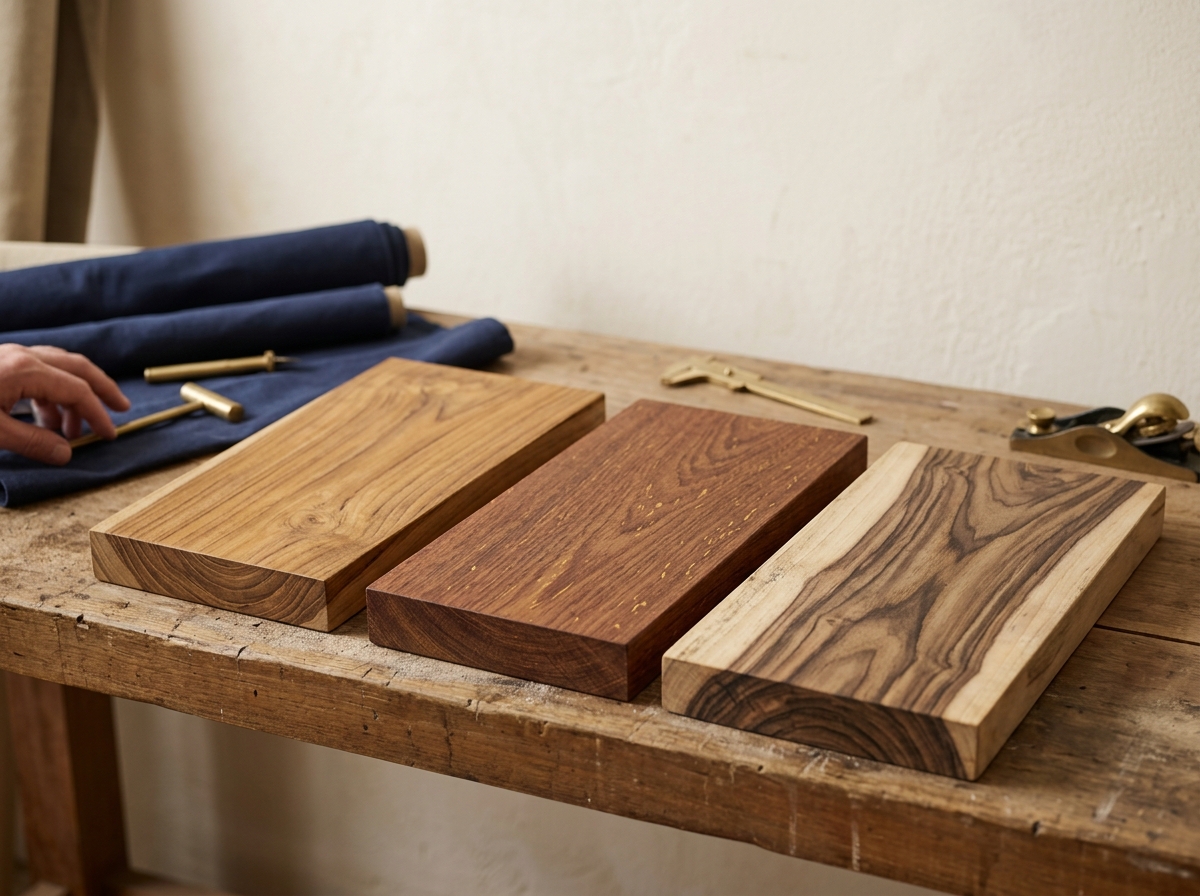
| Teak (*Tectona grandis*) | ~1,070 lbf | Class 1 | ✓ | ✓ | FSC plantation available; SVLK required |
| Merbau (*Intsia bijuga*) | ~1,925 lbf | Class 1–2 | ✓ | ✓ | SVLK required; sourcing scrutiny advised |
| Bengkirai (*Shorea laevifolia*) | ~1,580 lbf | Class 1–2 | ✓ | ✓ | SVLK required; availability variable |
| Suar / Monkeypod (*Albizia saman*) | ~950 lbf | Class 3 | ✓ | Limited | Plantation-grown; FSC available |
| Mahogany (*Swietenia macrophylla*) | ~900 lbf | Class 2–3 | ✓ | Limited | CITES Appendix II; legal chain-of-custody essential |
Janka hardness values are approximate. Durability class refers to natural durability against decay per EN 350 equivalents.
Teak remains the benchmark species for solid wood doors manufacturers Indonesia projects targeting prestige hospitality. FSC-certified plantation teak is commercially available and preferred by US hotel brands with sustainability commitments.
Merbau delivers superior hardness but faces tighter scrutiny on legal sourcing. Require full SVLK chain-of-custody documentation and verify the supplier's FSC certificate scope before specifying merbau on a large program.
Mahogany (Swietenia macrophylla) is listed under CITES Appendix II. Legal export is permitted with CITES documentation, but US Customs scrutiny is elevated. Confirm the factory's CITES export permit process before committing to mahogany in volume.
Reclaimed teak — recovered from old Javanese structures and railway sleepers — is a premium differentiator for boutique hotel projects. It carries a natural aged patina that new plantation teak cannot replicate. Supply is limited and lead times are longer. Treat reclaimed teak as a feature specification for feature doors and reception entries, not as a program-wide species.
Fire-Rated Door Options from Indonesian Factories: FD30, FD60, and Certification Pathways
Available Fire-Rating Levels
Indonesian factories can supply FD30 (30-minute) and FD60 (60-minute) fire-rated doors. FD90 is less common and typically requires specialist core assemblies sourced from certified component suppliers. Confirm rating availability early — fire-door production requires different core materials, intumescent strip rebates, and hardware prep that cannot be retrofitted after standard production begins.
Core and Facing Combinations Required
FD30 doors typically use a solid timber or particleboard core with intumescent strip channels routed into the door edge. FD60 doors require denser core assemblies — often mineral-based or high-density timber composites — with intumescent seals on all four edges plus the frame rebate.
Certification Requirements for US Projects
US building codes reference NFPA 80 and UL 10C (positive pressure) for fire door assemblies. Indonesian factories supplying US projects must hold test certificates from accredited laboratories — Intertek, UL, or equivalent — not only local Indonesian certifications. Confirm that the test certificate covers the exact door construction, thickness, and hardware configuration specified for your project.
Coordinating Fire-Door Schedules
Fire-rated doors require a separate door schedule submitted to the building authority. Coordinate this schedule with the main contractor's fire-stop and frame specification. Frame suppliers must provide matching fire-rated frames with intumescent seals. Sourcing frames and doors from the same Indonesian factory simplifies the tested-assembly coordination and reduces schedule risk.
Frame, Architrave, and Hardware Prep Packages That Reduce Site Coordination Risk
Sourcing door frames and architraves as matched-species packages from the same factory eliminates the grain and colour inconsistency that occurs when frames are sourced separately. Most mid-to-large Indonesian door factories offer this service. Specify the species, profile, and finish reference in the same purchase order as the doors.
ANSI/BHMA Hardware Prep Standards
Indonesian factories experienced with US hospitality projects should be familiar with ANSI/BHMA A156 hardware prep standards. Specify the following in your purchase order:
- Mortise lock cut-outs: ANSI A115.1 or A115.2 depending on the mortise lock specified - Hinge recesses: ANSI A115.1 hinge location template; specify full-mortise or half-mortise - Door closer reinforcement: ANSI A115.17 closer blocking at head and jamb - Door viewer prep: Specify bore diameter and centerline height per hardware schedule - Flush bolt prep: For double-leaf or communicating door pairs
- ✓Confirm ANSI A115 series template with hardware supplier before sending to factory
- ✓Specify hinge quantity and size on door schedule (typically 3x or 4x for commercial doors)
- ✓Include door closer blocking specification on shop drawing
- ✓Confirm mortise lock cut-out dimensions with lockset manufacturer
- ✓Specify door viewer bore diameter and height
- ✓Mark all hardware prep on approved shop drawings before production release
Pre-hung door units — door, frame, and hardware prep assembled at the factory — reduce on-site labour. However, they increase shipping volume and require precise site-measured opening dimensions before production. Knocked-down (KD) supply is more common for large hotel programs because it reduces freight cube and allows frame adjustment on site.
Finishing Systems: Factory Application vs. Site Finishing on Large Programs
| Finish System | VOC Level | Factory Application | Site Touch-Up | Typical Application |
|---|---|---|---|---|
| UV lacquer | Low | ✓ | Limited | High-volume hospitality, consistent sheen |
| Polyurethane (PU) | Medium | ✓ | Moderate | Mid-premium guestroom doors |
| Stain + sealer | Low–Medium | ✓ | Easy | Colour-matched hotel programs |
| Natural oil (Osmo-type) | Very low | ✓ | Easy | Boutique, sustainability-focused projects |
| Site-applied finish | Variable | — | Full | Custom or remediation scenarios |
Factory-applied finishing delivers sheen consistency across a 500-unit program that site finishing cannot match. It also accelerates the on-site programme — pre-finished doors can be hung and handed over without waiting for coating cure times. VOC compliance should be confirmed against the project's LEED or WELL requirements if applicable.
Match the finish specification to the hotel brand's interior design package before factory production starts. A gloss level or stain tone approved on a sample door but not locked into the purchase order creates disputes at delivery. Use RAL or NCS colour references alongside physical sample approval.
Touch-up kits — matching stain pens, lacquer aerosols, and grain-fill sticks — should be included in the shipping package for every project. Site-handling damage on door edges and corners is routine and must be remedied before snagging handover.
Project Scheduling, Lead Times, and Critical-Path Coordination for Hotel Fit-Out Programs
Production Lead Times for Project Quantities
| Program Size | Typical Production Lead Time | Notes |
|---|---|---|
| 200–500 units | Approximately 8–12 weeks | Assumes approved shop drawings and materials on hand |
| 500–1,000 units | Approximately 12–16 weeks | Phased production possible |
| 1,000–2,000+ units | Approximately 16–24 weeks | Requires early booking; kiln-drying lead time is the constraint |
All lead times are approximate and exclude ocean freight transit time (typically 25–35 days from Indonesian ports to US West Coast; add approximately 5–10 days for East Coast routing).
Critical Path: Site-Measure Freeze and Shop Drawing Approval
The single most common cause of schedule overrun on solid wood doors manufacturers Indonesia projects is late site-measure sign-off. Indonesian factories cannot finalise door and frame dimensions until the structural opening dimensions are confirmed. On hotel projects, this freeze date must be agreed with the main contractor and written into the supply contract.
The critical path typically runs: site-measure freeze → shop drawing submission → client approval → production start → factory QC → packaging → port loading at Tanjung Priok (Jakarta) or Tanjung Perak (Surabaya) → ocean freight → US port clearance → site delivery.
Allow a minimum of two weeks for shop drawing approval cycles. Any revision after production start incurs cost and delay.
Phased Delivery for Multi-Floor Hotel Programs
Large hotel fit-out programs rarely require all doors on site simultaneously. Coordinate phased delivery by floor or zone with the main contractor's programme. Indonesian factories can sequence production to match phased delivery — but this must be agreed before production starts, not after.
Quality Control, Packaging, and Pre-Shipment Inspection Protocols
Pre-shipment inspection is essential on orders of 200 units and above. Third-party inspection agencies SGS and Bureau Veritas operate in Indonesia and can be contracted for DUPRO (during production) and final random inspection (FRI) checks.
Key inspection checkpoints:
- Moisture content: Target 6–10% for US-bound doors. Values above 12% risk warping and finish failure in air-conditioned US environments. - Dimensional tolerances: Typically ±1.5 mm on door height and width; ±1.0 mm on thickness. - Finish quality: Check for runs, orange peel, colour consistency across batch, and adhesion on edges. - Hardware prep accuracy: Verify mortise cut-out dimensions and hinge recess depths against ANSI templates. - Species and grain verification: Confirm species matches specification, particularly on premium teak programs.
Export packaging for long ocean freight routes should include individual polythene wrapping, corner protection, and horizontal stacking in reinforced export cartons or on timber pallets. Doors shipped vertically in A-frames are less prone to face damage but increase container cube.
Documentation required for US Customs clearance:
- SVLK V-Legal certificate (mandatory for all Indonesian wood product exports) - Phytosanitary certificate (issued by Indonesian agricultural authority) - FSC chain-of-custody certificate (if FSC-certified timber is specified) - CITES permit (if mahogany or other CITES-listed species) - Commercial invoice and packing list - Bill of lading
US Import Tariffs and Lacey Act Compliance for Indonesian Wood Doors
HTS Classification and Duty Rates
Wooden doors from Indonesia are classified under HTS 4418.20 (builders' joinery and carpentry of wood — doors and their frames and thresholds). The general column 1 duty rate applicable to Indonesia is approximately 0%–4.8% depending on the specific sub-heading and construction type.
Indonesia tariff treatment under the US Generalized System of Preferences (GSP) has historically provided duty relief on certain wood product categories. However, GSP eligibility is subject to periodic US Congressional review and reinstatement. Verify current Indonesia tariff status with your customs broker at the time of contracting, as landed-cost calculations depend on it.
Lacey Act Due Diligence
The US Lacey Act prohibits the import of plant products — including wood doors — harvested or traded in violation of applicable laws. For Indonesian wood doors, Lacey Act compliance requires:
- A Lacey Act plant declaration (PPQ Form 505) filed with US Fish and Wildlife Service at entry - Documentation of species, country of harvest, and quantity - Chain-of-custody evidence supporting legal harvest — SVLK satisfies this requirement for Indonesian timber
Non-compliance carries civil and criminal penalties. The practical protection is to source exclusively from SVLK-certified factories and to require FSC chain-of-custody certificates where brand standards demand them.
Anti-Dumping and Third-Country Routing Risks
US anti-dumping and countervailing duty (AD/CVD) orders currently apply to certain wooden bedroom furniture from China. Doors are not under the same orders, but US Customs and Border Protection (CBP) scrutinises shipments that appear to circumvent origin rules by routing Chinese-processed components through Indonesia.
How to Evaluate and Select the Right Indonesian Door Factory for Your Program
Factory Audit Criteria
A credible Indonesian door factory for a US commercial program should demonstrate:
- Kiln-drying capacity: In-house kilns with logged drying cycles. No kiln-drying records is a disqualifying red flag. - Production capacity: Sufficient monthly output for your program without displacing existing customers mid-schedule. - Finishing lines: Enclosed spray booths or UV line for consistent factory finish. - Fire-door capability: Current third-party fire-test certificates, not just claimed capability. - SVLK certification: Active, verifiable certificate — not expired. - CARB-compliant panels: If any composite component is used.
OEM and Private-Label Capability
Indonesian factories operating as OEM manufacturers can produce doors to your exact specifications — species, profile, hardware prep, and finish — without applying their own brand. This is standard practice for hotel chain procurement programs where brand consistency across properties is required. Confirm the factory has NDA capability and experience protecting client design specifications.
Red Flags in Supplier Evaluation
- No kiln-drying records or equipment - SVLK certificate expired or not verifiable on the Indonesian government registry - Fire-door claims with no third-party test certificate - Inability to provide CARB compliance documentation for composite components - No experience with ANSI/BHMA hardware prep templates - No third-party inspection access
Build the supplier relationship progressively: sample approval first, then a pilot order of approximately 20–50 units, then the full program. Factory visits — even virtual audits — before production commitment reduce downstream risk significantly.
Frequently Asked Questions
What is the minimum order quantity for a project door program from an Indonesian manufacturer? Most mid-to-large Indonesian factories set project MOQs at approximately 100–200 units per specification for standard construction.
How do Indonesian solid wood doors compare to engineered core doors for hotel applications? Solid core doors outperform engineered core on acoustic privacy, hardware durability, and prestige finish quality. Engineered falcata or sengon cores reduce shipping weight and cost and are appropriate for back-of-house and lower-traffic applications.
Can Indonesian factories supply FD30 or FD60 fire-rated doors with US-accepted certifications? Yes, but only a subset of factories hold the required third-party fire-test certificates from Intertek, UL, or equivalent accredited laboratories. Always request the actual test report.
What hardwood species are sustainably available from Indonesia for door manufacturing? FSC-certified plantation teak and suar (monkeypod) are the most readily available sustainable options. Merbau and bengkirai are available with SVLK documentation. Mahogany requires CITES permits. Reclaimed teak is available in limited quantities for prestige applications.
How long does production and shipping take for a 500-unit door project from Indonesia to the US? Allow approximately 12–16 weeks for production of a 500-unit program after shop drawing approval, plus approximately 25–35 days ocean freight from Tanjung Priok or Tanjung Perak to a US West Coast port.
What documentation do US importers need to clear wooden doors through customs from Indonesia? Required documents include: SVLK V-Legal certificate, phytosanitary certificate, commercial invoice, packing list, bill of lading, and a Lacey Act plant declaration (PPQ Form 505). CITES permits are additionally required for mahogany.
Sourcing solid wood doors manufacturers Indonesia projects at commercial scale is a manageable process when the specification, compliance, and scheduling decisions are made in the correct sequence. Getting timber certification, fire-door test credentials, ANSI hardware prep, and Lacey Act documentation in order before production starts eliminates the majority of project risk.
You now have the specification and compliance framework to evaluate Indonesian door suppliers with precision. Request a project quote from a certified Indonesian solid wood door manufacturer today — bring your door schedule, species preference, fire-rating requirements, and target delivery window, and get a production-ready proposal.
Request a Project Quote →Need eyes on the ground in Indonesia?
MTS is an execution partner — supplier verification, manufacturing management, quality control and export logistics across Indonesia, Vietnam and China.
Related services
Related articles
Receive furniture sourcing insights across Asia.
One email per week. No spam.