How FF&E Procurement Companies Outsourcing Indonesia Execution Actually Structure On-Ground Partnerships
14 min read

Indonesia sits at the center of global hospitality furniture supply. Jepara produces teak and solid-wood casegoods recognized in hotel rooms from Southeast Asia to the Middle East. Cirebon dominates rattan. Bali delivers luxury artisan pieces for upper-upscale and resort properties. For US-based…
Indonesia sits at the center of global hospitality furniture supply. Jepara produces teak and solid-wood casegoods recognized in hotel rooms from Southeast Asia to the Middle East. Cirebon dominates rattan. Bali delivers luxury artisan pieces for upper-upscale and resort properties. For US-based FF&E procurement firms, this manufacturing depth is an opportunity — and a coordination problem.
The coordination problem is specific. A procurement firm can negotiate price, lock specifications, and issue purchase orders from a desk in New York or Dallas. What it cannot do from that desk is walk a factory floor in Central Java three weeks into production, verify that the teak grade matches the approved sample, or hold a payment milestone when joinery tolerances are off. That gap — between commercial authority and physical presence — is precisely where it creates structural efficiency. FF&E procurement companies outsourcing Indonesia execution to on-ground partners have found this gap valuable.
This article maps the full scope of that model. It covers what an execution partner does that a procurement firm cannot remotely replicate. It explains how the two scopes divide cleanly at the handoff line, and what factory access and in-production QC actually involve. It also addresses local contract enforcement under Indonesian commercial conditions and available fee structures. It also addresses the questions procurement directors ask most often before signing an execution partner engagement. The goal is a decision-ready picture, not a general introduction to outsourcing.
If your firm is evaluating whether to formalize Indonesia execution through a dedicated on-ground partner, consider this a starting point. This applies rather than relying on supplier self-reporting.
Why Indonesia FF&E Execution Demands a Dedicated On-Ground Partner
The Manufacturing Geography Creates Coordination Complexity
Indonesia's hospitality furniture cluster is not concentrated in one city. Jepara (Central Java) houses hundreds of workshops producing solid teak and mahogany casegoods. Cirebon (West Java) specializes in rattan and woven furniture. Bali produces luxury artisan and decorative pieces. Semarang and Surabaya function as logistics and consolidation hubs. A single FF&E package for a 200-key resort might draw product from three or four of these clusters simultaneously.
Managing across that geography remotely is not a documentation problem. It is a physical-presence problem. Factory visits, material inspections, and production-stage sign-offs require someone on the ground within driving distance of the workshop.
Supplier Self-Reporting Is Structurally Unreliable
Indonesian furniture manufacturersrange from large, ISO-certified export factories to small kampung-scale workshops. Many mid-tier suppliers lack the internal QC infrastructure that US procurement standards assume. When a procurement firm relies on supplier-submitted photos and production updates, it is receiving information curated by the party with the most incentive to delay bad news.
The risks are specific: wrong timber species substituted mid-run, finish samples approved on paper but not matched in batch production, dimensional tolerances drifting after the first few units. An execution partner catches these at mid-production inspection — before the container is packed.
US Procurement Firms Are Separating Strategy from Local Execution
The model of ff&e procurement companies outsourcing indonesia execution reflects a broader structural shift. Procurement firms retain the work that requires client relationships, design fluency, and commercial negotiation authority. They outsource the work that requires daily factory access in a different time zone and language. This is not offshoring the procurement function — it is a deliberate division of professional labor. The execution partner is not a replacement for the procurement firm. It is a specialist layer that makes the procurement firm's commitments to clients deliverable.
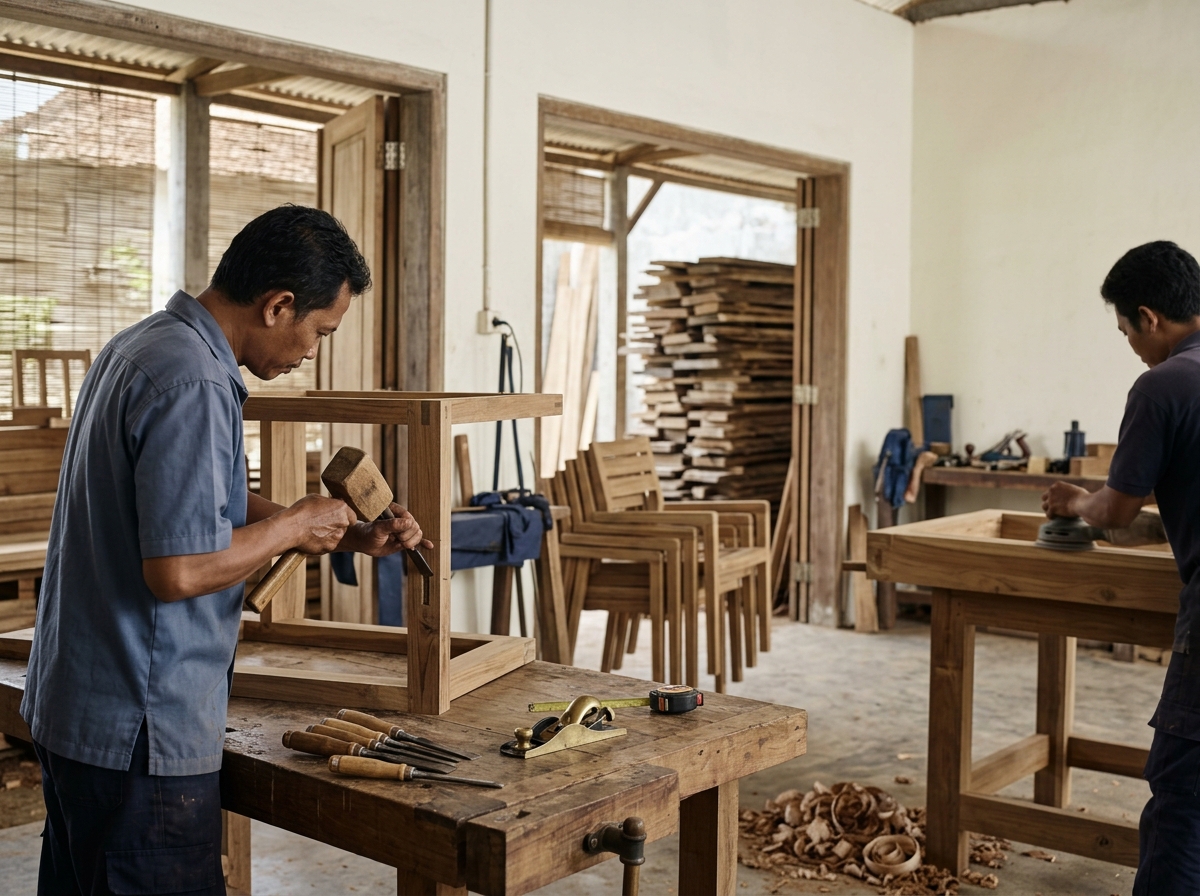
Procurement Firm Scope vs. Execution Partner Scope: The Boundary Every Engagement Needs
Scope confusion is the most common source of fee disputes and accountability gaps in Indonesia FF&E projects. The following table establishes a clean boundary.
| Responsibility | US Procurement Firm | Indonesia Execution Partner |
|---|---|---|
| Specification development | ✓ | — |
| Supplier selection and approval | ✓ (decision authority) | ✓ (factory audit input) |
| Commercial negotiation and PO issuance | ✓ | — |
| Client billing and reporting | ✓ | — |
| Factory floor access and relationship | — | ✓ |
| Pre-production material verification | — | ✓ |
| In-production QC inspections | — | ✓ |
| NCR issuance and rework management | — | ✓ |
| Payment milestone disbursement oversight | Approval authority | Execution and local enforcement |
| Export documentation and consolidation | — | ✓ |
| 3PL and freight forwarder coordination | ✓ (freight decisions) | ✓ (local logistics execution) |
| SVLK / FSC compliance verification | — | ✓ |
Documenting the Handoff in a Project Charter
Every engagement should open with a project charter that names handoff points explicitly. The charter should specify: who approves the pre-production sample, who issues the NCR if it fails, who authorizes a partial shipment hold, and who communicates status to the client. Without this document, both parties default to assumptions — and the client absorbs the gap.
Avoiding Scope Creep and Duplicate Fees
Scope creep typically moves in one direction. The execution partner gets pulled into supplier negotiation, or the procurement firm starts managing logistics and duplicates work the execution partner is already handling. Both patterns generate cost. The charter should include an explicit escalation path so that out-of-scope requests trigger a documented change order rather than informal absorption.
- ✓Pre-production sample approval authority
- ✓NCR issuance trigger and sign-off
- ✓Payment milestone release conditions
- ✓QC report delivery format and timeline
- ✓Export document review and sign-off
- ✓Client communication ownership by phase
Factory Access and Supplier Vetting in the Indonesian Market
Verified Access Is Not a Supplier Directory
Asourcing agentwith a contact list is not an execution partner with verified factory access. The distinction matters. Verified factory access means the execution partner has conducted physical audits at the facility. They maintain an ongoing relationship with production management. Their capacity, lead-time reliability, and compliance credentials are documented.
When vetting Indonesianfurniture manufacturers, certain documents are the minimum acceptable evidence. These documents confirm legitimate production capability.
- Nomor Induk Berusaha (NIB): Indonesia's business registration number, equivalent to an operating licence - Export licence (or merchant exporter arrangement if the factory lacks one directly) - SVLK / V-Legal certificate: Mandatory timber legality verification system for wood products exported from Indonesia - FSC Chain of Custody (CoC): Required by many US hotel brands for sustainable sourcing compliance - ISO 9001 certification: Quality management system standard; signals documented process control
Evaluating Factory Capacity and Red Flags
Physical inspection signals matter more than documentation alone. An execution partner conducting a factory audit should verify that the stated workforce matches the actual shop floor headcount. They must also confirm that kiln-drying equipment is present and operational and that a lumber yard with appropriate stock levels exists. An empty finishing line at a factory claiming 400 workers is a critical signal — not a minor discrepancy.
Remote red flags include reluctance to allow third-party DUPRO inspection. Additional warnings are inability to produce SVLK documentation and export invoicing routed through an undisclosed intermediary. Lead-time commitments that do not account for kiln-drying cycles on solid teak are also a concern.
In-Production QC Presence: What On-Site Inspection Actually Covers
FF&E QC in Indonesia is not a single pre-shipment event. It is a staged process tied to production milestones. Each stage addresses a different failure mode.
Pre-Production Material Verification
Before production begins, the execution partner verifies incoming materials against the approved specification. For solid-wood FF&E, this includes timber species confirmation and moisture content readings, typically measured with a pin-type meter against a project-specified tolerance. It also covers surface grade against the approved sample board and hardware verification against the approved finish and specification sheet.
This stage catches substitutions before they are built into finished pieces.
Mid-Production Dimensional and Joinery Inspections
At an agreed production percentage — commonly around 20–30% of the order quantity — the execution partner conducts a mid-production inspection. This covers dimensional tolerances against approved shop drawings, joinery method and glue application, structural integrity of frames, and finish consistency across the batch.
Non-conformances identified here are issued as formal NCRs with photographic documentation and a root-cause note. They also require a corrective action timeline.
Pre-Shipment Final Inspection
The pre-shipment inspection occurs before packing andcontainer loading. The execution partner works from an AQL sampling plan and a specific FF&E checklist that covers:
- Finish match to approved sample under standard lighting conditions - Hardware operation (drawer slides, hinges, door alignment) - Dimensional verification on a sample of units - Upholstery cover alignment and seam quality (where applicable) - Packaging adequacy for ocean freight (corner protection, humidity barriers)
QC Report Delivery to the US Procurement Firm
Reports should be delivered within 48 hours of inspection completion. A professionally structured QC report includes the inspection date, factory location, order reference, and quantity inspected. It must also include the AQL level, pass/fail determination, itemized findings with photographs, NCR log with status, and inspector certification. The format should be consistent across every inspection so the procurement firm can present it directly to the owner's representative without reformatting.
Local Contract Enforcement and Dispute Resolution in Indonesia
How Indonesian Commercial Law Applies
Purchase orders issued by US procurement firms and accepted by Indonesian manufacturers are binding commercial contracts. Indonesian contract law (under the Civil Code) recognizes breach-of-contract claims. However, practical enforcement through Indonesian courts is slow and resource-intensive for foreign parties. International arbitration clauses — specifying SIAC, ICC, or UNCITRAL rules — provide a more reliable enforcement path, but they are most useful as deterrents and for large-value disputes.
For day-to-day production disputes, the execution partner's local presence and relationships are the primary enforcement mechanism. No remote alternative replaces this.
Payment Milestones as the Primary Leverage Tool
The most effective enforcement tool in Indonesian FF&E contracts is the payment milestone structure. A typical structure splits payment into: deposit on order confirmation, payment on pre-production sample approval, payment on mid-production QC pass, and balance on pre-shipment inspection pass. The execution partner controls milestone release authorization — meaning non-conforming production does not advance to the next payment stage.
This structure gives the execution partner practical leverage without requiring legal proceedings.
NCR Management and Escalation
When an NCR is issued, the execution partner documents the finding, communicates it to the factory's production manager, and sets a corrective action deadline. If the factory fails to remediate within the agreed window, the execution partner can: withhold the next payment milestone, issue a partial shipment hold, or escalate to formal dispute resolution.
Escalation involving legal counsel is uncommon in well-structured projects. Most disputes resolve at the NCR stage when payment leverage is intact.
Consolidation, Export Handling, and Last-Mile Documentation
Multi-Factory Consolidation Logistics
When an FF&E package draws from multiple clusters — Jepara casegoods, Cirebon rattan, Bali decorative pieces — consolidation is required before export. The execution partner coordinates inland transport to a consolidation warehouse. This is typically located in Semarang or Surabaya for Java-sourced goods, or Denpasar for Bali-primary shipments. Warehouse custody includes receiving inspection, re-packing where necessary, and container stuffing under supervision.

The Export Document Stack for US Shipments
Every FCL or LCL shipment of FF&E from Indonesia to a US port requires a complete document package. Missing or incorrect documents trigger customs holds at US ports of entry.
| Document | Purpose | Who Prepares |
|---|---|---|
| Bill of Lading (B/L) | Title and transport contract | Freight forwarder / carrier |
| Commercial Invoice | Customs valuation | Exporter / execution partner |
| Packing List | Cargo content verification | Execution partner |
| Certificate of Origin (Form E or GSP) | Tariff preference determination | Indonesian trade authority |
| Phytosanitary Certificate | Wood pest-free certification | Indonesian quarantine authority |
| SVLK / V-Legal Certificate | Timber legality compliance (EU and US requirements) | SVLK-certified auditor |
| Fumigation Certificate | ISPM 15 compliance for wood packaging | Licensed fumigator |
Pre-empting Customs Holds
Common customs holds on Indonesian FF&E shipments involve incorrect HS code classification and missing or expired phytosanitary certificates. SVLK documentation gaps for solid-wood items are also a frequent cause, particularly for composite wood-and-upholstery furniture. An experienced execution partner reviews HS codes at the quotation stage, not at booking — correcting classification before the commercial invoice is issued.
Engagement Models and Fee Structures for Indonesia Execution Partners
Three Primary Models
FF&E procurement companies outsourcing Indonesia execution typically encounter three fee models. These models come from on-ground partners.
| Model | Structure | Best Fit | Approximate Range |
|---|---|---|---|
| Project Retainer | Fixed fee for defined scope, per project | Large single-hotel FF&E packages with predictable factory count | Varies by scope; typically quoted as a lump sum |
| FOB Percentage | Fee as a percentage of total FOB value of managed goods | Mid-size projects with multiple SKUs across multiple factories | Commonly 3–6% of FOB value (approximate) |
| Day-Rate Inspection | Per-inspection fee for QC visits only | Small supplemental orders or single-factory spot-checks | Typically quoted per inspection day plus travel |
Illustrative Cost Framing
For a mid-scale hospitality FF&E package sourced across three to five Indonesian factories, an FOB-percentage engagement is typical. It typically adds a low single-digit percentage to the total FOB value. A single defective container re-worked or refused at the US port can consume multiples of that fee. Against that alternative cost, the economics are straightforward.
Selecting the Right Indonesia Execution Partner: Evaluation Criteria
Minimum Staffing and Capability Requirements
An execution partner that operates as a one-person sourcing agent is not an execution partner. The minimum viable FF&E execution team requires at least one resident QC inspector with demonstrable furniture inspection credentials. It also requires a logistics coordinator with documented experience in Indonesian export workflows. A bilingual Bahasa Indonesia and English project manager able to interface with factory management and the US procurement firm without translation delay is also needed.
Certification and Audit Trail Standards
ISO 9001 certification signals that the execution partner's own internal processes are documented and auditable. It also confirms those processes are consistently applied. Ask for evidence of their inspection report archive — a credible partner maintains complete project files with photographic records, NCR logs, and sign-off chains. Transparency on subcontracting is also essential. Some execution partners outsource inspections to third-party inspection companies for specific projects. This is acceptable if disclosed, but the procurement firm should know who is physically on the factory floor.
Track Record Verification
Request references from US-based procurement firms or owners' representatives on comparable hospitality FF&E projects. Comparable scale means similar order value, similar factory count, and similar product categories. A partner with strong experience in outdoor teak furniture may lack the upholstery QC capability needed for a full-room FF&E package. Verify specifically.
Frequently Asked Questions on FF&E Procurement Outsourcing in Indonesia
What is the difference between an FF&E sourcing agent and an execution partner in Indonesia? A sourcing agent identifies suppliers and facilitates introductions. An execution partner takes ongoing operational responsibility for factory audits, in-production QC, and NCR management. They also handle payment milestone oversight, consolidation coordination, and export documentation. The execution partner is accountable for deliverables, not just referrals. A trading company adds another layer of margin and typically resists third-party inspector access — the opposite of what an execution partner provides.
How do procurement companies structure fees when outsourcing Indonesia execution? The three common models are project retainer, FOB-percentage, and day-rate inspection. FOB-percentage is most common for full-project engagement. Day-rate is used for supplemental inspection on smaller orders. Retainer structures work well for procurement firms with recurring Indonesia volume across multiple projects per year.
What documents are required to export FF&E from Indonesia to the United States? Required documents include: Bill of Lading, Commercial Invoice, Packing List, Certificate of Origin, Phytosanitary Certificate, SVLK/V-Legal certificate (for wood products), and Fumigation Certificate (ISPM 15 for wood packaging). HS code accuracy on the Commercial Invoice directly affects US Customs clearance speed.
How is quality control enforced during production atIndonesian furniturefactories? QC is enforced through staged inspections: pre-production material verification, mid-production dimensional and joinery inspection, and pre-shipment final inspection. Each stage is tied to a payment milestone that the execution partner controls. Non-conformances are documented in formal NCRs with corrective action deadlines. Payment release is withheld until the NCR is resolved.
Can an Indonesian execution partner enforce purchase order terms under local law? Indonesian contract law recognizes binding commercial agreements, but practical enforcement through courts is slow for foreign parties. The execution partner's primary enforcement tools are payment milestones, NCR issuance, and shipment holds — not litigation. International arbitration clauses in the PO provide a legal backstop for major disputes.
What is business process outsourcing in the context of FF&E procurement? In FF&E procurement, business process outsourcing means delegating defined operational workflows — QC inspection, logistics coordination, export documentation — to a specialized on-ground partner, while the procurement firm retains client-facing and commercial functions. It is not offshoring the entire procurement function. It is a structured division of roles that improves execution quality without adding internal headcount.
Outsourcing Indonesia FF&E execution works when scope boundaries are documented. It also requires a transparent fee structure to function effectively. The execution partner must also bring verifiable factory access, not just a contact list. A well-structured engagement gives the US firm client-ready QC reports and compliant export documentation. It also delivers payment-backed production control the firm cannot generate remotely.
You now have a complete framework for evaluating whether an Indonesia execution partner fits your project structure. You also have the standards to apply when selecting one. The logical next step is a conversation with a partner who operates at that standard.
You understand the scope, the fee models, and the compliance requirements. Now confirm whether an on-ground execution partner is the right structure for your next Indonesia FF&E project — and evaluate a specific partner against the criteria above.
Request a Scoping Call →Need eyes on the ground in Indonesia?
MTS is an execution partner — supplier verification, manufacturing management, quality control and export logistics across Indonesia, Vietnam and China.
Related services
Related articles
Receive furniture sourcing insights across Asia.
One email per week. No spam.